Cinque Terre
Italy Updated Apr 2026
The first thing you notice in Cinque Terre, Italy, is not the pastel houses but the dry wind scraping across kilometers of unmortared stone. This coastline was not painted into existence. It was hauled up a cliff face by hand, one fitted sandstone block at a time, starting around the 1100s.
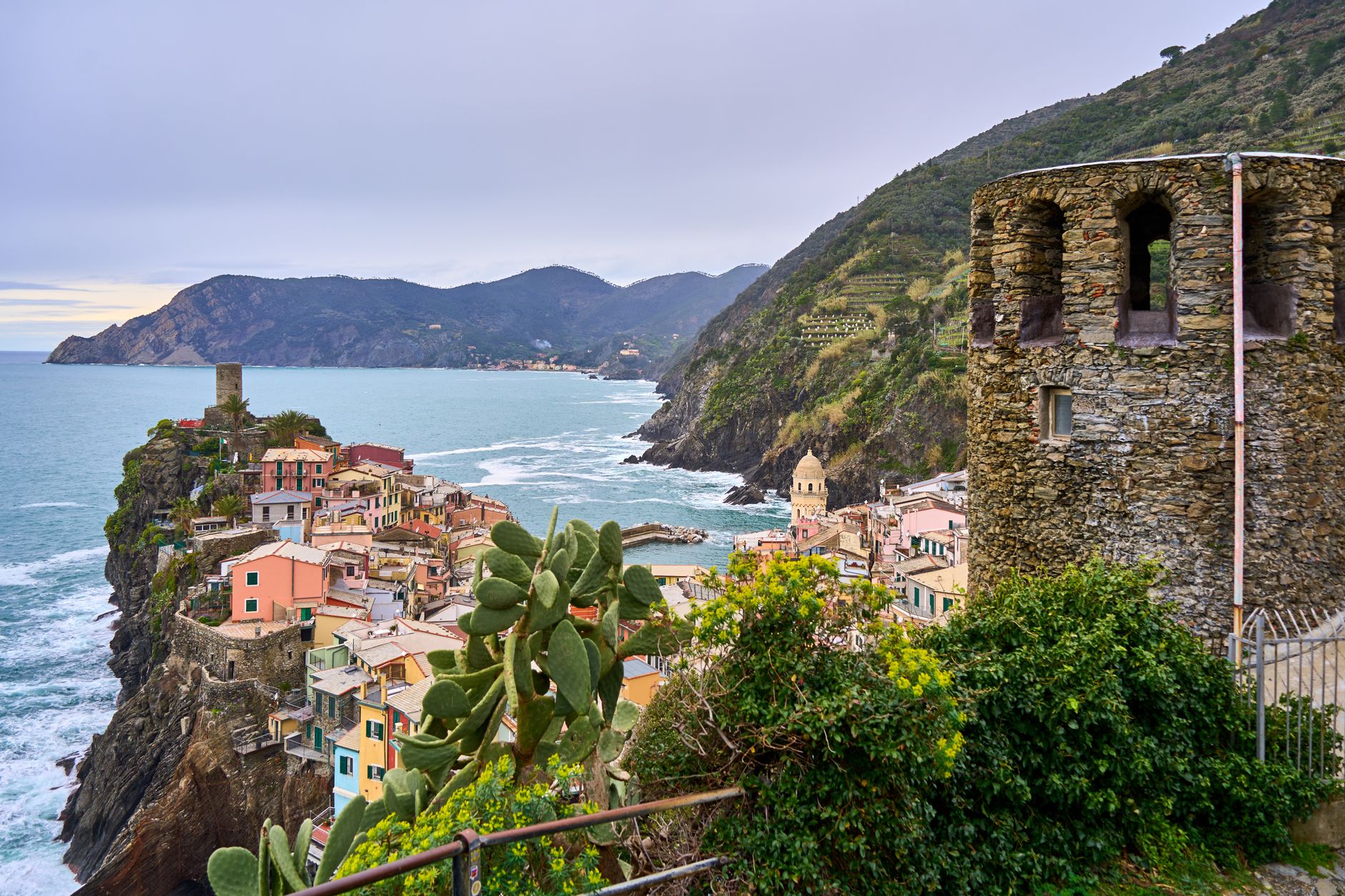 Photo: Gotta Be Worth It / Pexels
- Attractions
- 8
- Trip length
- 3 days
- Best season
- April-May or October
Why Cinque Terre
Built from cited sources · see the method · How we make our guides →
Tourists arrive for the harbors. Locals stay to keep the terraces from sliding into the Ligurian Sea. Every slope relies on the muretti a secco, dry-stone retaining walls that climb four hundred meters using nothing but friction and gravity.
The villages refuse to sprawl. Houses stack directly onto limestone outcrops, leaving every flat meter strictly for vines. You will climb 382 brick steps in Corniglia just for an espresso.
The real draw is learning to move at the pace of an October grape harvest. Forget the train timetable. You wait for the kitchen to open.
The Vertical Vineyards
Twelfth-century muretti a secco climb 400 meters from the shoreline, held together by thousands of hand-fitted sandstone blocks. You will smell crushed rosemary and damp earth as you walk the paths between the plots.The Hilltop Outlier
Corniglia sits alone on a limestone promontory, bypassing the sea entirely. Reaching it requires climbing the Lardarina's 382 brick steps, a quiet ascent that trades harbor crowds for uninterrupted coastal views.The Gulf of Poets' Light
The sharp, reflective coastal glow drew Eugenio Montale here to write his Nobel-winning verses and later anchored Arte Povera painters in Vernazza. Gallery spaces spill into historic church courtyards rather than occupying sterile white boxes.The Managed Blue Trail
The Sentiero Azzurro hugs the cliffs but operates under strict ecological limits, with seasonal one-way routing enforced between 9 AM and 2 PM. Walk early to hear only the scrape of boots on gravel and distant boat engines.
Neighborhoods
Where to wander, by quarter — each with its own rhythm.
Monterosso al Mare
The only village with a proper sandy beach, which explains the heavier tourist traffic. It splits into a medieval old town and the Fegina district, where Ristorante Miky has served tableside pyrotechnic anchovy pasta since 1980.Vernazza
Anchored by a rocky spur that deflects the open sea swells. The main piazza fills with locals for evening aperitivo, but the real architecture sits up the hill at the fifteenth-century Church of San Francesco. The cloistered garden completely drowns out the harbor noise.Corniglia
Perched a hundred meters above the waterline, making it the only settlement without a direct harbor. The elevation keeps casual day-trippers away. Homestyle osterias serve wine-braised rabbit overlooking the vineyards.Manarola
Houses cascade down a steep rocky spur along the narrow Grappa stream. Walk the pedestrian path toward Corniglia for quiet views of the working vineyards. Evening lights reflect off the water, but the best tables sit tucked behind the main church.Riomaggiore
Built on the covered valley of the Rio Maggiore stream, creating a linear layout that funnels everything toward the docks. The harbor draws photographers at sunset. The real dining happens two blocks uphill, where the steps finally widen.
Plan your trip
Before you go
- Getting There
- Fly into Pisa International Airport (PSA) or Genoa Cristoforo Colombo Airport (GOA), both roughly 90 minutes from the region by rail. Take the airport shuttle to Pisa Centrale or Genova Piazza Principe, then board a Trenitalia regional train toward La Spezia Centrale. Validate your paper ticket in the green station machines before boarding to avoid automatic fines.
- Getting Around
- A single regional rail line connects Levanto to La Spezia, stopping at all five villages every 15 minutes. Buy a Cinque Terre Card Treno at any station kiosk. It covers unlimited train travel, trail access, and local ATC buses. Leave your bicycle at home; the roads lack dedicated lanes and regional trains restrict bikes during peak hours.
- Climate & Best Time
- Target April through May or September through October for temperatures between 10°C and 25°C and reliable trail access. July and August push past 30°C with intense coastal humidity and peak visitor density, while November brings heavy rainfall that frequently triggers landslide closures. Pack waterproof layers regardless of the month. Mediterranean storms move quickly.
- Safety & Navigation
- Driving into the villages triggers automatic €100+ fines via 24/7 ZTL camera enforcement; park in La Spezia and take the train instead. Trail conditions shift rapidly after rain, so check the Parco Nazionale website for Sentiero Azzurro closures before setting out. Walk the harbors before 9 AM. You will avoid the midday crush and actually hear the water.
Stone, Salt, and the Artists Who Found the Coast
From medieval terracing to UNESCO preservation
- c. 1056
Dry-Stone Walls Carve The Coastline
Farmers stack limestone blocks into stepped terraces, transforming sheer cliffs into viable vineyards. Each wall takes years to anchor. The soil stays put only through relentless manual labor.
- 1198
Parish Churches Anchor The Hamlets
Stone naves rise in Monterosso and Vernazza. Their Romanesque arches echo the rhythm of passing merchant ships. Priests document harvests, binding scattered families into parish communities. The smell of damp incense mixes with salt air.
- c. 1320
Dante Praises The Vernaccia Vintage
While exiled in Ravenna, Dante Alighieri composes *Purgatorio* and immortalizes the steep slopes of Riomaggiore. He names the local white wine, proving the terraces already produce a valuable commodity. Literary fame arrives centuries before the first tourist boat docks.
- 1540
Corsair Raids Fortify The Harbors
Ottoman fleets sweep the Tyrrhenian Sea, forcing villagers to abandon open beaches for cliffside strongholds. Genoese engineers reinforce watchtowers. Their thick stone walls deflect cannon fire. Fishermen learn to read the horizon for enemy sails instead of storm clouds.
- 1640
Baroque Facades Mask Medieval Stone
Maritime trade funds church renovations, covering austere interiors with gold leaf and stucco saints. The Belforte tower receives a new upper chamber. It doubles as a bell tower and coastal lookout. Light filters through stained glass onto worn wooden pews.
- 1797
Napoleon Dissolves The Genoese Republic
French cannons breach the old merchant state's borders, absorbing Liguria into a short-lived client republic. Local magistrates trade Venetian-style councils for Napoleonic codes. The quiet harbors suddenly echo with marching boots.
Show the full timeline (19 moments)
- 1860
Signorini Discovers Riomaggiore
Telemaco Signorini steps off a coastal path and finds Riomaggiore stacked vertically against the rock. He paints the terraces in dappled sunlight. Academic rules fail against the raw coastal light. His canvases pull curious painters toward the isolated coves.
- 1874
Railway Splits Coast From Sea
Engineers blast through limestone to lay the Genoa-La Spezia line. Steam locomotives replace slow sailing boats, dumping coal smoke into previously pristine valleys. The sound of whistles permanently alters the harbor soundscape.
- 1896
Eugenio Montale Arrives In Monterosso
Born in Genoa, Montale inherits a coastal sensibility that rejects rhetorical flourish. He retreats to Fegina’s rocky shores. He listens to the crash of waves and the rustle of broom shrubs. The climate seeps into his syntax.
- 1925
Ossi Di Seppia Redefines Italian Poetry
Montale publishes his debut collection, weaving harsh terraces into sparse, hermetic verses. Critics initially dismiss the work. The coastal imagery eventually becomes a touchstone for post-war literature. The book sits on wooden shelves in local taverns.
- 1944
Allied Bombers Target The Railway
German forces occupy the narrow coastal line. Allied aircraft drop ordnance on harbor walls and tunnel entrances. Villagers flee into upper ridge paths, leaving vineyards exposed to shrapnel. Cordite briefly overpowers the scent of crushed basil.
- 1950
Renato Birolli Opens A Studio
Renato Birolli settles into a cramped stone room overlooking the Manarola harbor. His canvases shift toward abstract-figurative forms. They mirror the fractured geometry of the dry-stone walls. Weathered fishermen anchor his modernist techniques in reality.
- 1965
Pistoletto Stages Corniglia Street Theater
Michelangelo Pistoletto rents a room in Prevo and organizes impromptu performances on ancient flagstones. His participatory pieces blur the line between spectator and actor. Locals call him "U Cuxìn." An avant-garde disruptor joins their daily rhythm.
- 1997
UNESCO Recognizes The Living Topography
The committee inscribes the five villages as a global heritage site. Planners halt unchecked concrete development. They finally acknowledge that the true monument is continuous human labor holding the mountainside together. Legal frameworks replace casual neglect.
- 1999
National Park Enforces Trail Limits
Authorities establish the Parco Nazionale, instituting permit systems for the Sentiero Azzurro. Rangers monitor foot traffic to ensure ancient paths survive modern boots. Conservation shifts from theoretical to strictly regulated.
- 2011
October Floods Scour The Cliffs
Torrential rains overwhelm drainage systems, sending cubic meters of mud straight into Vernazza’s piazza. Thirteen lives are lost across the region. Bulldozers clear the streets for months. The flood exposes the fragile foundation beneath the picturesque facades.
- 2023
Archives Document The Artistic Legacy
Scholars publish a volume cataloging a century of painters who shaped the coastal identity. The book rescues forgotten canvases from damp cellars. Art historians finally treat the terraces as an open-air studio.
- 2025
One-Way Traffic Controls The Blue Trail
Park management mandates unidirectional flow on the Monterosso-Vernazza segment. The rule forces visitors into single-file lines along narrow ledges. Congestion drops sharply. Safety now dictates the pace of movement.
- 2026
Lorenzo Viviani Champions Agricultural Roots
Lorenzo Viviani assumes the park presidency and redirects subsidies toward terrace restoration. He publicly rejects mass tourism models. Policy shifts from visitor management to cultural preservation. The working farms remain the true attraction.
Who lived here
-
Poet · 1896–1975
Eugenio Montale
Extended stays in Monterosso al Mare
He rented a small house in the Fegina district to escape urban noise, letting the coastal broom shrubs and salt wind shape his Nobel-winning verses. If he saw the ferry queues today, he would likely retreat inland to Volastra and write about the silence.
-
Painter · 1835–1901
Telemaco Signorini
First documented artistic visit to Riomaggiore in July 1860
He arrived by boat and immediately set up his easel to capture how the Mediterranean light shattered against the limestone cliffs. His plein air sketches turned an isolated farming enclave into a destination for every Italian artist who followed.
-
Poet · c. 1265–1321
Dante Alighieri
Literary reference to Vernaccia wine in Purgatorio
He never walked these steps, but he tasted the local white vintage and praised its rare quality in the fourteenth century. He would recognize the same Sciacchetrà grapes on the terraces today, though he might balk at modern pricing.
Where to Eat
Where locals actually book dinner — not the tourist menus.
-
Trofie al Pesto
Hand-rolled twisted pasta coated in crushed basil, pine nuts, and Ligurian olive oil. Eat it in a family-run trattoria where the sauce is still ground with a marble mortar and wooden pestle.
-
Monterosso Anchovies
Small silver fish salt-cured in wooden barrels for months until the flesh turns translucent. Order them drizzled with local olive oil and a squeeze of lemon to taste the exact flavor of the Gulf of La Spezia.
-
Sciacchetrà
A rare dessert wine pressed from sun-dried Bosco, Albarola, and Vermentino grapes grown on the steepest terraces. The syrupy, apricot-rich liquid pairs naturally with aged Parmigiano or local amaretti cookies.
-
Farinata
A thick, golden chickpea flatbread baked in wood-fired copper pans until the edges crisp and the center stays custardy. Slice it hot from neighborhood ovens that have tracked baking temperatures by sight for generations.
-
Fritto Misto alla Ligure
A paper-lined basket of lightly battered anchovies, calamari rings, and seasonal zucchini blossoms fried in olive oil. The batter shatters on impact, leaving the seafood tender and entirely ungreasy.
-
Cappon Magro
A towering seafood and vegetable salad layered over hardtack biscuits and bound with a garlic-anchovy dressing. The sharp briny flavors cut through coastal humidity perfectly.
Insider tips
Small things that change how the city treats you.
Skip the Car
Park in La Spezia or Levanto and take the regional train. Roads are narrow, parking costs €25 daily, and unauthorized entry fines hit €100.Order Anchovies First
Look for spaghetti all'acciugata or vernazzana tegame. Locals eat standing at the counter before 11 AM, so skip lingering cappuccinos after breakfast.Buy the Park Pass
The Sentiero Azzurro requires a Cinque Terre card due to ecological management. Wet limestone steps are slick, so pack grippy shoes and carry €15 for mandatory access.Visit During Harvest
Summer crowds thin in October when grape pickers move across the terraces. You will hear farming tools instead of navigating single-file queues on the Blue Trail.Reserve Tables Early
Trattorias fill by midday and kitchens close until dinner. The coperto already covers bread and water, so round up the final bill by €2 rather than calculating percentages.
Gallery
The city, as it actually looks.


Frequently asked
Is Cinque Terre worth visiting?
Yes, but only if you treat it as a working agricultural landscape rather than a resort. The terraced vineyards require constant communal maintenance, so visiting in April or October reveals farming rhythms instead of summer congestion.
How many days in Cinque Terre?
Two full days cover the core villages without feeling rushed. Hike the Monterosso-Vernazza coastal path on day one, take the ferry to Manarola and Riomaggiore on day two, and leave the rest for a slow lunch in Corniglia.
Can I drive between the Cinque Terre villages?
No, private cars are banned from entering the historic centers. The regional train runs every fifteen minutes, while seasonal ferries connect the harbors for those who prefer open water over crowded tunnels.
How much does a trip to Cinque Terre cost?
Budget €120 to €180 per day excluding accommodation. That covers the €2.60 regional train ticket, the €15 trail access card, and sit-down meals where pasta dishes run €14 to €18.
Are the Cinque Terre hiking trails safe?
The paths are marked and maintained but demand weather awareness and proper footwear. Sections close immediately after heavy rain due to landslide risk, so check the Parco Nazionale website before heading out.
Where should I stay in Cinque Terre?
Monterosso offers the most hotel inventory and a flat sandy beach, while Corniglia and Manarola provide quieter, elevated rooms. Book inland agriturismi at Volastra or Drignana to avoid harbor premiums.
Pick up where you left off
Saved and recently read places — kept on this device only.
Photo credits (11)
- Gotta Be Worth It — Pexels License (https://www.pexels.com/license/) — Source: https://www.pexels.com/photo/31386728/
- AV5T tramonto dal Telegrafo — Tizianoitalia — CC BY-SA 4.0 (https://creativecommons.org/licenses/by-sa/4.0/) — Source: https://commons.wikimedia.org/wiki/File:AV5T_tramonto_dal_Telegrafo.jpg
- Beautiful Cinqe Terre — Mona Hassan Abo-Abda — CC BY-SA 4.0 (https://creativecommons.org/licenses/by-sa/4.0/) — Source: https://commons.wikimedia.org/wiki/File:Beautiful_Cinqe_Terre.jpg
- AV5T Grotta Artificiale — Tizianoitalia — CC BY-SA 4.0 (https://creativecommons.org/licenses/by-sa/4.0/) — Source: https://commons.wikimedia.org/wiki/File:AV5T_Grotta_Artificiale.jpg
- Along the Cinque Terre trail (2115872170) — Lee Coursey from Decatur, GA — CC BY 2.0 (https://creativecommons.org/licenses/by/2.0/) — Source: https://commons.wikimedia.org/wiki/File:Along_the_Cinque_Terre_trail_(2115872170).jpg
- Building at Cinque Terre, Italy — Vald0506 — CC BY 4.0 (https://creativecommons.org/licenses/by/4.0/) — Source: https://commons.wikimedia.org/wiki/File:Building_at_Cinque_Terre,_Italy.jpg
- Cactii Near Vernazza (4711612199) — Lee Coursey from Decatur, GA — CC BY 2.0 (https://creativecommons.org/licenses/by/2.0/) — Source: https://commons.wikimedia.org/wiki/File:Cactii_Near_Vernazza_(4711612199).jpg
- Cinque Terre (Italia) — Cultlab — CC BY-SA 4.0 (https://creativecommons.org/licenses/by-sa/4.0/) — Source: https://commons.wikimedia.org/wiki/File:Cinque_Terre_(Italia).jpg
- Cinque Terre (Italy, October 2020) - 107 (50543710737) — Bruno Rijsman — CC BY-SA 2.0 (https://creativecommons.org/licenses/by-sa/2.0/) — Source: https://commons.wikimedia.org/wiki/File:Cinque_Terre_(Italy,_October_2020)_-_107_(50543710737).jpg
- Cinque Terre (4711617511) — Lee Coursey from Decatur, GA — CC BY 2.0 (https://creativecommons.org/licenses/by/2.0/) — Source: https://commons.wikimedia.org/wiki/File:Cinque_Terre_(4711617511).jpg
- Cinque Terre (Italy, October 2020) - 10 (50543748722) — Bruno Rijsman — CC BY-SA 2.0 (https://creativecommons.org/licenses/by-sa/2.0/) — Source: https://commons.wikimedia.org/wiki/File:Cinque_Terre_(Italy,_October_2020)_-_10_(50543748722).jpg
Photos may have been resized or cropped.