Medieval Origins and Early Development
The Archi di Porta Nuova dates to around 1171 and originally formed a principal entrance in Milan’s medieval walls, which also followed the path of the Navigli canal system (Wikipedia - Porta Nuova (medievale, Milano)). Despite its name meaning “New Gate,” it is the oldest surviving city gate in Milan. The structure featured a double-arched passage flanked by two towers that served both defensive and symbolic purposes, marking the boundary between the city and the countryside. Its position at the end of Via Manzoni made it vital for trade and civic life.
Architectural Evolution and Modifications
Medieval to Renaissance Transformations
The arches were constructed from bi-colour marble and serizzo gneiss, typical of Lombard architecture. The distinctive lowered arches (sesto ribassato) are both structurally efficient and visually striking (Urbanfile - Porta Nuova; CaseMuseo - Archi di Porta Nuova). In the 1330s, a marble tabernacle was added, depicting the Madonna and Child with Milan’s patron saints, reflecting the growing role of religious iconography (Wikipedia - Porta Nuova (medievale, Milano)).
Spanish and Modern Interventions
In the 16th century, the construction of the Spanish walls led to the shortening of the gate’s towers, with their bases still visible today (CaseMuseo - Archi di Porta Nuova). Later, in 1861, architect Agostino Nazari added pedestrian passageways to accommodate increased foot traffic, and the lateral towers were widened in the early 20th century for vehicles (Urbanfile - Porta Nuova).
Preservation and Restoration Efforts
In 1869, plans to demolish Porta Nuova for urban development were halted by strong public opposition, notably from historian Damiano Muoni (Wikipedia - Porta Nuova (medievale, Milano)). Recent restoration projects have focused on preserving the monument’s structural integrity and historical authenticity (Urbanfile - Porta Nuova).
Artistic and Decorative Features
The arches blend medieval, Roman, and later artistic elements. Roman funerary plaques and busts from the first century AD are embedded in the wall on the Via Manzoni side, though their origins are uncertain (CaseMuseo - Archi di Porta Nuova). The 14th-century marble tabernacle, with reliefs of the Virgin and Milanese saints, exemplifies Lombard Gothic sculpture (Wikipedia - Porta Nuova (medievale, Milano)).
Cultural and Urban Significance
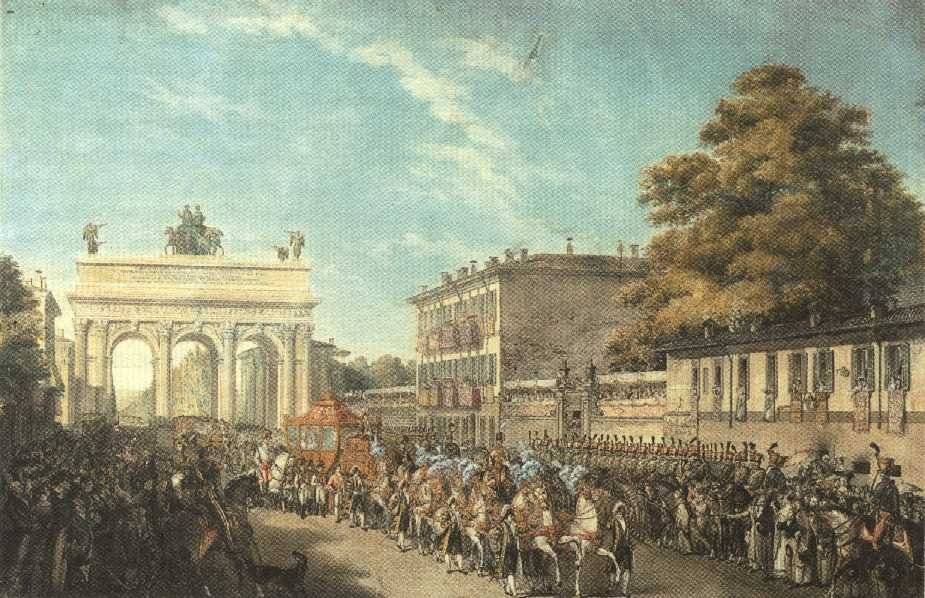
Porta Nuova is a symbol of Milan’s resilience and adaptability. Situated between historic Via Manzoni and the modern Porta Nuova district, it links the medieval city center to contemporary icons like the Unicredit Tower and Bosco Verticale (Milan Design Agenda - Porta Nuova). The gate has witnessed processions, civic events, and military parades, reinforcing its importance in Milanese identity (Wikipedia - Porta Nuova (medievale, Milano)).
Visiting Information
Visiting Hours
- Porta Nuova arches are accessible 24/7 as an open-air monument in a public space.
Tickets and Entry
- Entry is free; no tickets or reservations are needed.
Accessibility
- The area is pedestrian-friendly and wheelchair accessible. Nearby metro stations include Montenapoleone and Turati.
Travel Tips
- Best times Early morning or late afternoon for optimal lighting and fewer crowds.
- Getting there Metro M3 (Montenapoleone or Turati), buses, and trams serve the area.
- Nearby attractions Via Manzoni shopping, Teatro alla Scala, Brera district, Piazza Gae Aulenti, Bosco Verticale.
- Photography Capture the arches from Piazza Cavour with the modern skyline as backdrop.
Integration with the Modern City
The medieval arches now coexist with cutting-edge architecture in Milan’s Porta Nuova district. Landmarks like Unicredit Tower, Bosco Verticale, and the Biblioteca degli Alberi park showcase Milan’s fusion of tradition and innovation (Wallpaper - Porta Nuova BAM Park; Guiding Architects - Porta Nuova). The area is a model for sustainable urban development, with green spaces and pedestrian-friendly design (COIMA; Italia.it Porta Nuova District).
Frequently Asked Questions (FAQ)
Q: Are there visiting hours for Archi di Porta Nuova?
A: The arches are outdoors and accessible 24 hours a day.
Q: Is there an entry fee?
A: No, visiting the arches is free of charge.
Q: Are guided tours available?
A: Yes, many Milan walking tours include Porta Nuova; check with local providers.
Q: Is the site accessible for wheelchair users?
A: Yes, the area is pedestrian-friendly and accessible.
Q: What is the best way to reach Porta Nuova?
A: Use Metro M3 (Montenapoleone or Turati) or bus/tram routes.
Q: What else is nearby?
A: Brera district, Teatro alla Scala, Parco Sempione, Gae Aulenti, and Bosco Verticale.
Summary of Key Historical Facts
- Construction Circa 1171, as part of medieval fortifications
- Features Double-arched gateway, originally flanked by two towers
- Additions 14th-century marble tabernacle with religious reliefs
- Modifications Shortened towers (16th century), pedestrian passages (1861), vehicular widening (early 20th century)
- Preservation Saved from demolition in 1869 after public advocacy
- Current Status Freely accessible medieval gate, integrated with Milan’s urban core