Introduction
Sant’Alessandro in Colonna stands as a profound emblem of Bergamo’s religious, cultural, and artistic legacy. Rooted in early Christian tradition and dedicated to Saint Alexander, the city’s patron martyr, the church is a living monument that bridges Bergamo’s ancient past and vibrant present. Its layered architecture, artistic masterpieces, and enduring role in local devotion make it one of the city’s most compelling historical sites.
This detailed guide explores Sant’Alessandro in Colonna’s origins, architectural evolution, artistic treasures, and practical visitor information—ensuring you have everything needed for a rich and meaningful visit.
For updated hours, special event details, and planning resources, consult the official parish website (Parrocchia Sant’Alessandro in Colonna) and the Bergamo tourism portal (Visit Bergamo).
Early Origins and the Martyrdom of Saint Alexander
Sant’Alessandro in Colonna is intimately linked with the memory of Saint Alexander, a Roman legionary martyred in Bergamo for his Christian faith in the early 4th century CE. Tradition holds that the church stands on the precise spot of his execution—a site marked by a single ancient Roman column (Catholic Shrine Basilica; Lombardia Beni Culturali). Evidence of Christian worship at this location dates back to at least 1133, though the roots likely stretch deeper into late antiquity. The “in Colonna” designation refers directly to the presence of these Roman columns, underscoring the church’s foundational ties to Bergamo’s earliest Christian community (Visit Bergamo).
Architectural Evolution
Medieval and Renaissance Transformations
Built possibly atop the remnants of a pagan temple, Sant’Alessandro in Colonna has evolved through cycles of destruction and renewal. After partial collapse in 1447, the church was reconstructed and consecrated in 1474, reflecting late medieval ecclesiastical architecture. During this period, it also served as the seat of the powerful Chapter of Saint Alexander, competing with other major religious institutions in Bergamo (Prima Bergamo).
The complex originally included the adjacent church of San Pietro, the bishop’s residence, and charitable facilities, forming a significant religious and social hub.
Baroque and Neoclassical Redesigns
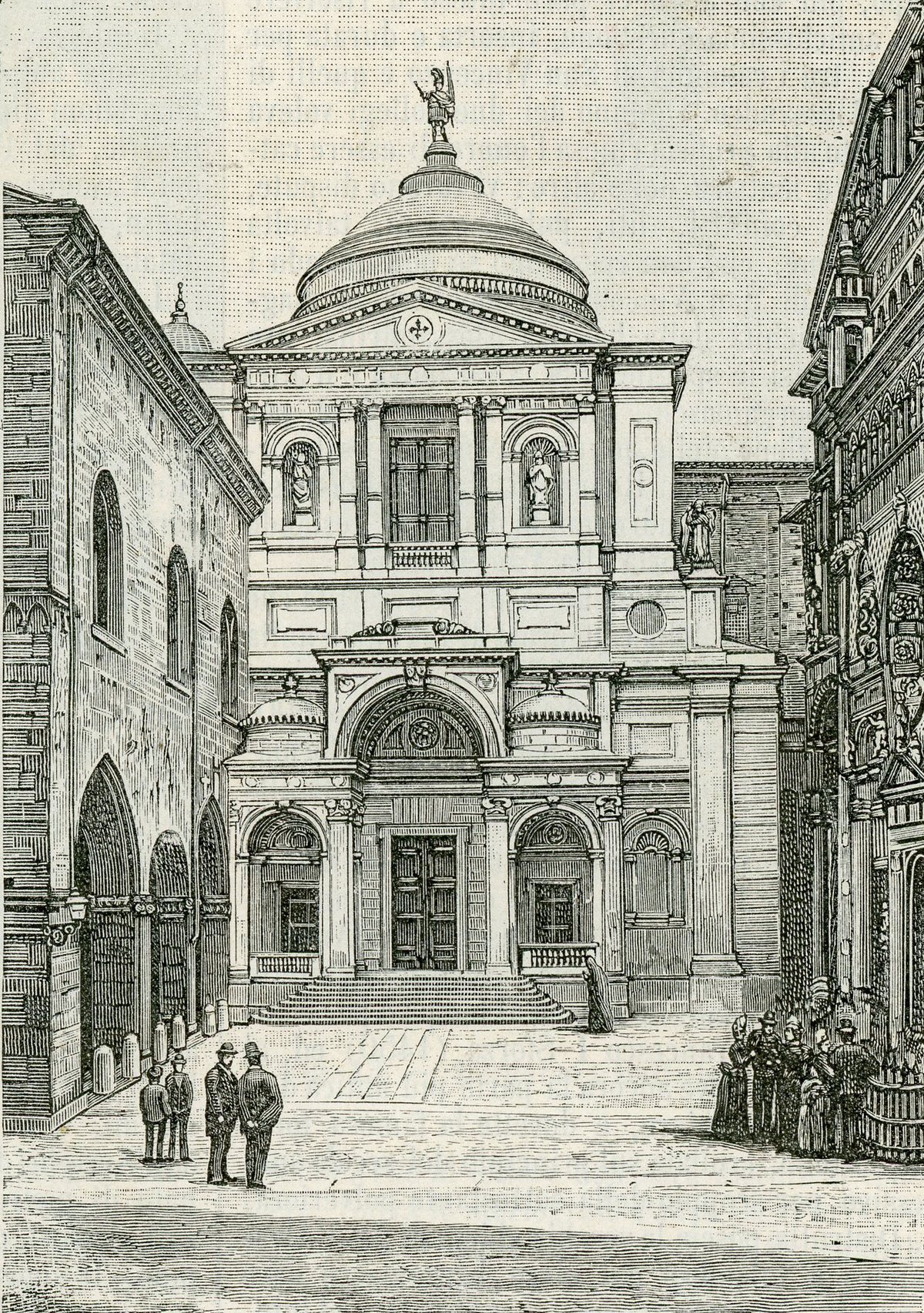
The 17th and 18th centuries brought major Baroque and Neoclassical transformations. The current façade, completed in the 18th century, is crafted from Botticino marble, structured with Corinthian pilasters, and adorned with three grand entrances. The nave and lateral chapels follow Neoclassical lines, with a barrel-vaulted ceiling and prominent cupola finished in 1780. The bell tower, begun in 1842 and completed in 1904, reflects continued architectural refinement (Lombardia Beni Culturali).
The Roman Column and Its Symbolism
A striking 10-meter Roman column stands before the church—a powerful symbol of Saint Alexander’s martyrdom and the city’s ancient Christian roots. Reconstructed in 1618 from Roman fragments, it is believed to be the last remnant of Bergamo’s original 4th-century cathedral, demolished in 1561 to construct the city’s Venetian walls (Prima Bergamo; Bergamo da Scoprire). The column’s restoration in 1961, sponsored by Pope John XXIII, marked the fourth centenary of this pivotal event.
Cultural and Religious Significance
Sant’Alessandro in Colonna has served as a center of worship, pilgrimage, and civic identity for centuries. The annual Festa di Sant’Alessandro (August 26) remains a cornerstone of Bergamo’s religious calendar, featuring processions and cultural celebrations (Parrocchia Sant’Alessandro in Colonna). Today, the church is an active parish, hosting liturgies, catechesis, and community events.
Artistic Heritage and Notable Features
The church’s interiors are a showcase of Renaissance and Baroque art:
- Francesco Zucco: His cycle on the life of Saint Alexander, including Sant’Alessandro si presenta ad un Vescovo (1627), is a highlight of the Baroque period (Best of Bergamo).
- Lorenzo Lotto: Lamentation over the Dead Christ (1520–1521), a rare tempera on canvas, stands as one of the church’s most prized works (Visit Bergamo).
- Enea Salmeggia: Noted for his Martyrdom of Saint Alexander.
- Gian Paolo Cavagna: Painted Santa Grata Collecting the Head of Saint Alexander.
- Other masters: Works by Romanino, Alessandro Bonvicino (il Moretto), Leandro and Giovanni Battista Bassano, and Girolamo Romanino further enrich the church’s chapels (Lombardia Beni Culturali).
Each artwork reflects key episodes in Saint Alexander’s story, weaving together themes of martyrdom, faith, and spiritual resilience.
Notable Historical Events
- Demolition of the Original Basilica (1561): The first cathedral, a focal point for early Christians, was demolished with the construction of the Venetian walls (Prima Bergamo).
- Relic Translations and Restorations: The movement of Saint Alexander’s relics and the restoration of the column in 1961 marked major religious milestones (Bergamo da Scoprire).
- Repeated Consecrations: Key dates include 1474, 1627, and 1739, each reflecting the church’s evolving role in Bergamo’s spiritual life (Lombardia Beni Culturali).
Visitor Information: Visiting Hours, Tickets, and Accessibility
- Visiting Hours:
- Monday to Saturday: 9:00 AM – 12:30 PM & 2:30 PM – 6:00 PM
- Sunday and Public Holidays: 9:00 AM – 12:30 PM
- Closed on Monday afternoon and certain holidays. Check the official website for updates.
- Tickets:
- Admission is free. Donations are welcome.
- Guided Tours:
- Available by appointment via the parish office or Bergamo tourist centers.
- Accessibility:
- The church is wheelchair accessible; assistance is available upon request.
- Location:
- Via Sant’Alessandro, in Bergamo’s Borgo San Leonardo district, easily reached on foot or by public transport.
- Nearby Attractions:
- Piazza Vecchia, Bergamo Cathedral, Accademia Carrara, and the Venetian Walls.
Frequently Asked Questions (FAQs)
Q: What are the opening hours of Sant’Alessandro in Colonna?
A: Monday to Saturday: 9:00 AM – 12:30 PM & 2:30 PM – 6:00 PM; Sunday and holidays: 9:00 AM – 12:30 PM.
Q: Is there an entry fee?
A: No, entry is free.
Q: Are guided tours offered?
A: Yes, bookable via the parish or Bergamo tourist office.
Q: Is the church accessible to people with disabilities?
A: Yes, with ramp access and assistance on request.
Q: Where can I find more information?
A: Official Parrocchia Sant’Alessandro in Colonna Website and Visit Bergamo.
Visuals and Media
Explore virtual tours and high-resolution images at Visit Bergamo, or see the church’s façade below:

Discover More
Ready to experience Bergamo’s heritage firsthand?
- Download the Audiala app for guided tours, maps, and event updates.
- Stay informed by following us on social media and checking the official parish and Bergamo tourism websites.
For more detailed guides, see:
- [Bergamo Historical Sites Guide]
- [Bergamo Cathedral Visit Information]
Listen to the full story in the app
Your Personal Curator, in Your Pocket.
Audio guides for 1,100+ cities across 96 countries. History, stories, and local insight — offline ready.
Audiala App
Available on iOS & Android
Join 50k+ Curators
Sources
- verified
- verified
- verified
- verified
- verified
Last reviewed: