Introduction
The concert hall that gave Israel its voice was bankrolled by a man who made his fortune manufacturing false teeth. Ohel Shem Hall, tucked onto Balfour Street in Tel Aviv, Israel, stands as one of those rare buildings whose importance has nothing to do with its architecture and everything to do with what happened inside. Come here to stand where Toscanini raised his baton, where Bialik preached secular Sabbath to a thousand listeners, and where thirty musicians recorded the anthem that played when a nation was born.
Samuel S. Bloom, a Lithuanian-born denture magnate from Philadelphia, spent £5,000 in 1928 to build this hall as a birthday gift for his friend Haim Nachman Bialik — the closest thing the Hebrew language had to a living national poet. The name "Ohel Shem," meaning "Tent of Shem," reaches back to Noah's eldest son, ancestor of all Semitic peoples. Bloom chose it deliberately. So did the crowd of over a thousand who showed up on opening day, May 9, 1929.
From the outside, the building barely registers against Tel Aviv's streetscape. Inside, the acoustics tell a different story. For twenty years this modest hall served as the only permanent home of the Palestine Philharmonic Orchestra, forcing every concert to be repeated eight times to satisfy demand. Arthur Rubinstein, Yehudi Menuhin, and Jascha Heifetz all played this stage — a room roughly the size of a high school gymnasium.
Ohel Shem's strangest trick was its split identity: synagogue on Friday evenings and holidays, secular lecture hall on Saturday afternoons. Bialik designed it that way on purpose, arguing that Shabbat could hold its own appeal without coercion. No other venue in Tel Aviv attempted the combination.
What to See
The Auditorium
Every sound in this room carries weight — some of it literal. The proscenium hall seats roughly 700 today, down from the original 1,000, and its proportions feel intimate enough that you half-expect the performer to make eye contact. Between 1936 and 1957, the Palestine Philharmonic Orchestra played here so regularly that each concert program had to be repeated eight times because the hall couldn't hold the crowds. Toscanini conducted on this stage. Rubinstein, Menuhin, and Heifetz all performed where you're standing.
But the room's most consequential moment came in April 1948, weeks before the Declaration of Independence, when sound engineer Lucien Salzman recorded 30 musicians playing Hatikva inside these walls. That recording became Kol Yisrael radio's nightly sign-off for decades — meaning most 20th-century Israelis heard the specific reverb of this auditorium every time they heard the national anthem. The room's acoustic signature embedded itself in the country's ear. Stand in the center aisle and you're inside the microphone.


The Eclectic Facade on Balfour Street
Ohel Shem looks like it arrived from a different decade — because it did. Built in 1928–29, it predates the Bauhaus wave that defines Tel Aviv's White City by several years. Where the surrounding apartment blocks are all clean lines and horizontal ribbon windows, Ohel Shem sits flush with the pavement in symmetrical white-rendered masonry, a central arch marking its entrance, heavier and more ceremonial than anything on the block. The contrast tells you something: this building had civic ambitions before the city had a civic architecture.
The street itself adds a layer. Balfour Street 30 is the same road as the Prime Minister's official residence at number 12, which since 2020 has become ground zero for Saturday-night political protest. A building conceived by the national poet as a place for secular Shabbat gatherings now shares a street with mass demonstrations on the same evening. Look for the Israeli heritage plaque near the entrance — designation IL-3-5000-231 — and, if you can find it, a cornerstone laid on Lag B'Omer 1928. No source describes the inscription. You'd be the first tourist to report what it says.
The Bialik Walk: Ohel Shem to Bialik House
Almost no tour connects these two buildings, which is absurd given that one is meaningless without the other. Haim Nachman Bialik started his Oneg Shabbat cultural gatherings in his living room at 22 Bialik Street in 1926. Crowds grew past the room, past the conservatory, past the 500-seat Gymnasia Herzliya. His friend Samuel S. Bloom — a Philadelphia denture manufacturer who'd immigrated to Palestine at age 65 — spent £5,000 building him a proper hall. That hall is Ohel Shem, 500 meters and a six-minute walk away.
The route between them retraces a path Bialik walked regularly until his death in 1934. Start at the hall, head northwest to the house-museum on Bialik Street, and you'll pass through the quiet residential grid that Bialik knew when Tel Aviv was a town of 50,000, not a metropolis of half a million. In spring, the jacarandas on nearby Rothschild Boulevard throw purple shadow across the pavement. Bialik House preserves his study and library almost exactly as he left them. The denture magnate who made it all possible is buried at Trumpeldor Cemetery, a 15-minute walk north. No English-language guide mentions any of this.

Photo Gallery
Explore Ohel Shem Hall in Pictures

Ohel Shem Hall is a prominent cultural venue in Tel Aviv, Israel, known for its modern architectural design and theater performances.
Michael.miller.photographer · cc by-sa 3.0

A historic view inside the Ohel Shem Hall in Tel Aviv, Israel, during a public gathering on stage.
Zoltan Kluger · public domain
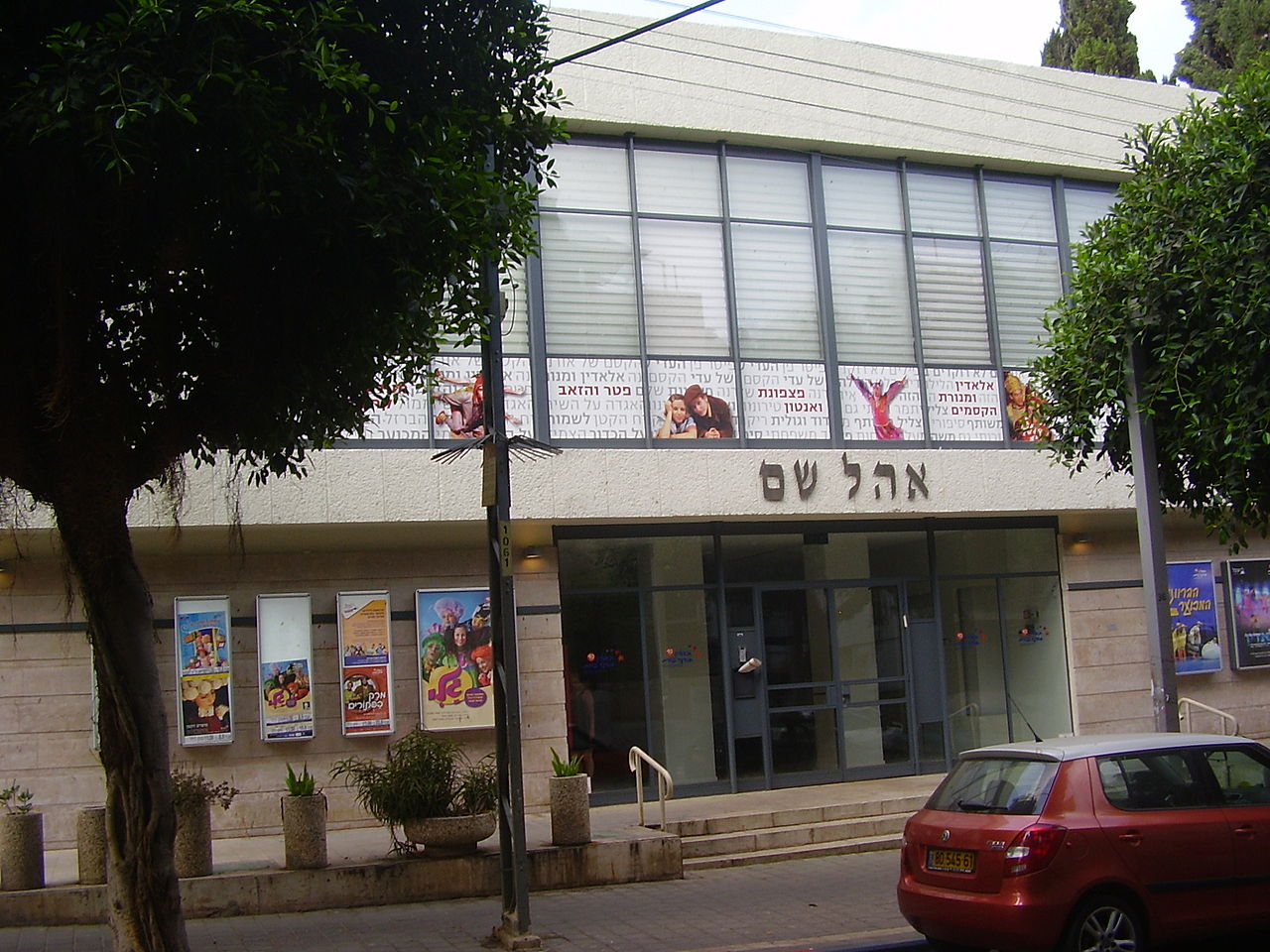
The Ohel Shem Hall in Tel Aviv, Israel, is a prominent cultural venue known for its modern architectural design and theatrical performances.
Avi1111 dr. avishai teicher · cc by 3.0

A speaker addresses an audience from the podium at Ohel Shem Hall in Tel Aviv, Israel, during a formal event.
Hans Pinn · public domain

Ohel Shem Hall in Tel Aviv, Israel, showcases a blend of modern architectural design with large glass windows and stone facade details.
Robinbagon · cc by-sa 3.0

A historic gathering at Ohel Shem Hall in Tel Aviv, Israel, featuring a speaker addressing an audience beneath a portrait of Theodor Herzl.
Hans Pinn · public domain

A somber crowd gathers for a funeral procession outside the historic Ohel Shem Hall in Tel Aviv, Israel, captured from an elevated perspective.
Zoltan Kluger · public domain

A historic view of a crowded gathering inside the Ohel Shem Hall in Tel Aviv, Israel, featuring a stage decorated with Hebrew banners and flags.
Zoltan Kluger · public domain

The Ohel Shem Hall in Tel Aviv, Israel, is a notable cultural venue known for its modernist architectural style and active event programming.
Avi1111 dr. avishai teicher · cc by 3.0

A historical aerial view captures a solemn funeral procession gathering outside the Ohel Shem Hall in Tel Aviv, Israel, during the mid-20th century.
Zoltan Kluger · public domain

A somber funeral procession gathers outside the historic Ohel Shem Hall in Tel Aviv, Israel, during the mid-20th century.
Zoltan Kluger · public domain

The Ohel Shem Hall in Tel Aviv, Israel, is a prominent cultural venue featuring a modern architectural design and outdoor display posters.
Dr. Avishai Teicher · cc by 2.5
Look for the cornerstone laid on Lag B'Omer 1928 — ceremonial foundation stones in Mandatory-era Tel Aviv buildings were often inscribed with the Hebrew date and donor names. The inscription, if visible on the exterior, would carry both Bloom's name and Bialik's jubilee dedication.
Visitor Logistics
Getting There
Balfour Street 30 sits roughly 300 meters west of Rothschild Boulevard — a seven-minute walk from the Allenby/Rothschild intersection. Bus lines along Allenby Street drop you within two blocks. From the Carmelit or HaShalom train station, figure on a 15-minute walk south through the Bauhaus quarter. Skip the taxi; the walk through tree-lined streets is half the experience.
Opening Hours
As of 2026, Ohel Shem's current operating schedule and event programming are not publicly listed online. The building is a protected heritage structure that has historically functioned as a synagogue on Friday evenings and Jewish holidays, with cultural events on other days. Contact the Tel Aviv municipality's heritage department or check on-site signage before planning a visit around interior access.
Time Needed
The exterior and its Balfour Street context reward about 15–20 minutes of attention — enough to read the historical plaques and absorb the architectural details. If you gain interior access during a service or event, add another 30–45 minutes. Pair it with a longer walk down Rothschild Boulevard and the stop becomes part of a satisfying two-hour cultural loop.
Tips for Visitors
Dress for Two Identities
If visiting during Friday evening services or Jewish holidays, cover shoulders and knees — men will need a kippah, usually available at the door. For cultural events or a Saturday afternoon exterior visit, Tel Aviv's standard uniform of jeans and a t-shirt is perfectly fine. The city would find overdressing funnier than underdressing.
Photography Boundaries
Exterior shots are unrestricted, and the facade photographs well in late-afternoon light when Balfour Street's ficus trees throw long shadows. During any Shabbat or holiday service, photography is prohibited — this applies to all synagogues in Israel, not just Ohel Shem. For interior shots at other times, ask permission from whoever manages the building.
Eat Off the Boulevard
Rothschild Boulevard's restaurants are good but carry a location premium. Walk two blocks southwest toward Neve Tzedek for the same quality at lower prices. For a proper Tel Aviv breakfast, find a café serving shakshuka or sabich — the fried-eggplant-and-egg pita that Iraqi Jewish immigrants brought to this part of the city. Bicicletta on Rothschild is worth the splurge if you want Italian-Israeli fusion done right.
Saturday Night Protests
The Israeli Prime Minister's residence is on this same street. Since 2020, Saturday evenings regularly bring large anti-government demonstrations with road closures and heavy police presence. The crowds are peaceful but loud and dense — plan accordingly if you're visiting on a Saturday night, or lean in and witness Israeli democracy doing what it does best.
Build a Walking Loop
Ohel Shem gains meaning in context. Start at the Bialik House museum (the poet's restored home, ten minutes north), then walk to Ohel Shem to see what his cultural ambitions built, then continue east to Rothschild Boulevard's UNESCO-listed Bauhaus buildings. Three stops, two hours, one coherent story of Tel Aviv inventing itself.
Skip Street Taxis
Use the Gett or Yango apps instead of hailing cabs on the street. Metered fares in Tel Aviv are fair, but some drivers quote tourist prices to anyone who looks uncertain. The apps lock in the route and cost before you get in.
Where to Eat
Don't Leave Without Trying
Itzik and Ruthie
local favoriteOrder: The sabich (fried eggplant, egg, and hummus in pita) is the real deal—crispy, layered, and exactly what locals grab on the way home. Don't skip the fresh lemonade.
This is where Sheinkin Street eats. A no-frills neighborhood institution with 200+ reviews and a 4.8 rating—that's not accident, that's locals voting with their feet. Cheap, fast, authentic.
Cafe Ahad Ha'am
cafeOrder: Start with their morning coffee and pastry—this is a proper café culture spot. Lunch is shakshuka (eggs poached in spiced tomato) or a fresh salad plate.
A genuine neighborhood café on a tree-lined street, loved by locals for breakfast and lunch. The 4.6 rating across 100+ reviews reflects consistent, unpretentious quality.
Cafe Balfour
cafeOrder: Their brunch is the draw—go for the eggs any style, fresh-squeezed juice, and whatever pastry is warm from the oven. The coffee is serious.
Balfour Street is a café haven, and this spot leads the pack with a 4.7 rating and 150+ reviews. It's where creative Tel Avivis linger over breakfast and work.
MoBo
local favoriteOrder: Order by the glass and ask the staff for recommendations—this is a serious wine bar with Israeli and imported selections. Pair with local cheese or charcuterie.
Perfect 5.0 rating and a genuine wine-focused spot on Ahad Ha'am Street. Small, curated list, and run by people who actually care about what's in the glass.
Dining Tips
- check Lunch hours in Tel Aviv run 12:30–15:00; dinner service begins around 19:30.
- check Most restaurants in this area are kosher-certified; confirm opening dates during Jewish holidays (Pesach/Passover closures are common).
- check Sheinkin Street is a walking neighborhood—many cafés are casual walk-in spots; reservations rarely needed for lunch.
- check Carmel Market (Shuk HaCarmel) is a 10–15 minute walk and offers fresh produce, street food, and cheap eats.
Restaurant data powered by Google
Historical Context
The Poet Who Needed a Bigger Room
In December 1926, Haim Nachman Bialik began hosting what he called "Oneg Shabbat" — Sabbath Delight — Saturday afternoon gatherings of lectures, poetry, and communal singing. They started in his living room, migrated to the Shulamit Conservatory, then to Gymnasia Herzliya's 500-seat auditorium. Within months, more than a thousand people were cramming in. Bialik had a problem most poets would envy: too large an audience.
Tel Aviv in the late 1920s was a city of sand and ambition, barely two decades old, with no concert hall, no cultural center, no building designed for the life of the mind. What it did have was a growing population of European Jewish immigrants hungry for exactly the kind of intellectual community Bialik was conjuring every Saturday. He needed a purpose-built hall. Enter a denture manufacturer from Philadelphia.
Bloom's £5,000 Birthday Present
Samuel S. Bloom was born in Vilkomir, Lithuania, on December 25, 1860. He emigrated to America, built a denture-manufacturing business in Philadelphia, and by his sixties had accumulated enough wealth to act on a late-life conviction: move to Palestine and spend his money where it mattered. He arrived in 1926, the same year Bialik's Oneg Shabbat gatherings began straining every available venue in the city.
Bloom and Bialik became friends. When Bialik's 60th jubilee approached, Bloom decided against the usual tribute — a festschrift, a banquet, a commemorative volume. He laid a cornerstone instead. On Lag B'Omer 1928, construction began at Balfour Street 30, with contractor Sam Wilson overseeing the work. The total cost: £5,000, paid entirely by Bloom. On May 9, 1929, Mayor Meir Dizengoff joined Bloom and Bialik on stage for the inauguration. A denture magnate had given a poet the one thing money can actually buy an artist: a room large enough for the audience.
Bloom never left. He lived in Tel Aviv until his death on September 10, 1941, long enough to see his gift become the permanent home of the Palestine Philharmonic and the center of the city's cultural life. The building outlasted him, outlasted the British Mandate, and carried a recording of "Hatikva" into the founding moments of a new state.
Eight Concerts for Every One
When violinist Bronislaw Huberman founded the Palestine Orchestra on December 26, 1936, he chose Ohel Shem as its home — the only hall in Tel Aviv with decent acoustics and a real stage. Arturo Toscanini conducted the inaugural concert. But the hall was small, and demand was ferocious. Every program had to be performed eight times to accommodate the audience. Rubinstein, Menuhin, and Heifetz all played under these conditions, repeating their recitals night after night in a room that would have been a rehearsal space in any European capital. The orchestra finally moved to the Fredric R. Mann Auditorium in 1957, but those twenty-one years of enforced repetition gave Tel Aviv's concertgoers an intimacy with orchestral music that larger halls can never replicate.
The Anthem Before the Nation
In April 1948, weeks before David Ben-Gurion declared independence, sound engineer Lucien Salzman set up recording equipment inside Ohel Shem. The Palestine Philharmonic, reduced to just 30 players, performed "Hatikva" — the song that would become Israel's national anthem. Salzman captured it for Kol Yisrael, the nascent state radio service. When independence was proclaimed on May 14, that Ohel Shem recording was what played over the airwaves. The anthem existed before the country did, and this modest hall on Balfour Street is where it was committed to tape.
Listen to the full story in the app
Your Personal Curator, in Your Pocket.
Audio guides for 1,100+ cities across 96 countries. History, stories, and local insight — offline ready.
Audiala App
Available on iOS & Android
Join 50k+ Curators
Frequently Asked
Is Ohel Shem Hall in Tel Aviv worth visiting? add
Yes — if you care about the story of how Tel Aviv became a cultural city, this is where it started. Built in 1929 as a personal gift from a Philadelphia denture manufacturer to his friend, the national poet Bialik, the hall served as Tel Aviv's primary civic and concert venue for decades. The Palestine Philharmonic Orchestra played here from 1936 to 1957, and the recording of Hatikva that became Israel's unofficial anthem was captured inside this room in April 1948.
How do I get to Ohel Shem Hall from central Tel Aviv? add
Walk — it's at 30 Balfour Street, about 300 meters west of Rothschild Boulevard. From the Rothschild-Herzl intersection, head west on any cross street toward Balfour; the building sits flush with the pavement, older and heavier than the Bauhaus blocks around it. No dedicated parking exists, but the area is well served by bus routes along Rothschild and Allenby.
What is the history of Ohel Shem Hall in Tel Aviv? add
Poet Haim Nachman Bialik launched his Oneg Shabbat cultural gatherings in 1926, outgrew every venue in the city, and his friend Samuel S. Bloom — an American industrialist who made his fortune in dentures — spent £5,000 to build him a proper hall. The cornerstone went down on Lag B'Omer 1928, and the doors opened on May 9, 1929, with Bialik, Bloom, and Mayor Dizengoff speaking. From 1936 to 1957 it was the home of the Palestine Philharmonic Orchestra, where Toscanini, Rubinstein, and Menuhin performed — each concert repeated eight times because the 1,000-seat hall couldn't hold the demand.
Can you visit Ohel Shem Hall for free? add
The building is currently operated by HaMakom, a Jewish cultural center, and includes a coffee lounge that may allow casual drop-in visits. Specific entry fees depend on programming — contact HaMakom at 073-2668888 or [email protected] to confirm current access and event schedules before your visit.
What should I not miss at Ohel Shem Hall? add
Stand inside the auditorium and consider that the specific reverb of this room was broadcast nightly as Kol Yisrael's closing signal for decades — most 20th-century Israelis heard this acoustic signature every time they heard Hatikva. Look for the cornerstone from 1928 and the heritage plaque near the entrance. Then walk 500 meters to Bialik House on 22 Bialik Street — the two sites are historically inseparable, and the six-minute walk retraces the poet's own regular route.
What is the best time to visit Ohel Shem Hall? add
Friday late afternoon, as Shabbat approaches and the neighborhood quiets, lets you feel the building's dual identity as both synagogue and secular cultural hall. Spring brings the jacaranda bloom along nearby Rothschild Boulevard — deep purple canopy overhead on the walk from the hall. Avoid Saturday evenings if you want calm; Balfour Street has been a regular site of political protests since 2020, with the Prime Minister's residence just 400 meters north.
How long do you need at Ohel Shem Hall? add
The hall itself takes 20 to 30 minutes to appreciate — exterior, interior auditorium, and any lobby inscriptions. Budget an extra 30 minutes if you combine it with the walk to Bialik House on Bialik Street, which adds the full story of how these Saturday cultural gatherings outgrew the poet's living room and became a civic institution.
What was the Palestine Philharmonic Orchestra's connection to Ohel Shem Hall? add
Ohel Shem was the orchestra's permanent home for 21 years, from the late 1930s until 1957. Founded in 1936 by Bronislaw Huberman with an inaugural concert conducted by Arturo Toscanini, the orchestra performed every major program on this stage — Arthur Rubinstein, Yehudi Menuhin, and Jascha Heifetz all played here. Demand so outstripped the hall's roughly 1,000 seats that each concert program had to be performed eight times.
Sources
-
verified
Hebrew Wikipedia — Ohel Shem
Core historical details: construction dates, Bialik's Oneg Shabbat movement, opening ceremony, capacity, and Palestine Philharmonic residency
-
verified
Hamichlol Encyclopedia — Ohel Shem
Samuel S. Bloom biography, contractor Sam Wilson, hall capacity, cornerstone details
-
verified
HaMakom — Center for Jewish Culture and Spirit
Current operator information, 2021 handover, programming details, contact information
-
verified
Jewish Telegraphic Agency Archive (1929)
Opening ceremony report, land provision by Jewish National Fund, May 1929 dedication details
-
verified
Wikipedia — Samuel S. Bloom
Bloom biography: denture manufacturing fortune, immigration to Palestine, £5,000 construction cost, friendship with Bialik
-
verified
Israel Philharmonic Orchestra — Official History
Palestine Philharmonic founding in 1936, Ohel Shem as home venue 1936–1957, Toscanini inaugural concert
-
verified
J Weekly (1998)
Each concert repeated eight times due to demand exceeding hall capacity
-
verified
Haaretz — Legal Reporting
Hekdesh (sacred endowment) legal dispute, Orna Porat Theater eviction, 2021 court ruling
-
verified
Haaretz — 80th Anniversary Coverage (2010)
Anniversary coverage confirming May 9, 1929 opening date and historical significance
-
verified
PICRYL Image Archive
Historical photographs including Yehuda Leib Pinsker's public funeral procession from the hall
-
verified
Tel Aviv Foundation — HaMakom Initiative
Single source claiming Frank Gehry involvement in renovation design (unverified)
-
verified
Wikimedia Commons — Ohel Shem Interior
Interior and exterior photographs of the hall and auditorium
-
verified
Wikidata — Ohel Shem Hall
Structured data: heritage designation number IL-3-5000-231, address, opening date
-
verified
TripAdvisor — Rothschild Boulevard Area Restaurants
Nearby restaurant ratings and dining options within walking distance of the hall
Last reviewed: