account_balance
Layered Sacred Cities
Jerusalem, Nazareth, and Tiberias are not museum pieces. They are working cities where scripture, empire, and present-day life share the same streets.
Israel packs beach cities, biblical landscapes, Arab markets, desert craters, and 3,000 years of argument into a country you can cross in hours. Few places change character this fast, or ask you to pay such close attention.
EntryETA-IL required for many visa-exempt travelers
IAn Israel travel guide needs to cover more than one country’s worth of contrasts: beaches in Tel Aviv, millennia of stone in Jerusalem, and desert silence near Mitzpe Ramon.
Israel compresses distance in a way few countries do. You can leave Tel Aviv after breakfast, reach Jerusalem before the coffee wears off, and stand by afternoon in a city where Roman paving, Ottoman walls, and modern politics still press against each other. Head north and the mood shifts again: Haifa climbs a steep green slope above the Mediterranean, Acre keeps Crusader vaults under its market streets, and Nazareth folds church bells, mosques, and workshop noise into the same few blocks. Small map, huge density.
History here is not background decoration. Caesarea still shows how Rome staged power by the sea; Safed turns mysticism into street geography; Tiberias sits beside the Kinneret, where faith, empire, and freshwater all shaped the same shoreline. Even the food reads like a migration record: sabich from Iraqi Jewish kitchens, jachnun from Yemenite Shabbat tables, kanafeh in Arab towns, grilled skewers and chopped salads from one end of the country to the other. Meals arrive fast, arguments faster.
Kingdoms, Prophets, and Exile, c. 1200 BCE-538 BCE
A woman sits beneath a palm between Ramah and Bethel, judging disputes and sending men to war. That is how one of the oldest scenes in the land begins: Deborah not on a throne, not in armor, but under a tree, with words sharp enough to move an army. Ce que l'on ignore souvent, c'est que the deep past here was never only kings and battles; it was also women, shepherds, scribes, and city rulers writing desperate letters because the harvest had failed and the neighbors were stealing villages.
Then comes David, and with him the dangerous seduction of Jerusalem. He takes a hill town and turns it into a capital, then his son Solomon crowns the gesture with a Temple whose cedar came from Tyre and whose labor came from conscription. One detail says everything: the sanctuary took seven years to build, the royal palace thirteen. Even in sacred architecture, power likes comfortable ceilings.
After Solomon's death, the family drama becomes state collapse. Rehoboam is asked for tax relief and answers, in effect, with a whip. Ten tribes walk away. The northern kingdom of Israel and the southern kingdom of Judah spend the next centuries quarreling, marrying badly, fearing Assyria, and listening only when it is too late to the prophets who warned that injustice has a political price. Jezebel, so often flattened into a villain, remains one of the great theatrical figures of the age: foreign princess, queen, patron, and finally a woman who paints her eyes before death because she will not grant her enemies the pleasure of fear.
The end, when it comes in 586 BCE, is smoke over Jerusalem. Nebuchadnezzar's armies destroy the First Temple and carry the elite to Babylon. And yet the strange miracle of this country is that catastrophe so often produces reinvention: texts are gathered, memory is organized, prayer becomes portable. The road from ruin to return begins there, with a people learning that stone can burn while a story survives.
David appears in the tradition as warrior and poet, but the man behind the bronze statue was also a ruler haunted by his own appetites and the cost of counting his people.
The Siloam Tunnel inscription in Jerusalem records the exact moment two digging teams heard each other's picks through the rock and broke through from opposite ends in 701 BCE.
Empires, Revolt, and the Sacred Stage, 538 BCE-638 CE
The return from Babylon does not bring serenity; it brings rebuilding. A modest Second Temple rises in Jerusalem, later transformed by Herod the Great into a dazzling political machine of white stone, gold, and intimidation. Herod understood spectacle better than many modern statesmen: if you cannot make people love you, overwhelm them.
He leaves his signature everywhere. In Caesarea, he builds a port where there had been none, pouring Roman concrete into the sea as if he meant to command the Mediterranean itself. In Jerusalem, he enlarges the Temple platform to a scale still felt in the body when you stand by its retaining walls. Ce que l'on ignore souvent, c'est que Herod, remembered as a tyrant, was also one of the great builders of the ancient world, a man who mistrusted nearly everyone, including members of his own family, and kept building as if masonry could cure paranoia.
Roman rule hardens the atmosphere. Priests maneuver, governors blunder, and the city grows tense enough to catch fire from a single insult. The Jewish revolt of 66 CE ends in 70 with the destruction of the Second Temple, one of the defining breaks in the history of Jerusalem and of Jewish memory. A few decades later, after the Bar Kokhba revolt, the Romans refashion the city as Aelia Capitolina. Change the name, change the gods, erase the wound. States always think that works.
But this land never keeps one script for long. Christianity takes root in places already heavy with memory: Nazareth, Jerusalem, Tiberias, the roads around the Galilee. Then Byzantines, monks, pilgrims, mosaics. Then, in the seventh century, Arab armies take Jerusalem. Another chapter opens, not by wiping away the old ones, but by laying a new text over them. That is the habit of this country: inheritance by accumulation, never by clean replacement.
Herod the Great built like a visionary and ruled like a man who slept badly, which is often how grand projects begin.
At Masada, Herod's desert refuge kept storerooms so well stocked that archaeologists found food remains preserved by the dry air nearly two thousand years later.
Caliphates, Crusaders, and Ottoman Centuries, 638-1917
In 1099, the Crusaders enter Jerusalem in blood and incense. Chroniclers speak of victory; the stones would have had another word for it. Yet even here, where faith so often arrives with a sword, daily life resumes with unnerving speed: markets reopen, pilgrims bargain, cooks light fires, tax collectors keep their ledgers. History likes proclamations. People still need bread.
Acre becomes one of the great stages of the medieval Levant, crowded with merchants, soldiers, rival orders, and ship captains shouting in half a dozen languages. Walk its walls today and you can still feel the port city's old nerve, the sense that Europe and the Arab world once faced each other here not in abstraction but across warehouses, customs dues, and dinner tables. Ce que l'on ignore souvent, c'est que crusading piety was also a business model.
Then comes Saladin, then Mamluks, then the long Ottoman stretch beginning in 1517. If the Crusader period is theatrical, the Ottoman one is more patient and in some ways more decisive. Jerusalem remains holy, yes, but also administratively neglected, periodically repaired, and inhabited by communities that learn the exhausting art of living side by side. In the sixteenth century Suleiman the Magnificent orders the rebuilding of Jerusalem's walls, the ones visitors still photograph, admire, and wrongly imagine to be older than they are.
By the nineteenth century the old city is too tight for the number of people, ambitions, and foreign consulates pressing into it. New neighborhoods rise outside the walls. Pilgrims arrive faster. Missionaries, bankers, archaeologists, and imperial meddlers all want a piece of the sacred. The Ottoman order weakens, and the land enters the age of European schemes. The next era will not merely change rulers. It will change the question being asked.
Suleiman the Magnificent never lived in Jerusalem, yet his decision to refortify it in the 1530s shaped the city's silhouette more durably than many dynasties that prayed there.
One section of Jerusalem's present walls leaves Mount Zion outside the enclosure, according to local tradition because the sultan's planners made a costly mistake and paid dearly for it.
Mandate, Partition, and the State Under Pressure, 1917-present
On 11 December 1917, General Allenby enters Jerusalem on foot through the Jaffa Gate. He refuses to ride, partly from calculation, partly from theater; conquerors know when humility photographs well. The Ottoman centuries are over. The British Mandate begins, bringing censuses, commissions, promises made twice over, and the slow hardening of two national movements on the same strip of earth.
The decades that follow are full of papers that change lives: the Balfour Declaration, White Papers, land deeds, immigration certificates, arrest orders. Tel Aviv grows from dune-town experiment into a Hebrew city with cafes, arguments, Bauhaus lines, and sea air. Jerusalem becomes more tense, not less, because every street now carries both devotion and strategy. Ce que l'on ignore souvent, c'est que statehood here was prepared as much by clerks, teachers, and road builders as by soldiers.
In 1948 the declaration of independence is read in Tel Aviv, and within hours war begins. Families flee, armies cross borders, and the map hardens in blood. In 1967, six days redraw it again: Israel takes East Jerusalem, the West Bank, Gaza, Sinai, and the Golan Heights. For some, redemption; for others, dispossession deepened. A landing page should not flatter any regime, and this history does not permit innocence. The same victory parade can look like triumph from one balcony and catastrophe from the next street.
Modern Israel is inventive, anxious, brilliant, bruising, and rarely still. It absorbs immigrants from Morocco, Iraq, Ethiopia, the former Soviet Union, France, Yemen, Argentina, and beyond. It builds universities, start-ups, highways, fences, museums, settlements, rail lines, and a political culture of permanent argument. You can breakfast in Tel Aviv, climb toward Jerusalem by noon, and reach Be'er Sheva before dusk; the distances are tiny, the historical voltage immense. The next chapter, if one day it is written with less grief, will depend on whether this country can imagine security without forgetting the people who live under its shadow.
David Ben-Gurion cultivated the look of a stern founding father, yet behind the wild white hair stood a man obsessed with archives, desert settlement, and the dangerous romance of beginnings.
At the independence ceremony in Tel Aviv on 14 May 1948, the musicians had not been fully rehearsed, and the new state's first anthem was played in a rush before anyone knew exactly how long the moment would last.
Hebrew in Israel does not stroll. It arrives. On Allenby Street in Tel Aviv, in the Carmel Market, on the platform for the fast train to Jerusalem, the language lands in quick bright blows, each sentence sounding as if it has already made up its mind. Then Arabic enters the room and lengthens the air. Russian cuts through with its winter consonants. French appears in little gusts around pastry counters. A cafe table can hold four languages and one argument.
A few local words explain more than any constitution. Dugri means plain speaking, but the plainness is rarely plain: it can sound like affection disguised as impatience. Tachles means the point, the kernel, the thing itself, and one hears it in offices, kitchens, taxis, and family quarrels. Yalla, borrowed from Arabic, is an entire civic philosophy in two syllables. Move. Decide. Eat. Go.
In Jerusalem, language feels older than the stones and less obedient. Sacred Hebrew, market Arabic, American English from pilgrims, the polished French of nuns near the Christian Quarter, all of it rubbing against one another like cutlery in a drawer. In Haifa, the tones soften a little; the mountain and the port impose a certain breadth of breath. But softness is relative. Israel speaks as if silence were a luxury item.
Israeli etiquette removes the ribbons and keeps the cake. People ask direct questions with the serene boldness of customs officers and aunts: why are you alone, why are you wearing that jacket, why did you order only one coffee, where are you staying in Jerusalem, what do you mean you have not yet been to Acre. The first reaction, if you come from a country that wraps every remark in tissue paper, is surprise. The second is gratitude.
Ceremony is thin here; involvement is thick. A stranger may cut across your sentence, seize your phone, open the transit app, and show you which bus reaches Haifa before Shabbat closes the day like a theater curtain. Queue discipline exists in fragments. Advice arrives uninvited. So does help. One learns that interruption is not always hostility. Often it is participation wearing work boots.
Friday changes the choreography. In secular Tel Aviv, restaurants fill early, supermarkets become a study in accelerated desire, and taxis turn into minor diplomatic crises. In Jerusalem, the light before sunset on Friday carries actual urgency: shirts, challah, flowers, traffic, ovens, grandmothers, every domestic ritual moving toward the same invisible bell. A country is a table set for strangers.
Israeli food tastes like migration refusing to become abstract. You eat the history with your hands. Arab, Yemenite, Iraqi, Moroccan, Persian, Balkan, Russian, Polish, Tunisian, Georgian traditions meet on the same plate and continue the discussion there, with tahini acting as mediator and chili as heckler. The result is not purity. Purity would be dull.
In Tel Aviv, breakfast can arrive like a diplomatic summit: chopped cucumber and tomato, white cheese, olives, eggs, salads, bread, coffee, another salad, then perhaps a third for moral support. In Jerusalem, the market grammar is more muscular. At Mahane Yehuda the scent of grilled chicken hearts, coffee, pickles, yeast, and crushed herbs rises in layers so exact that hunger becomes a form of attention. Meorav Yerushalmi belongs here. So does bourekas with a hard-boiled egg and grated tomato, which proves that grease and tenderness are old allies.
Then come the dishes that abolish dignity in the best way. Sabich, credited to Iraqi Jewish kitchens, demands that you lean forward and accept amba on your wrist. Jachnun on Saturday morning tastes like patience rendered edible: dough baked overnight until it turns brown, sweet, and almost candied, then revived with grated tomato and zhug. In Nazareth and Acre, kanafeh arrives hot enough to scorch ambition. No one complains. Complaint would waste time better spent chewing.
Religion in Israel is not a distant inheritance stored behind glass. It dictates traffic, bakery hours, wedding calendars, radio silences, funeral routes, school schedules, and the texture of a Friday afternoon. In Jerusalem, belief is audible in shoes on stone, in bells, in the muezzin's call, in Sabbath songs slipping from apartment windows just before dark. One does not need devotion to feel the voltage. The city supplies it.
What unsettles and moves the visitor is compression. In a short walk you can pass black coats and fur hats, Armenian priests, soldiers with rifles, women carrying supermarket flowers, boys running with soccer balls, Muslim families climbing toward prayer, pilgrims searching for one more station, one more wall, one more answer. No museum labels. Only proximity.
Safed adds another register. Mysticism there is not decorative folklore but a local climate, helped by altitude and blue doors and alleys that seem designed for revelation or at least for rumor. Nazareth moves in a different cadence, more domestic and more fragrant, where church calendars and kitchen calendars overlap without fuss. And in secular corners of Tel Aviv, disbelief itself can take on ritual form: Friday beach, Saturday brunch, the faithful return of the espresso. Humans worship more things than they admit.
Israeli architecture begins with the argument between sunlight and survival. In Jerusalem, the famous local stone makes whole neighborhoods look carved rather than built, as if walls had merely agreed to stand. By late afternoon the facades turn honey, then bone, then ash. This is not sentiment. It is geology performing theater.
Tel Aviv answers with a different religion: Bauhaus discipline, shaded balconies, pilotis, white facades made to catch breeze rather than admiration. The White City can look severe at noon and unexpectedly tender at six in the evening, when the sea air softens edges and laundry returns the buildings to civilian life. Good modernism always needed laundry. Otherwise it risked becoming doctrine.
Haifa stacks itself on a mountain and therefore forces architecture into vertical negotiation. Staircases, terraces, retaining walls, views that arrive in installments. Acre compresses centuries into stone vaults and Ottoman proportions, the sea forever nearby like a witness who refuses to leave. Caesarea stages Roman appetite with theatrical calm: columns, hippodrome, harbor remnants, empire translated into salt and weather. Then Mitzpe Ramon strips architecture back to the oldest lesson of all. In the desert, every wall is a question about shade.
Israel reads with appetite. Bookstores stay busy because argument needs fuel, and books are one of the few socially approved ways to continue an argument in someone's absence. Hebrew literature performs the national habit of compression: irony beside grief, domestic detail beside theology, kitchen table beside apocalypse. Amos Oz understood this. So did A. B. Yehoshua, David Grossman, Yehuda Amichai in poetry, and before them S. Y. Agnon, who wrote as if piety and mischief had signed a secret pact.
The pleasure for a traveler lies in noticing how literary the ordinary already is. Train stations announce names with biblical weight. Street signs carry poets, generals, rabbis, and labor leaders in a single glance. In Jerusalem, language itself seems to walk with footnotes. In Tel Aviv, by contrast, literature has the insolence of a city that prefers cafes to monuments and still produces both.
Arabic literature belongs just as fully to the country's cultural truth, and any honest traveler should hear that register too. In Haifa and Nazareth, books and speech remember families, villages, losses, recipes, schoolrooms, and jokes that refuse official borders. This is what literature does when history becomes too loud: it lowers the voice and becomes impossible to ignore.
Israeli music seldom accepts one ancestry when five are available. The ear catches liturgical modes, Arab maqam, Eastern European melancholy, Yemenite ornament, North African percussion, Russian nostalgia, American pop ambition, nightclub bass from Tel Aviv, and old army songs that entire tables still know by heart. A wedding can move from prayer to techno without needing an explanation. The explanation is the country.
In Jerusalem, sacred music changes the density of the evening. A chant from a synagogue, church bells, the call to prayer, all of them rising from different elevations, each convinced and each vulnerable to the same wind. The soundscape refuses tidy curation. Good. Tidy curation would betray the material.
Tel Aviv after dark prefers beat, volume, sweat, irony, and release. But even there, older forms sneak in. A Yemenite vocal line, a violin phrase with Eastern Europe still inside it, a drum pattern that remembers the Maghreb. In Acre and Nazareth, the musical line often bends elsewhere, toward Arabic traditions with their own patience and splendor. Music here does not blend so much as coexist intensely, which is more interesting and far more honest.
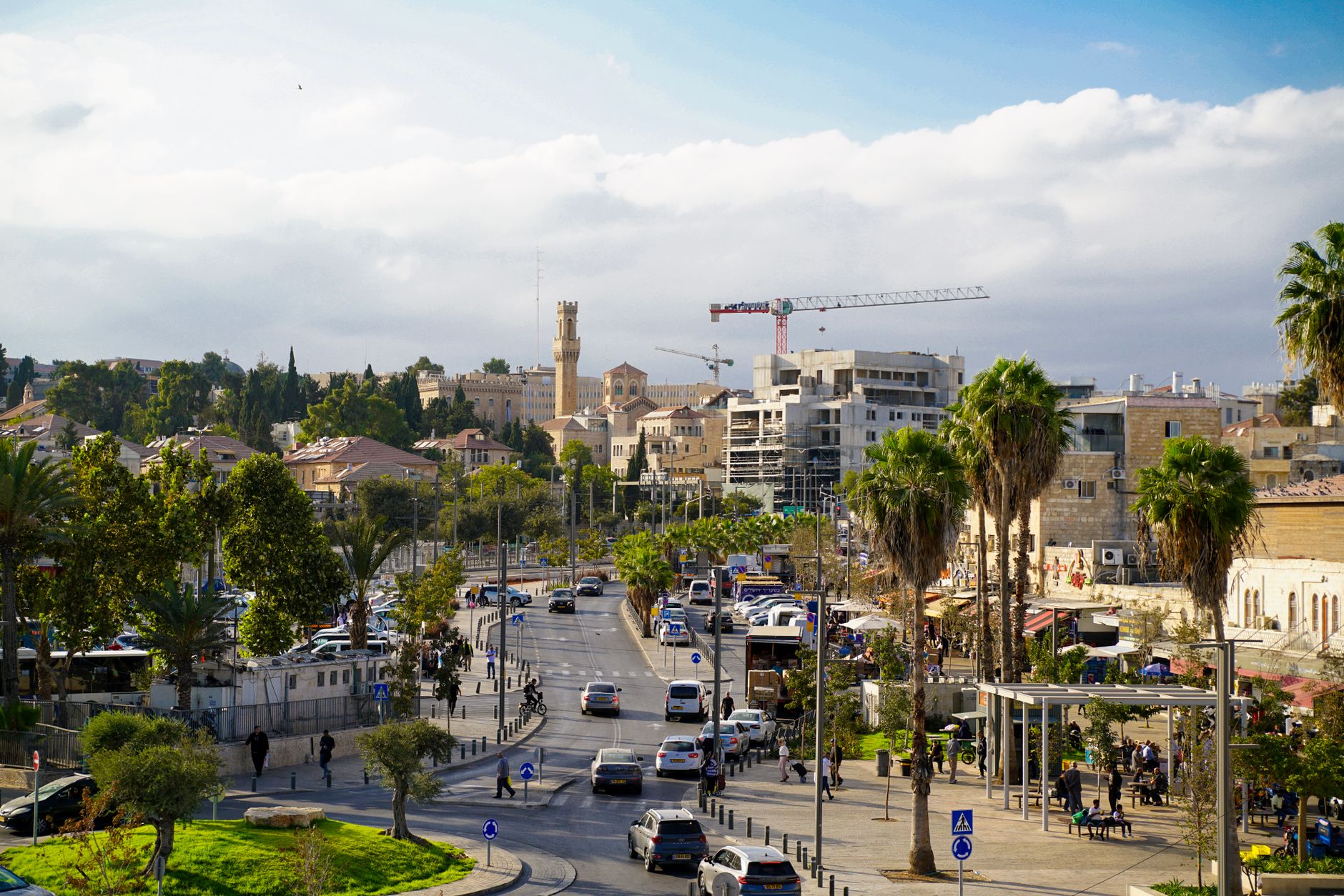
Jerusalem, Nazareth, and Tiberias are not museum pieces. They are working cities where scripture, empire, and present-day life share the same streets.
Israeli food makes sense once you taste the routes that built it: Yemenite breads, Iraqi sabich, Levantine hummus, North African shakshuka, and Arab pastry traditions that predate the state.
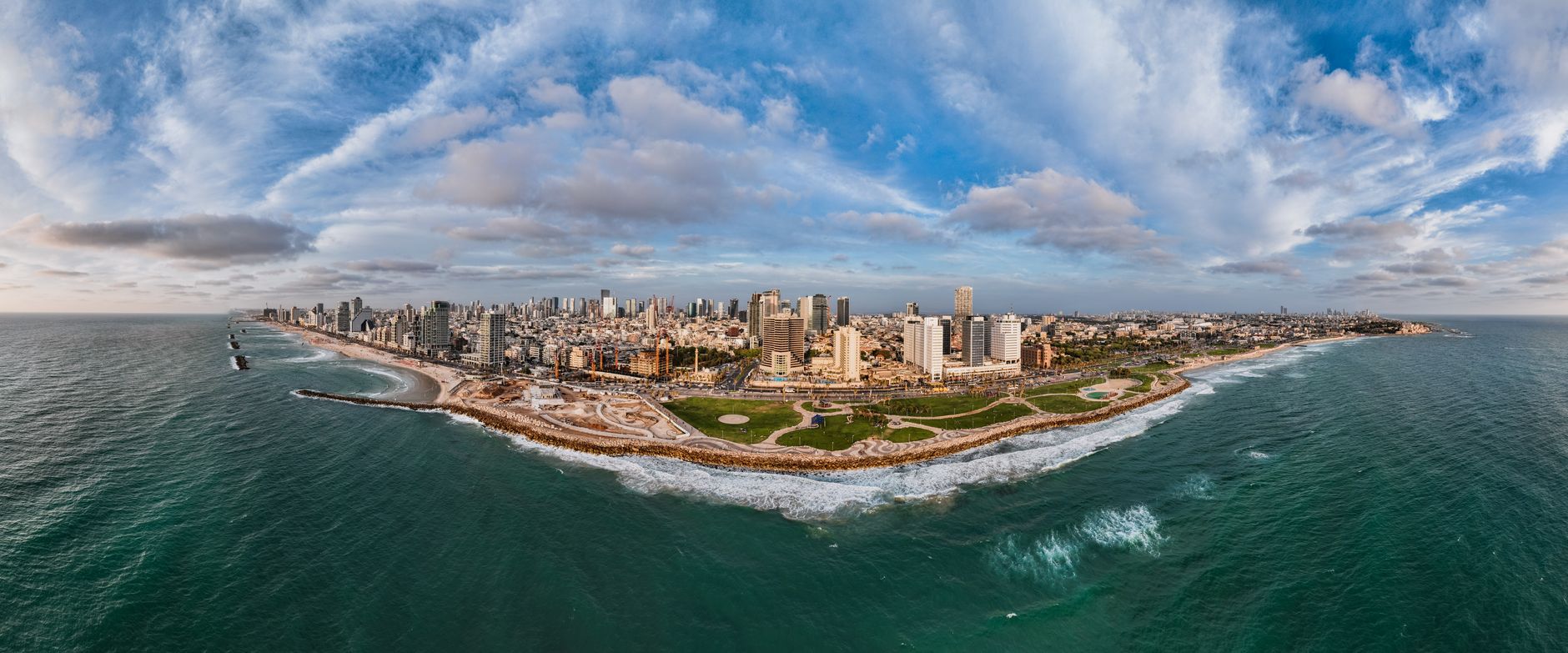
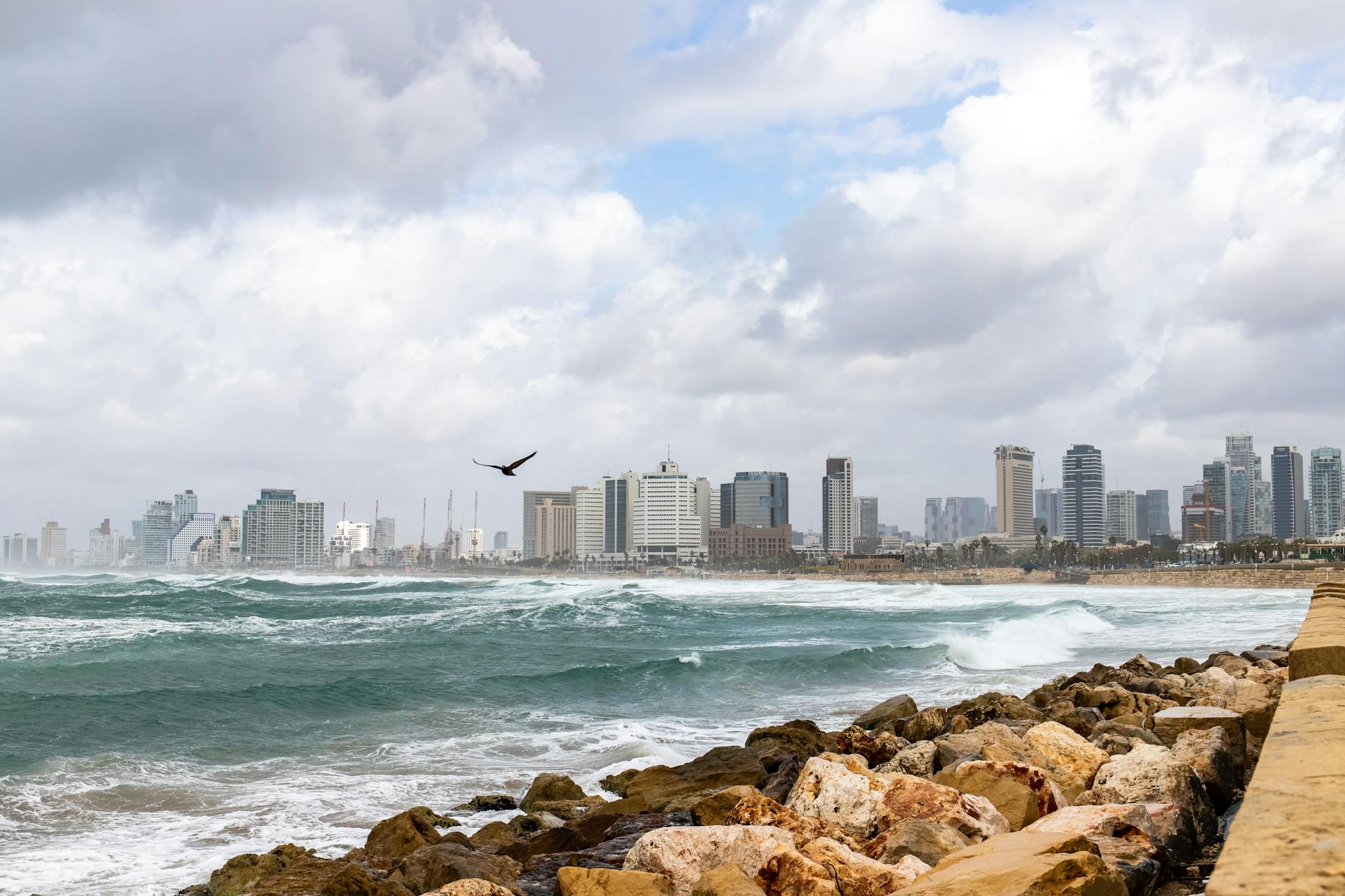
Tel Aviv and Haifa give you long Mediterranean beaches, while Eilat trades surf for coral reefs and clear water. The shift feels dramatic because the country is so compact.
The Negev covers about 60 percent of Israel, and Mitzpe Ramon opens onto the world’s largest erosion crater. This is where the country stops talking and starts echoing.
Acre, Caesarea, and Jerusalem hold Crusader halls, Roman theaters, Ottoman walls, and ancient water systems within day-trip range of each other. Few itineraries offer this much architectural argument in so little space.
Israel rewards short itineraries because travel times are modest. Base in Tel Aviv or Jerusalem, then reach Haifa, Acre, Be'er Sheva, or Caesarea without losing whole days in transit.
12 cities — start with the ones we'd send you to first.
A Bauhaus city that never sleeps before 2 a.m., where the beach ends and the startup pitch begins without a detectable seam.
Three faiths press their foreheads against the same limestone walls here, and the friction between them is the city's entire personality.
The only place in Israel where Jews, Arabs, and Bahá'í pilgrims share a hillside in something approaching habitual peace, terraced gardens cascading to the port below.
The largest Arab city in Israel smells of cardamom coffee and roasting meat, its Ottoman-era souk still conducting actual commerce rather than theater for tourists.
A Crusader city swallowed by an Ottoman city swallowed by a modern Arab city, its vaulted underground halls still damp with eight centuries of Mediterranean ambition.
Perched at 900 meters above the Galilee, this medieval hilltop town became the world capital of Jewish mysticism in the sixteenth century and still wears that obsession visibly on every painted doorframe.
The oldest continuously inhabited city on Earth sits at 258 meters below sea level, surrounded by desert, sustained by a spring that has been running since before writing existed.
The capital of the Negev is a Bedouin market town turned Soviet-immigrant chess capital, where grandmasters play in public parks and the desert begins at the last traffic light.
Israel's twelve kilometers of Red Sea coastline end here, where the coral reefs begin and the country's entire landmass is visible in a single backward glance.
This is the country's fastest-moving strip: beach mornings, startup money, Bauhaus facades, and a nightlife economy that treats sleep as a negotiable detail. Tel Aviv sets the tone, but Caesarea adds Roman theater and sea-facing ruins, while Haifa shifts the mood north with port grit and terraced gardens.
Jerusalem runs on faith, argument, and stone that seems to store heat long after sunset. The hills around it feel compact on a map and enormous in meaning, with Jericho to the east marking the sudden drop toward the Jordan Valley and one of the oldest continuously inhabited cities on earth.
The northwest mixes crusader vaults, Ottoman markets, and working port life with less ceremony than visitors expect. Acre is the anchor, Haifa gives you the bay and the mountain, and the whole region works well for short rail-based travel if you want history without the pressure-cooker intensity of Jerusalem.
Galilee is slower, greener in season, and full of places where the religious stakes are high but the landscapes do some of the talking. Nazareth brings dense urban history, Tiberias sits by the Sea of Galilee, and Safed climbs into mysticism, artists' workshops, and mountain light that changes by the hour.
The Negev is where Israel suddenly becomes about distance, silence, and geology rather than density. Be'er Sheva is the practical launch point, but Mitzpe Ramon is the emotional center, with the Ramon Crater opening under the town like a collapsed planet and roads that reward anyone willing to start early.
Eilat is the country's southern edge and feels separate from the rest of Israel in climate, rhythm, and color. People come for diving, coral, and winter sun, but the real trick is pairing the city with desert approaches so the arrival feels earned rather than flown over.
A denture millionaire built this hall for poet Bialik in 1929.
From Canaanite cities to a modern state still being written
The land is a patchwork of fortified towns tied to Egyptian power by tribute, trade, and fear. Letters from local rulers show politics at ground level: stolen villages, broken alliances, and appeals to a distant pharaoh who often has other concerns.
Tradition places Deborah beneath a palm between Ramah and Bethel, settling disputes and summoning warriors. Her victory song preserves one of the oldest Hebrew voices to survive, and it is a woman's voice, not a king's.
David captures the hill city and turns it into a royal capital, binding political ambition to sacred geography. Jerusalem's later weight in world history begins with this decision.
The Temple rises in Jerusalem with cedar from Lebanon and a bureaucracy to match the grandeur. It fixes the city as a spiritual center while exposing the fiscal and human cost of royal magnificence.
After Solomon's death, Rehoboam rejects pleas for lighter taxation and the realm splits in two. Israel forms in the north, Judah remains in the south, and a family quarrel becomes a geopolitical habit.
Nebuchadnezzar's forces raze the First Temple and deport much of Judah's elite to Babylon. Out of the loss comes a harder, more portable form of religious memory that no single building can contain.
After Cyrus allows exiles to return, Jerusalem begins to rebuild. The city is poorer than memory, but the act of return itself becomes one of the founding rhythms of the land.
Antiochus IV's religious policies trigger an uprising led by the priestly Hasmonean family. It is a revolt of worship, sovereignty, and rural fury, later remembered each year at Hanukkah.
Backed by Rome, Herod takes power and transforms the country through colossal building campaigns. His reign leaves paranoia in the chronicles and stone on the ground, especially in Jerusalem and Caesarea.
Roman forces crush the Jewish revolt and destroy the Temple in Jerusalem. Few dates have cut more deeply into the memory of the country, because the loss is political, liturgical, and intimate all at once.
A final major revolt against Rome ends in devastation. Jerusalem is reshaped as Aelia Capitolina, and the empire tries, with typical imperial confidence, to solve memory by renaming space.
Muslim armies take Jerusalem, bringing the city into the orbit of the early caliphates. A new sacred and political layer settles over the older ones without erasing them.
The First Crusade seizes the city in scenes remembered for both triumph and slaughter. Latin rule follows, but the land remains a contested meeting point of devotion, commerce, and war.
Saladin defeats the Crusader kingdom's army at Hattin and then recovers Jerusalem. His victory alters the balance of the region and reshapes the city's symbolic life for centuries.
The Ottomans absorb the land into a larger imperial system that will last four centuries. The change is quieter than conquest scenes suggest, but it proves durable.
Suleiman the Magnificent rebuilds Jerusalem's walls, giving the city the profile visitors still recognize. Few royal decisions have shaped so much later emotion with so much stone.
Jewish immigration from Eastern Europe and Yemen begins to alter the demographic and agricultural map. Colonies, orchards, and land purchases lay foundations for the harder politics to come.
General Allenby enters Jerusalem on foot, and Ottoman rule ends. The British Mandate will bring administration, promises, unrest, and a new framework for competing national claims.
David Ben-Gurion reads the declaration in Tel Aviv on 14 May 1948, and war follows at once. Statehood arrives not in calm legality but under invasion, displacement, and irreversible fracture.
In six days Israel captures East Jerusalem, the West Bank, Gaza, Sinai, and the Golan Heights. The military victory is swift; its political, moral, and territorial consequences are still unfolding.
Egypt and Syria launch a surprise attack on the holiest day of the Jewish calendar. Israel survives, but the war punctures the belief that military superiority guarantees warning and control.
Israel signs peace with Egypt, proving that even after repeated wars the regional order is not frozen. Sinai will be returned, and the map shifts through diplomacy rather than tanks.
Israeli and Palestinian leaders sign the Oslo Accords on the White House lawn after secret talks in Norway. The moment carries hope, ambiguity, and enough unfinished detail to haunt the decades that follow.
A failed peace process, accumulated anger, and a visit to a contested sacred compound ignite years of violence. Daily life in Jerusalem, Tel Aviv, and beyond changes under the pressure of bombs, checkpoints, and fear.
Hamas attacks southern Israel, killing civilians and soldiers and taking hostages, and Israel responds with a devastating war in Gaza. The shock reorders politics, grief, and security thinking across the country.
Kingdoms, Prophets, and Exile
David appears in the tradition as warrior and poet, but the man behind the bronze statue was also a ruler haunted by his own appetites and the cost of counting his people.
A woman sits beneath a palm between Ramah and Bethel, judging disputes and sending men to war. That is how one of the oldest scenes in the land begins: Deborah not on a throne, not in armor, but under a tree, with words sharp enough to move an army. Ce que l'on ignore souvent, c'est que the deep past here was never only kings and battles; it was also women, shepherds, scribes, and city rulers writing desperate letters because the harvest had failed and the neighbors were stealing villages.
Then comes David, and with him the dangerous seduction of Jerusalem. He takes a hill town and turns it into a capital, then his son Solomon crowns the gesture with a Temple whose cedar came from Tyre and whose labor came from conscription. One detail says everything: the sanctuary took seven years to build, the royal palace thirteen. Even in sacred architecture, power likes comfortable ceilings.
After Solomon's death, the family drama becomes state collapse. Rehoboam is asked for tax relief and answers, in effect, with a whip. Ten tribes walk away. The northern kingdom of Israel and the southern kingdom of Judah spend the next centuries quarreling, marrying badly, fearing Assyria, and listening only when it is too late to the prophets who warned that injustice has a political price. Jezebel, so often flattened into a villain, remains one of the great theatrical figures of the age: foreign princess, queen, patron, and finally a woman who paints her eyes before death because she will not grant her enemies the pleasure of fear.
The end, when it comes in 586 BCE, is smoke over Jerusalem. Nebuchadnezzar's armies destroy the First Temple and carry the elite to Babylon. And yet the strange miracle of this country is that catastrophe so often produces reinvention: texts are gathered, memory is organized, prayer becomes portable. The road from ruin to return begins there, with a people learning that stone can burn while a story survives.
The Siloam Tunnel inscription in Jerusalem records the exact moment two digging teams heard each other's picks through the rock and broke through from opposite ends in 701 BCE.
Empires, Revolt, and the Sacred Stage
Herod the Great built like a visionary and ruled like a man who slept badly, which is often how grand projects begin.
The return from Babylon does not bring serenity; it brings rebuilding. A modest Second Temple rises in Jerusalem, later transformed by Herod the Great into a dazzling political machine of white stone, gold, and intimidation. Herod understood spectacle better than many modern statesmen: if you cannot make people love you, overwhelm them.
He leaves his signature everywhere. In Caesarea, he builds a port where there had been none, pouring Roman concrete into the sea as if he meant to command the Mediterranean itself. In Jerusalem, he enlarges the Temple platform to a scale still felt in the body when you stand by its retaining walls. Ce que l'on ignore souvent, c'est que Herod, remembered as a tyrant, was also one of the great builders of the ancient world, a man who mistrusted nearly everyone, including members of his own family, and kept building as if masonry could cure paranoia.
Roman rule hardens the atmosphere. Priests maneuver, governors blunder, and the city grows tense enough to catch fire from a single insult. The Jewish revolt of 66 CE ends in 70 with the destruction of the Second Temple, one of the defining breaks in the history of Jerusalem and of Jewish memory. A few decades later, after the Bar Kokhba revolt, the Romans refashion the city as Aelia Capitolina. Change the name, change the gods, erase the wound. States always think that works.
But this land never keeps one script for long. Christianity takes root in places already heavy with memory: Nazareth, Jerusalem, Tiberias, the roads around the Galilee. Then Byzantines, monks, pilgrims, mosaics. Then, in the seventh century, Arab armies take Jerusalem. Another chapter opens, not by wiping away the old ones, but by laying a new text over them. That is the habit of this country: inheritance by accumulation, never by clean replacement.
At Masada, Herod's desert refuge kept storerooms so well stocked that archaeologists found food remains preserved by the dry air nearly two thousand years later.
Caliphates, Crusaders, and Ottoman Centuries
Suleiman the Magnificent never lived in Jerusalem, yet his decision to refortify it in the 1530s shaped the city's silhouette more durably than many dynasties that prayed there.
In 1099, the Crusaders enter Jerusalem in blood and incense. Chroniclers speak of victory; the stones would have had another word for it. Yet even here, where faith so often arrives with a sword, daily life resumes with unnerving speed: markets reopen, pilgrims bargain, cooks light fires, tax collectors keep their ledgers. History likes proclamations. People still need bread.
Acre becomes one of the great stages of the medieval Levant, crowded with merchants, soldiers, rival orders, and ship captains shouting in half a dozen languages. Walk its walls today and you can still feel the port city's old nerve, the sense that Europe and the Arab world once faced each other here not in abstraction but across warehouses, customs dues, and dinner tables. Ce que l'on ignore souvent, c'est que crusading piety was also a business model.
Then comes Saladin, then Mamluks, then the long Ottoman stretch beginning in 1517. If the Crusader period is theatrical, the Ottoman one is more patient and in some ways more decisive. Jerusalem remains holy, yes, but also administratively neglected, periodically repaired, and inhabited by communities that learn the exhausting art of living side by side. In the sixteenth century Suleiman the Magnificent orders the rebuilding of Jerusalem's walls, the ones visitors still photograph, admire, and wrongly imagine to be older than they are.
By the nineteenth century the old city is too tight for the number of people, ambitions, and foreign consulates pressing into it. New neighborhoods rise outside the walls. Pilgrims arrive faster. Missionaries, bankers, archaeologists, and imperial meddlers all want a piece of the sacred. The Ottoman order weakens, and the land enters the age of European schemes. The next era will not merely change rulers. It will change the question being asked.
One section of Jerusalem's present walls leaves Mount Zion outside the enclosure, according to local tradition because the sultan's planners made a costly mistake and paid dearly for it.
Mandate, Partition, and the State Under Pressure
David Ben-Gurion cultivated the look of a stern founding father, yet behind the wild white hair stood a man obsessed with archives, desert settlement, and the dangerous romance of beginnings.
On 11 December 1917, General Allenby enters Jerusalem on foot through the Jaffa Gate. He refuses to ride, partly from calculation, partly from theater; conquerors know when humility photographs well. The Ottoman centuries are over. The British Mandate begins, bringing censuses, commissions, promises made twice over, and the slow hardening of two national movements on the same strip of earth.
The decades that follow are full of papers that change lives: the Balfour Declaration, White Papers, land deeds, immigration certificates, arrest orders. Tel Aviv grows from dune-town experiment into a Hebrew city with cafes, arguments, Bauhaus lines, and sea air. Jerusalem becomes more tense, not less, because every street now carries both devotion and strategy. Ce que l'on ignore souvent, c'est que statehood here was prepared as much by clerks, teachers, and road builders as by soldiers.
In 1948 the declaration of independence is read in Tel Aviv, and within hours war begins. Families flee, armies cross borders, and the map hardens in blood. In 1967, six days redraw it again: Israel takes East Jerusalem, the West Bank, Gaza, Sinai, and the Golan Heights. For some, redemption; for others, dispossession deepened. A landing page should not flatter any regime, and this history does not permit innocence. The same victory parade can look like triumph from one balcony and catastrophe from the next street.
Modern Israel is inventive, anxious, brilliant, bruising, and rarely still. It absorbs immigrants from Morocco, Iraq, Ethiopia, the former Soviet Union, France, Yemen, Argentina, and beyond. It builds universities, start-ups, highways, fences, museums, settlements, rail lines, and a political culture of permanent argument. You can breakfast in Tel Aviv, climb toward Jerusalem by noon, and reach Be'er Sheva before dusk; the distances are tiny, the historical voltage immense. The next chapter, if one day it is written with less grief, will depend on whether this country can imagine security without forgetting the people who live under its shadow.
At the independence ceremony in Tel Aviv on 14 May 1948, the musicians had not been fully rehearsed, and the new state's first anthem was played in a rush before anyone knew exactly how long the moment would last.
Hebrew in Israel does not stroll. It arrives. On Allenby Street in Tel Aviv, in the Carmel Market, on the platform for the fast train to Jerusalem, the language lands in quick bright blows, each sentence sounding as if it has already made up its mind. Then Arabic enters the room and lengthens the air. Russian cuts through with its winter consonants. French appears in little gusts around pastry counters. A cafe table can hold four languages and one argument.
A few local words explain more than any constitution. Dugri means plain speaking, but the plainness is rarely plain: it can sound like affection disguised as impatience. Tachles means the point, the kernel, the thing itself, and one hears it in offices, kitchens, taxis, and family quarrels. Yalla, borrowed from Arabic, is an entire civic philosophy in two syllables. Move. Decide. Eat. Go.
In Jerusalem, language feels older than the stones and less obedient. Sacred Hebrew, market Arabic, American English from pilgrims, the polished French of nuns near the Christian Quarter, all of it rubbing against one another like cutlery in a drawer. In Haifa, the tones soften a little; the mountain and the port impose a certain breadth of breath. But softness is relative. Israel speaks as if silence were a luxury item.
Israeli etiquette removes the ribbons and keeps the cake. People ask direct questions with the serene boldness of customs officers and aunts: why are you alone, why are you wearing that jacket, why did you order only one coffee, where are you staying in Jerusalem, what do you mean you have not yet been to Acre. The first reaction, if you come from a country that wraps every remark in tissue paper, is surprise. The second is gratitude.
Ceremony is thin here; involvement is thick. A stranger may cut across your sentence, seize your phone, open the transit app, and show you which bus reaches Haifa before Shabbat closes the day like a theater curtain. Queue discipline exists in fragments. Advice arrives uninvited. So does help. One learns that interruption is not always hostility. Often it is participation wearing work boots.
Friday changes the choreography. In secular Tel Aviv, restaurants fill early, supermarkets become a study in accelerated desire, and taxis turn into minor diplomatic crises. In Jerusalem, the light before sunset on Friday carries actual urgency: shirts, challah, flowers, traffic, ovens, grandmothers, every domestic ritual moving toward the same invisible bell. A country is a table set for strangers.
Israeli food tastes like migration refusing to become abstract. You eat the history with your hands. Arab, Yemenite, Iraqi, Moroccan, Persian, Balkan, Russian, Polish, Tunisian, Georgian traditions meet on the same plate and continue the discussion there, with tahini acting as mediator and chili as heckler. The result is not purity. Purity would be dull.
In Tel Aviv, breakfast can arrive like a diplomatic summit: chopped cucumber and tomato, white cheese, olives, eggs, salads, bread, coffee, another salad, then perhaps a third for moral support. In Jerusalem, the market grammar is more muscular. At Mahane Yehuda the scent of grilled chicken hearts, coffee, pickles, yeast, and crushed herbs rises in layers so exact that hunger becomes a form of attention. Meorav Yerushalmi belongs here. So does bourekas with a hard-boiled egg and grated tomato, which proves that grease and tenderness are old allies.
Then come the dishes that abolish dignity in the best way. Sabich, credited to Iraqi Jewish kitchens, demands that you lean forward and accept amba on your wrist. Jachnun on Saturday morning tastes like patience rendered edible: dough baked overnight until it turns brown, sweet, and almost candied, then revived with grated tomato and zhug. In Nazareth and Acre, kanafeh arrives hot enough to scorch ambition. No one complains. Complaint would waste time better spent chewing.
Religion in Israel is not a distant inheritance stored behind glass. It dictates traffic, bakery hours, wedding calendars, radio silences, funeral routes, school schedules, and the texture of a Friday afternoon. In Jerusalem, belief is audible in shoes on stone, in bells, in the muezzin's call, in Sabbath songs slipping from apartment windows just before dark. One does not need devotion to feel the voltage. The city supplies it.
What unsettles and moves the visitor is compression. In a short walk you can pass black coats and fur hats, Armenian priests, soldiers with rifles, women carrying supermarket flowers, boys running with soccer balls, Muslim families climbing toward prayer, pilgrims searching for one more station, one more wall, one more answer. No museum labels. Only proximity.
Safed adds another register. Mysticism there is not decorative folklore but a local climate, helped by altitude and blue doors and alleys that seem designed for revelation or at least for rumor. Nazareth moves in a different cadence, more domestic and more fragrant, where church calendars and kitchen calendars overlap without fuss. And in secular corners of Tel Aviv, disbelief itself can take on ritual form: Friday beach, Saturday brunch, the faithful return of the espresso. Humans worship more things than they admit.
Israeli architecture begins with the argument between sunlight and survival. In Jerusalem, the famous local stone makes whole neighborhoods look carved rather than built, as if walls had merely agreed to stand. By late afternoon the facades turn honey, then bone, then ash. This is not sentiment. It is geology performing theater.
Tel Aviv answers with a different religion: Bauhaus discipline, shaded balconies, pilotis, white facades made to catch breeze rather than admiration. The White City can look severe at noon and unexpectedly tender at six in the evening, when the sea air softens edges and laundry returns the buildings to civilian life. Good modernism always needed laundry. Otherwise it risked becoming doctrine.
Haifa stacks itself on a mountain and therefore forces architecture into vertical negotiation. Staircases, terraces, retaining walls, views that arrive in installments. Acre compresses centuries into stone vaults and Ottoman proportions, the sea forever nearby like a witness who refuses to leave. Caesarea stages Roman appetite with theatrical calm: columns, hippodrome, harbor remnants, empire translated into salt and weather. Then Mitzpe Ramon strips architecture back to the oldest lesson of all. In the desert, every wall is a question about shade.
Israel reads with appetite. Bookstores stay busy because argument needs fuel, and books are one of the few socially approved ways to continue an argument in someone's absence. Hebrew literature performs the national habit of compression: irony beside grief, domestic detail beside theology, kitchen table beside apocalypse. Amos Oz understood this. So did A. B. Yehoshua, David Grossman, Yehuda Amichai in poetry, and before them S. Y. Agnon, who wrote as if piety and mischief had signed a secret pact.
The pleasure for a traveler lies in noticing how literary the ordinary already is. Train stations announce names with biblical weight. Street signs carry poets, generals, rabbis, and labor leaders in a single glance. In Jerusalem, language itself seems to walk with footnotes. In Tel Aviv, by contrast, literature has the insolence of a city that prefers cafes to monuments and still produces both.
Arabic literature belongs just as fully to the country's cultural truth, and any honest traveler should hear that register too. In Haifa and Nazareth, books and speech remember families, villages, losses, recipes, schoolrooms, and jokes that refuse official borders. This is what literature does when history becomes too loud: it lowers the voice and becomes impossible to ignore.
Israeli music seldom accepts one ancestry when five are available. The ear catches liturgical modes, Arab maqam, Eastern European melancholy, Yemenite ornament, North African percussion, Russian nostalgia, American pop ambition, nightclub bass from Tel Aviv, and old army songs that entire tables still know by heart. A wedding can move from prayer to techno without needing an explanation. The explanation is the country.
In Jerusalem, sacred music changes the density of the evening. A chant from a synagogue, church bells, the call to prayer, all of them rising from different elevations, each convinced and each vulnerable to the same wind. The soundscape refuses tidy curation. Good. Tidy curation would betray the material.
Tel Aviv after dark prefers beat, volume, sweat, irony, and release. But even there, older forms sneak in. A Yemenite vocal line, a violin phrase with Eastern Europe still inside it, a drum pattern that remembers the Maghreb. In Acre and Nazareth, the musical line often bends elsewhere, toward Arabic traditions with their own patience and splendor. Music here does not blend so much as coexist intensely, which is more interesting and far more honest.
David's bond with the country is not abstract; it is topographical. He seized Jerusalem, brought the Ark there, and turned a hill fortress into the emotional center of a people, all while leaving behind the uneasy portrait of a ruler capable of lyric tenderness and brutal calculation in the same life.
Solomon fixed Jerusalem in the imagination of the world by giving it a Temple and a court glittering with imported cedar, gold, and diplomacy. Yet the detail that matters is almost domestic in its pettiness: he built the sanctuary in seven years and his own palace in thirteen, which tells you exactly how royal priorities work.
Jezebel belongs to this land because she changed its politics, religion, and tone. Married into the house of Ahab, she brought Phoenician influence to Israel and met death with terrifying composure, painting her eyes before the coup reached her window.
Herod stamped the country with stone. Caesarea, Masada, the expanded Temple Mount in Jerusalem: each project says the same thing about the man who commissioned it, that he trusted architecture more than loyalty and left behind monuments grand enough to outlive his reputation.
Saladin's place in the history of Israel lies in the way he changed the moral weather of the region. When he retook Jerusalem from the Crusaders, he restored Muslim rule to the city and became, in memory at least, the figure who replaced massacre with disciplined power.
Suleiman never needed to reside in Jerusalem to shape it permanently. The walls he ordered in the 1530s still choreograph how the city is seen, entered, and imagined, which is not a bad legacy for a sovereign ruling from far away.
Herzl did not build Tel Aviv or plant an orchard, but he gave political form to longing that had long been religious, cultural, and scattered. His connection to the country is the strange power of an idea written in Europe and pursued, with consequences he never lived to see, on Levantine soil.
Golda Meir carried the air of a severe grandmother who had no time for nonsense, which was only partly a pose. Her link to the country is bound to one of its rawest modern shocks, the 1973 war that shattered assumptions of invulnerability and marked her legacy with grit rather than glamour.
Ben-Gurion made statehood sound like an administrative decision and a biblical gamble at once. He read the declaration in Tel Aviv on 14 May 1948, then spent the rest of his life insisting that the future of the country would be tested not only in Jerusalem but in the Negev, near Be'er Sheva and beyond.
This is the fastest route if you want urban energy, Roman ruins, and a serious dose of sea air without wasting time on long transfers. Start in Tel Aviv, move north through Caesarea, then finish with the port cities of Haifa and Acre, where the architecture turns older, heavier, and more layered by the hour.
This route trades beaches for religion, archaeology, and hill country light. Begin in Jerusalem, dip east to Jericho, then arc north through Tiberias, Nazareth, and Safed for a week that moves from sacred geography to Ottoman lanes and lake-edge landscapes.
If you want space, sky, and fewer urban compromises, head south. Be'er Sheva gives you the practical gateway, Mitzpe Ramon opens the Negev in full scale, and Eilat ends the trip with reef water, desert mountains, and the odd sensation of finishing Israel where it narrows to a point.
Warm bowl, torn pita, noon. Friends, workers, grandparents. Wipe, scoop, argue, repeat.
Pita, fried eggplant, hard-boiled egg, tahini, amba, chopped salad. Morning or lunch. Lean forward, eat alone or with one impatient companion.
Overnight dough, grated tomato, hard-boiled egg, zhug. Family table after synagogue or after sleep. Hands, not ceremony.
Chicken hearts, liver, onions, spices, pita. Night, market, standing counter in Jerusalem. Pickles, tahini, quick hunger.
Cheese pastry, syrup, hot tray. Late afternoon or after dinner in Nazareth or Acre. Fork optional, silence likely.
Skillet, eggs, tomato, bread. Breakfast, hangover, slow lunch. Share the pan, tear the bread, chase the red oil.
Flaky pastry, hard-boiled egg, grated tomato, paper napkins. Bus station, bakery, roadside stop. Coffee nearby, always.




Visa-exempt visitors, including travelers from the US, UK, EU, Canada, and Australia, currently need ETA-IL before arrival. The official fee is 25 ILS, approval is usually issued within 72 hours, and a tourist stay is normally capped at 90 days per visit.
Israel uses the Israeli new shekel, written ILS or ₪, and daily life is highly cashless in Tel Aviv, Jerusalem, and Haifa. Budget around ₪250-450 a day for simple travel, ₪550-900 for a comfortable mid-range trip, and tip 10-15% in sit-down restaurants if service is not already included.
Most visitors arrive through Ben Gurion Airport near Tel Aviv, about 15 km from central Tel Aviv and 40 km from Jerusalem. The airport rail station sits under Terminal 3, so you can reach Tel Aviv or Jerusalem without bargaining with a taxi after a long flight.
Trains work best on the main spine: Tel Aviv, Ben Gurion Airport, Jerusalem, Haifa, Acre, and Be'er Sheva. Buses cover the gaps, but Shabbat changes everything: from Friday sunset to Saturday night, much public transport stops or runs on a sharply reduced schedule, and many buses do not take cash onboard.
Spring and autumn are the easiest seasons for most routes, with milder temperatures from the coast to the Negev. July and August can hit 35-42C in many regions, while winter is often the sweet spot for Eilat, the Dead Sea area, and desert drives around Mitzpe Ramon.
Mobile coverage is strong in cities and along the main intercity roads, and local SIMs or eSIMs are easy to buy for a week of data. Card payments are standard, Apple Pay and contactless are common, and free Wi-Fi is routine in cafes, hotels, and many stations.
Israel is a high-risk destination as of April 20, 2026, and official advisories can tighten with little warning. Check your own government's travel advice, watch the Home Front guidance while you are on the ground, and build every rail, road, or flight day around the possibility of same-day disruption.
Use a card for almost everything in Tel Aviv, Jerusalem, and Haifa, but keep a little cash for markets, small guesthouses, and the occasional taxi. Shekels matter more than dollars or euros once you leave airport and hotel counters.
Put your expensive or time-sensitive moves on weekdays, not between Friday sunset and Saturday night. That single calendar choice saves more stress than any discount fare.
Buy or load a Rav-Kav card early if you plan to use buses or trains more than once. It is the simplest way to avoid ticket friction, and many buses do not accept cash onboard.
Ben Gurion security is thorough even on an ordinary day, and current conditions add another layer of unpredictability. For international departures, three hours is the sensible minimum.
In sit-down restaurants, 10-15% is the normal range, and cash is still the cleanest way to leave it even in a card-heavy economy. Check the bill first in case service is already included.
Book rooms well ahead for Passover, Easter, Christmas in Jerusalem, and the Jewish High Holidays. Prices jump fast, and the most useful places sell out before the glamorous ones do.
Israeli conversation is often blunt, fast, and less padded than in North America or northern Europe. It usually reads harsher than it means, so judge intent by helpfulness, not by softness.
Explore Israel with a personal guide in your pocket
Audio guides for 1,100+ cities across 96 countries. History, stories, and local insight — offline ready.

Only if you are prepared for a high-risk trip with same-day changes. As of April 20, 2026, major official advisories remain severe, so you should check your own government's latest notice, confirm that your insurer will still cover the trip, and keep room in the plan for shelter alerts or transport disruption.
Usually no visa, but yes, an ETA-IL is required before travel for visa-exempt short stays. The current official baseline is 25 ILS, validity for up to two years or until passport expiry, and a normal tourist stay of up to 90 days per visit.
Seven to ten days is the useful range for a first trip. That gives you enough time to pair Tel Aviv with Jerusalem and still add either the Galilee through Nazareth and Tiberias or the south through Be'er Sheva and Mitzpe Ramon without turning the week into a luggage drill.
Yes on weekdays, especially on the rail spine linking Ben Gurion Airport, Tel Aviv, Jerusalem, Haifa, Acre, and Be'er Sheva. It becomes much less reliable for trip planning on Shabbat, when many services stop or thin out sharply.
Yes, if your route stays on the main city corridor and you are happy to use trains and buses. Rent a car only when you want the Negev, remote Dead Sea access, Upper Galilee detours, or early starts that public transport handles badly.
Yes, especially once you add hotels, taxis, and restaurant dinners in Tel Aviv or Jerusalem. A careful traveler can stay around ₪250-450 a day, but a comfortable mid-range trip often lands closer to ₪550-900 per person.
April, May, October, and November usually give the best balance of temperature, daylight, and transport ease. July and August are punishingly hot in much of the country, while winter works best if your priorities are Eilat, the Negev, or lower prices outside holiday peaks.
You can use cards for most daily spending, and contactless payment is common. Carry some cash anyway for market stalls, tips, small shops, and moments when a machine or a bus ticket setup decides not to cooperate.
Last reviewed