Limerick
Ireland Updated Apr 2026
Gulls wheel over the Shannon, the castle walls catch a wet silver light, and somewhere near the Milk Market you can smell coffee, frying sausages, and the river in the same breath. Limerick, Ireland, is less polished than Galway and less theatrical than Dublin, which is exactly why it stays with people. The city wears its layers in public: Norman stone on King’s Island, Georgian brick around Pery Square, rugby noise out by Thomond Park, and old industrial muscle still standing by the water.
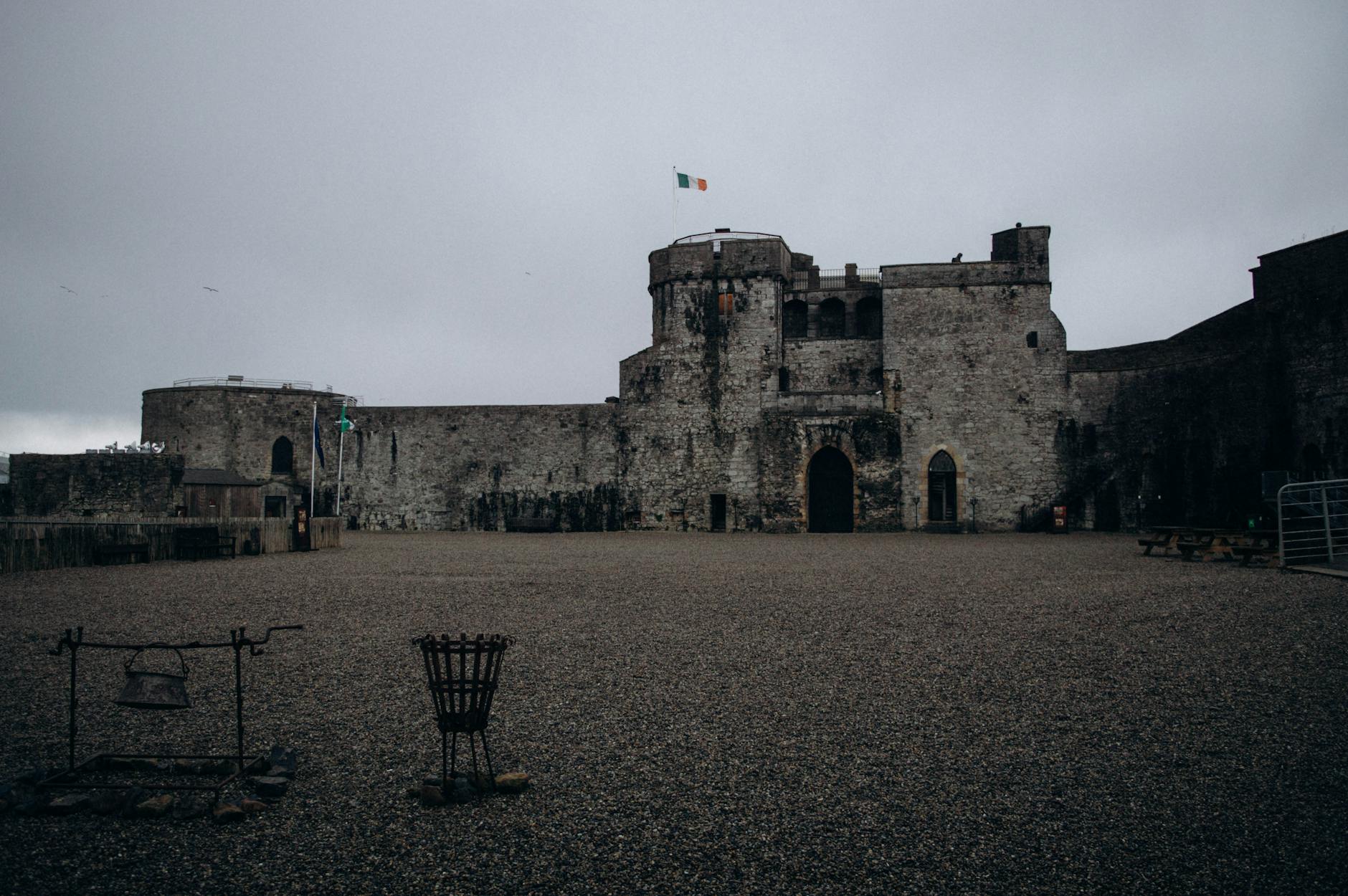 Photo: Liudmyla Shalimova / Pexels
- Attractions
- 12
- Trip length
- 2-3 days
- Best season
- Late spring to early autumn (May-September)
Why Limerick
Built from cited sources · see the method · How we make our guides →
Limerick works best when you stop treating it as a checklist and start reading it as three overlapping cities. The medieval core gathers around King John’s Castle and St Mary’s Cathedral, where a cathedral founded in 1168 still carries cannonball scars and a leper’s squint, while the Shannon slides past just beyond the walls. Ten minutes away, the old Custom House holds the Hunt Museum, and the whole place suddenly shifts from siege history to silver, paintings, and quiet rooms facing the river.
Then Newtown Pery changes the mood completely. Pery Square, the Carnegie building of the Limerick City Gallery of Art, and the terraces around People’s Park give you the 18th- and 19th-century city in brick and proportion, the sort of streetscape that makes you slow down without quite knowing why. Saturday morning at the Milk Market does the opposite: traders calling out prices, paper cups of coffee, butter-heavy pastries, cheese, fish, and the kind of local traffic no museum can fake.
What makes Limerick worth your time is its refusal to be one thing. This is a city of treaty myths and rugby certainties, of trad sessions at the Locke or Dolan’s, of river walks that take you from medieval lanes to the 350-meter Living Bridge without much warning. By the time you leave, the point is no longer the castle alone or the market alone, but the way the Shannon keeps stitching all of it together.
Medieval Core
King John's Castle and St Mary's Cathedral sit a few minutes apart on King's Island, which tells you exactly how Limerick grew: Norman muscle beside ecclesiastical power. The castle's river walls and the cathedral's Romanesque doorway give the old city a hard, weathered edge that feels earned.Georgian Limerick
Newtown Pery changes the city's tempo. Pery Square, the Carnegie Building of Limerick City Gallery of Art, and the terraces around People's Park bring late-Georgian order after the medieval tangle by the Shannon.River City
Limerick makes the most sense on foot along the water. The 3.6 km Three Bridges Walk loops past Arthur's Quay, the Hunt Museum, street art, and broad Shannon views, while the 350 m Living Bridge adds a clean modern line upriver at the University of Limerick.After-Dark Culture
Evenings here lean local rather than polished. Dolan's, Belltable, Lime Tree Theatre, and Thomond Park on match days give Limerick its real pulse: trad sessions, touring acts, theater, and rugby noise rolling into the night.
Neighborhoods
Where to wander, by quarter — each with its own rhythm.
King’s Island
King’s Island is the old stone heart of Limerick, where King John’s Castle, St Mary’s Cathedral, and scraps of earlier settlement crowd close to the Shannon. Come here for the city’s deepest history, then stay long enough to notice the texture: narrow streets, river wind, and views that make the Treaty City name feel earned rather than branded.Medieval Quarter
Around Nicholas Street, Bridge Street, and the castle approaches, the Medieval Quarter feels lived-in rather than preserved under glass. You’ll find heritage sites, the Locke Bar for music and seafood, Treaty City Brewery for a modern counterpoint, and enough rough edges to keep the quarter from turning into a stage set.Newtown Pery
Newtown Pery is Limerick’s Georgian answer to the medieval city, laid out in the late 18th century with long terraces and clean proportions. Pery Square, the People’s Museum, and People’s Park give this district its shape, while the streets around it hold cafés, hotels, and the kind of urban calm that makes a good afternoon feel longer.Market Quarter
The Market Quarter is where Limerick sounds most like itself. The Milk Market anchors the area, especially from Friday to Sunday, and the nearby lanes fill out the picture with coffee bars, casual food, and nightlife that starts with dinner and often ends with music rather than ceremony.Catherine Street
Catherine Street is the daytime version of the city at its sharpest: espresso machines hissing, bakery counters filling early, and locals treating brunch as a serious civic duty. Canteen, Fika, Wildberry, and the nearby Little Catherine Street spots make this the place to come when you want Limerick in a cup and on a plate, not behind museum glass.Thomas Street and Wickham Street
Thomas Street and Wickham Street carry much of the city’s newer food-and-drink energy. Cornstore and Crew Brewing Co sit in this orbit, and Wickham Way adds a more current, pop-up, market-hall mood that feels younger and less ceremonial than the grander Georgian blocks nearby.Clancy’s Strand and George’s Quay
Clancy’s Strand and George’s Quay are for river views, long pub lunches, and the kind of evening light that makes even industrial edges look tender. The Curragower has one of the better castle-facing positions in town, and the whole stretch gives you Limerick as a river city first, not a monument city.Dock Road
Dock Road is not pretty, and that is beside the point. This is Dolan’s territory, where people come for live music, pints, and late conversations, and where Limerick’s cultural confidence shows up without asking for approval. If the night matters more than the façade, go here.
Plan your trip
Before you go
- Getting There
- In 2026, Shannon Airport (SNN) is the obvious arrival point, about 24-25 km from the city, with direct bus links including Bus Eireann route 343. Dublin Airport (DUB) is about 200 km away but has more flight choice, with direct coaches such as JJ Kavanagh 735 and Dublin Coach 300 M7 Express; rail arrivals use Limerick Colbert Station, and the main road approach is the M7 from Dublin, with links onward via the N18 toward Shannon and Galway.
- Getting Around
- Limerick has no metro, subway, or tram in 2026; local transport is bus-led, with TFI and Bus Eireann routes including 301, 302, 303, 304, 304A, 305, 306, 310, 313, and 323. The center is compact enough to walk, the city has more than 100 km of dedicated cycle lanes, and TFI Bikes costs EUR 3 for 3 days or EUR 10 annually, with the first 30 minutes free; for buses, a TFI Leap Card adult fare starts at EUR 1.35, with a 24-hour red zone ticket at EUR 3.80.
- Climate & Best Time
- Shannon Airport's 1991-2020 climate normals are the best guide for Limerick: spring runs roughly 11-16 C by day, summer 18-20 C, autumn 11-18 C, and winter 9-10 C, with nights often falling to 3-6 C outside summer. April and May are the driest months, November and December the wettest, so the smartest 2026 visit window is April to June for lighter rain and long daylight, while July and August bring the warmest weather and the busiest visitor months.
- Language & Currency
- English is the working language you'll use everywhere, though Irish appears on signage, transport information, and official buildings, so bilingual place names are normal rather than decorative. Ireland uses the euro in 2026, cards are routine, but carrying a little cash still helps for market stalls, smaller independents, and the odd backup moment.
- Safety
- Limerick doesn't need melodrama, just city sense: stick to well-lit central streets after midnight, watch phones and wallets around Colbert Station, bus stops, and late-night venues, and take a licensed taxi if you're heading back late. Emergency numbers are 112 or 999, and the city center has Community Safety Wardens in busy pedestrian areas as of 2026.
A River Port Forged by Siege, Trade, and Stubborn Reinvention
From a Shannon island settlement to the Treaty City of memory and argument
- 150
Ptolemy Marks Regia
A Greco-Roman mapmaker placed a settlement called Regia on Ireland's west coast, and many scholars connect it to the ground now known as King's Island. The detail is small, almost offhand, yet it matters: Limerick enters recorded geography as a place worth naming. Long before stone walls and treaty tables, the Shannon crossing was already pulling people in.
- 561
Luimneach Enters the Record
The name Luimneach appears in the written record, usually linked to a bare or muddy marsh by the Shannon. That fits the place. Water, reeds, shifting banks, and an island that could be defended if trouble came downstream.
- 922
Vikings Fortify King's Island
A permanent Viking base took shape on King's Island, turning the Shannon into a highway for trade and raiding. Boats would have crowded the quays with tar, wool, slaves, iron, and bad intentions. Limerick stops being just a crossing here and becomes a walled port with teeth.
- 937
Norse Power Breaks
Defeats in the 10th century cut Limerick's Viking rulers down from regional predators to something smaller and more exposed. Battles with Dublin Norse and rising Irish powers left the settlement weakened. The city survived, but swagger gave way to bargaining.
- 1106
Gilbert Orders a Diocese
Gilbert of Limerick, the city's first bishop, tied local church life to wider European reform and gave Limerick ecclesiastical weight. His work was administrative, theological, and intensely practical. He helped turn a river settlement into a city that could speak in the language of bishops as well as merchants.
- 1168
St Mary's Cathedral Rises
St Mary's Cathedral was founded on King's Island, and its stones still hold the cold breath of the medieval city. The building grew out of a Norse-turned-Irish town that wanted permanence in cut limestone. You can still read damage from later wars in its walls, which is a very Limerick detail.
Show the full timeline (28 moments)
- 1174
O'Brien Burns the City
Domhnall Mór Ó Briain burned Limerick rather than let it fall intact to the Normans. Brutal choice. Smoke over the Shannon bought time, but it also announced that the city's future would be written by people willing to destroy it to keep it.
- 1195
Normans Seize Limerick
Norman forces captured Limerick under King John, pulling the city into the Anglo-Norman world of charters, castles, and tax records. Rule changed fast; street life would have changed more slowly. That tension between imposed order and local habit runs through the city's history.
- 1197
A Chartered City Emerges
Limerick received its first city charter and began to act like a formal urban corporation instead of a contested river stronghold. Offices, dues, privileges, arguments over who counted as a citizen: all the machinery of medieval city life arrived. Paper can be as transformative as stone.
- c. 1200
King John's Castle Completed
King John's Castle rose over the Shannon with thick curtain walls and squat towers built to dominate the crossing. It was less a residence than a statement in limestone: we are here, and we expect obedience. The castle still explains the city better than any slogan ever could.
- 1574
A Visitor Sees a Rich Port
A Spanish ambassador described Limerick as stronger and more beautiful than any other city in Ireland, praising its worked-stone walls and bridges. Foreign eyes noticed what locals already knew: this was a serious port, not a provincial afterthought. Trade gave the city polish, and fortification gave it nerve.
- 1651
Siege, Plague, and Surrender
Cromwellian forces battered Limerick through 1651 until bombardment, hunger, and disease did what cannon alone could not. Around 5,000 civilians are said to have died from famine and plague, while Henry Ireton himself died during the campaign. The city that emerged was emptied, exhausted, and under harsher power.
- 1690
Sarsfield Saves the Walls
During the first Williamite siege, Patrick Sarsfield's raid destroyed heavy siege guns bound for the city and helped keep Limerick standing. The defense had grit, mud, smoke, and panic behind every gate. William's army withdrew, and Limerick earned a reputation for refusing to fold on command.
- 1691
The Treaty Ends a War
The Treaty of Limerick was signed in October 1691 after a second siege and the slaughter of Jacobite defenders at Thomond Bridge. Its terms allowed thousands of Irish soldiers to leave for France in the Flight of the Wild Geese. The treaty made Limerick famous, and the later breaking of its promises made it bitterly memorable.
- 1774
House of Industry Opens
The House of Industry rose on the north bank as poorhouse, infirmary, and instrument of social control. Georgian Limerick liked elegant facades, but it also built institutions for poverty, illness, and discipline. Cities show their conscience in stone. They show their fear there too.
- c. 1780
Newtown Pery Expands Southward
Georgian Limerick pushed into Newtown Pery with long terraces, measured streets, and the self-confidence of a trading city making money from the Atlantic world. The air would have smelled of coal smoke, river damp, and commerce. This is the Limerick of squares, sash windows, and ambition.
- 1800
Union Drains the Boom
The Act of Union pulled political gravity toward London and punctured the commercial momentum that had fed Georgian Limerick. Prosperity did not vanish in a day, but the city's edge dulled. A long habit of economic disappointment begins here.
- 1818
Catherine Hayes Is Born
Catherine Hayes was born in Limerick and went on to become one of the 19th century's celebrated opera voices. Her rise from a provincial Irish city to European stages says something flattering about local talent and less flattering things about how often talent had to leave. Limerick keeps producing people like that.
- 1847
Famine Remakes the City
During the Great Famine, County Limerick lost around a fifth of its population while the city filled with people driven in from the countryside. Workhouses and relief became part of the urban rhythm, and food still left the port under guard. Few facts capture 19th-century Ireland more coldly than that one.
- 1866
Annie Sullivan Begins Here
Annie Sullivan, later the teacher who transformed Helen Keller's life, was born in Limerick before emigrating as a child. Her story starts in hardship rather than sentiment. That matters, because Limerick in the 19th century exported people as often as goods.
- 1884
Anti-Jewish Violence Erupts
Violence and intimidation against Limerick's small Jewish community began on Easter Sunday 1884, exposing a mean streak beneath the city's pieties. Shops were targeted, livelihoods threatened, and belonging made conditional. A city's history is not honest if it only remembers its courage.
- 1897
Kate O'Brien Is Born
Kate O'Brien was born in Limerick and later turned the city into literature full of restraint, class tension, religion, and suppressed heat. She understood that provincial streets can hold operatic emotions. Read her, then walk O'Connell Street, and the facades start talking back.
- 1916
Limerick Men Die for the Rising
Edward Daly and Con Colbert, both tied to Limerick, were executed after the Easter Rising in Dublin. Their deaths pushed the city's republican memory out of abstraction and into grief with names attached. Politics became personal, which is when it usually becomes irreversible.
- 1971
Dolores O'Riordan Is Born
Dolores O'Riordan was born into the Limerick world that would shape her voice: tough, wounded, unsentimental, and capable of sudden beauty. With the Cranberries she carried that sound far beyond the Shannon. Few artists made the city's mix of ache and defiance so audible.
- 1972
A New Institute Bets on Industry
The National Institute for Higher Education opened with a sharper, more practical brief than old Irish universities usually had. Limerick was trying to invent a new future rather than decorate an old one. Classrooms, labs, and employer links became part of the city's recovery plan.
- 1989
University Status Changes the City
The institute became the University of Limerick, the state's first new university since independence. That was more than an administrative upgrade. It shifted the city's center of gravity toward students, research, and the idea that Limerick could be a place people arrived for, not just left from.
- 1990s
The Long Slump Finally Lifts
The economic boom of the 1990s began to loosen two centuries of underinvestment and frustration. New jobs, new building, and new confidence changed the feel of the city, though never evenly and never without scars. Limerick improved by arguing with itself, which is its usual method.
- 2025
Culture Fills the Streets
More than 70 free events for Culture Night spread across the city, from galleries and studios to improvised public spaces. That scale says something real about present-day Limerick: culture here is not garnish. It has become one of the ways the city explains itself after all the sieges, losses, and exits.
Who lived here
-
Priest and missionary · 1870–1947
John Creagh
Born in Thomondgate, Limerick
John Creagh was born in Thomondgate, on the north side of the Shannon, and his name still carries a difficult charge in Limerick because of his part in the 1904 boycott against the small Jewish community. He later left for missionary work in Western Australia. Today's city, more open and self-questioning, would probably force him into a hard conversation.
-
Novelist and short-story writer · born 1969
Kevin Barry
Born in Limerick
Kevin Barry was born in Limerick, and you can hear the city's sly timing in the way his sentences turn from comedy to ache in a heartbeat. He writes as if he knows every side street has overheard something. Modern Limerick, with its mix of cracked grandeur and sharp reinvention, feels made for that voice.
-
Bishop · died 1145
Gilbert of Limerick
First Bishop of Limerick
Gilbert of Limerick helped give the city a formal church shape in the early 12th century, when the place was still negotiating between Norse, Irish, and reforming European worlds. He belonged to a Limerick of river trade, raw power, and ambitious clerics. Stand by St Mary's and that older city doesn't feel far away.
Where to Eat
Where locals actually book dinner — not the tourist menus.
-
Limerick Milk Market
Friday to Sunday, this is where the city stops performing and starts eating. You'll find traders selling bread, cheese, pastries, coffee, and ready-to-eat lunches under one roof, with the smell of baking and roast coffee doing half the persuasion for you.
-
Treaty City Brewery
For something current rather than nostalgic, head to Treaty City Brewery in the medieval quarter. The beer gives you a clean read on Limerick's newer food-and-drink confidence, and it works well as a late-afternoon stop after the castle.
-
Dolan's Pub and Restaurant
Dolan's is one of the better ways to combine dinner with a proper Limerick night out. Eat here if you want solid pub cooking, then stay put for the music instead of shuffling between separate venues.
-
The Hunt Museum Cafe
This one earns its place with the setting as much as the menu. A light lunch or coffee beside the Shannon, with views toward Curragower Falls, works especially well when you need a quiet hour between museums and river walks.
Insider tips
Small things that change how the city treats you.
Saturday Market First
Head to the Milk Market on Saturday between 8am and 3pm, when the trader lineup is fullest and breakfast stalls are in full swing. Friday and Sunday run later and thinner, so Saturday gives you the clearest read on how Limerick eats.Book Music Nights
If you want the classic Limerick evening, reserve ahead for the Locke or Dolan's, especially on weekends. The Locke runs trad sessions nightly, and Dolan's has trad in the bar from Wednesday to Sunday at 9pm.Coffee Before Five
Treat Catherine Street as a morning and lunch strip, not an evening one. Many of the stronger independent cafes close around 4pm to 6pm, so leave coffee too late and you'll be down to slimmer options.Tip Lightly
About 10% for good sit-down service is normal in Ireland. You don't need to tip for every pint at the bar unless you're getting table service or staying for a meal.Use the River
Limerick makes sense on foot once you've done the Three Bridges Walk. It links the Shannon, King John's Castle, and the city center in one loop, which is a better orientation tool than staring at a map.Pick Busy Streets
For late food and drinks, stick to the active strips around George's Quay, Thomas Street, Bedford Row, and Denmark Street. That's where the city puts its social energy after dark, and it's easier to keep the night simple.
Frequently asked
Is Limerick worth visiting?
Yes, especially if you like cities with rough edges, strong music culture, and real historical weight. Limerick gives you a Norman castle, a cathedral founded in 1168, Georgian terraces, and pubs where dinner turns into a session without much ceremony. It works best for travelers who prefer character over polish.
How many days in Limerick?
Two to three days is the sweet spot. That gives you time for King John's Castle, St Mary's Cathedral, the Hunt Museum, a river walk, and one proper food-and-music night. Add a fourth day if you want day trips to places like Lough Gur or Curraghchase.
Can you get around Limerick without a car?
Yes. The city center is compact, and the core visitor areas, including King John's Castle, the Hunt Museum, the Georgian quarter, and the riverfront, are easy to cover on foot. A car only starts to matter once you want county day trips.
Where should I go for live music in Limerick?
Start with Dolan's or the Locke Bar. Dolan's is the city's live-music institution, while the Locke gives you trad sessions in a riverside pub that still feels like a local night out rather than a staged performance. Nancy Blakes is another good call if you're around Denmark Street.
Is Limerick expensive to visit?
No, not by Irish city standards. You can fill a day with low-cost or free staples like the Three Bridges Walk, People's Park, the Milk Market atmosphere, and time along the Shannon, then spend your money where it counts on a castle ticket or a good dinner. It rewards selective spending.
What should I eat in Limerick?
Order seafood chowder, fish, or a pub plate by the river, then save room for brunch the next morning. The city doesn't hinge on one signature dish; its food identity comes through in places like the Milk Market, the Locke, the Curragower, Story Cafe, and Catherine Street coffee spots. Seafood and breakfast are the safest bets.
Pick up where you left off
Saved and recently read places — kept on this device only.
Photo credits (1)
- Liudmyla Shalimova — Pexels License (https://www.pexels.com/license/) — Source: https://www.pexels.com/photo/15153790/
Photos may have been resized or cropped.