Menlo Castle and Blake’s Castle, Galway
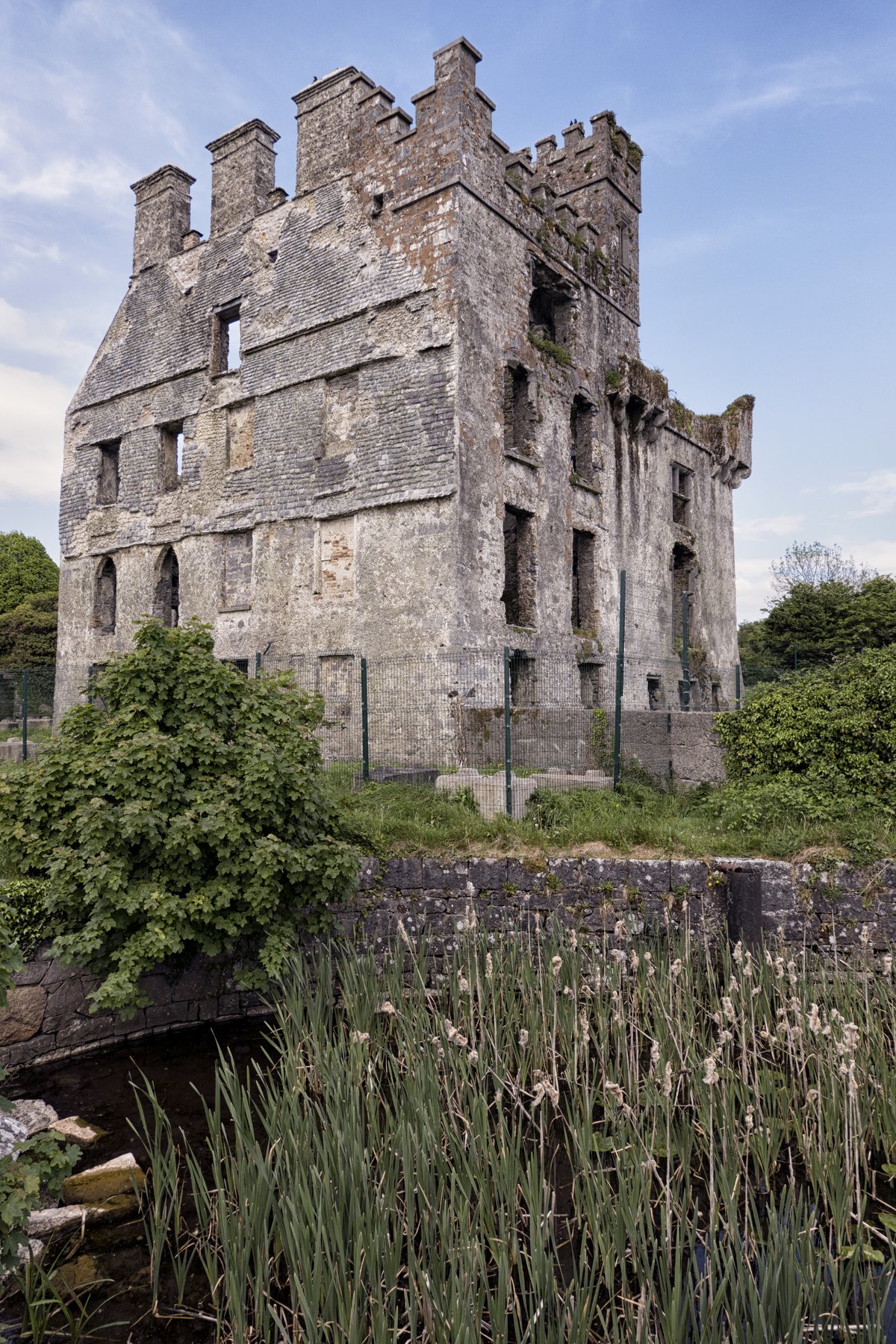
Menlo Castle, also known as Blake’s Castle or Menlough Castle, is an ivy-clad riverside ruin near Menlo village, outside Galway city. Set on the banks of the River Corrib, it is associated with the Blake family, one of Galway’s “Tribes,” and is known for its history, architecture and scenic setting. The interior is closed to visitors, but the grounds and nearby public viewpoints offer views of the castle and river. (Wikipedia: Menlo Castle; Oi.ie; Audiala)
Blake’s Castle in central Galway is a separate, 15th-century urban tower house built by the Blake family. Near Quay Street and the Spanish Arch, its exterior is a surviving link to the city’s medieval history and merchant families. (Galway City Museum; Galway Tourism)
History
Menlo Castle
Menlo Castle (Irish: Caisleán Mhionlaigh) dates to the mid-16th century and is described as having been erected around 1569. Its earliest known occupant was Thomas Colman in 1574. It began as a fortified tower house, typical of defensive residences of the Anglo-Norman and Gaelic elite, and later developed into a Jacobean mansion with Georgian elements. (Wikipedia: Menlo Castle; Visit Galway)
The Blakes lived at and owned Menlo Castle from the early 1600s, for more than 300 years. They were among the “Fourteen Tribes of Galway,” influential in the city’s economic and social life. In the 18th century, the family expanded the castle with residential blocks and a turret, reflecting their growing wealth and status. The transformation from defensive tower house to stately home reflected a wider shift among the Irish gentry towards comfort and display. (oi.ie; This is Galway)
The castle was known for its hospitality and community life. Its “May in Menlo” festival, also called “Maying in Menlo,” brought people together for music, dance and sports. The Blakes’ intermarriage with the Forster family produced the Blake-Forster lineage, extending their social and political influence in Galway. (Patrick Comerford’s Journal)
The castle’s history is marked by the fire of July 26, 1910. Sir Valentine and Lady Blake were away when the fire broke out. Accounts differ in how they describe the victims: one says that two maids and the Blakes’ disabled daughter Eleanor died; another says that daughter Ellen Blake and two staff members were trapped, with only one of the three surviving. Eyewitness accounts describe desperate escape attempts and unsuccessful rescues. The fire destroyed the interior and ended the family’s residence at Menlo Castle. (Oi.ie; Galway Advertiser; ItsOn.ie)
The castle was abandoned after the fire. In 1923, the Land Commission divided the estate as part of wider land reforms. Galway City Council acquired the site in 2000. The ruins remain a reminder of the Blake family’s influence and the changing fortunes of Ireland’s gentry. Conservation debates continue, including following recent storm damage. (Wikipedia: Menlo Castle; Audiala; Galway Tourism)
Local folklore, including tales of faeries and the haunting story of Eleanor Blake, forms part of the castle’s place in local memory and identity. (This is Galway)
Blake’s Castle in Galway city
Dating to the 15th century, the city-centre Blake’s Castle was built by the Blake family. It is among Galway’s last remaining medieval structures and was originally used to defend the quays and control access to the river. Later commercial adaptations included its use as a warehouse. (Galway City Museum)
What to see
Menlo Castle
The castle combines the thick stone walls and narrow slit windows of its original defensive design with later residential features. Its square turret at the eastern end is a distinctive feature. Visitors can view the ivy-covered ruins and their riverside setting; the opposite bank of the River Corrib, particularly the National University of Ireland, Galway campus, is a noted viewpoint.
Menlo Castle is also visited for photography, picnics and quiet riverside walks. The interior is closed for safety and preservation, but views are available from public areas and guided boat tours.
Blake’s Castle in Galway city
The city castle’s exterior features robust limestone walls, arrow slits and defensive loopholes. Other surviving features include a vaulted ground floor with a stone ceiling and remains of battlements. Visitors can admire the stonework and defensive details, and read interpretive plaques about the Blakes and Galway’s medieval past.
Practical visiting information
Menlo Castle: hours, admission and access
- Hours The grounds are listed as open daily, generally from 9:00 AM to 6:00 PM. The site is also described as accessible year-round; daylight visits are advised for safety.
- Admission Free; no ticket is required. Donations for preservation are welcomed.
- Facilities There are no official visitor amenities on-site. The site is maintained by Galway City Council.
- Interior Closed to visitors.
- Guided tours Tours are occasionally offered by local historical societies or tour operators. Other information describes tours as available on weekends or by appointment, and several local operators include Menlo Castle in their itineraries. Tour fees may apply. Check Galway Tourism for updates.
- Access The castle is reached via a small road off the R336. Parking is limited; public transport, cycling or a taxi from Galway city are alternatives.
- Mobility The terrain is uneven and paths are not fully developed, so wheelchair access is limited.
Blake’s Castle in Galway city: hours, admission and access
- Exterior Free to view from the street at any time.
- Interior Not generally open to the public. Access may be possible during special heritage events or by arrangement.
- Guided tours Walking tours of Galway’s medieval quarter often include the exterior; some may offer interior access during events. (Galway Walking Tours)
Tips
- Wear sturdy shoes at Menlo Castle because of the uneven terrain.
- Bring a camera for the castle and riverside views.
- The site is outdoors, and Galway’s weather can be changeable; check the weather in advance and dress accordingly.
- Spring and summer are suggested as good times to visit Menlo Castle.
- For Blake’s Castle, visiting during Galway’s festivals adds to the city-centre setting.
- Audio-guide apps such as Audiala are another way to explore the site.
Nearby places
Near Menlo Castle, visitors can explore Lynch’s Castle, the Spanish Arch, Galway City Walls and Claddagh Village. Other nearby attractions include Galway City Museum and Eyre Square.
Blake’s Castle is close to Quay Street and the Spanish Arch. The Galway City Museum and Spanish Arch are also suggested stops for learning more about Galway’s history. Menlo Castle views are available from across the Corrib, including from the National University of Ireland, Galway campus.
FAQ
Menlo Castle
What are Menlo Castle’s visiting hours?
The grounds are generally listed as open daily from 9:00 AM to 6:00 PM. The site is described as accessible year-round; daylight visits are advised.
Is there an entrance fee?
No. Admission is free and no ticket is required. Donations for preservation are welcomed.
Can I enter Menlo Castle?
No. The interior is closed for safety and preservation. Views are available from public areas or guided boat tours.
Are guided tours available?
Occasionally. Tours are described as available through local operators or historical societies, on weekends or by appointment. Check Galway Tourism for updates. Tour fees may apply.
Is Menlo Castle wheelchair accessible?
Access is limited because the terrain is uneven and paths are not fully developed. One visitor-information account advises contacting the visitor center for details.
When is a good time to visit?
Spring and summer are suggested. Visit during daylight hours for safety.
Blake’s Castle in Galway city
When can I visit Blake’s Castle?
The exterior can be viewed from the street at any time. Interior access is rare.
Is there an entry fee?
There is no fee to view the exterior.
Can I enter the castle?
Interior access is generally limited to special events or arranged tours.
Are guided tours available?
Yes. Several local companies offer walking tours with historical context; some may provide interior access during events.