Type 2+ letters to search all countries, cities, and places
/Ctrl KEsc
travel_explore
Type 2+ letters to search all countries, cities, and places
Press Enter to open the top result
National Library of Ireland
Dublin·Ireland·53° N · 6° W·Updated Jul 2026
Free exhibitions and a domed Victorian reading room make the National Library of Ireland feel less like a museum and more like Dublin's paper memory bank.
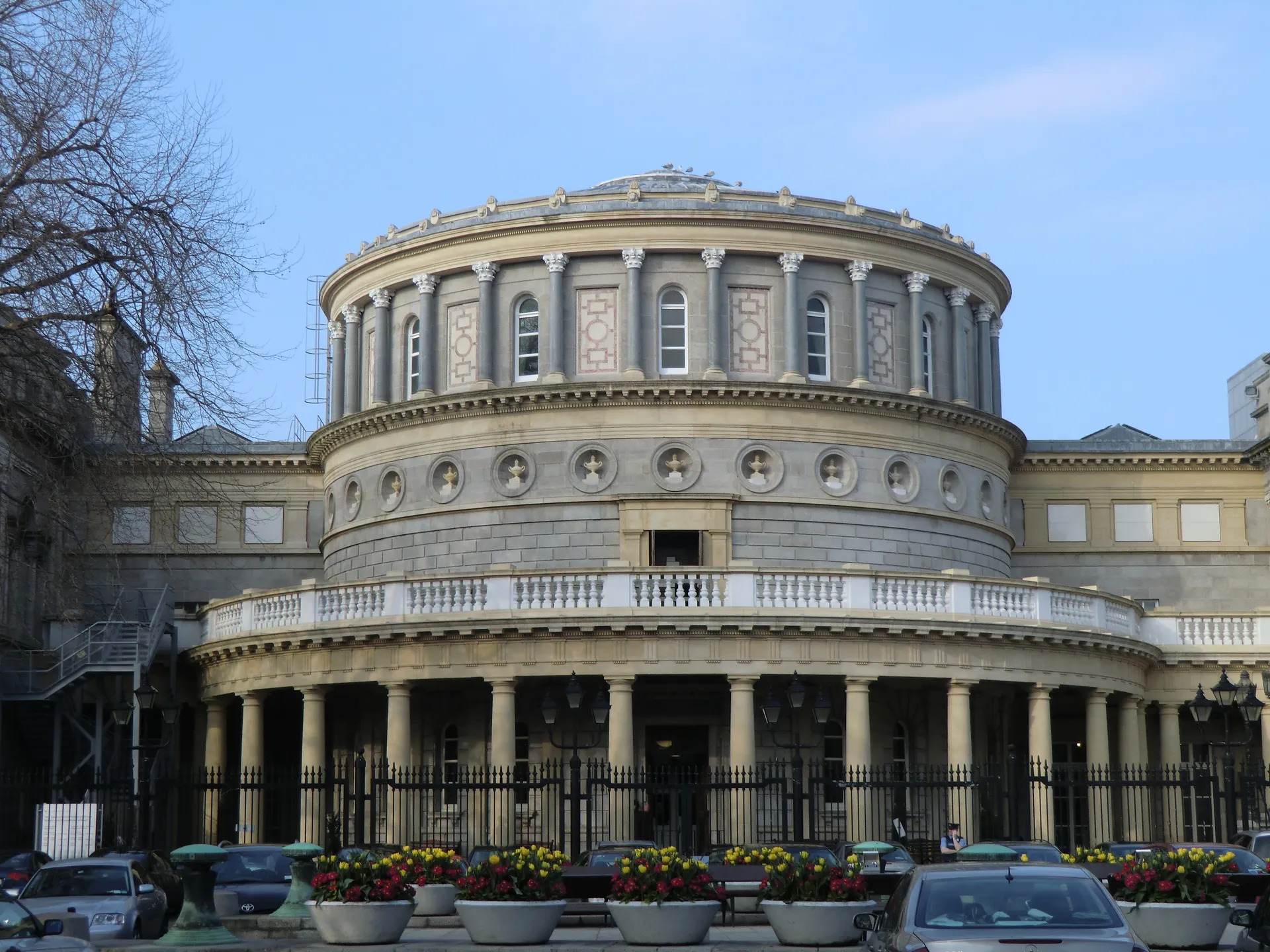
Why does the National Library of Ireland in Dublin, Republic of Ireland, feel less like a library than a quiet argument about who gets to own memory? Step through the Kildare Street doors and the answer starts in the body: mosaic owls underfoot, stained glass above, the hush of a domed reading room, and that faint old-paper smell that makes even hurried visitors slow down. Come for the architecture, the free exhibitions, and the chance to see Ireland's memory bank still doing its original job rather than pretending to be a fossil.
Most first-time visitors expect a literary shrine. That's too small. Records show this place has served since 1890 as a working national repository, where manuscripts, photographs, newspapers, music, family records, and born-digital archives all end up under one Victorian roof or within the institution that roof anchors.
The building helps the drama along. Thomas Newenham Deane and Thomas Manly Deane designed it as the twin of the National Museum across the lawn, and the result still has that late-19th-century confidence: carved stone, polished wood, and a reading room shaped to make silence feel ceremonial.
But the best reason to visit is the tension it still carries. You are standing in Dublin, in a place built with imperial money, claimed by an independent state, and now being remade again so more people feel entitled to walk in, look up, and stay.
Researched by the Audiala editorial team from historical records, architectural archives, and local expertise.
What to see
The Front Hall and Main Staircase
The surprise comes under your shoes. Step in from Kildare Street and the National Library’s Victorian gravity immediately gives way to a floor mosaic in green, blue, grey and gold, where owls circle the word sapientia while 12 stained-glass windows pull your gaze upward; the hall can sound pleasantly public or sharply echoey, which only makes the climb feel more ceremonial. Look hard at the marble on the staircase as you go: green, black and white stone from Irish quarries slides past your hand, and the glass above slips in Michelangelo and Leonardo like a quiet syllabus, as if the building were teaching you how to look before you’ve read a single page.
Yeats Below, the Reading Room Above
Most visitors head for the manuscripts first, and fair enough: the free Yeats exhibition has the pull of intimacy, with drafts of "The Lake Isle of Innisfree" and "Easter, 1916," the Nobel medal, and that carved piece of lapis lazuli sitting a few feet away instead of behind the fog of schoolroom reverence. Then look up, literally, toward the library’s great D-shaped reading room, opened in 1890 and built for 75 readers, a space sized more like a small theatre than a warehouse of books; access is limited unless you join a special visit, but even knowing it is there changes the mood of the whole building, because this place stops feeling like a museum and starts feeling like the engine room of Irish memory.
Take the Building as a Sequence
The best way to see the library is not to charge through it but to follow its change in temperature and tone: street noise on Kildare Street, the echo of the rotunda, the cooler lift of stone and stained glass on the stairs, then the quieter pull of the galleries below. If you can book one of the after-hours Dublin by Dusk openings, do it; evening light softens the Victorian formality, and the whole place finally reveals what it really is, not a static monument but a working national memory palace where even the umbrella stands seem to know a story.
Plan your visit
Getting There
Kildare Street puts the library in the middle of Dublin 2’s museum-and-government strip, a 5 to 8 minute walk from Trinity College, Grafton Street, or St Stephen’s Green via Nassau Street or Dawson Street. As of 2026, the Luas Green Line stop at Dawson is about 300 metres away, Pearse Station about 500 metres, and bus 4 from Heuston stops on Nassau Street for a final walk of roughly 3 minutes; if you drive, skip the idea of onsite parking because the library has none.
Opening Hours
As of 2026, the main Kildare Street visitor site opens Monday, Thursday, Friday, Saturday, and Sunday from 9:30am to 5:00pm, with longer Tuesday and Wednesday hours until 7:00pm; public holiday Mondays run 12:00pm to 5:00pm. Official pages disagree slightly on last entry, so play safe and arrive by 4:30pm; researchers should also check separate reading-room closures and the monthly late-opening “Dublin by Dusk” evenings on the last Thursday of selected months.
Time Needed
Give it 30 to 45 minutes if you want the Yeats exhibition and a look at the entrance hall, stained glass, and the hush that settles once the street noise drops away. An hour to 90 minutes feels right if you actually read the displays, and 2 to 3 hours makes sense only if you’re using a reader’s ticket or pairing the stop with nearby cultural heavyweights like the National Gallery or Merrion Square.
Accessibility
As of 2026, wheelchair access comes through the main Kildare Street entrance by ramp, with automated doors, a lift to the Main Reading Room and Yeats exhibition, and accessible toilets off the front hall. Hearing loops are installed throughout, guide and assistance dogs are welcome, and the library is JAM Card friendly, though the visual guide warns that the entrance zone can feel busy, echoey, and dim in places because conservation light is kept low.
Cost & Tickets
The pleasant surprise is that general admission costs nothing: as of 2026, all exhibitions are free, including the Yeats exhibition, and you do not need to book ahead. Reading rooms are different: they require a reader’s ticket, and while that saves money compared with paid attractions nearby, it also turns a casual visit into a more formal research stop.
History
A House Built to Keep Ireland Talking to Itself
The National Library of Ireland has changed governments, readers, technologies, and even its own sense of who belongs inside, yet its basic function has held. Records show that since the institution was established by the Dublin Science and Art Museum Act in 1877, and since the Kildare Street building opened on 29 August 1890, the point has remained the same: gather the record, protect it, and put it back into public use.
That continuity is more moving in person than it sounds on paper. Readers still sit under the dome. Family historians still arrive with half-remembered names. Every Bloomsday, Joyce returns in voices rather than glass cases, and the library's old hush turns briefly into performance.
The turning point
Thomas William Lyster and the Steps Outside
At first glance, the story seems simple: a grand Victorian library opened in 1890, and Dublin's readers gratefully filed in to admire the oak desks and stained glass. That version suits the architecture. It flatters the building too.
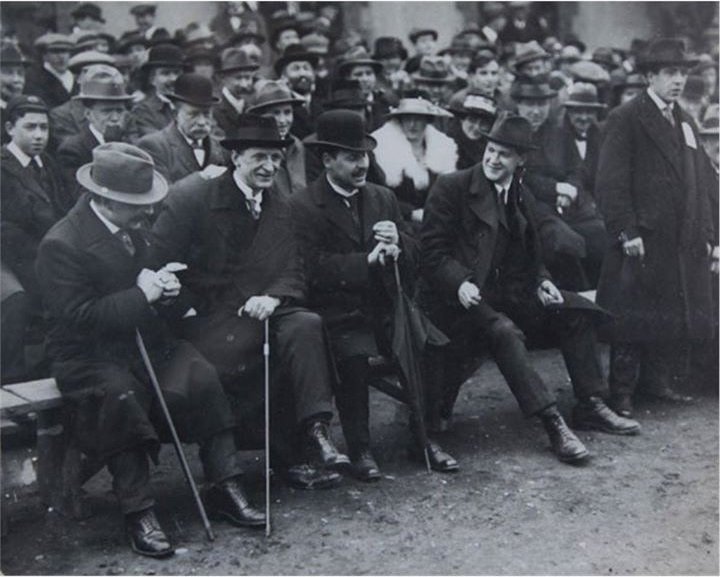
But one detail spoils the neat picture. Documented accounts from the library's early years describe complaints from Dublin elites about working-class boys sitting on the front steps and, in their view, lowering the tone. For Thomas William Lyster, director from 1895 to 1920, this was personal as well as professional: if he yielded, the library would become a handsome club; if he refused, he was declaring that a publicly funded institution belonged to the public in the unruly, literal sense.
The turning point came when Lyster answered the complaints with a line that has outlived most official speeches: those boys had to be allowed to sit there because this was their library. That is the hidden truth behind the polished facade. The library's continuity is not just shelves and legal deposit; it is the repeated insistence that access matters more than social comfort.
Once you know that, the building looks different. The dome stops feeling like decoration and starts reading as a promise, and the front steps become part of the collection: not stone alone, but a small stage where Ireland argued over who was allowed to belong.
What Changed
Almost everything around the core mission has shifted. The original shared reading tables were replaced in the 1920s and 1930s with smaller desks to discourage chatter; open coal fires gave way to safer systems; and the current Capital Development Project, documented by the library as its biggest spatial rethink since 1890, is moving about 350,000 volumes, enough books to fill a long city block of shelving, to create new galleries and public spaces before the 150th anniversary in 2027.
What Endured
The act of turning private memory into public record never stopped. Readers still consult manuscripts and newspapers on site, the Family History Service still helps people test family lore against parish registers and directories, and annual rituals such as Bloomsday and Poetry Aloud keep the place vocal rather than embalmed. A library, this one suggests, is not a storehouse. It is a machine for making remembrance usable.
Tips for visitors
Read the Camera Rules
Flash, tripods, and scanners are not allowed, and the library explicitly asks visitors not to take selfies, videos, or photos in the reading rooms because readers deserve privacy. In public exhibition areas, keep it discreet and ask staff if you want anything more than a quick handheld shot.
Treat It Like Reading Space
No formal dress code exists, but the social code is plain: silence matters, phones should stay muted, and food or drink does not belong in the reading rooms. If you plan to research, bring a pencil rather than a pen and expect bags and coats to go into lockers.
Eat With Context
For the best literary pairing, walk 6 to 8 minutes to Davy Byrnes on Duke Street for the Joyce lunch of gorgonzola sandwich and burgundy, a mid-range stop with actual Dublin pedigree. Tang on Dawson Street works for a budget-to-lower-mid-range lunch, while The Garden Room at The Merrion is the polished splurge when you want linen, calm, and a bill that knows exactly where you are.
Go Late On Tuesday
Tuesday and Wednesday are the smart choices if you want breathing room after office hours, since the building stays open until 7:00pm in 2026. Better still, the last-Thursday 'Dublin by Dusk' openings keep the Yeats exhibition and Main Reading Room open into the evening, when the domed interior feels more like a lantern than a public institution.
Watch Your Bag Outside
Kildare Street itself feels orderly, hemmed in by parliament buildings and museums, but the risk rises once you drift back toward Grafton Street’s retail crowds. Dublin’s usual problem is petty theft, not drama, so keep phones off café tables and zip bags before you head west.
Pair It Properly
This stop works best as part of a compact cultural loop: step out to Merrion Square, the National Gallery, or back toward Dublin without wasting time on taxis. If you need a quiet reset after the reading room’s echo and dim light, St Stephen’s Green is close enough to reach before the mood breaks.
Where to Eat
local_dining
Don't Leave Without Trying
Dublin coddleIrish stewFull Irish breakfastSoda bread or brown breadSeafood chowderFish and chipsBacon and cabbageColcannon or champBlack and white puddingDublin Bay prawns
Tang (Cumberland Place)
cafe
Modern Middle Eastern cafe with strong vegetarian options€€star4.8(494)
Order: Go for the egg toast or mushroom toast at breakfast, and expect big, salad-heavy plates if you come for lunch.
This is the Tang branch that makes the most sense from the National Library: close, fast-moving, and clearly loved by regulars. Reviews keep coming back to generous portions, sharp service, and a garden seating area with a big tree in the middle.
Order: Order the prix fixe menu and, if available, don’t skip the prawn risotto or the bread with duck butter.
A small Dublin room with real personality, not a polished hotel-dining imitation of one. People rave about the generous three-course menu, the intimate service, and a kitchen that feels personal rather than corporate.
Creative modern Irish restaurant with tasting-menu leanings€€star4.7(371)
Order: Build your meal around multiple snacks and starters; reviewers single out the artichokes, rabbit and ox-tongue, and hamachi.
This is the sharpest dinner option within easy reach of Kildare Street if you want cooking with ambition. The room is understated, the staff know what they’re doing, and the menu sounds like a kitchen pushing past the safe version of Dublin dining.
Middle Eastern breakfast and lunch cafe€star4.8(1433)
Order: Get the shakshuka if it’s on, or go for breakfast plates with beans, hummus, and fresh vegetables; the pancakes also get strong praise.
Tang’s Dawson Street branch has the rare combination of low prices, serious flavor, and a location that actually works between museums, shops, and the library. Reviews describe it as packed for good reason: bright spices, fresh cooking, and brunch that feels far more alive than the usual city-centre fallback.
checkAround the National Library, the most useful dining zones are the Grafton Street and Creative Quarter area, Merrion Row and St Stephen’s Green, and Temple Bar across the river.
checkMonday is the most common limited-service or closure day in Dublin, especially for independent and higher-end restaurants.
checkSome Dublin restaurants close between lunch and dinner, so check whether a place runs a split service before you set out.
checkTemple Bar Food Market runs on Saturday in Meeting House Square, with sources giving the opening as either 9:30am or 10:00am; the close is consistently listed as 3:30pm.
checkMoore Street Market hours vary by source: one lists Monday to Saturday, 11am to 5pm, while another says the traditional fruit-and-veg traders are there Wednesday to Saturday, 11am to 5pm.
checkHerbert Park Farmers Market runs on Sunday from 11am to 4pm and is one of the easier southside market options from this part of Dublin.
checkGeorge’s Street Arcade is a daily covered market in the south city centre and Creative Quarter area, useful if you want artisan food without waiting for a weekend market.
Food districts:Grafton Street and the Creative QuarterMerrion Row and St Stephen’s GreenTemple BarPortobello and Camden StreetBallsbridge and Herbert ParkStoneybatter and Smithfield
Restaurant data powered by Google
Frequently asked
Is National Library of Ireland worth visiting?
Yes, especially if you like buildings that reveal their best detail slowly. The Kildare Street library opened on 29 August 1890, and the real pleasure is not just the free Yeats exhibition but the Victorian shell around it: mosaic owls underfoot, stained glass above, and a reading room shaped like a capital D. Even people who never open an archive box usually leave remembering the hush after the echo of the front hall.
How long do you need at National Library of Ireland?
Give it 45 minutes for a quick visit, and 60 to 90 minutes if you want to do it properly. Half an hour covers the Yeats exhibition and a look at the entrance hall, but the place rewards slower looking: the staircase marble, the "sapientia" mosaic, and the reading-room details many visitors miss on the first pass. If you are coming as a researcher with a reader's ticket, a couple of hours disappears fast.
How do I get to National Library of Ireland from Dublin city centre?
Walk if you are already in central Dublin. The library is at 7/8 Kildare Street, Dublin 2, less than 500 metres from Trinity College and Grafton Street, about 300 metres from Dawson on the Luas Green Line, and about 500 metres from Pearse Street Station. From Heuston Station, the official advice is bus 4 to Nassau Street, then a short 3-minute walk.
What is the best time to visit National Library of Ireland?
Late morning on a weekday is the sweet spot if you want calm without feeling shut out. The building can feel busy and echoey at the entrance, so earlier daytime visits make it easier to notice the stained glass and floor mosaic before the foot traffic builds; Tuesday and Wednesday also run later, until 7:00pm. If you want the rare treat, go on the last Thursday of the month for "Dublin by Dusk," when the Reading Room opens from 5:00pm to 8:30pm and the whole place shifts from working library to evening stage set.
Can you visit National Library of Ireland for free?
Yes, the public exhibitions are free. The Yeats exhibition does not require booking, and the National Library says admission to all exhibitions is free of charge; the catch is that reading rooms are different and need a reader's ticket. For a casual visitor, that means one of Dublin's better-value cultural stops costs exactly nothing.
What should I not miss at National Library of Ireland?
Do not miss the floor before you look at the ceiling. The easiest detail to overlook is Ludwig Oppenheimer's entrance mosaic with owls and the word "sapientia," then the staircase stained glass, then, if you can access it on a tour or late opening, the D-shaped Main Reading Room with its coffered ceiling and oak desks. The Yeats exhibition is the public centerpiece, but the building itself is the secret.
Sources & attribution10
Researched and written by the Audiala editorial team from historical records, architectural archives, and local expertise. Last updated July 2026.
National Library of Ireland — Used for the library's overall role as Ireland's national memory institution and for confirming the public visitor offer.
National Library of Ireland Opening Hours — Used for exhibition admission being free, weekly opening hours, last-admission caution, reading-room access, and public holiday timings.
National Library of Ireland Getting Here — Used for the full address on Kildare Street, walking distances from central landmarks, Luas and rail distances, bus routes, and the Heuston Station route.
National Library of Ireland Visual Guide — Used for sensory details about the front hall being busy, noisy, and echoey, and for general visitor movement through the building.
Saved and recently read places — kept on this device only.
Photo credits (3)
File:Circular Design of the National Library in Dublin - panoramio — Lobster1 — CC BY-SA 3.0 (https://creativecommons.org/licenses/by-sa/3.0/) — Source: https://commons.wikimedia.org/wiki/File:File:Circular_Design_of_the_National_Library_in_Dublin_-_panoramio.jpg
Strictly necessary cookies keep the site working. Analytics (PostHog, Google Analytics) measures how each visitor uses our pages. Marketing loads YouTube videos and walking-route maps without a tap and lets Google Analytics set advertising cookies. We never sell your data. You can change this any time from the footer.
Analytics and marketing cookies are optional and only load if you agree. Details under Customize.
Privacy
Cookie preferences
Pick what you're okay with. You can change this any time from the footer.
Strictly necessary
Always on
Sign-in, language, navigation. Always on.
Product analytics
PostHog (EU) and Google Analytics record which pages you view and how you use them, under a random identifier stored in your browser. Helps us see which pages work and which need fixing. Google's ad personalisation stays off. No selling.
Marketing
Loads YouTube videos and the walking-route maps (OpenFreeMap) without a tap; without it, they load only when you tap them. If analytics is also on, Google Analytics may set advertising cookies. Ad personalisation stays off.