


Place
Indonesia Updated Jul 2026
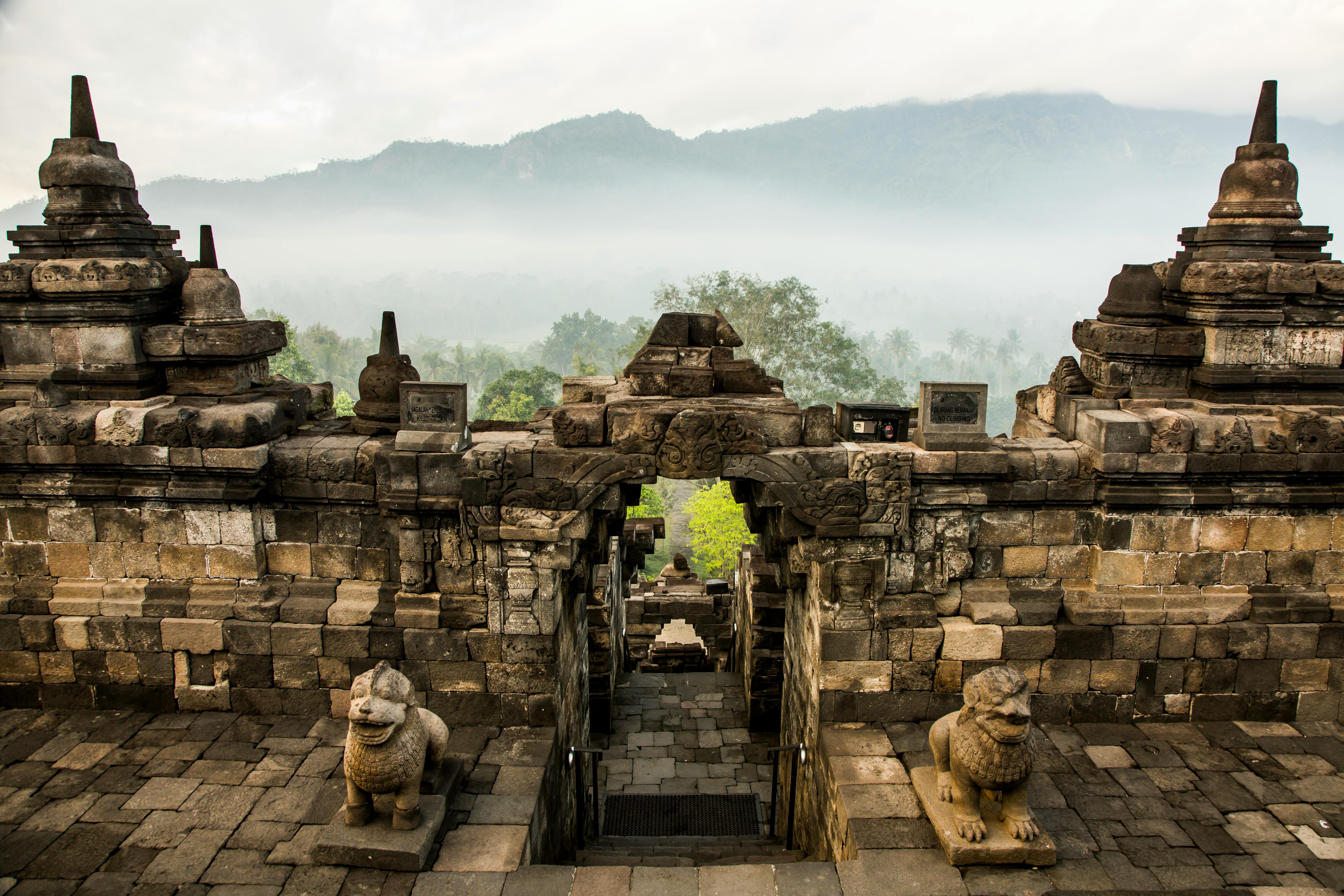
Dawn in Magelang, Indonesia, often arrives as a trick of light: the Kedu Valley still full of mist, the outline of Borobudur floating above it, and the volcanoes behind looking close enough to touch. That surprises people. Magelang is not one place but two overlapping ones, a compact inland city and a wider regency of temples, villages, hot springs, and mountain roads, and you understand it properly only when you let both into the frame.
Built from cited sources · see the method · How we make our guides →
Borobudur is the name everyone knows, and fair enough: an 8th- to 9th-century Buddhist monument built in volcanic stone, wrapped in relief panels and crowned with 72 perforated stupas, will dominate any conversation. But Magelang gets more interesting once you step off the main circuit. Mendut still holds a monumental seated Buddha in its dim interior, Pawon sits quietly on the old ritual axis, and Punthuk Setumbu turns sunrise into theater without saying a word.
The city itself moves at a different tempo. Around Alun-Alun Kota Magelang and the streets that feed into it, breakfast means hot bowls of sop senerek by 06:00, kupat tahu slick with peanut sauce and chili, then long slow evenings of coffee, guitar, and families lingering under the trees rather than racing to the next sight.
What stays with you is the way sacred grandeur and everyday life keep brushing against each other. A world monument stands a short drive from horse-cart village tours in Candirejo, sulfur pools at Candi Umbul, and roadside warungs serving mangut beong hot enough to make you sit up straight. Magelang never performs for you too hard. It simply lets the valley, the stone, and the people make their case.
Not every monument, just the ones we'd walk you past ourselves.
Where to wander, by quarter — each with its own rhythm.
Before you go
From early rice settlements in the Kedu plain to a modern city living in Borobudur's long shadow
Most scholars tie the Kedu Valley's first settled farming life to Austronesian migration into Java. Wet-rice cultivation turned this volcanic basin into a worked landscape of terraces, water channels, and village clearings, the kind of geography from which Magelang would later grow.
By the late 8th century, the Kedu plain sat inside the orbit of the Sailendra dynasty, whose Buddhist court had money, labor, and a taste for stone on a grand scale. Fertile soil paid for piety here. Rice fed masons as surely as monks.
Mendut Temple began to rise east of Borobudur, built from andesite blocks dark as wet charcoal after rain. Its great seated Buddha and bodhisattvas gave the valley a ritual center with real physical weight, not a legend but a monument you can still feel in the cool interior air.
Construction of Borobudur likely began around the turn of the 9th century, with terraces stacked one above another like a mountain translated into geometry. The project was extravagant by any measure: thousands of relief panels, hundreds of Buddha images, and a hill reshaped into cosmology.
By about 825, Borobudur stood complete in the Magelang regency: nine levels, 72 perforated stupas, and 504 Buddha statues arranged with unnerving precision. Morning light still does the same trick it did then, catching the stone so the monument seems less built than revealed.
Pawon Temple completed the ceremonial line linking Mendut, Pawon, and Borobudur across the plain. That alignment matters because it shows this was never one isolated monument in a field; it was a choreographed ritual landscape, measured in footsteps, prayer, and sightlines.
When the Javanese court moved east in the 10th century, the Kedu Valley lost political gravity even if it kept its fertile soil. Borobudur and its companion temples slowly slipped from active ritual use. Ash, jungle, and forgetting did the rest.
The rise of the Islamic Mataram Sultanate pulled the Magelang region into a new political world centered on Javanese courts that were Muslim in faith but deeply local in practice. Old sacred sites remained in the ground and in memory. The region did not erase its past; it layered over it.
The Treaty of Giyanti split the old Mataram realm and reshaped authority across central Java, including the Kedu area around Magelang. Court politics in distant palaces had local consequences: taxes, allegiances, and chains of command changed on the plain below the volcanoes.
After the VOC collapsed, the Dutch colonial state took direct control of Java's interior. For Magelang, that meant tighter administration, more formal mapping, and the kind of bureaucratic attention that turns an agrarian basin into a governed district.
The Java War erupted in 1825, and the Kedu region became part of a brutal struggle that mixed anti-colonial resistance, court fracture, and village survival. Roads filled with troops, pack animals, and fear. Central Java still carries the memory in place names and barracks.
In the war's aftermath, Dutch power hardened Magelang into a military and administrative town tied to the Kedu Residency. Barracks, roads, and European civic buildings gave the city its colonial bones, many of which still structure the street grid even when the facades have changed.
Jusuf Wibisono, later twice Indonesia's finance minister, was born in Magelang in 1909. His career linked this inland city to the making of the republic's economic life, a reminder that Magelang produced more than soldiers and civil servants.
Ali Said was born in Magelang in 1927 and went on to become attorney general, law minister, and chief justice. His trajectory ran through the armed, legal, and political machinery of modern Indonesia, which gives his Magelang origin a sharper edge than a birthplace footnote usually carries.
Kris Biantoro was born in Magelang in 1938 before becoming one of Indonesia's familiar television and entertainment figures. His path from this small Central Javanese city to national screens says something about Magelang too: it has long exported talent that sounds larger than its map footprint.
Japanese forces occupied Java in 1942, dismantling Dutch authority with shocking speed. In Magelang, as across the island, occupation brought coercion, scarcity, and forced labor, but it also cracked the colonial order open in ways the Dutch would never fully repair.
After Indonesia proclaimed independence on 17 August 1945, Magelang became part of the revolutionary belt of central Java and later earned the title Kota Pejuang, the City of Struggle. This was not rhetoric minted after the fact. The town served as a logistical hub and a contested space in a war whose front lines often ran through roads, markets, and rail links.
Dutch recognition of Indonesian sovereignty on 27 December 1949 ended the formal revolution and fixed Magelang inside the new republic. The city's military character did not vanish. It simply changed uniform.
Komaruddin Hidayat, born in the Magelang area in 1953, would become one of Indonesia's better-known Muslim intellectuals and university leaders. His connection matters because it ties Magelang not just to monuments and battalions, but to post-independence thought and education.
Djarot Saiful Hidayat was born in Magelang in 1962 and later became governor of Jakarta. That arc from a Central Javanese hometown to the capital's rough political stage gives Magelang another kind of historical presence: quiet at first, then suddenly national.
UNESCO-backed restoration work in the 1970s dismantled and rebuilt large sections of Borobudur stone by stone, a project of engineering as much as archaeology. Workers lifted blocks, cleaned drainage, and stabilized the monument so it would stop rotting from within. Few visitors guess how much of what they see survived because someone was willing to take the temple apart to save it.
Borobudur was inscribed as a UNESCO World Heritage Site in 1991, locking the Magelang regency into a global heritage map. International recognition brought prestige, money, crowds, and a familiar headache: how do you keep a monument alive when the world wants to climb it all at once?
Around the Borobudur area, places such as Candirejo began turning village life itself into a visitor experience through cycling routes, horse-cart rides, cooking, farming, and performance. Done badly, that sort of program can feel staged. Here, it often works because the rural setting is the point, not scenery pasted behind a souvenir stall.
New visitor management rules drew a firmer line between entering the park and climbing the temple structure itself. The change annoyed some travelers used to treating old stone as a staircase, but the logic was hard to argue with: every footstep wears a monument that already survived ash, neglect, and empire.
In 2026, Magelang marked the groundbreaking of Pura Jagad Natha, a new Hindu temple in the city. The moment carried a quiet historical echo. More than a thousand years after Central Java's great Hindu-Buddhist age, sacred building returned in a modern civic setting rather than a royal one.
Actor, singer, and television presenter · 1938–2013
Born here
Kris Biantoro was born in Magelang before becoming one of the familiar faces of Indonesian television, the sort of entertainer who could make a studio feel like a living room. He came from a city better known for barracks and temples than show business, which makes his career feel like a sideways turn Magelang would probably enjoy.
Actress · 1938–2022
Born here
Aminah Cendrakasih was born in Magelang, then carried that Central Javanese steadiness into a long acting career remembered by generations of viewers. You can imagine her reading the town well: formal at first glance, softer once you stay long enough for the evening food stalls to fill.
Politician · born 1962
Born here
Djarot Saiful Hidayat was born in Magelang, and one story from his biography says a trader in his hometown market gave him the name 'Djarot.' That detail fits the place: a city where markets, schools, and military roads have always rubbed shoulders, and where public life starts at street level.
Academic and public intellectual · born 1953
Born here and educated in the Magelang area
Komaruddin Hidayat's connection to Magelang runs deeper than a birthplace line; his early education is tied to Pabelan and Muntilan in the wider area. A thinker shaped in the Kedu Valley makes sense, because this is a region where Buddhist stone, Islamic schools, and Javanese village life have been arguing politely for centuries.
Politician and economist · 1909–1982
Born here
Jusuf Wibisono was born in Magelang before rising to serve twice as Indonesia's finance minister. His story starts in a town of disciplined geometry and fertile fields, which may be why Magelang still feels like a place that values order, but never forgets the soil underneath it.
Where locals actually book dinner — not the tourist menus.
This local snack from Pagersari belongs in the category of things that look modest and then disappear from the plate too fast. Expect a chewy, savory village bite rather than polished cafe food; it makes the most sense when eaten where it's made, with conversation and sweet tea doing half the work.
Candirejo's food experiences lean into what rural Central Java actually cooks and dries for daily life: tempeh, cassava, and the kind of crisp crackers that taste better after you've seen the process. Join a workshop if you can. The smoke, oil, and starch in the air tell you more than a restaurant menu ever will.
Wanurejo is a good place to look beyond refined sweetness and taste fresh palm sugar close to the source. It carries a darker, slightly smoky depth that works in drinks, sweets, and market snacks, and the tapping demonstrations make the ingredient feel less like a souvenir and more like agricultural craft.
Tofu-making workshops around Wanurejo sound humble because they are, and that's the point. Fresh tofu here is soft, warm, and lightly nutty, miles away from the anonymous blocks sold in supermarkets, and it usually arrives with sambal that wakes everything up.
Around Borobudur, the smartest breakfast is often at a roadside warung rather than a hotel buffet: rice, tempeh, fried snacks, strong coffee, and air that still feels cool before the buses arrive. Eat early. The temple day goes better when you've started like a local, not like a conference guest.
Small things that change how the city treats you.
The city, as it actually looks.
Yes, especially if you want more than a quick Borobudur photo. The draw is the mix: a 9th-century Buddhist monument, misty sunrise hills, village roads lined with bamboo, and local food like sop senerek that feels rooted rather than staged.
Two to three days works well for most travelers. Give one day to Borobudur, Mendut, and Pawon, then use another for Punthuk Setumbu, Candirejo, or Ketep Pass; a third day helps if you want slow mornings and village time.
Most travelers go by car from Yogyakarta International Airport or Adisutjipto Airport. Grab has official airport pickup zones, private transfers are easy to pre-book, and there is no train line into Magelang.
Only with the Temple Structure ticket, and spaces are controlled. The cheaper ground-access ticket lets you enter the park but does not automatically include walking up the monument.
Generally, yes. The bigger risks are traffic, narrow mountain roads in rain or fog, and the usual petty theft around markets or transport hubs rather than serious street crime.
No, not by Indonesian tourist standards. Transport inside town is cheap, local meals are inexpensive, and the biggest cost jump usually comes from Borobudur tickets, private drivers, or staying near the temple in high season.
Stay near Borobudur if sunrise views and temple access are the point of your trip. Stay in Kota Magelang if you want a more local urban base, easier everyday food options, and lower-key evenings.
May, June, and September are the sweet spot. You get drier weather, clearer dawn views, and fewer rain-soaked afternoons than the November to April wet season.
Saved and recently read places — kept on this device only.