Kanaka Durga on Indrakeeladri
The temple’s white gopuram rises 23 m above the Krishna River; priests just finished the 12-year Kumbhabhishekam in March 2026. Sunrise darshan gives you both the goddess and the city’s best panorama.
Vijayawada, India, is where the Kanaka Durga Temple just held its once-in-12-year Kumbhabhishekam. The best season to visit is November–February, and a suggested visit duration is 2–3 days. The guide covers 9 listed attractions.
The Krishna River doesn’t flow past Vijayawada—it performs. At dawn the water turns molten copper under Indrakeeladri Hill, while barefoot priests sprint up 300 granite steps to beat the sun to Kanaka Durga’s shrine. By dusk the same river becomes a mirror for neon fishing boats and the city’s hunger: cumin, dried chili, and tamarind steam rising from street carts along Prakasam Barrage. This is India’s Andhra Pradesh at full volume, a place where temple bells compete with lorry horns and every meal arrives with a heat warning that locals ignore.
 Vijayawada · India
Researched from Wikidata, Wikipedia & official sources · fact-checked · How we make our guides →
VThe Krishna River doesn’t flow past Vijayawada—it performs. At dawn the water turns molten copper under Indrakeeladri Hill, while barefoot priests sprint up 300 granite steps to beat the sun to Kanaka Durga’s shrine. By dusk the same river becomes a mirror for neon fishing boats and the city’s hunger: cumin, dried chili, and tamarind steam rising from street carts along Prakasam Barrage. This is India’s Andhra Pradesh at full volume, a place where temple bells compete with lorry horns and every meal arrives with a heat warning that locals ignore.
Vijayawada runs on three currencies: devotion, commerce, and the belief that lunch should make you sweat. Pilgrims come for the goddess Durga, whose temple receives up to 100,000 visitors during the nine-night Navaratri siege. Traders come for the wholesale markets that empty an entire river island of bananas before sunrise. Everyone else comes because the city sits at the crossroads of two national highways and refuses to let you pass through hungry.
The grid is simple—river on the west, railway line on the east, MG Road stitching them together—but the texture changes every hundred meters. One block smells of sandalwood and marigold from a 7th-century cave shrine; the next reeks of diesel and roasting mirchi bajji. A twelve-year ritual cycle ended here in March 2026 when priests re-consecrated Kanaka Durga with a Kumbhabhishekam fire so hot it cracked the hill’s stone cladding. Three months later the same granite cooled under the feet of kids flying kites during Sankranti, paper diamonds slicing across apartment towers that didn’t exist the last time the goddess got new paint.
What makes this place worth slowing down for.
The temple’s white gopuram rises 23 m above the Krishna River; priests just finished the 12-year Kumbhabhishekam in March 2026. Sunrise darshan gives you both the goddess and the city’s best panorama.
Fourth-century rock-cut cells turn into a three-storey monastery carved out of a sandstone cliff. Inside, a 5 m reclining Buddha still smells faintly of wet earth after monsoon.
An entire village hand-carves light-weight wood into bright festival toys; the same families have done it since the 16th-century fort above them was built.
Bhavani Island ferry docks at dusk and the air fills with Guntur-chili smoke from pop-up fish grills. The heat level is not negotiable; the beer is cold.
Not every monument, just the ones we'd walk you past ourselves.

The Prakasam Barrage, an iconic landmark in Vijayawada, India, is a marvel of engineering that seamlessly blends historical significance with contemporary…

Nestled in the historic town of Amaravathi, India, the Akkanna Madanna Caves stand as a remarkable testament to the region's rich cultural and architectural…

Museum Road in Vijayawada, India, is a captivating destination that offers a rich blend of history, culture, and modernity.

Nestled on a sandstone hillside overlooking the serene Krishna River near Vijayawada, the Undavalli Caves stand as a remarkable monument that encapsulates…
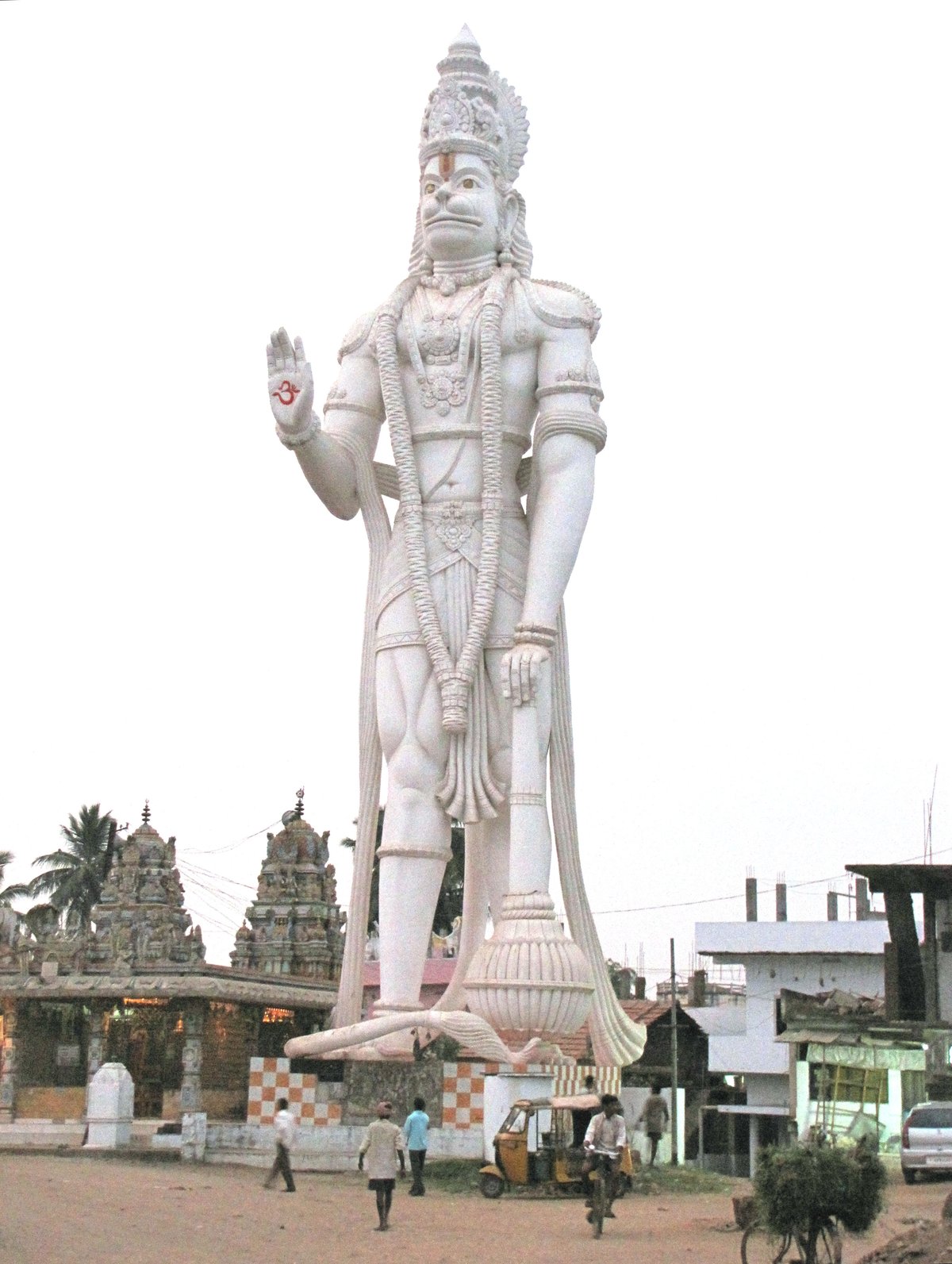
The Veera Abhaya Anjaneya Hanuman Swami temple, located in Kanchikacherla Mandal, Andhra Pradesh, India, stands as a monumental testament to the rich cultural…

Nestled in the bustling city of Vijayawada, Andhra Pradesh, Dr.

Pandit Nehru Bus Station (PNBS) in Vijayawada, Andhra Pradesh, stands as one of India’s largest and most dynamic bus terminals, serving as a crucial nexus for…
Where to wander, by quarter — each with its own rhythm.
Steep, slippery, and never silent. The temple steps start at 4 a.m. with chai vendors who know pilgrims by name and end at the barrage where couples buy ₹10 popcorn to watch the water change color. Between them: monkeys stealing coconuts, priests selling ₹40 packets of temple pulihora that taste better than most restaurants, and views that make the climb worth every blister.
The city’s living room. One side is court buildings and 24-hour dosa stalls; the other is jewelry shops blasting film songs loud enough to drown the traffic. After 8 p.m. the IGMC Stadium car park becomes an open-air food court—dosas as thin as newspaper, mirchi bajji the size of your fist, and a sugar-cane man who remembers how you like your juice (no ice, extra ginger).
A 600-meter strip that sells everything from school uniforms to silver anklets, punctuated by sweet shops that have been diabetic traps since 1952. The air is equal parts jasmine garlands and diesel exhaust; the rhythm is set by textile clerks clapping to summon tailors. Come hungry—hidden staircases lead to first-floor messes serving banana-leaf meals for ₹120.
Where Vijayawada pretends it has nightlife. Pubs with names like Vault and Skydeck sit above bike showrooms, closing obediently at 11 p.m. because Andhra excise police don’t negotiate. The real action is on the pavement: Arabian shawarma carts, sugar-cane stalls, and couples sharing a single plastic cup of filter coffee before the last bus home.
Twenty kilometers west, but everyone calls it “up the hill.” The 14th-century fort is a sunset playground of broken ramparts and panoramic selfies; below it, the toy colony smells of fresh-cut white-cedar. Watch artisans carve bullock-cart joints so precisely you can’t slip a paper between them, then buy a miniature Dasavatar set for ₹350 that your niece will actually play with.
Christian Vijayawada. The Mary Matha shrine rises like a white exclamation point over the railway freight yard; February’s festival turns surrounding lanes into a tent city of 800,000 pilgrims. Off-season you get stone staircases painted with Bible verses, vendors selling sugar-coated rosaries, and silence broken only by the clang of the 1927 church bell.
From rock-cut monks to metro commuters, Vijayawada has always been the crossroads that refuses to stand still
Buddhist monks pick the soft sandstone cliffs above the Krishna and chip out the first caves at Undavalli. Their chisel marks are still visible—short, confident strokes that opened meditation cells no wider than a modern elevator. Trade boats already stop here; the river is the highway, the caves become the first roadside rest stop.
The settlement known simply as ‘the ferry’ is formally called Vijayavata—‘place of victory.’ A toll station goes up on the north bank; copper coins stamped with the elephant standard of the Satavahanas buy you safe passage. The name sticks for the next eighteen centuries.
Local king Madhava Varma commissions five rock-cut shrines inside today’s city limits. Sculptors leave an Ardhanarisvara—half-Shiva, half-Parvati—that art historians will later call the earliest southern example of the androgynous deity. The caves are so small that evening lamp-smoke still blackens the ceiling after fourteen hundred years.
On the forested ridge 16 km west, the Chalukyas lay the first stone of Kondapalli. The walls use granite blocks hauled by elephants from the nearby hills; the watchtower gives scouts a 40-km view up and down the Krishna. From now on, whoever holds the fort controls the river crossing—and the city’s fate.
Prolaya Vema Reddi moves his court from Addanki to the fertile Krishna bend. Irrigation tanks are dug, Telugu poetry is patronised, and the ferry prospers into a genuine urban knot. You can still eat at a sweet shop on Kasturba Road that claims lineage from a 1346 royal cook.
Akbar’s general Khan-i-Khanan plants artillery on Indrakeeladri Hill to overawe the local Nayakas. The cannons are cast in the fort’s own foundry—bronze pieces 2.4 m long that require twelve oxen to drag uphill. Worship at the Durga shrine is briefly suspended; the goddess is carried downriver to a secret village shrine until the guns leave in 1580.
The emperor’s diwan tries to cross the monsoon-swollen Krishna at the ferry. His howdah elephant slips; 300 crates of new revenue coins spill into the brown water. Local divers recover enough to fund a mosque on the south bank, but legend says a handful of Mughal silver still glints on the riverbed after every big flood.
East India Company merchant Henry Watson pays 1,200 star pagodas for a coconut grove beside the ferry ghat. He builds a brick warehouse and—more importantly—a 12-meter flagpole. The Union Jack snaps in the river wind for the first time; the village elders realise the next empire has arrived.
The first train whistles across the Krishna on a 1.2-km iron bridge. Boatmen who once poled 40,000 passengers a month watch their fares evaporate overnight. The station master records 127 daily tickets sold on opening day; within a year the number tops 2,000.
The social-reform crusader prints the first issue of ‘Vijayawada Patrika’ in a shed behind the old post office. He attacks child marriage and quotes Voltaire in the same column. Circulation reaches 800—tiny, but every clerk in the district learns to read by passing the paper hand to hand.
When bubonic plague jumps from Madras, the district collector commandeers a mango orchard and erects a 120-bed wooden hospital in under three weeks. Patients are carried across the river at night so as not to spook the markets. The timber structure burns down in 1902—arson by landlords who want the migrants to keep working.
The Mahatma arrives by special train and speaks where the new Prakasam Barrage will eventually stand. He asks boatmen to burn foreign cloth; 2,000 dhotis float like white flags on the Krishna’s current. The Collector’s diary notes: ‘Crowd orderly, but the river itself seemed to clap.’
Students storm the municipal reading room after the British librarian shelves Nannaya’s 11th-century epic under ‘Folklore.’ Police lathi-charge 400 undergraduates; the magistrate fines each protestor one rupee. The next year the city gets its first dedicated Telugu section—paid for by the fines.
3,900 pre-stressed concrete blocks lock into a 1.2-km dam that finally tames the Krishna. Water spreads into a lake wide enough to create Bhavani Island; the ferrymen become boat-party operators. Engineers leave a plaque: ‘May the river forgive our impudence.’
In a modest house on Eluru Road, the girl who will become Motorola’s first female CTO learns arithmetic on a slate her father brought from the railway workshop. She cycles to the government girls’ school past bullock carts and Ambassador cars, solving algebra problems in her head faster than the bus can crawl.
In Gudivada, 30 km east, a five-year-old beats the local chess coach in 23 moves. By 15 she is India’s youngest woman Grandmaster; the city’s sports hostel names a dormitory after her. She still returns every December to play blitz on the same stone table where she learnt the Scholar’s Mate.
‘Sri Net’ charges Rs 60 per hour for a 14.4 kbps connection. Engineering students queue to email resumes to California; the owner installs a second phone line after two weeks. Within a year the city has 42 such dens, and every teenager learns to spell ‘hotmail’ before ‘intermediate exams.’
The left-handed shuttler from LIC Colony defends his national crown in front of a home crowd at the Indira Gandhi Stadium. Spectators beat steel plates instead of clappers; the sound becomes the stadium’s signature. After the final point he signs autographs on shuttlecocks and hands them to kids still wearing school uniforms.
The first 28-meter concrete pillar rises at Benz Circle, forcing traffic into a chaotic waltz. Shopkeepers complain the construction dust turns idlis grey; commuters still ride the half-built line on trial runs, posting selfies captioned ‘Ghost train.’ The completed Blue Line will carry 110,000 passengers a day—equal to the old ferry’s yearly count.
After 12 years, the once-in-a-lifetime Kumbhabhishekam sees 1.2 million devotees climb Indrakeeladri in 72 hours. Drones circle the gopuram, streaming live to 8 million phones. The goddess receives a new gold crown—1.8 kg, paid for by the city’s bus conductors who dropped one-rupee coins into 300 donation boxes every single day.
The people who shaped the city — and were shaped by it.
She learned chess on a plywood board in her father’s lap at the Vijayawada Chess Academy, becoming India’s youngest woman GM at 15. Today the city’s open-air tournaments still finish under single ceiling fans, but every kid knows the local girl who once beat Kasparov’s clock.
She grew up on Temple Road, solving math problems while temple bells rang overhead, then became Motorola’s first female CTO. When she visits now, the old neighbours still call her ‘Padma’ and ask her to fix their smartphones.
He trained on the wooden courts of SRR College, smashing shuttles past freight trains that rumbled behind the gym. Four national titles later, he runs an academy on the same cracked courts, telling kids that if the wind from a passing train catches the shuttle, adjust your drop shot.
He gave 16,000 public speeches—often under banyan trees outside the old bus stand—biographing everyone from Gandhi to local poets in fluent Telugu. College students still imitate his rolling ‘r’s when they want to sound convincing at citywide debates.
Where locals actually book dinner — not the tourist menus.
Small things that change how the city treats you.
Visit Kanaka Durga Temple at dawn—queues are shorter, the Krishna glows gold, and you’ll get the temple’s famous pulihora before it sells out. After 8 a.m. the stone floors scorch bare feet.
At lunch counters ask for ‘meals’—a bottom-less thali on a banana leaf for ₹80–120. Wave your hand for extra sambar; servers stop when you fold the leaf.
Tell the cook ‘takkuva kaaram’ or you’ll get Andhra-level fire that can ruin an afternoon. Even the ‘mild’ mirchi bajji here has a kick.
Skip the ₹600 taxi; the APSRTC airport bus reaches Pandit Nehru Bus Station in 45 min for ₹30–50 and runs every 30 min till 11 p.m.
At river ghats remove shoes before stepping onto the steps—socks included. Photographs are fine, but ask before pointing cameras at bathers.
Street stalls and temple counters don’t take cards or UPI. Keep ₹100 notes for autos, ₹20 coins for shoe-mind outside shrines.
The city, as it actually looks.

A view of the contemporary Balaji Cine Villa cinema complex in Vijayawada, India, showcasing its architectural design and surrounding parking area.
Saishna96

A breathtaking aerial perspective of Vijayawada at night, showcasing the city's vibrant urban lights and the illuminated bridge spanning the river.
Saiphani02
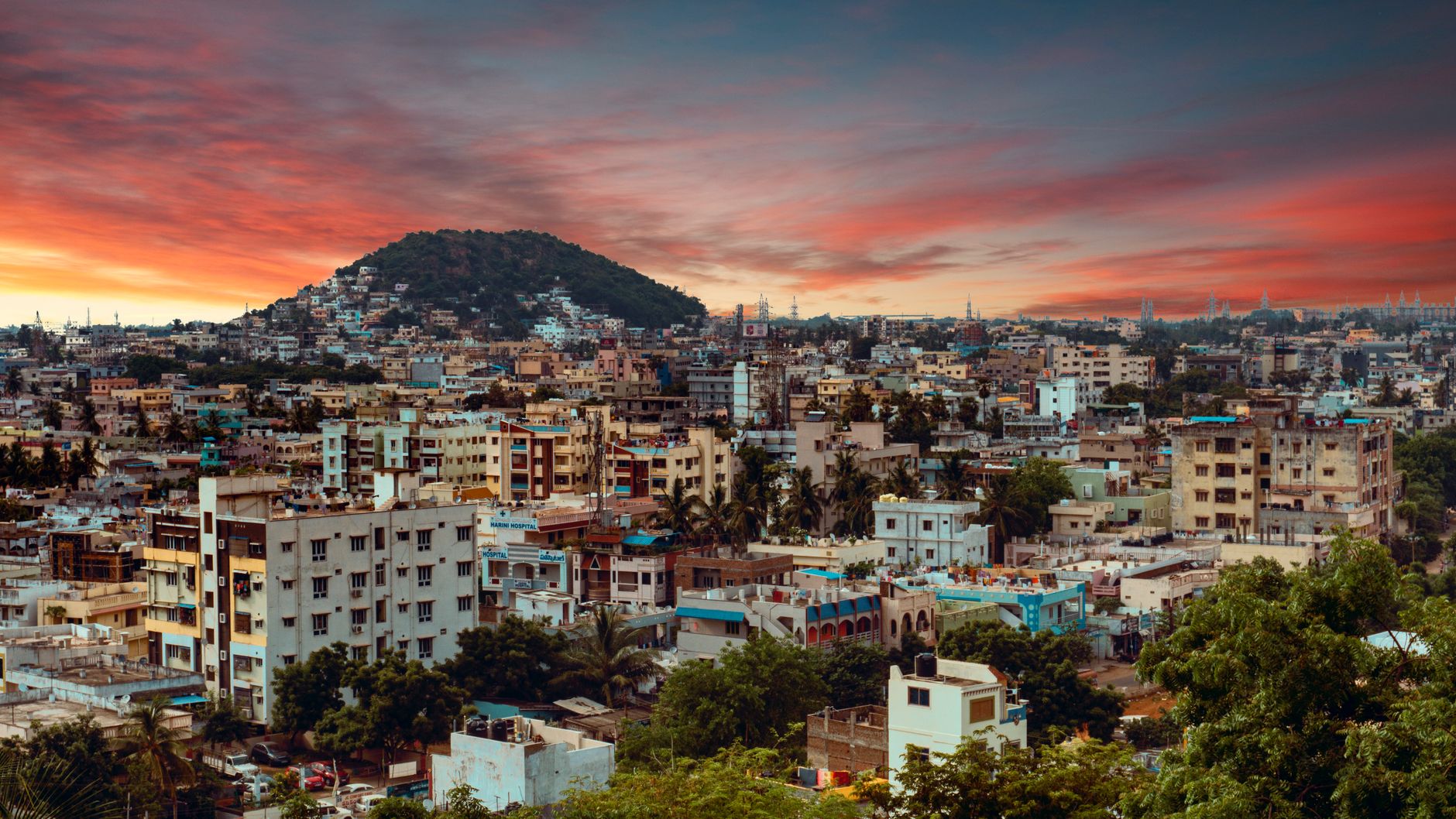
A breathtaking sunset illuminates the dense urban landscape and iconic hills of Vijayawada, India.
rompalli harish on Pexels

A view of an electrical substation facility and utility infrastructure located in Vijayawada, India.
SeekerAlamahgem

This architectural floor plan illustrates the layout of an ancient rock-cut cave temple located in Vijayawada, India.
Ms Sarah Welch

A dynamic live musical performance captured on stage under dramatic purple lighting in Vijayawada, India.
Saishna96

Intricately carved stone figures and guardian lions stand guard at the historic Undavalli Caves, a prominent archaeological site near Vijayawada, India.
Sigirisetty Surya Kiran Sigirisetti (talk) (Uploads)

The glowing red Om symbol shines brightly atop a hill in Vijayawada, India, overlooking the city at night.
EnrichIndegi

A view of Vijayawada, India.
en:user:Man praveen

A multi-story school building in Vijayawada, India, set against a dramatic backdrop of rugged, green-covered hills.
Raj1269

The inviting facade of Chillies Restaurant in Vijayawada, India, glows with festive evening lighting and decorative palm trees.
Saishna96

A view of the historic ruins overlooking the city of Vijayawada, India, offering a glimpse into the region's rich architectural heritage.
Jansher Chakkittammal on Pexels
Yes, if you want to see living South-Indian temple culture rather than monuments in glass cases. The city’s energy peaks during Dasara when one million pilgrims climb Indrakeeladri Hill, and the Krishna River ghats light up like a moving festival every evening.
Two full days cover the essentials—temple sunrise, Undavalli Caves, Kondapalli fort and toy village, plus an evening street-food crawl on MG Road. Add a third day if you plan boat trips to Bhavani Island or side excursions to Amaravati.
Take the bright-red APSRTC airport bus; it leaves every 30 min, costs under ₹50 and drops you opposite the main railway station in 45 min. Pre-paid taxis charge ₹400–600 and save only ten minutes when traffic is light.
Generally yes, but use app-based cabs after 10 p.m. instead of haggling with auto drivers. The temple hill and river ghats are crowded till late, yet lonely stretches near Prakasam Barrage should be avoided after dark.
Budget ₹1,200–1,500: ₹300 for a clean double room in Labbipet, ₹150 per meal at a ‘meals’ mess, ₹100 for city buses, and ₹150 entry to caves or fort. Upscale hotels and river-view restaurants push daily spend to ₹3,000+.
Dasara (Navaratri) in September–October is the city’s biggest surge—Kanaka Durga Temple hosts a million visitors over ten days. In 2026 the once-in-12-years Kumbhabhishekam reconsecration already happened (March 6-8), so crowds return to normal levels.
Ready to book?
Vijayawada International Airport (VGA) at Gannavaram has daily non-stops to DEL, BOM, BLR, MAA, HYD, CCU, PNQ, AMD. The city rail junction is on the Howrah-Chennai main line; all Kolkata-Chennai expresses stop here. NH-16 and NH-65 feed long-distance buses from Hyderabad (270 km) and Chennai (420 km).
No metro yet. APSRTC city buses radiate from Pandit Nehru Bus Station; fares ₹5-30. Ola and Uber cover the core; autos quote ₹30-100 for short hops but rarely use the meter. APTDC day-tour coach hits Undavalli, Kondapalli and Amaravati for ₹550 including ferry to Bhavani Island—book at aptdc.ap.gov.in.
Winter (Dec-Jan) 28 °C days, 16 °C nights—ideal. February warms to 32 °C and stays dry. Summer (Apr-May) peaks at 43 °C; avoid. Monsoon (Jun-Sep) drops highs to 34 °C but brings 900 mm of rain, mostly July. October is sticky; November cools and clears—second-best window.
Telugu dominates; Hindi is patchy, English works at hotels and bigger restaurants. Carry small ₹100 notes—street stalls and temple donation boxes rarely take cards. UPI (PhonePe, Google Pay) is accepted even for ₹10 coconut water.
9 places to discover
