Introduction
How does a place where a man once sat down and talked to five friends become the axis around which an entire civilization turns? Sarnath Deer Park, ten kilometers northeast of Varanasi, India, is where Gautama Buddha delivered his first sermon roughly 2,500 years ago — and the ground still hums with that conversation. Come here not for spectacle but for the strange, accumulating weight of a spot that changed the direction of human thought.
What you see today is a wide, green lawn anchored by the Dhamek Stupa, a 43.6-meter cylinder of stone and brick — taller than a ten-story building — rising from the flat Gangetic plain like a landlocked lighthouse. Monks in saffron and maroon robes circle it slowly. The air smells of cut grass and sandalwood incense drifting from the nearby Mulagandha Kuti Vihara. Spotted deer graze behind a low fence, a living footnote to the park's ancient name: Mrigadava, the Deer Grove.
But the serenity is deceptive. Sarnath is also a crime scene. The greatest single act of heritage destruction in this region happened here in 1794, when a local official demolished an entire ancient stupa for building materials and dumped its sacred relics into the Ganges. What survives is a fraction of what Chinese pilgrims described seeing a thousand years earlier — hundreds of stupas, a tower taller than the Leaning Tower of Pisa. Most of that world is gone, either scavenged for bricks or buried beneath the modern village.
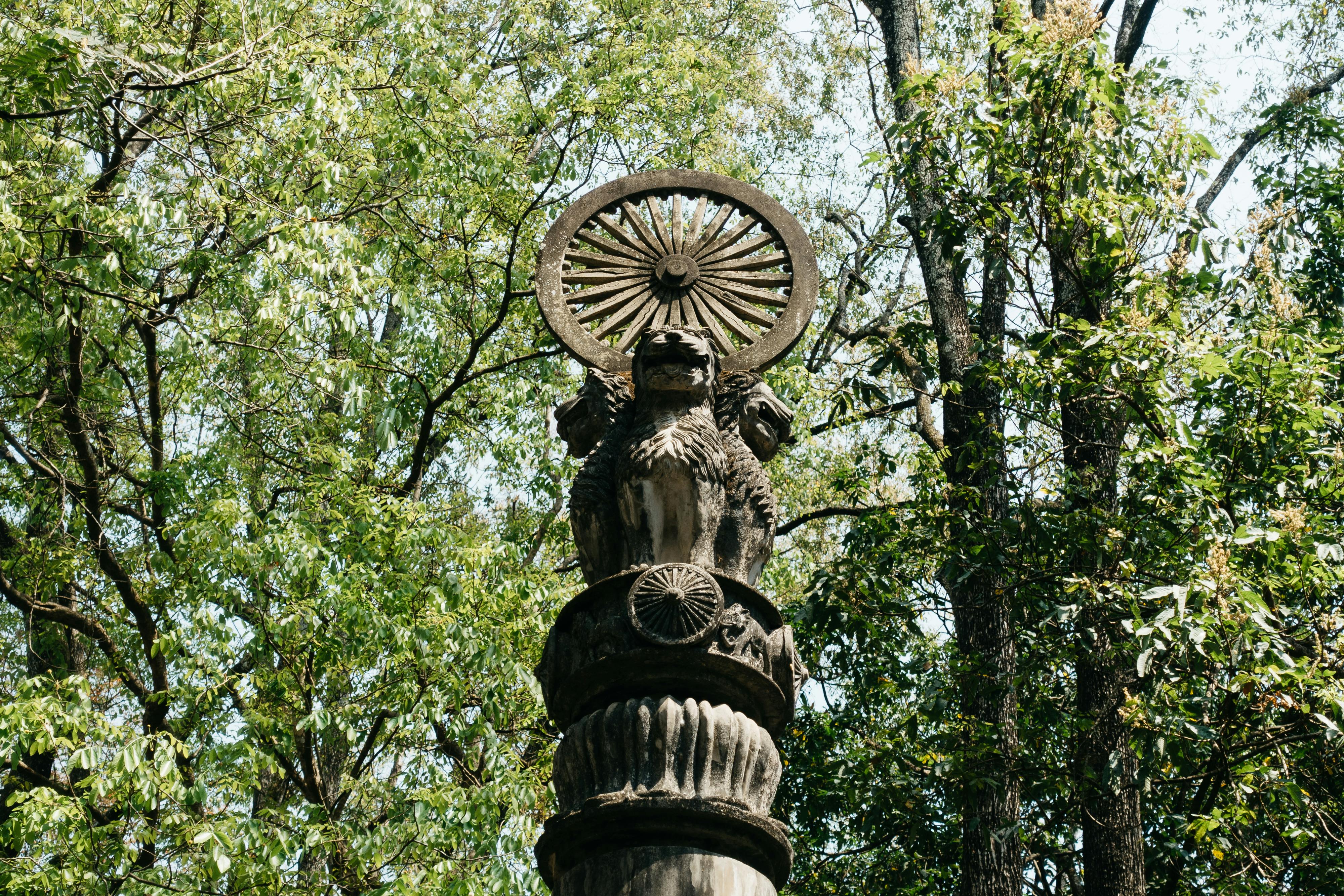
The site matters today for reasons both spiritual and civic. The Lion Capital of Ashoka, unearthed here in 1905, became India's National Emblem — the four roaring lions you see on every rupee note and government letterhead. Tibetan, Thai, Burmese, and Japanese monasteries cluster around the ruins, each maintaining its own traditions. On Asalha Puja each July, thousands of pilgrims gather to hear the same sermon recited that the Buddha first spoke here. The words are the same. The deer are still watching.
What to See
Dhamek Stupa
The first thing that strikes you is the scale. Dhamek Stupa rises 43.6 meters — roughly the height of a twelve-story building — from a base 28 meters wide, and it has been standing here in some form since the Gupta period, around the 5th century CE. This is the spot where, around 528 BCE, Siddhartha Gautama delivered his first sermon to five disciples and set Buddhist philosophy into motion. The lower stone courses still carry intricate floral and geometric carvings from Gupta-era artisans, though wind and monsoons have softened them into something almost organic, as if the stone is slowly returning to the earth it describes. Look closer at the base blocks and you'll find faint grooves worn into the surface — not by weather, but by centuries of pilgrims running their hands along the stone during circumambulation. The monument doesn't shout its importance. It simply outlasts everything around it. Come at sunset, when low-angle light catches every texture in the brickwork and the lawns empty out, and you'll understand why monks still sit cross-legged in its shadow, facing the same direction the Buddha's audience once did.

Sarnath Archaeological Museum
A ten-minute walk from the stupa grounds, this museum — opened in 1910 and one of the oldest site museums in India — holds the object you've already seen a thousand times without knowing it. The Lion Capital of Ashoka, four back-to-back Asiatic lions carved from a single block of polished Chunar sandstone around 249 BCE, became India's national emblem in 1950. Seeing it at arm's length is genuinely disorienting; photographs flatten its power. The sandstone has a near-metallic sheen that Mauryan sculptors achieved through a polishing technique scholars still debate. Beyond the capital, the museum holds over 6,000 artifacts spanning a millennium, but the standout is the 5th-century seated Buddha in the Sarnath school style — hands positioned in the teaching gesture, eyes half-closed, carved with a precision that makes Gupta-period sculpture feel less like religious art and more like portraiture. The collection is small enough to absorb in an hour. Don't rush past the inscribed clay seals in the side galleries; they reveal Sarnath's long second life as a scholarly hub, centuries after the Buddha walked here.
A Walking Circuit: Ruins, Deer, and the Bodhi Tree
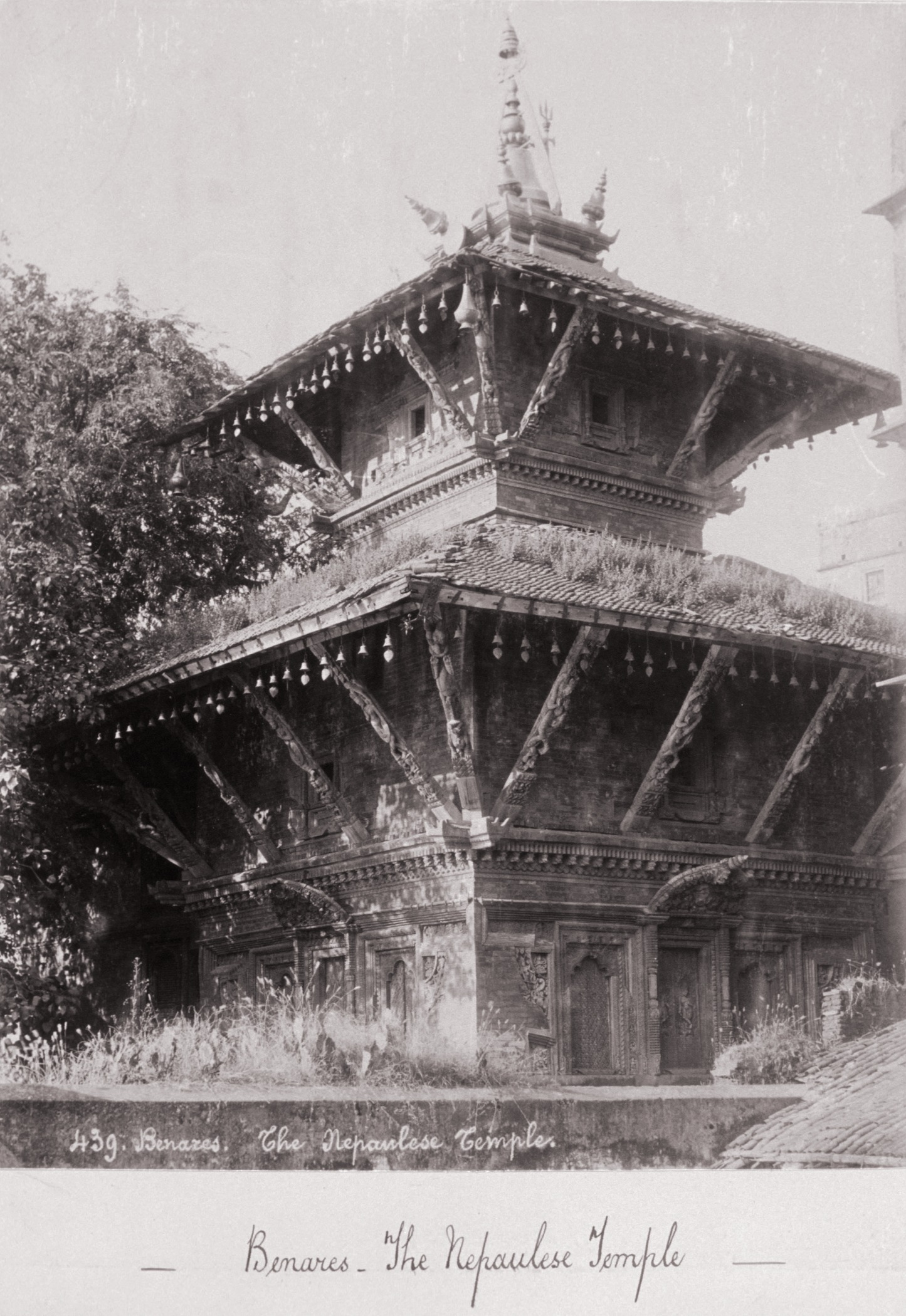
Start at the Chaukhandi Stupa on the approach road — its terraced rectangular base marks where the Buddha reunited with his five former companions, and the octagonal tower on top was added in 1588 CE to commemorate Mughal Emperor Humayun's visit. From there, enter the main archaeological zone and walk slowly through the exposed monastery foundations. These low brick walls once supported viharas that housed hundreds of monks, and tracing their floor plans gives you a physical sense of the community that grew here. Spotted deer still graze the lawns between the ruins, a living echo of the park's ancient name, Mrigadava — "Deer Grove." End at the Mulagandha Kuti Vihara, the modern temple completed in 1931, where a cutting from the sacred Bodhi tree in Anuradhapura, Sri Lanka — itself descended from the original tree in Bodh Gaya — was planted in the courtyard. The whole circuit takes about ninety minutes at a contemplative pace. Winter mornings, between November and February, are ideal: the air is cool, the light is soft, and the site is quiet enough that you can hear birds in the ancient trees before you hear another visitor.

Photo Gallery
Explore Sarnath Deer Park in Pictures

On the lower cylindrical band of the Dhamek Stupa, run your eyes slowly across the carved stone frieze — interlocking floral scrolls and geometric knotwork from the Gupta period (4th–6th century CE) survive in remarkable detail. Look for the subtle human and bird figures folded into the foliage, which most visitors walk past without noticing.
Visitor Logistics
Getting There
Sarnath sits about 10 km northeast of Varanasi city center. The fastest option is the local train from Varanasi Junction to Sarnath Railway Station — just 7 to 10 minutes, cheaper than a cup of chai. Auto-rickshaws and taxis take 30 to 50 minutes depending on traffic; book through Ola or Uber to avoid the inevitable fare inflation at the station.
Opening Hours
As of 2025, the archaeological park opens at sunrise and closes at sunset, with most visitors arriving between 8:00 AM and 5:00 PM. The Sarnath Museum keeps the same hours but closes every Friday. During Buddha Purnima (usually May), expect large crowds and plan transport 2–3 weeks ahead.
Time Needed
A focused visit covering the Dhamek Stupa and Ashoka Pillar base takes 1 to 2 hours. To properly absorb the museum's Lion Capital, walk through the Mulagandha Kuti Vihara frescoes, and sit beneath the Bodhi tree, budget 3 to 4 hours. The place rewards slowness.
Tickets & Cost
As of 2025, entry fees range from ₹5 for Indian nationals to around ₹300 for foreign visitors, with combo tickets covering both the ruins and the museum. Tickets are sold at the gate by the Archaeological Survey of India — third-party "skip-the-line" bookings exist online but rarely save time at a site this manageable.
Accessibility
The main pathways through the archaeological park are flat and gravel-surfaced, manageable for wheelchairs in dry weather. Monastery mounds and stupa interiors involve uneven brick and raised thresholds with no ramps or elevators. After rain, gravel paths soften considerably — stick to the paved central route.
Tips for Visitors
Dress Modestly, Remove Shoes
Cover shoulders and knees — this is a living pilgrimage site, not just ruins. Remove footwear before entering the Mulagandha Kuti Vihara; the stone floor runs cool even in summer.
No Photos in Museum
Photography is welcome across the open-air ruins, but the Sarnath Museum strictly prohibits cameras inside its galleries — including phones. You'll see the original Ashoka Lion Capital here, so linger with your eyes instead.
Dodge the Touts
Self-appointed guides and "donation collectors" for animal feed or temple upkeep cluster near the entrance. Politely decline — the ASI signage inside the park is thorough, and legitimate guides carry government-issued ID cards.
Arrive Early, Avoid Summer
Morning light — before 9 AM — hits the Dhamek Stupa's Gupta-era carvings at a raking angle that makes the 1,500-year-old floral patterns pop. April through June temperatures regularly exceed 42°C; October to March is far more humane.
Eat Local Outside Gates
Food is prohibited inside the archaeological zone. For a post-visit meal, the small kachori-sabzi stalls in the market lane just outside the main gate are budget-friendly and better than the tourist-facing cafés. Aditya Restaurant offers a decent mid-range thali if you want to sit down.
Combine Nearby Sites
The Myanmar Temple, with its red-and-gold interior, and the Chaukhandi Stupa — where Akbar added an octagonal tower in 1588 — are both within a short walk or rickshaw hop. Together with the main park, they fill a satisfying half-day away from Varanasi's intensity.
Where to Eat
Don't Leave Without Trying
Restaurant U.P. 61
local favoriteOrder: Baati Chokha — roasted wheat balls paired with spiced mashed eggplant and potato. A rustic, deeply satisfying North Indian staple that captures the region's Bhojpuri culinary soul.
Located directly within the Buddhist temple complex at Sarnath, this is where pilgrims and local visitors actually eat after exploring the Deer Park and Dhamek Stupa. The vegetarian focus reflects the spiritual character of the site.
Dining Tips
- check Most restaurants in Sarnath are strictly vegetarian or heavily vegetarian-focused, reflecting the Buddhist pilgrimage site's spiritual character.
- check Sarnath Main Road and Mawaiya Road are the primary hubs for dining options — easily accessible via taxi or auto-rickshaw from the Deer Park.
- check Street food stalls near the Dhamek Stupa offer authentic local snacks like samosas and chaat at very affordable prices.
- check Always confirm opening hours before visiting, as business hours can vary seasonally and during pilgrimage periods.
Restaurant data powered by Google
Historical Context
The Sermon, the Emperor, and the Man Who Threw It All in the River
Sarnath's history spans over two millennia, but it bends around three gravity points: a sermon that launched a world religion, an emperor who monumentalized it, and a bureaucrat who nearly erased it all. According to Buddhist tradition, around 528 BCE the Buddha walked here from Bodh Gaya — roughly 250 kilometers on foot — to find five ascetics who had once abandoned him. He spoke to them in this deer grove, and what he said became the Dhammacakkappavattana Sutta, the foundational text of Buddhism.
Emperor Ashoka arrived about 280 years later, around 249 BCE, and transformed the site from a place of memory into a place of stone. His workers erected pillars, stupas, and monasteries. The Lion Capital they carved for the top of his pillar — four Asiatic lions standing back to back, each about the height of a grown man — would be excavated by F.O. Oertel in 1905 and eventually become the emblem of the Republic of India. Between Ashoka and the 12th century, Sarnath grew into a major monastic university where the Sammatiya school of Buddhism thrived. Then came centuries of decline, destruction, and rediscovery.
Jagat Singh and the Stupa He Fed to the Ganges
Most visitors assume that Sarnath's ruins look the way they do because of age — that time and weather slowly ground down the monasteries and stupas into their current state of elegant decay. The Dhamek Stupa stands massive and intact; the rest is rubble. A natural process, you might think. It wasn't.
In 1794, Jagat Singh, the Diwan (chief minister) to Raja Chet Singh of Banaras, needed bricks. He was building a marketplace in Varanasi, and the ancient Dharmarajika Stupa — a structure Emperor Ashoka's laborers had raised some two thousand years earlier — offered a convenient quarry. Jagat Singh ordered his workers to tear it apart. During the demolition, they cracked open a stone box buried deep inside the stupa's core. Inside sat a marble casket containing human bone fragments — almost certainly relics venerated as the Buddha's own remains. Jagat Singh's men threw the bones into the Ganges. The marketplace got its bricks.
What changed? Everything you don't see. The Chinese pilgrim Xuanzang, visiting in the 7th century, described a 61-meter-tall Vihara and hundreds of smaller stupas crowding the site. Today you see the Dhamek Stupa and a field of low brick foundations. Jagat Singh didn't act alone — centuries of neglect preceded him — but his demolition was the tipping point, the moment when the material record of Sarnath's golden age became irrecoverable. Stand at the circular foundation of the Dharmarajika Stupa today and you're looking at an absence. The green grass filling the center grows where sacred architecture once rose higher than the surrounding treeline.
Ashoka's Mark and India's Emblem
The Ashoka Pillar at Sarnath once stood complete — a polished sandstone shaft topped by the Lion Capital, carved around 249 BCE by stoneworkers whose names are lost but whose skill remains astonishing. The pillar's mirror-smooth surface still baffles materials scientists; no one has definitively explained how Mauryan-era craftspeople achieved that polish. Only the base remains in situ today. The Lion Capital sits in the Sarnath Archaeological Museum, 200 meters away, behind glass. In 1950, the newly independent Republic of India adopted it as the National Emblem, linking a 21st-century democracy to a 3rd-century-BCE ideal of governance through dharma. Every Indian passport, every rupee coin, every government seal carries the image of something that was pulled from the dirt of this park.
A Living Temple Among the Ruins
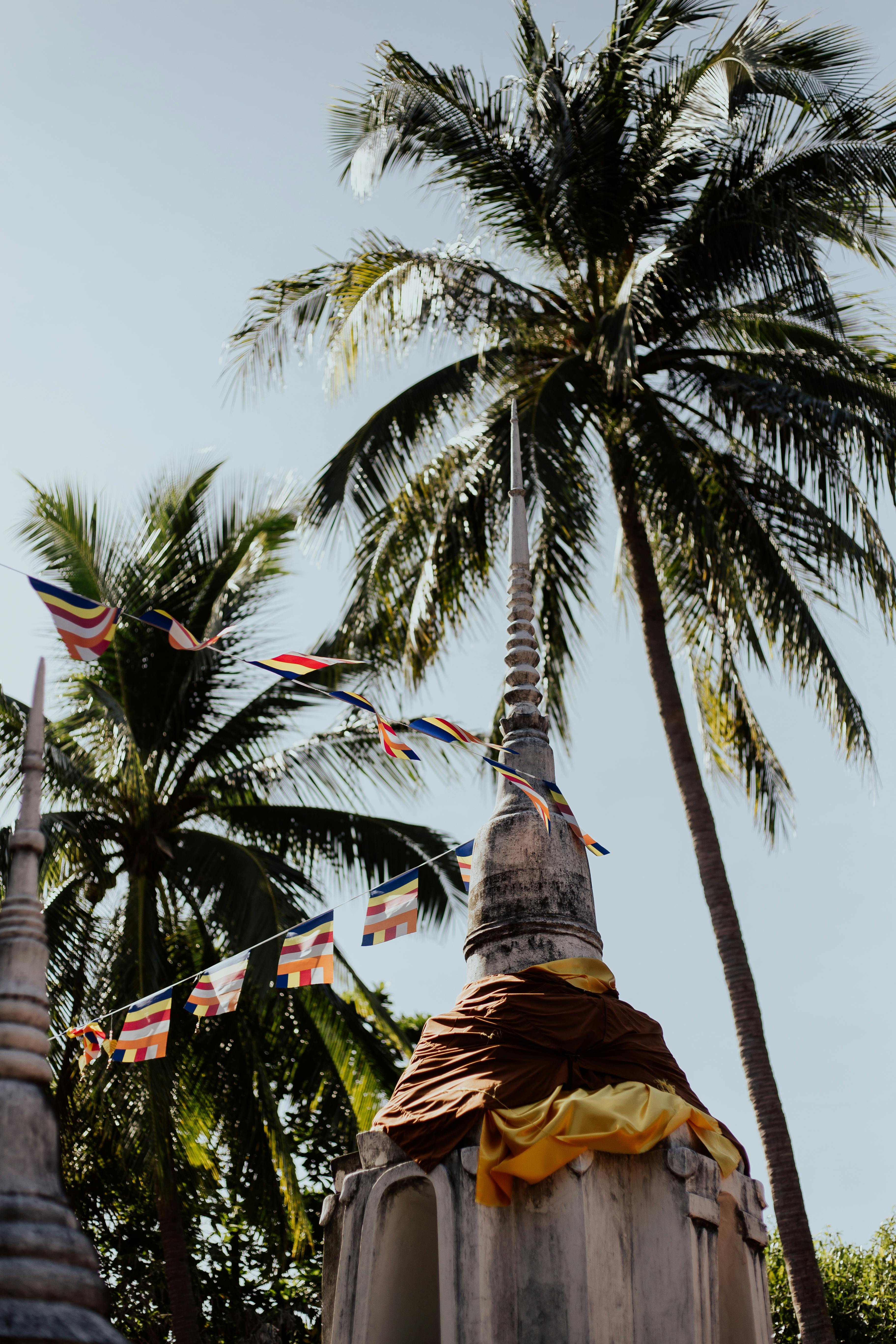
The Mulagandha Kuti Vihara, completed in 1931 by the Mahabodhi Society, is the youngest major structure at Sarnath and the only one still in daily use for worship. Japanese artist Kosetsu Nosu painted its interior murals depicting the Buddha's life — rich golds and deep reds that glow in the dim light. Outside, a Bodhi tree grows from a cutting brought from Anuradhapura, Sri Lanka, itself descended from the original tree at Bodh Gaya. The tree is less than a century old but its lineage stretches back over two thousand years. Monks from Tibetan, Thai, Burmese, and Japanese traditions maintain separate monasteries within walking distance, each performing their own daily rituals — masked Cham dances, Pali chanting, Zen meditation — creating a kind of living atlas of Buddhist practice concentrated in a few square kilometers of Uttar Pradesh.
The Chinese pilgrim Xuanzang described a 61-meter Vihara and hundreds of stupas at Sarnath in the 7th century; archaeologists have accounted for only a fraction of these structures, and whether the rest lie buried beneath the modern village of Sarnath or were entirely dismantled for building materials remains an open question that no excavation has yet resolved.
If you were standing on this exact spot on a full-moon night around 528 BCE, you would see five gaunt men sitting cross-legged on the grass of a deer grove, fireflies drifting between sal trees. A sixth man — thin, recently recovered from years of extreme fasting — speaks quietly. There is no stupa, no pillar, no monastery. Just a voice explaining suffering, its origin, its cessation, and the path. The deer graze unbothered at the edge of the clearing. One of the five listeners, Kaundinya, suddenly understands. The Buddha pauses and says, according to tradition, 'Kaundinya knows.' That sentence sets the wheel turning.
Listen to the full story in the app
Your Personal Curator, in Your Pocket.
Audio guides for 1,100+ cities across 96 countries. History, stories, and local insight — offline ready.
Audiala App
Available on iOS & Android
Join 50k+ Curators
Frequently Asked
Is Sarnath Deer Park worth visiting? add
Yes — if you care about history more than polish. This is where the Buddha delivered his first sermon around 528 BCE, making it one of the four holiest sites in Buddhism and older than the Parthenon by nearly a century. The Dhamek Stupa alone, 43.6 meters tall (roughly the height of a 14-story building), rewards the 10 km trip from Varanasi. But manage expectations: the animal enclosures are neglected, and the site is more contemplative ruin than manicured attraction.
How long do you need at Sarnath Deer Park? add
Plan for two to four hours depending on your appetite for archaeology. A quick circuit of the Dhamek Stupa and Ashoka Pillar base takes about 90 minutes. Add another hour or two if you want to explore the Sarnath Archaeological Museum — home to the original Lion Capital that became India's national emblem — and the Mulagandha Kuti Vihara with its striking interior frescoes.
How do I get to Sarnath Deer Park from Varanasi? add
The fastest option is the local train from Varanasi Junction to Sarnath Railway Station, which takes roughly 7–10 minutes. Auto-rickshaws and taxis cover the 10–12 km distance in about 30–40 minutes depending on traffic; use Uber or Ola to avoid the overcharging that plagues the tourist routes. Local buses run from the Varanasi Bus Stand but can take up to 50 minutes.
What is the best time to visit Sarnath Deer Park? add
November through February, when daytime temperatures are cool enough to walk the exposed ruins comfortably. The site has almost no shade, so summer visits between April and June can be brutal. If you want to witness Sarnath at its most alive, time your visit for Buddha Purnima (April/May) or Asalha Puja (July), when monks from Tibetan, Thai, Burmese, and Japanese monasteries gather for chanting and circumambulation — though book transport and lodging weeks in advance.
Can you visit Sarnath Deer Park for free? add
Not quite. Entry fees range from ₹5 for Indian nationals to around ₹300 for foreign visitors, depending on whether you buy a combo ticket covering the archaeological ruins and the museum. The Mulagandha Kuti Vihara, just outside the ticketed zone, is free to enter. The museum is closed every Friday, so plan accordingly.
What should I not miss at Sarnath Deer Park? add
The Dhamek Stupa is the obvious anchor, but look closely at its stone base — faint grooves worn into the rock mark centuries of pilgrims touching the surface during circumambulation. Don't skip the Archaeological Museum and its Lion Capital of Ashoka, unearthed here in 1905 by F.O. Oertel. And seek out the remains of the Dharmarajika Stupa: in 1794, Jagat Singh, diwan to Raja Chet Singh, demolished it for building bricks and dumped the bone relics found inside into the Ganges. What's left is a quiet, damning absence.
Is photography allowed at Sarnath Deer Park? add
Photography is freely permitted throughout the open-air archaeological ruins and around the Dhamek Stupa. Inside the Sarnath Museum galleries, however, cameras and phones are strictly prohibited. Be respectful around monks and pilgrims — ask before photographing people in prayer, and leave the drone at home unless you've secured an ASI permit.
What is the history of Sarnath Deer Park in Varanasi? add
Sarnath is where the Buddha set the Dharma in motion, delivering his first sermon to five disciples around 528 BCE. Emperor Ashoka built the original stupas and his famous pillar here around 249 BCE. The Gupta dynasty expanded the Dhamek Stupa between the 4th and 6th centuries CE into the massive structure visitors see today. The site's darkest chapter came in 1794, when Jagat Singh demolished the ancient Dharmarajika Stupa for construction materials, destroying irreplaceable relics in the process. British-era excavations beginning in the early 1900s recovered the Lion Capital and revealed the monastic foundations that now cover the grounds.
Sources
-
verified
UNESCO World Heritage Centre – Tentative List
Historical timeline, Chaukhandi Stupa details, and UNESCO nomination context for Sarnath
-
verified
Wikipedia – Sarnath
General history, etymology, accounts of Chinese pilgrims Faxian and Xuanzang, and overview of lost structures
-
verified
Itihaas – Sarnath
Historical significance of the first sermon, Gupta-period expansion details, and etymology of Sarnath
-
verified
Incredible India – Dhamek Stupa
Architectural details and dating of the Dhamek Stupa, including Gupta-period attribution
-
verified
Trawell.in – Sarnath Archaeological Remains
Details on the Dharmarajika Stupa destruction in 1794, Sunga-period monolithic railing, and Ashoka's activity
-
verified
Kashi.gov.in – Sarnath Museum
Information on the Ashoka Pillar, Lion Capital, Chaukhandi Stupa, and Gupta-period construction
-
verified
Pawanpath UP Government – Sarnath
Details on the 1931 Mulagandha Kuti Vihara opening, Bodhi tree planting, and UP government tourism initiatives
-
verified
KashiTaxi – Sarnath Timing & Visit Guide
Practical visitor information including opening hours, ticket prices, and museum closure days
-
verified
TripAdvisor – Sarnath Deer Park Reviews
Visitor reviews providing local opinions, time-needed estimates, and animal enclosure condition reports
-
verified
Gops.org – Sarnath
Details on Emperor Ashoka's pillar erection and early stupa construction circa 249 BCE
-
verified
Rome2Rio – Varanasi to Sarnath
Transportation options and travel times between Varanasi city center and Sarnath
-
verified
BanarasDiary – Distance and Transportation
Specific distance and transit details from Varanasi Cantonment to Sarnath
-
verified
Teja On The Horizon – Varanasi Day Trip Sarnath
On-the-ground practical details including food restrictions, toilet availability, and photography rules
-
verified
Critical Collective – Sarnath Art History
Details on the Ashokan Pillar inscriptions and their anti-schism edicts
-
verified
Namaste India Trip – Sarnath Festivals
Information on Asalha Puja, Buddha Purnima, and Sangha Day observances at Sarnath
-
verified
Lion's Roar – Buddhist Calendar
Context on Buddhist holy days and their observance at major pilgrimage sites including Sarnath
-
verified
MDPI / Shinde – Heritage Management Research
Scholarly analysis of tensions between pilgrimage tourism, local community needs, and archaeological preservation at Sarnath
-
verified
Varanasi Guru – Tourist Scams
Warnings about fake guides, donation traps, and transport overcharging around Sarnath
-
verified
Google Arts & Culture – Sarnath: Turning the Wheel of Law
ASI-curated overview of the Lion Capital discovery and the Sarnath school of sculpture
-
verified
UP Tourism / Facebook – Vajra Vidya Vihara
Information on the lesser-known Vajra Vidya Vihara monastery near the main archaeological complex
Last reviewed: