An introduction.
Researched by the Audiala editorial team from historical records, architectural archives, and local expertise.
EEvery semester, thousands of students walk to class beneath trees planted on the orders of a Mughal emperor — and almost none of them know it. The University of Kashmir in Srinagar, India, occupies Naseem Bagh, a royal pleasure garden that Emperor Akbar commissioned in 1586, and its chinar trees are older than the Taj Mahal by half a century. Come here not for the lecture halls but for what the campus accidentally preserves: a compressed archive of everything Kashmir has been, from imperial conquest to sacred relic to modern university, layered into a single stretch of Dal Lake shoreline.
The campus sits at Hazratbal, 200 meters from the shrine that holds what the faithful believe is a hair of the Prophet Muhammad. That proximity is not an accident. When the founders chose this site in 1948 — three years after Partition tore the subcontinent apart — they were making a statement about where modern education belongs in Kashmiri Muslim life. The university's motto, rendered in English as "From Darkness to Light," is a direct Quranic verse: Min al-Zulumat ila al-Nur. A secular public university quoting scripture as its founding principle. The tension in that choice still hums beneath the surface.
What you see today is a functioning campus with 30,000-odd students, NAAC Grade A++ accreditation as of 2025, and satellite campuses stretching from Anantnag in the south to Baramulla in the north. What you don't see is the decade the university effectively lost — the 1990s, when conflict shut classrooms and the Indian Army cordoned off the campus during the Hazratbal Shrine siege of 1993. The promotional materials skip from 1969 to 2002. The gap speaks loudly.
The reason to visit is the ground itself. Walk through the main campus and you are walking through 440 years of Kashmiri history that no one has bothered to label. The chinar trees — some with trunks wider than a car — are living Mughal monuments. The shrine dome visible across the water has shaped the politics of the entire subcontinent. And the university, built in the space between, keeps trying to be ordinary. It isn't.
01 What to see.
Naseem Bagh
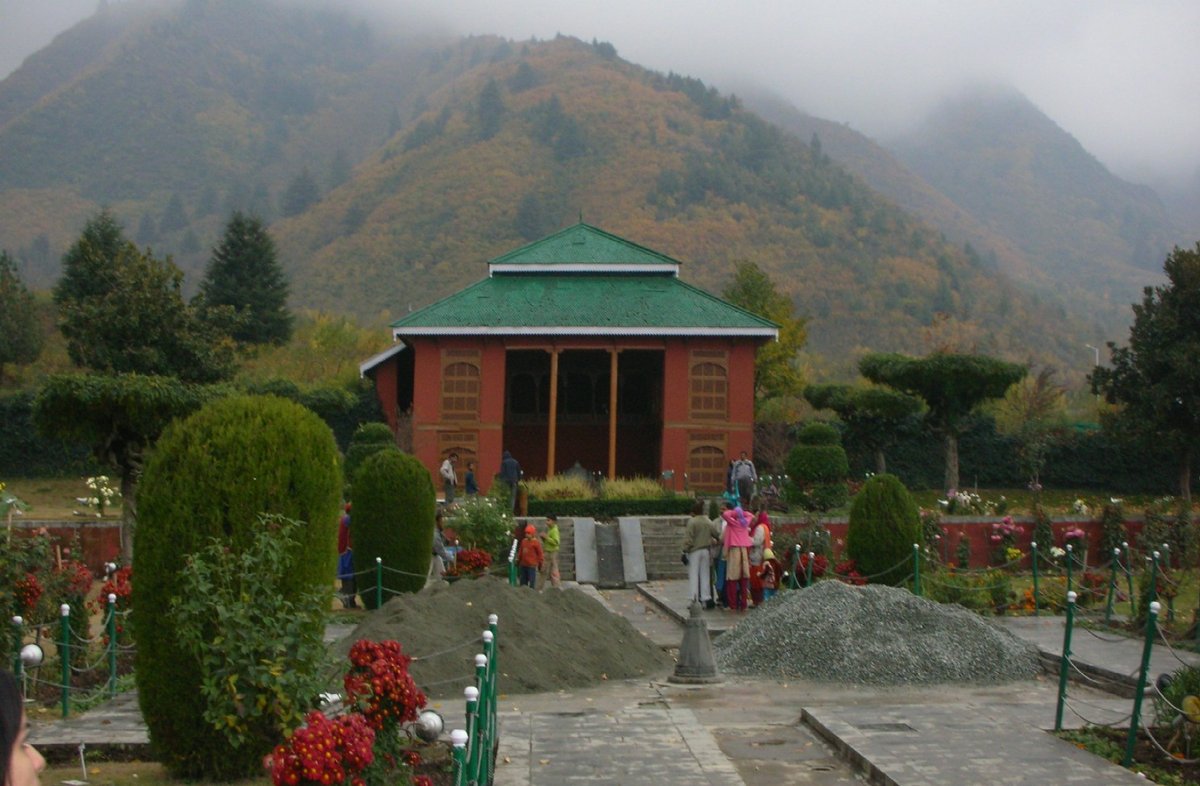
Emperor Akbar founded this garden in 1586. Fifty years later, Shah Jahan had roughly 700 chinar trees planted in a pattern most visitors never notice: four trees at each clearing's corners, angled so the canopy covers the center ground regardless of the sun's position. The Mughals engineered shade the way other empires engineered fortifications — with geometry.
Those chinars still stand, nearly 400 years old, each trunk wider than a car. In autumn, the leaves shift from green to gold to a crimson so saturated it looks like the trees are on fire, and the ground disappears under a crunching carpet of color.
Water channels fed from Dal Lake thread between small ponds and stone fountains, still running on nothing but gravity. Trace their path and you're reading a 16th-century hydraulic blueprint. Come at dawn in October — backlit chinar leaves glow amber against the rising sun, an effect that vanishes entirely by midday.
The Administration Building
A mature fir tree stood exactly where ANA Design Studio needed to place the entrance of this 4,000-square-metre building in 2018. They didn't remove it. The tree became the building's organizing principle — rising through a central atrium, visible from the front door through the full depth of the interior.
Bridges cross the atrium at different heights. Stand at ground level and look straight up: tree trunk, bridge railings, and skylight layer into a single geometric frame that feels more like installation art than institutional architecture.
The building's enthalpy controls shut down compressors entirely when outdoor conditions allow it, flooding the interior with mountain air. On a cool autumn morning, the inside smells like the outside. Interior details reference Khatamband — the traditional Kashmiri technique of interlocking geometric wooden pieces without a single nail — executed here in contemporary materials. A government building that defers to a tree. That alone is worth the visit.
A Campus Walk: Bones, Bricks, and Shifting Light
Start at the Allama Iqbal Library, a seven-storey tower holding 617,000 volumes — the largest university collection in Jammu & Kashmir, built alongside the university in 1948. The real surprise sits inside its Central Asian Museum: alongside ancient coins and Kashmiri manuscripts, you'll find Neolithic skeletons excavated from Burzuhama, roughly 5,000 years old.
Human remains inside a university library. Nobody warns you.
From there, walk the campus paths and read the buildings like geological strata. Colonial-era structures show Anglo-Indian Gothic signatures — steep gabled roofs, half-timbered facades, tall narrow chimneys. Older Kashmiri buildings use Dhajji Dewari construction, a timber-and-brick patchwork technique that flexes during earthquakes instead of cracking.
Find a traditional building with jali screens on a sunny morning and watch: the carved lattice casts geometric shadow patterns that migrate across the floor as the sun moves. The geometry is deliberate. The effect is temporary.
The campus sits on the shore of Dal Lake, with the white marble dome of Hazratbal Shrine visible just beyond the boundary. The atmosphere runs quieter than comparable Indian university campuses — the lakes, the mountains, and those ancient trees impose a contemplative hush particular to Srinagar.
02 In pictures.


Plan and listen to University Of Kashmir with Audiala.
Audio guide in your pocket, itinerary in your browser. Built for the way you actually visit.
03 Visitor logistics.
The practical scaffolding for a good visit — kept short.
Getting There
Red Bus Route 1 runs from TRC to Hazratbal University via Nigeen — look for Hazratbal Bus Stop 2, directly opposite the campus gate on Lal Bazar Road. From Lal Chowk, a shared sumo or auto-rickshaw takes 20–30 minutes over roughly 8 km. Sheikh ul-Alam International Airport sits 18 km south; budget 45–60 minutes by taxi with no direct bus option.
Opening Hours
As of 2026, the campus is accessible Monday through Saturday, 9:00 AM to 5:00 PM. Sundays follow standard Indian university practice — expect gates closed or access limited to security. Kashmir winters (December through February) don't officially shutter the university, but heavy snowfall and highway closures can make reaching it unpredictable.
Time Needed
A quick photo walk along the lakeside edge of the 247-acre campus — roughly the size of 140 football pitches — takes 45 to 90 minutes. If you want to explore the departmental buildings, the chinar-lined paths, and the views over both Dal and Nigeen lakes, set aside 3 to 4 hours. Combine it with the adjacent Hazratbal Shrine and you have a full half-day.
Cost
Entry is free — this is a public university, not a ticketed attraction. No booking or registration required for a casual visit. Specific facilities like the Allama Iqbal Library may restrict access to non-students, but walking the grounds and photographing the campus costs nothing.
04 Tips for visitors.
Small things that change the day.
Dress Conservatively
The campus sits in Hazratbal, one of Srinagar's most religiously observant neighborhoods. Cover shoulders and legs, and women should carry a scarf — especially if walking the few minutes to Hazratbal Shrine, which houses a relic of the Prophet Muhammad.
Camera Caution
Outdoor campus photography is generally fine, but never photograph military checkpoints, security personnel, or installations — J&K's security presence is heavy, and this is enforced. During high-profile events like convocations or Milad-un-Nabi, expect restrictions to tighten further.
Carry Your ID
Security checkpoints are common across Srinagar, including near the campus. Foreign nationals should carry their passport; Indian visitors need a government-issued ID. This is routine, not alarming — cooperate and you'll pass through in seconds.
Eat Like a Student
Chiliz The Pizza Shop (4.0 stars, budget-friendly) and Molly's Cafe both sit in the Kashmir University Aishibagh area and cater to the student crowd. For something more Kashmiri, hunt down a cup of noon chai — the pink, salt-laced tea sold by street vendors near Hazratbal — paired with fresh kulcha bread.
Avoid Friday Afternoons
Friday prayers at Hazratbal Shrine draw enormous crowds, and the roads around the university become a security corridor. Unless you specifically want to witness the gathering, plan your visit for a weekday morning when the campus is calm and accessible.
Walk Through Naseem Bagh
Adjacent to campus, this Mughal-era chinar grove is one of the oldest in Kashmir — massive plane trees planted centuries ago, their canopies filtering light onto worn paths. Locals use it for evening walks. It pairs perfectly with a campus visit and costs nothing.
05 A history of reinvention.
The Emperor's Garden, the Scholar's Blessing
The story of this place does not begin in 1948 with an act of parliament. It begins in 1586, when Akbar's armies conquered the Kashmir Valley and the emperor ordered a garden planted along the western shore of Dal Lake. Naseem Bagh — "Garden of the Morning Breeze" — was a chahar-bagh in the Persian style, its quadrants divided by water channels, its avenues lined with chinar saplings brought from Central Asia. Those saplings are now 440-year-old giants, and the garden they anchor became a university campus.
Between Akbar's gardeners and today's graduate students, the land passed through Afghan governors who let it decay, Sikh soldiers who used the shoreline strategically, and Dogra maharajas who held ceremonies under the same trees. Each regime left less visible trace than the last. The chinars outlasted them all.
A Sufi Scholar Blesses a Modern Campus, 1951
In 1951, three years after the university was constituted by act of the new state government, a man named Syed Meerak Shah Kashani stood on Mughal garden soil at Hazratbal and laid the foundation stone for the permanent campus. Photographs of the ceremony still circulate on Kashmiri social media — formal, black-and-white, a crowd gathered around a figure whose name now carries the honorific Radi Allahu Anhu, reserved in South Asian Sufi tradition for scholars of the highest spiritual rank. His precise biography has been lost; no standalone entry survives in any accessible reference work.
What was at stake for Kashani was more than a building. Kashmir in 1951 was raw. Partition had happened four years earlier. The first Kashmir War had ended only in 1949. Sheikh Abdullah's secular National Conference government was trying to build a modern state identity for a Muslim-majority population that had just been through the trauma of accession and invasion. Placing the university at Hazratbal — beside the most sacred Islamic site in the valley — was deliberate. And choosing a Sufi scholar, not a politician, to consecrate it was the turning point: a spiritual figure sanctifying secular education on ground that Akbar had claimed for empire four centuries before.
Kashani performed what amounted to a charged symbolic act — blessing a project whose long-term meaning was still unresolved. Modern education, Islamic tradition, Mughal imperial memory, and Kashmiri self-determination, all condensed into a single ceremony. The foundation stone went down. The questions it raised are still open.
Akbar's Pleasure Garden (1586–1947)
Birth and Bifurcation (1948–1969)
The Lost Decade and Recovery (1990s–Present)
Listen to the full story in the app
The whole University Of Kashmir,
told well.
Audio guides for 1,100+ cities across 96 countries. History, stories, and local insight — offline ready.

06 Frequently asked.
The questions travellers send us most about University Of Kashmir.
Is the University of Kashmir worth visiting?
Yes — but not for the reasons you'd expect from a university campus. The grounds occupy Naseem Bagh, a Mughal garden planted by Emperor Akbar in 1586, with ancient chinar trees older than the Taj Mahal lining the Dal Lake shore. The combination of 440-year-old living trees, lakeside views, and layered architecture from colonial to contemporary makes it unlike any other campus on the subcontinent.
How long do you need at the University of Kashmir?
A focused walk through Naseem Bagh and the main campus takes 60 to 90 minutes. If you want to explore the Allama Iqbal Library's Central Asian Museum, study the architectural layers across different eras of campus buildings, and linger under the chinar canopy, allow three to four hours. Combine it with the adjacent Hazratbal Shrine for a half-day visit.
How do I get to the University of Kashmir from Srinagar city centre?
From Lal Chowk, the campus is about 8 km north — a 20 to 30 minute ride by auto-rickshaw or shared taxi. Srinagar's Red Bus Route 1 runs from TRC through Nigeen to Hazratbal University, and Hazratbal Bus Stop 2 sits directly opposite the campus on Lal Bazar Road. From the airport, expect a 45 to 60 minute taxi ride covering roughly 18 km.
What is the best time to visit the University of Kashmir?
Autumn, between September and November, is the clear winner. The campus's hundreds of chinar trees turn from green to gold to crimson, carpeting the Mughal-era garden paths in fallen leaves against a backdrop of snow-capped mountains. Spring (March to May) brings almond blossoms and fresh green growth. Avoid December through February — heavy snowfall and winter vacation leave the campus largely empty.
Can you visit the University of Kashmir for free?
Yes, entry to the campus is free. The university is a public institution with open grounds accessible Monday through Saturday, roughly 9 AM to 5 PM. Some internal facilities like the library or museum may have restricted access, so ask at the gate if you want to go beyond the gardens and general campus areas.
What should I not miss at the University of Kashmir?
Three things. First, the chinar trees of Naseem Bagh — planted under Mughal orders in the 1580s and 1630s, arranged in a deliberate four-corner shading pattern most visitors walk past without understanding. Second, the New Administration Building, where the entire structure was designed around a pre-existing fir tree visible through a glass atrium with bridges crossing overhead. Third, walk to the campus edge facing Dal Lake at golden hour — the Hazratbal Shrine's white marble dome catches the last light across the water.
What is the history of the University of Kashmir?
The university was established by Act in 1948, one year after Indian independence, as the University of Jammu and Kashmir. In 1951, a Sufi scholar named Syed Meerak Shah Kashani laid the foundation stone of the permanent campus at Hazratbal — on land that had been Emperor Akbar's Naseem Bagh garden since 1586. The institution bifurcated in 1969 into the University of Kashmir (Srinagar) and the University of Jammu. The campus endured effective shutdown during the 1990s conflict, including the month-long Hazratbal Shrine siege of 1993 at its front door, before expanding with satellite campuses in the 2000s.
Is the University of Kashmir near Hazratbal Shrine?
They're essentially neighbours — the Hazratbal Shrine sits immediately adjacent to the campus, sharing the same Dal Lake shoreline. You can walk between the university gate and the shrine in minutes. Locals treat the two as a single zone, and on Fridays or during Islamic holy days the entire area transforms into a pilgrimage corridor with heavy foot traffic and security presence.
Verified, and shown.
Researched and written by the Audiala editorial team from historical records, architectural archives, and local expertise.
Founding dates (1948, 1969 bifurcation), satellite campus details, expansion history under various Vice-Chancellors, NAAC accreditation
Campus size (247 acres), location at Hazratbal, official founding information, active admission notices confirming 2026 operations
Confirmation of 1948 founding date
Mughal garden history, founding by Emperor Akbar in 1586, chinar tree planting, garden layout and heritage status
Current state of Naseem Bagh, heritage conservation concerns, jurisdictional disputes
New Administration Building design details — fir tree as focal point, atrium bridges, enthalpy control, materials and construction
Architectural specifications, glass-wool insulated panels, Aludecor composite panels, 4,000 sqm built area
Library scale (617,000 volumes, seven storeys), Central Asian Museum contents including Burzuhama Neolithic skeletons, campus network of 52 departmental libraries
Convocation hall specifications — 25,000 sq ft, 2,500-seat capacity, construction dates and cost
Srinagar Red Bus Route 1 details including Hazratbal University stop
Bus stop location directly opposite Kashmir University on Lal Bazar Road
Historical context of Srinagar's urban development and cultural significance
Harwan Buddhist monastery ruins near the university, on UNESCO Silk Road tentative list
Traditional Kashmiri architectural techniques — Khatamband ceilings, Dhajji Dewari construction, jali screens
Structural details of traditional Kashmiri building techniques found in heritage campus structures
Seasonal sensory descriptions of chinar trees in autumn — color changes, sounds, atmosphere
1956 postgraduate department establishment, additional founding context in Hindi
Nearby restaurant listings and ratings — Amigos Foods, Chiliz Pizza Shop, Hatrick Fast Food
Local business listings near campus — Molly's Cafe, The Sonnet Cafe, Moonland Restaurant, Habba Kadal Heritage Restaurant
Historical photograph of Syed Meerak Shah Kashani laying the 1951 foundation stone
Researched from Wikidata, Wikipedia & official sources · fact-checked · How we make our guides →