Type 2+ letters to search all countries, cities, and places
/Ctrl KEsc
travel_explore
Type 2+ letters to search all countries, cities, and places
Press Enter to open the top result
Sher Garhi Palace
Srinagar·India·34° N · 74° E·Updated Apr 2026
An Afghan fortress built in 1772, Sher Garhi became Kashmir's seat of power—fort, Dogra court, secretariat—and now an art gallery on the banks of the Jhelum.
Limited — historic site with uneven surfaces and stairs
Best season
Spring (April–May) or autumn (September–October)
Petitioners once climbed the river steps of Sher Garhi Palace to plead their case before whoever held power in Srinagar that decade — Afghan governor, Sikh commander, Dogra maharaja. This fortress on the Jhelum, in India's Kashmir Valley, has served every regime that claimed the city since 1772, and the scorch marks on its walls keep the tally. If you want to understand how power actually worked in Kashmir, skip the gardens and come here.
Sher Garhi — the name translates roughly as 'tiger fortress' — sits on the right bank of the Jhelum in central Srinagar, close enough to the old Amira Kadal bridge that you can hear the traffic from its courtyard. It was never a retreat. This was a working seat of government: treasury, audience hall, temple, and later the state secretariat and legislative assembly, all compressed into a single walled compound.
Fires in the late 20th century gutted much of the riverfront wing, and decades of government use stripped away whatever courtly elegance the Dogra rulers had added. What remains is a palimpsest — Afghan bones, Dogra neoclassical facades, post-independence concrete patches — now partly converted into an art and heritage center. The complex rewards the kind of visitor who reads buildings the way other people read diaries.
Researched by the Audiala editorial team from historical records, architectural archives, and local expertise.
What to see
The Riverfront Colonnade
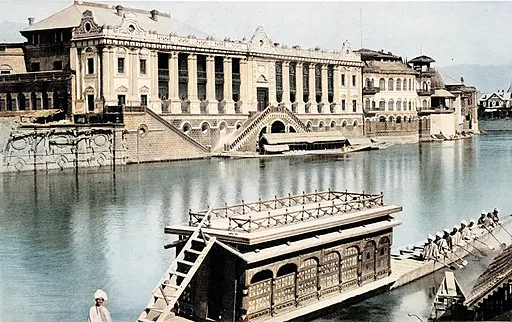
The neoclassical facade that the Dogra rulers added around 1900 still faces the Jhelum, though fire has hollowed out much of the wing behind it. The Corinthian columns are gloriously out of place — Calcutta-style colonial grandeur transplanted to a Kashmiri riverbank — and that dissonance is exactly what makes them worth seeking out. Stand on the opposite bank near Amira Kadal bridge for the best view: the columns frame the river in a way that makes clear this building was designed to be seen from the water, by everyone passing through the center of the city.
The Temple Compound
William Wakefield noticed the gilt dome from across the Jhelum in 1879, and it still catches light today. The temple within the Sher Garhi complex reminds you that this was never purely a military or administrative site — Dogra rulers embedded religious architecture into the compound as a statement of legitimacy. From the river or the bridge, the dome punctuates the skyline the way a bell tower marks a European town square, though at street level you might walk right past it.
The Art and Cultural Centre
Since 2022, restored sections of the palace have operated as an art and cultural center, hosting exhibitions of contemporary Kashmiri painting, calligraphy, and photography — World Heritage Week events in 2024 and 2025 drew local artists and heritage organizations into these old rooms. The conversion is imperfect — you're walking through spaces that were a governor's audience hall, then a clerk's office, and now a gallery — but that layering is part of the appeal. Check with the Directorate of Archives, Archaeology and Museums for current schedules, as programming is intermittent rather than year-round.
Plan your visit
Getting There
Sher Garhi sits on the right bank of the Jhelum in central Srinagar, near the Amira Kadal bridge — about 3 km from Dal Lake and 15 km from Sheikh ul-Alam International Airport. Auto-rickshaws from Lal Chowk take under ten minutes; ask for "Shergarhi" or "Old Secretariat" since drivers know both names. Walking from Lal Chowk along the Jhelum embankment takes roughly twenty minutes and gives you the colonnaded river facade the Dogra rulers intended you to see first.
Opening Hours
As of 2026, the restored Shergarhi Art Gallery operates under the Directorate of Archives, Archaeology & Museums (DAAM) and typically opens 10:00–16:00, Tuesday through Saturday, though hours shift without much warning — especially during winter months when Kashmir's government offices keep shorter days. The complex hosts special exhibitions during World Heritage Week each November. Check with the J&K DAAM office or your hotel before making it your sole plan for the day; "intermittently active" is the honest description.
Time Needed
A focused walk through the restored gallery wing and the surviving Dogra-era colonnaded facade takes 30–45 minutes. If you want to absorb the layered history — Afghan fort walls, Dogra neoclassical columns, post-1947 secretariat traces — and linger on the Jhelum-facing side where petitioners once arrived by boat, allow 60–90 minutes. Much of the complex remains partially restored or closed off, so you won't need a full half-day.
Cost
Entry to the Shergarhi Art Gallery has been free during exhibitions and World Heritage Week events through 2024–2025. A nominal ticket fee (around ₹20–50) may apply for regular visits, but don't count on card machines — carry small cash. Special exhibitions during November's Heritage Week are reliably free of charge.
Photo Gallery
A vintage view of the Sher Garhi Palace in Srinagar, India, showcasing its ornate riverfront architecture and a traditional houseboat on the Jhelum River. · Agence Rol. Agence photographique (commanditaire)A detailed historical painting depicting the layout and architectural design of the Sher Garhi Palace complex in Srinagar, India. · Sahib RamAn 1852 watercolor depiction of the historic Sher Garhi Palace situated along the river in Srinagar, India. · Godfrey Thomas Vigne [G. T. Vigne] (1 September 1801 – 12 July 1863)A historic view of the Sher Garhi Palace in Srinagar, India, showcasing its grand riverside architecture and the Maharaja's royal barge in the foreground. · JonarjaA historic view of the Sher Garhi Palace complex along the Jhelum River in Srinagar, Kashmir, showcasing its traditional architectural grandeur. · H.A. Mirza & Sons Delhi c. 1910 CollotypeThis detailed textile artwork depicts the historic Sher Garhi Palace complex in Srinagar, India, showcasing its unique architecture and landscape. · Unknown authorUnknown authorA historic view of the Sher Garhi Palace, the former royal residence of the Maharajas of Jammu and Kashmir, situated along the banks of the Jhelum River in Srinagar. · Unknown
History
A Fortress That Changed Masters But Never Lost Its Grip
Every power that controlled the Kashmir Valley between 1772 and 1947 ruled from inside these walls. Afghan governors built Sher Garhi as a fortified administrative seat on the Jhelum in 1772; Sikh conquerors seized it in 1819. Dogra maharajas, who purchased Kashmir from the British through the Treaty of Amritsar in 1846, transformed it from a garrison into something approaching a European court.
The compound's architecture tells that story in layers, though fire and neglect have erased many chapters. What survives is enough to piece together how the palace functioned — not as a private royal residence, but as the visible machinery of state.
The turning point
William Wakefield and the Riverfront Court, 1879
In 1879, the British traveler William Wakefield described a scene at Sher Garhi that reads less like a palace visit and more like an open-air courthouse. Crowds gathered on the river steps — the Jhelum was the main highway — waiting to petition the Dewan or catch a glimpse of the Dogra governor. Boats jostled for position at the landing, and justice was performed publicly, at the water's edge, where everyone could see.
Wakefield catalogued what he found inside: a treasury, an audience hall, the Dewan's private residence, and a gilt-domed temple whose dome caught sunlight from across the river. The palace functioned like a small city-within-a-city. Finance, ritual, petition, transport, and surveillance all happened within the same walled compound, connected by stairs that ran straight down to the water.
By 1900, the Dogra rulers had added a neoclassical facade facing the Jhelum — tall Corinthian columns in a style that owed more to Calcutta's colonial architecture than to Kashmiri tradition. A 1940 travel account still marveled at the 'huge massive walls, lofty columns' and the gleaming temple dome. The palace was dressing itself for a new century it would not survive intact.
The Afghan Foundation, 1772
Afghan governor Amir Khan Jawansher Khan — sometimes recorded as Amir Khan Sher Jawan — laid out the fortress in 1772, during a period when Afghan-appointed governors controlled Kashmir from behind thick walls and garrisoned troops. The name 'Sher Garhi' dates to this era. Its compound was designed for defense and administration in equal measure: thick enough to withstand siege, visible enough from the river to remind Srinagar who was in charge.
Secretariat, Assembly, Art Gallery
After 1947, Sher Garhi's royal chapter ended and its bureaucratic one began — the complex became the state secretariat, then the legislative assembly, the democratic inheritor of rooms where Dogra governors had once heard petitions. Fires in the late 20th century destroyed major portions, and government moved to newer buildings. The complex received state-protected monument status in 2017, and by 2022 restored sections reopened as an art and cultural center where World Heritage Week exhibitions now fill old rooms with contemporary Kashmiri work.
Tips for visitors
Time Your Visit Right
Late morning light hits the Jhelum-facing colonnade at its best — those oversized Corinthian columns the Dogras added around 1900 were designed to impress from the river, and they still do between 10:00 and noon. November visits coincide with World Heritage Week exhibitions, when the gallery is guaranteed open and actively staffed.
Photograph From the River
The most striking angle of Sher Garhi is from the opposite bank of the Jhelum or from the Amira Kadal bridge itself — the neoclassical facade stretching along the water is what every 19th-century traveler described first. Cross to the left bank for a wide shot that captures the scale colonial visitors compared to a European riverside palace.
Pair With Old City
Sher Garhi sits at the hinge between Srinagar's old city and the Lal Chowk commercial center. Walk south along the Jhelum after your visit toward the Shah-i-Hamadan shrine (Khanqah-e-Moula) and the Jamia Masjid — all within a 20-minute riverside walk that traces 700 years of Kashmiri power and prayer in sequence.
Expect Security Checks
The Shergarhi complex shares its neighbourhood with government buildings, and security checkpoints appear at unpredictable intervals on surrounding roads. Carry a photo ID, stay patient with bag checks, and avoid photographing any military or police installations nearby — cameras pointed the wrong direction attract unwanted attention fast.
Read the Layers
This is not one building but a palimpsest: Afghan-era fort walls at the base, Dogra columns on the facade, mid-20th-century secretariat additions behind them, and a gilded Hindu temple dome that William Wakefield described gleaming above the complex in 1879. Look for where rough stone meets smooth plaster — that seam is where the 1770s end and the 1890s begin.
Where to Eat
local_dining
Don't Leave Without Trying
Rogan Josh — slow-cooked lamb in aromatic tomato and yogurt gravyGushtaba — ground meat and spice meatballs poached in yogurt sauceRista — tender meat balls in a light, fragrant brothTabak Maaz — rib chops fried until crispy and aromaticNadru Yakhni — lotus root in a delicate broth, often vegetarianKahwa — saffron-infused green tea with cardamom, cinnamon, and nutsNoon Chai — pink, salty Kashmiri tea traditionally served in the morningKashmiri Breads — kulcha, sheermal, bakarkhani, girda, and lavasaWazwan — ceremonial feast of meat dishes, traditionally served at weddingsHarissa — slow-cooked mutton and rice breakfast dish (winter specialty)
Molvi Tariq Muradabadi Biryani
local favorite
Kashmiri & Mughlai€€star5.0(2)directions_walk~800m / 10 min walk
Order: The biryani is the star here — fragrant, layered, and made with the slow-cooked precision Muradabadi tradition demands. Pair it with a cooling raita or fresh salad.
A specialist biryani house that honors the Muradabadi legacy, this is where locals go for authentic layered rice and meat cooked the old way. The perfect stop if you want one serious, unfussy meal near Lal Chowk.
Cafe, Indian, International€€star4.0(535)directions_walk~700m / 8 min walk
Order: Start with a local tea or kahwa, then move to their Indian mains. The cafe side is strong for breakfast or a light lunch; the fine-dine section handles evening meals with more ambition.
Straddling the line between casual cafe and proper restaurant, Jhelum captures the riverside energy of central Srinagar with over 500 reviews and a loyal local following. The Budshah Bridge location is unbeatable for people-watching.
Cafe€€star4.2(131)directions_walk~700m / 8 min walk
Order: Order a pot of kahwa or noon chai with local bakery items — kulcha, sheermal, or whatever fresh breads they have that morning. This is tea-and-snack territory, not a full meal.
A classic Lal Chowk institution right on Budshah Bridge, Budshah Residency is where Srinagar takes its morning or afternoon chai break. The vibe is unhurried and deeply local.
Restaurant, Indian, International€€star4.4(92)directions_walk~700m / 8 min walk
Order: Stick with the Indian mains — rogan josh, gushtaba, or whatever Kashmiri specials are on the menu that day. The restaurant handles traditional dishes better than fusion experiments.
With 92 reviews and a solid 4.4 rating, Crown And Caves has earned trust from the Lal Chowk crowd as a reliable spot for proper Indian and Kashmiri food. Long opening hours (9 AM–9 PM) make it flexible for any meal.
checkLal Chowk and Budshah Bridge are the heart of central Srinagar dining — most restaurants cluster here within a 5–10 minute walk of Sher Garhi Palace.
checkKashmiri tea culture is serious: kahwa and noon chai are morning and afternoon rituals, best enjoyed with local bakery items rather than as standalone drinks.
checkWazwan dishes like rogan josh and gushtaba are the foundation of Kashmiri cuisine — order them when available, especially at Molvi Tariq and Crown And Caves.
checkMany traditional spots have limited or irregular opening hours; call ahead or check Google Maps in real time before making a special trip.
checkMaharaja Bazar and Polo View Market are within easy walking distance and worth a browse for bakery stops, dry fruits, and casual market-side snacking.
checkResidency Road runs parallel to the Jhelum River and connects most of these restaurants — it's a natural walking route for food exploration.
Food districts:Lal Chowk — the city's main commercial hub with mixed street food and established restaurantsBudshah Bridge area — riverside dining and tea stops with strong local characterResidency Road — central spine connecting cafes, bakeries, and informal eateriesMaharaja Bazar — old-market feel with bakeries and local snack shopsPolo View Market — upscale market area with modern cafes and bakeries
Restaurant data powered by Google
Frequently asked
Is Sher Garhi Palace worth visiting?
Yes, if you want to stand somewhere that has been the seat of Afghan, Sikh, Dogra, and Indian administration for over 250 years. The neoclassical Corinthian facade rising directly from the Jhelum riverbank is unlike anything else in Srinagar, and the restored art gallery gives you a reason to go inside rather than just photograph the exterior.
How long do you need at Sher Garhi Palace?
An hour covers the exterior and the gallery spaces comfortably. Allow two hours if you want to walk the riverfront, take in the temple compound, and stay for whatever is showing in the cultural center. The site is a working heritage venue, not a fixed museum circuit, so your pace is your own.
What is Sher Garhi Palace used for today?
The complex now houses an art and cultural center that opened by 2022, and the gallery has been running events regularly—including the annual World Heritage Week exhibitions held in November 2024 and November 2025. Some sections remain government-occupied; the riverfront areas and gallery wings are the most accessible to visitors.
Is Sher Garhi Palace free to enter?
Access to the grounds and the exterior is generally free. Entry to specific gallery exhibitions may vary by event, so check locally before visiting—policies at active heritage venues in Srinagar can shift without much notice.
When was Sher Garhi Palace built?
Construction dates to 1772 under the Afghan governor Jawansher Khan. The Corinthian-columned riverfront facade visible today was added during Dogra rebuilding around 1900, so the building you see is a composite of two very different architectural eras separated by a century.
What does Sher Garhi mean in English?
Secondary sources translate it as 'tiger fortress' or 'lion fort,' though the exact animal in the name shifts depending on transliteration. What is consistent is the fortress part—this was always conceived as a seat of military and administrative power, not a pleasure garden.
What happened to Sher Garhi Palace after Indian independence?
After 1947 the complex became the Old Secretariat, housing state government offices, the legislative assembly, and the legislative council. Fires in the 1970s and early 2000s destroyed large portions of the riverfront wing. A formal restoration push was announced in 2015, and the site was declared a state-protected monument in 2017.
What architectural style is Sher Garhi Palace?
The most photographed section—the Jhelum-facing front—is neoclassical, with large Corinthian columns added during Dogra rebuilding around 1900. The underlying structure is an 18th-century Afghan fortified complex, so the columns are essentially a grand Victorian-era mask on a much older military shell.
Sources & attribution8
Researched and written by the Audiala editorial team from historical records, architectural archives, and local expertise. Last updated April 2026.
William Wakefield, The Happy Valley (1879) — 1879 eyewitness description of petitioners gathering on the Jhelum river steps, the Dewan's residence, treasury, audience hall, and a gilt-domed temple within the complex.
Palace-of-srinagar 0 — H.A. Mirza & Sons Delhi c. 1910 Collotype — CC BY 4.0 (https://creativecommons.org/licenses/by/4.0/) — Source: https://commons.wikimedia.org/wiki/File:Palace-of-srinagar_0.jpg
Strictly necessary cookies keep the site working. Analytics (PostHog, Google Analytics) measures how each visitor uses our pages. Marketing loads YouTube videos and walking-route maps without a tap and lets Google Analytics set advertising cookies. We never sell your data. You can change this any time from the footer.
Analytics and marketing cookies are optional and only load if you agree. Details under Customize.
Privacy
Cookie preferences
Pick what you're okay with. You can change this any time from the footer.
Strictly necessary
Always on
Sign-in, language, navigation. Always on.
Product analytics
PostHog (EU) and Google Analytics record which pages you view and how you use them, under a random identifier stored in your browser. Helps us see which pages work and which need fixing. Google's ad personalisation stays off. No selling.
Marketing
Loads YouTube videos and the walking-route maps (OpenFreeMap) without a tap; without it, they load only when you tap them. If analytics is also on, Google Analytics may set advertising cookies. Ad personalisation stays off.