An introduction.
Researched by the Audiala editorial team from historical records, architectural archives, and local expertise.
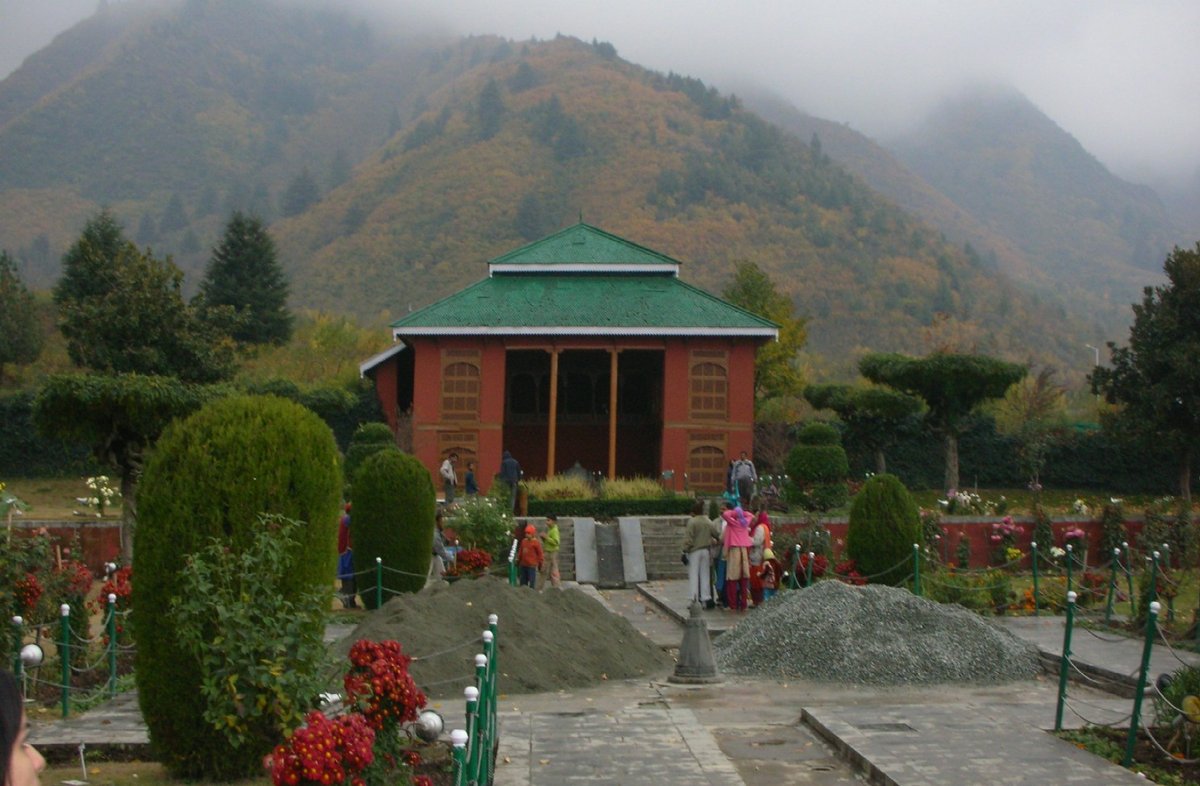
TThe most powerful woman in seventeenth-century Asia built a mosque out of stone in a city where everyone built in wood — and local clerics declared it cursed before the mortar dried. Pathar Masjid sits on the south bank of the Jhelum River in Srinagar, India, its grey limestone walls a rebuke to four centuries of slander, neglect, and political weaponization. Come here not for grandeur — the Jama Masjid across the river is grander — but for a building whose silences tell a more honest story about Kashmir than any monument in the valley.
The name translates simply: Stone Mosque. In a city where mosques and shrines were traditionally built from deodar wood and brick, the choice of grey limestone was itself a provocation. Nur Jahan, empress of the Mughal Empire, ordered its construction around 1623 — though no inscription or dated farman survives to pin down the exact year. The architect, identified in local tradition as Malik Hyder, raised nine arches across the façade and topped the roof with twenty-seven small ribbed domes. The effect, even today, is more fortress than prayer hall.
What happened next is where the story gets strange. Legend holds that Nur Jahan compared the mosque's cost to the price of her shoe, and that mullahs declared it unfit for worship. INTACH conservation architects call this story fabricated — a piece of sectarian propaganda from the 1930s with no basis in any Mughal-era source. The real reason the mosque stood empty for over a century is simpler and uglier: Sikh forces seized it in 1819, ripped up the floor stones, and converted it into a rice granary. Dogra rulers who followed kept it shuttered. The "shoe story" is a convenient fiction that erases 130 years of deliberate suppression.
Today Pathar Masjid is a Centrally Protected Monument under the Archaeological Survey of India, and worshippers still pray here in summer months. Its courtyard, once packed with 300,000 people for the founding of Kashmir's first political party, is now mostly quiet — a few tourists, a watchman, pigeons threading between the domes. The Jhelum slides past a few meters away, slowly pulling the riverbank and the mosque's buried plinth deeper into the silt.
01 What to see.
The Nine-Arched Façade
The Interior: Eighteen Columns and Twenty-Seven Domes
The Bridge View: Two Worlds Across the Jhelum
02 In pictures.


Plan and listen to Pathar Masjid with Audiala.
Audio guide in your pocket, itinerary in your browser. Built for the way you actually visit.
03 Visitor logistics.
The practical scaffolding for a good visit — kept short.
Getting There
From Lal Chowk, take an auto-rickshaw to Zaina Kadal or Nowhatta Chowk (₹100–150, about 15 minutes), then walk the final 200–400 metres through old city lanes. From the airport, a prepaid taxi costs ₹700–1,000 and takes 45–60 minutes. Srinagar's new red e-buses on Route 3B (TRC → Soura via Nowhatta) stop within 300 metres of the mosque. Don't bring a car — the lanes are too narrow for parking, and drop-off is your only option.
Opening Hours
As of 2025, the mosque is open daily from roughly 9 AM to 9 PM for visitors, with no entry fee. The prayer hall is actively used for worship only during summer months (April–October) — the open-arched stone construction makes winter prayer unbearable, so congregants shift to a nearby Darasgah from November through March. The exterior, courtyard, and Chinar-shaded lawn remain viewable year-round during daylight.
Time Needed
A focused visit — the nine-arch facade, courtyard garden, and riverside setting — takes 20–30 minutes. For the full experience including the 27-domed interior, rooftop staircase, lotus-leaf stone carvings, and quiet time under the Chinars, allow 45–90 minutes. The real reward is combining it with the Old City Core Walk: Pathar Masjid → Khanqah-e-Moula (200m across the Jhelum) → Jamia Masjid (800m) fills a rich half-day.
Cost
Entry is completely free, every day, for all visitors regardless of nationality. No tickets, no booking system, no queue. For context, nearby SPS Museum charges ₹10 for Indians and ₹50 for foreigners, and the Mughal Gardens run ₹20–100 — but Pathar Masjid costs nothing.
Accessibility
The mosque sits on a raised stone plinth with steps at the entrance, and the surrounding old city lanes are narrow, uneven, and cobbled — wheelchair access is very difficult. The front lawn is flat and reachable at ground level, offering a clear view of the facade. Srinagar's new e-buses do have ramps for wheelchair users, but the final 200–400 metre approach on foot remains the real barrier.
04 Tips for visitors.
Small things that change the day.
Dress Code Matters
This is an active mosque: remove shoes before entering the prayer hall, cover your head (women and men), and ensure shoulders and knees are covered. Headscarves are not provided — bring your own or pick one up from the Nowhatta bazaar stalls for ₹50–100.
Avoid Friday Afternoons
The Nowhatta neighbourhood has a history of post-Friday-prayer protests and heightened security presence. Visit on any other day, or come Friday morning before noon, to experience the mosque without tension or road closures.
Photography Etiquette
Photograph the architecture freely, but do not point cameras at worshippers during prayer or at security checkpoints and personnel in the surrounding lanes. The best light on the nine-arch limestone facade comes in the late afternoon, when the stone turns warm gold.
Say 'Naev Masheed'
Locals call this mosque Naev Masheed in Kashmiri, not Pathar Masjid. Using the Kashmiri name when asking for directions signals respect and gets you faster, friendlier help in the old city lanes.
Eat in the Old City
Walk 800 metres to Kareema Restaurant on Residency Road for an authentic wazwan thali (~₹750) — locals rate it above the tourist-heavy options. For breakfast, hunt for a harissa shop near Nowhatta (winter months only): slow-cooked meat porridge eaten with fresh kulcha bread, available nowhere else in India.
Best Season: Summer
Visit between May and September to see the mosque as a living place of worship, with prayers echoing off limestone and madrassa students reciting under the Chinars. In winter the prayer hall sits empty, and the stone radiates cold rather than atmosphere.
05 A history of reinvention.
A Queen's Claim in Stone, a Valley's Claim to Politics
Pathar Masjid's history is not one story but three, layered like sediment along the Jhelum. The first is imperial: a Mughal empress stamping her dynasty's presence onto Kashmir in limestone when everyone else used wood. The second is colonial: Sikh and Dogra rulers stripping the mosque of its function, its floor, and its dome. The third is revolutionary: a young man named Sheikh Abdullah choosing this exact building — desecrated, contested, politically radioactive — as the birthplace of Kashmiri political identity.
Each layer contradicts the one the tour guides tell. The mosque was not abandoned because of a curse. It was seized. It was not reopened out of piety. It was reclaimed as an act of defiance.
Nur Jahan's Last Monument and the Power She Couldn't Keep
By 1623, Nur Jahan was not merely an empress — she was, by most contemporary accounts, the actual ruler of the Mughal Empire. Her husband Jahangir, addicted to opium and wine, had ceded effective control. She issued farmans under her own seal, struck coins bearing her name, and made decisions on war and succession that shaped the subcontinent. European merchants at court described Jahangir as "her prisoner." She commissioned Pathar Masjid for Srinagar's Shia community — she was Shia herself — and chose grey limestone because transporting white marble or red sandstone to the remote Kashmir valley would have strained even the imperial treasury.
But the mosque was also a political marker. In 1622, Prince Khurram — the future Shah Jahan — had revolted against Jahangir, and Nur Jahan was maneuvering to install her own son-in-law Shahriyar as heir. Kashmir served as the Mughal summer court, and a permanent stone mosque bearing her patronage was a dynastic claim embedded in the valley's geography. Malik Hyder, the architect she appointed, raised the only all-stone mosque in a wooden city. The message was clear: this dynasty is not leaving.
The dynasty did leave. When Jahangir died in 1627, Nur Jahan backed Shahriyar for the throne. Her own brother Asaf Khan — father of Mumtaz Mahal, the woman for whom Shah Jahan would build the Taj Mahal — betrayed her and supported Khurram instead. Shahriyar was executed. Nur Jahan was stripped of power, her coins pulled from circulation. She spent her final eighteen years in Lahore, dressed only in white, visiting Jahangir's tomb. The mosque she built in Srinagar — her most ambitious religious construction in Kashmir — outlived her influence by four centuries. It still stands on the riverbank, grey and stubborn, long after the woman who ordered it was erased from the imperial record.
Granary, Orphanage, Battleground
October 1932: Three Hundred Thousand on the Riverbank
Listen to the full story in the app
The whole Pathar Masjid,
told well.
Audio guides for 1,100+ cities across 96 countries. History, stories, and local insight — offline ready.

06 Frequently asked.
The questions travellers send us most about Pathar Masjid.
Is Pathar Masjid in Srinagar worth visiting?
Yes — it's the only stone mosque in a city built almost entirely of wood, and that alone makes it architecturally singular. The nine-arched grey limestone façade stands in stark contrast to the ornate wooden Khanqah-e-Moula shrine directly across the Jhelum River, creating one of Srinagar's most dramatic visual pairings. Beyond the architecture, this is where Sheikh Abdullah founded Kashmir's first political party in 1932, so the site carries weight that most visitors never learn about from signage.
Can you visit Pathar Masjid for free?
Completely free, every day, no ticket required. The mosque is managed by the J&K Wakf Board and protected by the Archaeological Survey of India, but there's no entry fee, no booking system, and no queue. Walk in during daylight hours — roughly 9 AM to 9 PM — though access may be briefly restricted during the five daily prayer times.
How long do you need at Pathar Masjid?
A focused visit takes 30 to 45 minutes if you examine the façade, the 18 massive interior columns, and the 27 domes overhead. Pair it with Khanqah-e-Moula across the river and Jamia Masjid 800 metres away, and you have a 3-to-4-hour Old City walking route that covers Srinagar's most concentrated stretch of heritage architecture.
What is the best time to visit Pathar Masjid?
Early morning or late afternoon between April and October. The mosque faces east, so morning sunlight hits the nine-arch façade directly, revealing the carved lotus-leaf details that flatten into invisibility at midday. In winter, the uninsulated stone interior becomes brutally cold and active worship stops — the building is still viewable but the prayer hall feels abandoned.
How do I get to Pathar Masjid from Lal Chowk Srinagar?
Take an auto-rickshaw for about ₹100–150, which covers the 3 km in roughly 15 minutes. Srinagar's new red electric e-buses on Route 3B (TRC to Soura via Nowhatta) also pass through the neighborhood. Don't drive yourself — the old city lanes around Zaldagar and Nowhatta are too narrow for comfortable parking, so ask your driver to drop you at Nowhatta Chowk and walk the final 200 metres.
What should I not miss at Pathar Masjid?
Look up inside: the 27 domes aren't identical — some are ribbed in star patterns, others are flat barrel vaults, and the central dome is missing entirely because Sikh forces demolished it around 1819. At the base of the building, crouch down and find the lotus-leaf coping carved into the plinth — it's mostly buried underground after four centuries of subsidence, so you're seeing only the top of a structure that was originally several feet taller. Between the cornice and the eaves, some of the carved stone lotus leaves have been pierced clean through, turning ornament into a 400-year-old ventilation system.
Who built Pathar Masjid and why?
Empress Nur Jahan commissioned the mosque around 1623, when she effectively governed the Mughal Empire on behalf of her opium-addicted husband Jahangir. She built it in grey Kashmiri limestone — rather than the white marble or red sandstone of Delhi and Agra — because transporting imperial building materials to Kashmir was prohibitively expensive even for the Mughal treasury. The mosque served Srinagar's Shia Muslim community, reflecting Nur Jahan's own Shia faith, and doubled as a statement of dynastic power in the Mughal summer capital.
Is the story about Nur Jahan's shoe and Pathar Masjid true?
Almost certainly not. The famous tale — that Nur Jahan compared the mosque's cost to her bejeweled shoe, causing clerics to declare it ritually impure — appears in no Mughal-era chronicle, no inscription, and no contemporary source. INTACH architect Hakim Sameer Hamdani and former J&K Tourism Director Saleem Beigh have both stated on record that the story is unverified. Scholars trace its circulation to the 1930s, when political opponents of Sheikh Abdullah spread it as sectarian propaganda to discourage Muslims from gathering at a mosque Abdullah had chosen as his rallying point.
Verified, and shown.
Researched and written by the Audiala editorial team from historical records, architectural archives, and local expertise.
General history, construction date, architectural details, ASI protection status, and the shoe legend overview.
Quotes from INTACH architect Hakim Sameer Hamdani and Convener Saleem Beigh debunking the shoe story, contesting the 1623 date, and describing the political weaponization of the legend in the 1930s.
Detailed architectural analysis by Arka Chakraborty, including winter closure of prayer hall, madrassa use, and conservation concerns.
Quotes from Ram Chandra Kak's 1933 Ancient Monuments of Kashmir, details on the buried plinth, lotus-leaf coping, bedpost columns, dome demolition by Sikhs, and the Shankaracharya stairway stone-sourcing legend.
First-person visitor account with details on difficulty finding the entrance, architect Malik Hyder, grey limestone properties, and horizontal arch construction.
2024 report on Wakf Board Chairperson Dr. Darakhshan Andrabi's visit, confirmation of active Friday prayers, and community stewardship acknowledgment.
Peer-reviewed source confirming the October 14-16, 1932 founding session of the All J&K Muslim Conference at Pathar Masjid and the June 1939 National Conference renaming session.
Details on the 1932 founding convention, Sheikh Abdullah's election as first president, and the 300,000-person attendance figure.
Historical timeline including Sikh seizure in 1819, Dogra-era orphanage threat, and political history of the mosque.
Biographical details on Nur Jahan including birth in Kandahar, marriage to Jahangir in 1611, coin-minting authority, and post-1627 exile.
Opening hours (9 AM–9 PM), free entry confirmation, route directions from Syed Mansoor Bridge, and afternoon crowd timing.
Opening hours, free entry, 1-2 hour visit duration recommendation, and nearby attraction distances.
Aggregated 903 Google reviews (4.6/5 rating), Ramadan Iftar atmosphere, summer evening visit recommendation, crowd levels, and parking advice.
Route 3B (TRC to Soura via Nowhatta) and Route 11 details, wheelchair ramp features on new electric buses.
Current taxi fare estimates from airport and Lal Chowk to old city area.
Recommended Old City Core Walk itinerary: Zaina Kadal to Khanqah-e-Moula to Pathar Masjid to Jamia Masjid.
Report on the November 5-6, 2020 fire caused by short circuit, confirming partial damage to the mosque.
Hindi-language reporting on the 2020 fire, using the local name 'Naahav Masheed'.
User reviews confirming summer-only prayer use, open-arch cold exposure in winter, and active worship status.
Primary source describing the mosque as a rice granary under Sikh rule, with stone steps from the Jhelum to the courtyard. Quoted in SearchKashmir.org.
Authoritative early-20th-century architectural survey documenting the buried plinth, lotus-leaf coping, Sikh dome demolition, bedpost columns, and 18 interior column details. Quoted in SearchKashmir.org.
Researched from Wikidata, Wikipedia & official sources · fact-checked · How we make our guides →