An introduction.
Researched by the Audiala editorial team from historical records, architectural archives, and local expertise.
BBlue-green tiles flash from the brick like a rumor that refused to die. Madin Sahib in Srinagar, India, is worth your time because it shows a different Kashmir from the postcard one: older, stranger, and touched by Persia, Central Asia, and local devotion all at once. Come for the shrine of Syed Mohammad Madani, then stay for the surviving tilework, which feels less like decoration than evidence.
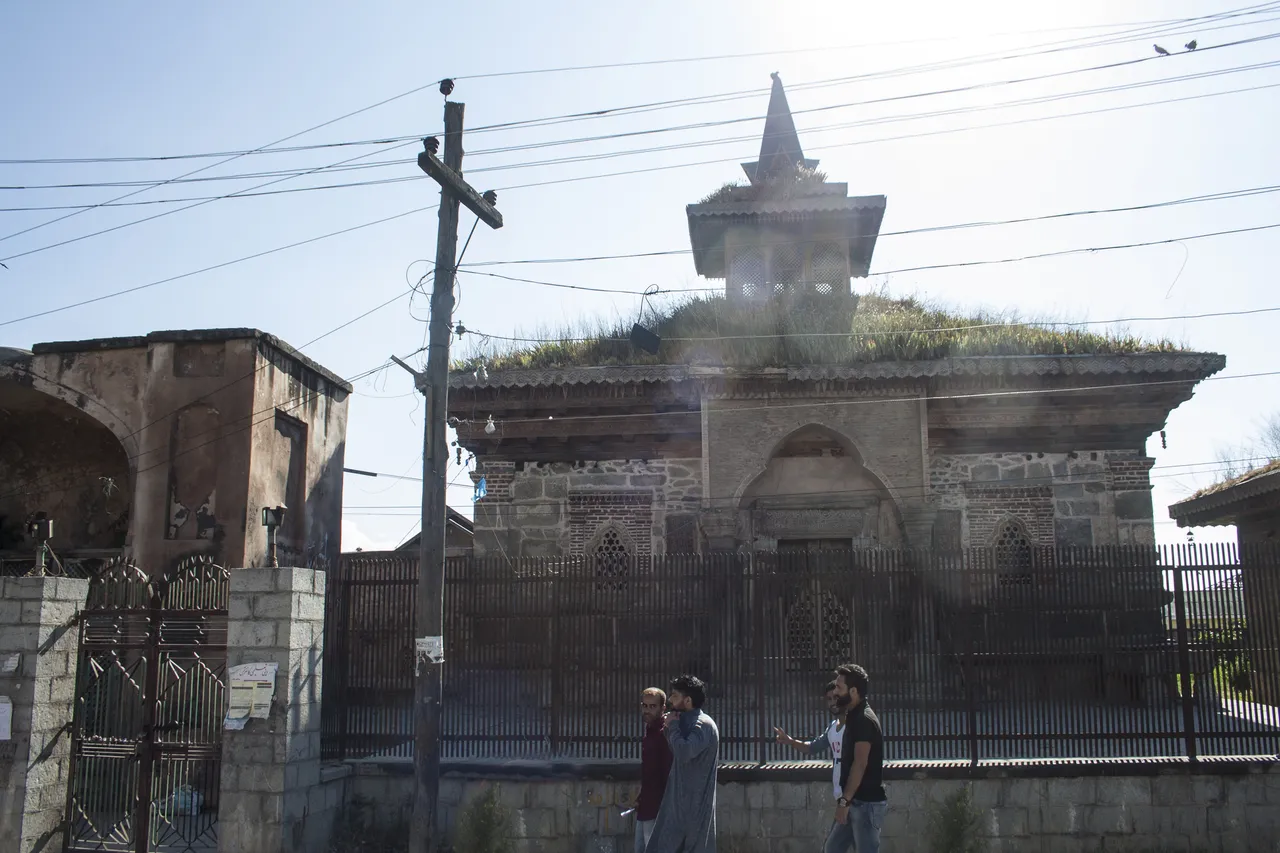
Most visitors to Srinagar chase lakes, gardens, and houseboats. Fair enough. But Hawal and Zadibal keep the city's harder, more revealing stories, and Madin Sahib is one of them: a mosque-shrine said to have been built in 1448 by Sultan Zain-ul-Abideen for his teacher.
The building doesn't meet the lazy idea of what an Indian mosque should look like. Its timber-and-brick body rises into a pagoda-like spire, and the surviving glazed tiles carry Persian habits of color into Kashmiri weather, smoke, and dust.
Access can be frustrating. Several recent local sources say the interior has been locked or heavily restricted since 2002, so you may only see the exterior and precinct, but even that is enough to understand why this place still provokes argument, loyalty, and a little awe.
01 What to see.
The Surviving Glazed Tiles
The Entrance Arch and Its Strange Creature
The Locked Interior, Read From Outside
02 In pictures.


Plan and listen to Madin Sahib with Audiala.
Audio guide in your pocket, itinerary in your browser. Built for the way you actually visit.
03 Visitor logistics.
The practical scaffolding for a good visit — kept short.
Getting There
Madin Sahib sits in the Hawal-Zadibal-Alamgari Bazar cluster of old Srinagar, usually listed as Astaan Shareef Madin Sahib, Hawal. From Lal Chowk or central Srinagar, a taxi or auto-rickshaw is the least fiddly option and usually takes about 20 to 30 minutes in normal traffic; by bus, aim for Alamgari Bazar Chowk, then walk the last few minutes through the old-city lanes.
Opening Hours
As of 2026, online hours are unreliable: one listing gives 9:30 AM to 5:30 PM, while local reporting says the shrine interior has been locked or heavily restricted since 2002. Plan on seeing the exterior and precinct unless a local caretaker or resident confirms that the inside is open that day.
Time Needed
Give it 20 to 30 minutes if you're here just to study the surviving tilework and façade details. If you like reading buildings slowly, allow 45 minutes, especially if you're pairing it with a wider wander through Srinagar old-city neighborhoods.
Cost & Tickets
As of 2026, I found no solid evidence of a ticketed entry system, and secondary listings describe the site as free. Bring small cash for transport anyway, because the real expense here is getting across Srinagar, not getting through the gate.
04 Tips for visitors.
Small things that change the day.
Shrine Etiquette
This is a working religious place, not an empty monument. Dress modestly, keep your voice low, and remove your shoes if you are invited past the threshold; if the interior is shut, don't treat the locked entrance as a photo prop.
Photograph The Tiles
Go for the entrance spandrels, archway edges, and any surviving glazed fragments rather than wide shots alone. Morning light usually gives the tile surface more relief, and you should ask before photographing worshippers or anyone tending the precinct.
Read The Room
Madin Sahib carries a long Sunni-Shia custodianship dispute, and locals know that history better than any guidebook does. Keep questions respectful, avoid turning sectarian tensions into sightseeing chatter, and move on if a conversation tightens.
Pair It Well
This works best as part of an old Srinagar day, not as a stand-alone cross-city mission. Combine it with a slow walk through Hawal and Zadibal, or fold it into a broader heritage route with Sher Garhi Palace if you're tracing the city's layered political and religious history.
Pick Dry Weather
Choose a dry day if you can. The surrounding lanes can feel cramped and muddy after rain, and this site rewards patient looking at surface details that vanish when walls are wet, shadowed, or filmed with dust.
Ask Locally
Don't rely on map pins alone once you reach Hawal. A quick check with a shopkeeper or driver for 'Madin Saeb' usually works better, because the monument sits in that dense old-city weave where one wrong turn can cost you ten minutes.
Where to Eat
Don't Leave Without Trying
Le Delice
local favoriteOrder: Fresh kandur breads, particularly girda and bakarkhani; pair with noon chai for an authentic Kashmiri breakfast experience.
With nearly 2,600 reviews and a 4.9 rating, this is Srinagar's most trusted bakery stop. It's where locals grab their daily bread and pastries—the real deal, not a tourist trap.
Majlis Eatery & Specialty Coffee
cafeOrder: Specialty coffee and light bites; a solid choice for a proper café experience rather than a quick counter.
One of the few proper sit-down café spaces in central Srinagar with consistent quality (4.9 rating across 182 reviews). It's where you go when you want to linger over coffee, not just grab and go.
DRAGON PAN ASIAN CUISINE
quick biteOrder: Pan-Asian specialties; a perfect quick stop if you want something different from Kashmiri fare but don't have time for a full meal.
Perfect 5.0 rating makes this a reliable choice for Asian cuisine in a convenient food-court setting. Useful if you're shopping nearby or want a break from traditional Kashmiri dishes.
Sulaiman
local favoriteOrder: North Indian and Kashmiri staples; the long opening hours (7 AM–10:30 PM) make it ideal for breakfast, lunch, or dinner.
Perfect 5.0 rating and extended hours mean you can hit this spot for breakfast before exploring Madin Sahib or grab dinner late. It's a reliable all-day option in a hotel setting.
Dining Tips
- check Alamgiri Bazar and Hawal are the immediate food neighborhoods around Madin Sahib—best for quick bites, momos, and street snacks.
- check For wazwan or trout dishes, plan a short auto ride to Rainawari rather than walking; these specialty restaurants are worth the 3 km journey.
- check Harisa is a Kashmiri breakfast specialty best eaten in the cooler months; Dilshad Restaurant on Lal Chowk (about 4.8 km away) is the standout verified spot for this.
- check Khayam Chowk is Srinagar's main evening food street for kebabs, tujj, fried fish, and barbecue—go by auto in the evening for the full street-food experience.
- check Zaina Kadal old-city lanes and Aali Kadal/Bat Kandur area are worth exploring for traditional bakeries and bread culture, though they're better for snacking than sit-down meals.
Restaurant data powered by Google
05 A history of reinvention.
A Shrine Built From Exile, Learning, and Argument
Madin Sahib begins with an arrival story. According to tradition repeated in Kashmiri historical accounts, Syed Mohammad Madani came from Medina with Timur in 1398, entered Kashmir during Sultan Sikandar's reign, and stayed long enough to become part of the valley's religious memory.
Records cited in later summaries place Madani's death on 13 October 1445, and local tradition says Sultan Zain-ul-Abideen, better remembered as Budshah, built the mosque in his honor in 1448. That date matters. It places the shrine inside one of Kashmir's most cultured courts, when Persianate learning, local craftsmanship, and political ambition were all leaning in the same direction.
Zain-ul-Abideen Builds for His Teacher
The heart of Madin Sahib is the relationship between a ruler and a scholar. Local tradition describes Syed Mohammad Madani as a teacher of Sultan Zain-ul-Abideen, and the mosque-shrine becomes more interesting once you read it that way: not as a generic pious foundation, but as an act of memory by a king who wanted learning given architectural form.
Zain-ul-Abideen's Kashmir had room for experiment. You can feel it here in the building's timber-and-brick structure, in the pagoda-like profile more at home in the valley than in imperial fantasies, and in the glazed tiles that suggest workshops and ideas moving across mountains like traders on the old routes to Central Asia.
And then the story darkens. Madin Sahib later became entangled in long Sunni-Shia disputes over control, and multiple recent sources say the shrine has remained locked or severely restricted since 2002. A building raised for devotion turned, over centuries, into a measure of how fragile shared custody can be.
The Riot That Won't Leave the Walls
A Wall Said to Bleed
Listen to the full story in the app
The whole Madin Sahib,
told well.
Audio guides for 1,100+ cities across 96 countries. History, stories, and local insight — offline ready.
06 Frequently asked.
The questions travellers send us most about Madin Sahib.
Is Madin Sahib worth visiting?
Yes, if you care more about rare architectural detail than easy sightseeing. Madin Sahib stands out for its glazed tile work, which museum records connect to cuerda seca techniques, and for its Kashmiri pagoda-like spire. Go for the facade and the history; don't go expecting a fully open shrine experience.
How long do you need at Madin Sahib?
About 20 to 40 minutes is usually enough. Most visitors come to study the exterior, surviving tile fragments, and the setting in old Srinagar. If the precinct is accessible and you like photographing ornament, give it closer to 45 minutes.
Is Madin Sahib open to visitors?
Maybe from the outside, but you should not assume the interior is open. Multiple recent sources say the shrine or mosque has been locked, or heavily restricted, since 2002 because of a long Sunni-Shia custodianship dispute. Ask locally in Hawal or Zadibal before making a special trip.
Is there an entry fee for Madin Sahib?
No ticket fee is reliably reported. Secondary travel listings describe entry as free, though they are less consistent on opening hours than on cost. Carry small cash for transport, not for admission.
What is special about Madin Sahib?
Its tile work is the reason to pay attention. Madin Sahib belongs to Kashmir's timber-and-brick mosque tradition, but the glazed decoration sets it apart, with floral scrolls, inscriptions, and motifs linked to Persian and Chinese visual worlds. Even in fragments, the facade still feels like it remembers being far richer.
Who is buried at Madin Sahib?
The shrine is associated with Syed Mohammad Madani, also called Madin Sahib or Madin Saeb. According to widely repeated local historical accounts, he came from Medina with Timur in 1398, stayed in Kashmir, and died on October 13, 1445. The mosque is generally attributed to Sultan Zain-ul-Abideen, who is said to have built it in his teacher's honor.
How do you get to Madin Sahib in Srinagar?
The easiest way is usually by taxi or auto-rickshaw into the Hawal-Zadibal-Alamgari Bazar area. Alamgari Bazar Chowk is the stop named most often in transport listings. Old-city lanes can be slow, so build in extra time even for a short ride.
Verified, and shown.
Researched and written by the Audiala editorial team from historical records, architectural archives, and local expertise.
Checked for a dedicated World Heritage or tentative-list entry; none found for Madin Sahib as of April 6, 2026.
Used for the summary chronology repeated in the research notes, including 1398, 1445, 1448, and the 2002 closure claim.
Used for date and identity details on Syed Mohammad Madani and the shrine.
Used for local historical narrative, the 1448 attribution, later sectarian history, and closure context.
Used as a secondary source for chronology and monument description.
Used for reported local narratives, conflicting date references, and closure history; treated cautiously where unconfirmed.
Used for evidence on surviving tiles from the tomb and identification of the decoration as cuerda seca work.
Used as a weak secondary source for reported opening hours; flagged as inconsistent.
Used for common address formats, free-entry claims, and basic visitor logistics, though not treated as authoritative.
Used to support the site's protected status and decorative-art significance.
Used to support the claim that access restrictions remained a current issue into 2025.
Researched from Wikidata, Wikipedia & official sources · fact-checked · How we make our guides →