An introduction.
Researched by the Audiala editorial team from historical records, architectural archives, and local expertise.
EEvery photograph you have ever seen of the Diwan-i-Aam is wrong. The bare red sandstone walls that millions photograph each year at New Delhi's Red Fort were originally invisible — buried under polished white lime plaster and gilded paint so convincing that 17th-century French travelers mistook the hall for marble. To stand here in India is to stand inside a 380-year-old illusion stripped bare — the most public room of the Mughal empire, where emperors dispensed justice and where, in 1858, a dynasty was put on trial.
Shah Jahan built this Hall of Public Audience between 1639 and 1648 as the centerpiece of his new capital, Shahjahanabad. The concept was theatrical: a hall wide enough to hold hundreds of petitioners, with the emperor elevated on a marble throne at the far end, backlit and unreachable.
The architecture enforced hierarchy. You looked up at your ruler; he looked down at you. A gold railing separated sovereign from subject — not ornament, but the physical boundary between power and petition.
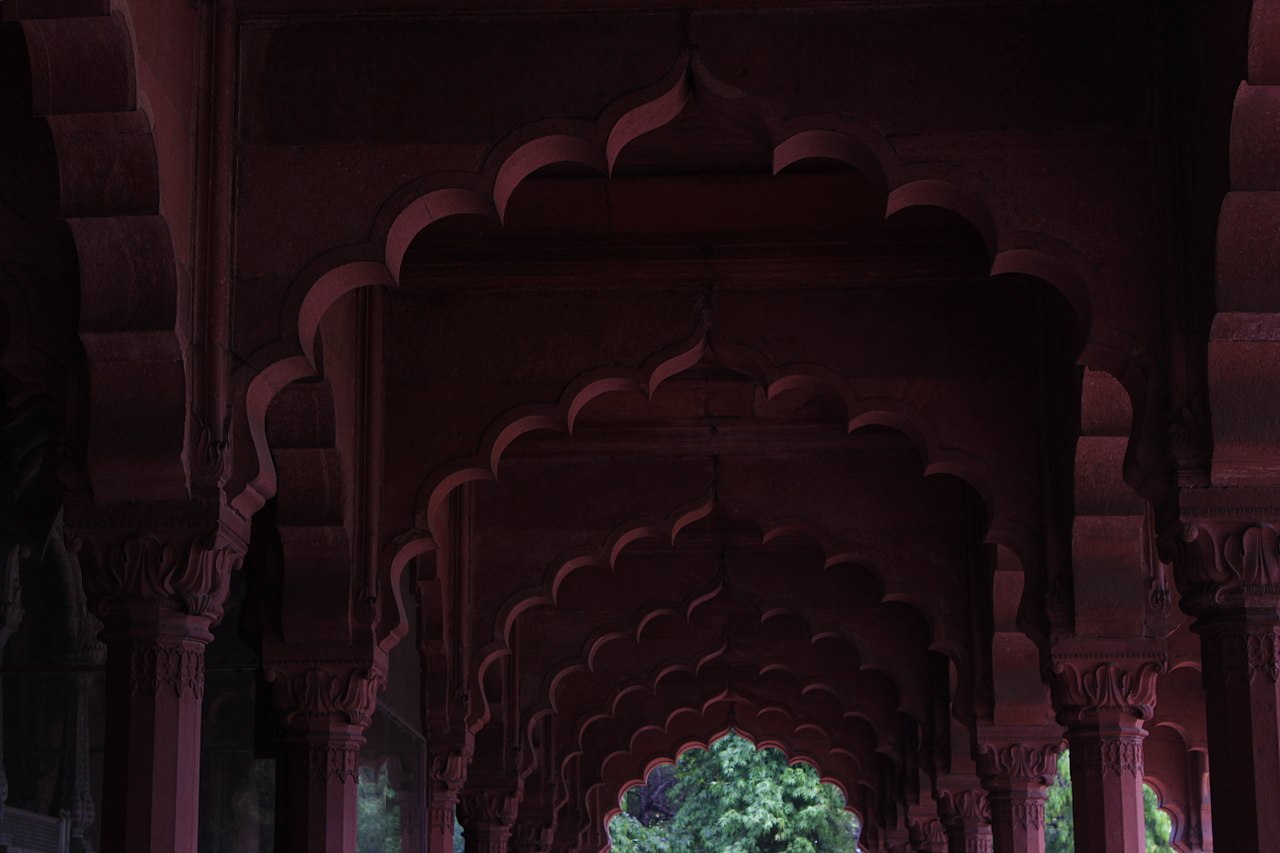
Today the hall stands open to Delhi's heat and light, its plaster gone, its gold railing vanished. Nine arched openings face the courtyard, each taller than a double-decker bus, framing views Shah Jahan's architects calibrated with obsessive precision. Stand in that courtyard and look toward the throne alcove — even empty, the architecture still pulls every eye forward.
The Diwan-i-Aam is where Mughal India made its power visible to ordinary people. And where, two centuries later, that power was publicly extinguished.
01 What to see.
The Hall of Public Audience
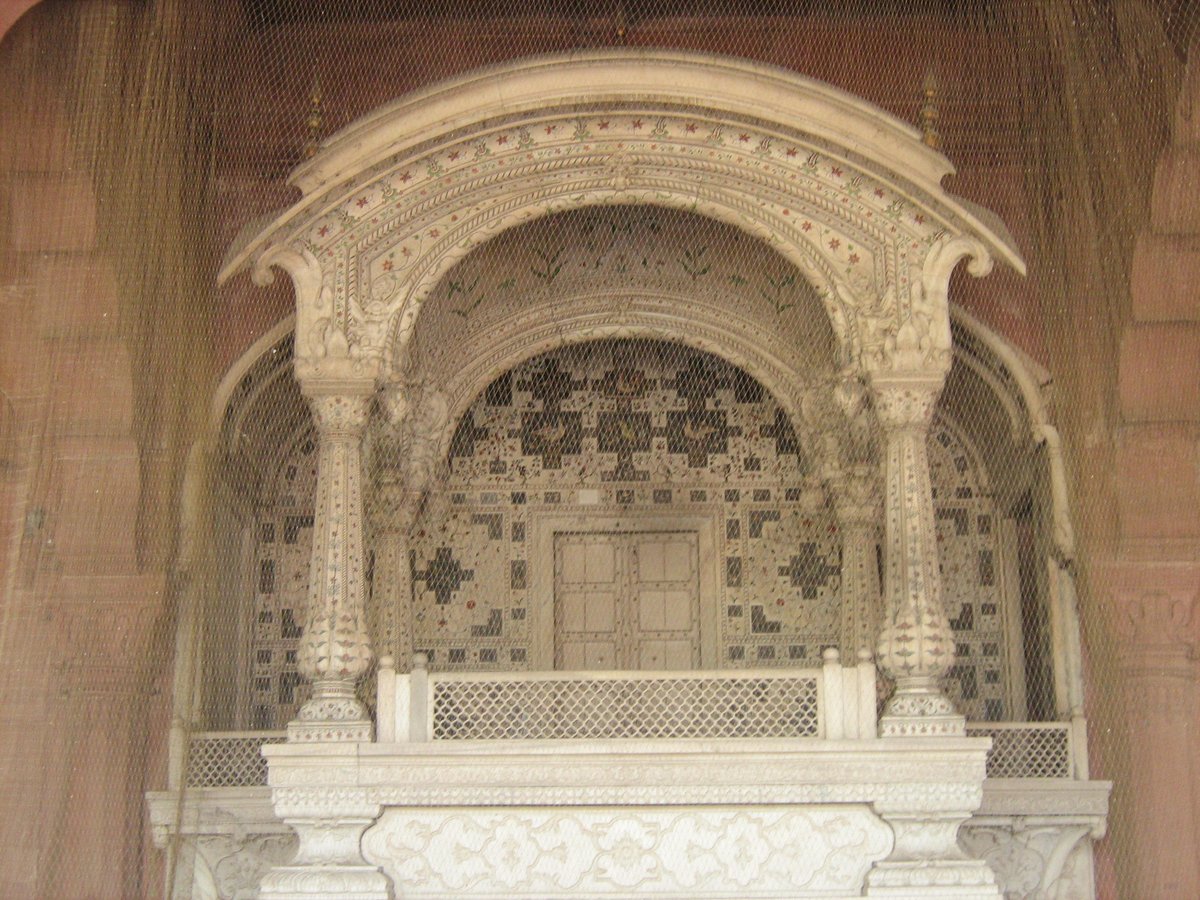
The Throne Pavilion and Orpheus Panel
Reading the Room: Courtyard, Galleries, and the Architecture of Power
02 In pictures.




Plan and listen to Diwan-I-Am with Audiala.
Audio guide in your pocket, itinerary in your browser. Built for the way you actually visit.
03 Visitor logistics.
The practical scaffolding for a good visit — kept short.
Getting There
Take the Delhi Metro Yellow Line to Chandni Chowk station (Gate 5), then walk 12–15 minutes east along the main boulevard toward the fort's unmistakable red walls. Lal Quila station on the Violet Line is closer — just a 5-minute walk. Skip driving: parking is distant and Old Delhi traffic is merciless. Ola or Uber work well if you drop at "Red Fort Lahori Gate."
Opening Hours
As of 2026, the Red Fort complex (which includes Diwan-i-Aam) opens Tuesday through Sunday, 9:30 AM to 4:30 PM, with last entry around 4:00 PM. Closed every Monday and on select national holidays. A separate Sound & Light Show runs after sunset on open evenings — Hindi and English on alternate nights. Verify current hours at asi.nic.in, as seasonal adjustments happen.
Time Needed
The Diwan-i-Aam alone takes 20–30 minutes if you read the information boards and absorb the courtyard's scale. But rushing through and leaving misses the point — the hall only makes sense within the full fort circuit. Budget 1.5–2 hours for a standard visit including the Diwan-i-Khas, Royal Baths, and gardens. History-focused visitors who explore the museums easily spend 3–4 hours.
Tickets
As of 2026, entry to the Red Fort is ₹35 for Indian nationals and approximately ₹550 for foreign visitors — though ASI has been raising prices, so confirm at the gate or online portal. Children under 15 enter free. Buy tickets online through the ASI e-ticketing portal to skip the Lahori Gate queue, which can stretch 20–45 minutes on weekends during peak season.
Accessibility
The main pathways from Lahori Gate to the Diwan-i-Aam are paved and wheelchair-navigable, though surfaces are uneven 17th-century stone in places. The hall itself sits on a raised plinth reached by shallow steps with no ramp — the marble throne alcove is not accessible. The courtyard is almost entirely unshaded, making summer visits punishing for anyone with heat sensitivity.
04 Tips for visitors.
Small things that change the day.
Dodge the Fake Guides
Men outside Lahori Gate will claim to be "official ASI guides" — they're not. Real licensed guides carry photo ID and are hired at the designated counter inside the gate. Freelancers commonly agree on ₹200, then demand ₹2,000 at the end. Same goes for ticket touts: buy at the official counter or online, never through a helpful stranger.
Photography Rules
Personal photos and video are allowed throughout the complex at no extra charge, but tripods require prior ASI permission and drones are absolutely prohibited — Red Fort sits in a high-security zone with active military presence, and violations carry serious penalties. Avoid pointing your camera at CISF guards or security installations.
Eat in Old Delhi After
No food is sold inside the fort, so plan your meal for after. Walk 20 minutes to Karim's near Jama Masjid for mutton korma descended from Mughal court cooks (₹400–700/person), or hit Paranthe Wali Gali for stuffed flatbreads at budget prices. Old Famous Jalebi Wala, operating since 1884, does thick fresh jalebis that justify the queue.
Time Your Visit Right
October through February is ideal — Delhi's summers routinely hit 40°C and the Diwan-i-Aam courtyard offers zero shade, about as forgiving as standing on a griddle. Arrive at 9:30 AM opening for the smallest crowds and best morning light on the sandstone. Late afternoon (4–5 PM) is gorgeous for photography but leaves little time before closing.
Walk the Full Circuit
The Diwan-i-Aam alone is a pillared hall stripped bare — powerful in context, underwhelming in isolation. Walk the full sequence: Lahori Gate, Chhatta Chowk bazaar, Diwan-i-Aam, then onward to the Diwan-i-Khas, Royal Baths, and Moti Masjid. The Peacock Throne was in the Khas, not here — many visitors mix them up. Don't skip the often-empty Salimgarh Fort, connected by bridge, where Aurangzeb imprisoned his own sons.
Combine with Jama Masjid
India's largest mosque stands a 10-minute walk southwest — free entry, though there's a camera fee. From there, राजघाट समाधि परिसर is another 15 minutes south on foot, a serene counterpoint to the fort's intensity. All three fit comfortably in a single morning if you start at opening.
Where to Eat
Don't Leave Without Trying
Cafe Delhi Heights
cafeOrder: Coffee and light snacks while taking in views of the Red Fort's interior courtyards — a convenient refuel spot during your Diwaan-e-Aam visit.
Located directly within the Red Fort premises, this is your only verified option for a sit-down cafe without leaving the monument. It's institutional but beats the street vendors if you need air conditioning and a proper seat.
Dining Tips
- check Visit street food vendors outside the Red Fort in early morning (before 11 AM) when fresh batches of parathas and jalebi are still warm — this is peak freshness time.
- check Carry bottled water; avoid fresh juices from street carts to prevent stomach upset.
- check Most Old Delhi eateries are cash-preferred, though UPI is increasingly accepted — have small notes ready.
- check The Chandni Chowk area gets extremely crowded on Fridays after mosque prayers; plan your visit accordingly.
- check Diwaan-e-Aam is best explored early morning; pair this with breakfast at nearby street food vendors, then return for lunch after the crowds thin out.
Restaurant data powered by Google
05 The Throne Room That Became a Courtroom
The Red Fort took nine years to build, from 1639 to 1648, and the Diwan-i-Aam was its most public gesture. Shah Jahan had moved his capital from Agra to Delhi, and he needed a space where Shahjahanabad's population could witness imperial authority firsthand. The hall served that function for 209 years — from completion until the Indian Rebellion of 1857 brought the Mughal dynasty to its end.
The daily ritual barely changed across those two centuries. Each morning at prescribed hours, the emperor appeared on the marble throne. Below him, on a separate dais, the wazir received petitions — ordinary subjects never addressed the sovereign directly, and his silence was itself a form of theater.
The Last Emperor in the Dock
Visitors see a serene, open-air hall. The guides explain that emperors held court here, heard petitions, dispensed justice — the story sounds almost bureaucratic. What they rarely mention is that this same room hosted one of the most deliberately humiliating acts of political theater in colonial history.
On January 27, 1858, Bahadur Shah Zafar II — eighty-two years old, partially deaf, and the last Mughal emperor — was brought into the Diwan-i-Aam not to sit on the throne but to stand trial beneath it. The British chose this room with precision. For 210 years, emperors had appeared above the gold railing, elevated and untouchable — Zafar now sat at court level, the position of a petitioner.
British soldiers stood where Mughal nobles once ranked themselves by favor. The proceedings were conducted in English, in a hall built to carry Persian, presided over by Lieutenant Colonel F.N. Maisey. Guilty on all charges — the verdict was never in doubt.
Zafar was exiled to Rangoon, where he died in November 1862 — his captors left the grave unmarked, afraid it would become a shrine. It became one anyway. The empty throne canopy in front of you tells the rest: Mughal sovereignty was not merely ended here but performed as ended, staged in the very architecture designed to perform its opposite.
The Ghost of White Walls
Orpheus Behind the Emperor's Throne
Listen to the full story in the app
The whole Diwan-I-Am,
told well.
Listen to sourced travel stories with local history and practical context — ready offline.

06 Frequently asked.
The questions travellers send us most about Diwan-I-Am.
Is Diwan-i-Aam at Red Fort worth visiting?
Yes — but only if you know what you're looking at. The hall is stripped bare compared to its Mughal-era glory, when every red sandstone column was coated in polished white lime plaster and the ceiling was painted with gold. Bring binoculars or a zoom lens to see the remarkable pietra dura panel behind the throne, which depicts the Greek myth of Orpheus — carved by a European craftsman for a Mughal emperor. Without that context, it reads as a handsome but empty colonnade.
How long do you need at Diwan-i-Aam in Red Fort?
Budget 25–35 minutes for the Diwan-i-Aam itself, and 2–3 hours for the full Red Fort complex. The hall rewards patience: walk to the far western edge of the courtyard for the axial view Shah Jahan's architects intended, where nine cusped arches frame the marble throne in perfect symmetry. Rushing through in 10 minutes — as most visitors do — means missing the spatial drama entirely.
How do I get to Diwan-i-Aam from New Delhi?
Take the Delhi Metro to Lal Quila station (Violet Line), a 5–7 minute walk from the Lahori Gate entrance. Chandni Chowk station (Yellow Line) is also close — about 12–15 minutes on foot east along the main bazaar road. Auto-rickshaws from Connaught Place should cost ₹80–120 by meter; insist on the meter or use Ola/Uber, as tourists are routinely quoted three times the correct fare.
What is the best time to visit Diwan-i-Aam?
Weekday mornings between 9:30 and 11:00 AM, from November through February. The throne pavilion faces east, so morning light catches the marble and pietra dura inlay at its best. Summer temperatures regularly exceed 40°C and the courtyard has zero shade — the sandstone radiates heat like an oven. If you visit during monsoon season, the wet sandstone turns from warm orange to deep burgundy, which is beautiful but slippery underfoot.
Can you visit Diwan-i-Aam for free?
No — entry is through the Red Fort complex, which charges ₹35 for Indian nationals and around ₹550 for foreign visitors. The Diwan-i-Aam is included in general admission with no extra fee. Book tickets online through the ASI e-ticketing portal to skip the queue at Lahori Gate, which can stretch to 45 minutes on weekends.
What should I not miss at Diwan-i-Aam?
The Orpheus pietra dura panel behind the emperor's throne — invisible to the naked eye from the visitor barrier, but extraordinary through a zoom lens. Look for the Bengal-style curved roof above the throne canopy, a vernacular Indian form crowning the most powerful seat in the Mughal empire. And stand on the low platform step where the hall meets the courtyard: that subtle rise is the threshold ordinary petitioners were never allowed to cross.
What is the difference between Diwan-i-Aam and Diwan-i-Khas at Red Fort?
The Diwan-i-Aam was the Hall of Public Audience, open on three sides, where the emperor heard petitions from common subjects — though in practice, the prime minister handled the paperwork while the emperor watched in silence from above. The Diwan-i-Khas, accessible through a gate on the northern side, was the smaller, enclosed Hall of Private Audience for nobles and foreign ambassadors. The famous inscription "If there is paradise on earth, it is this" belongs to the Diwan-i-Khas, not the Diwan-i-Aam — a detail many guidebooks get wrong.
What happened at Diwan-i-Aam historically?
Built between 1639 and 1648 by Shah Jahan, the hall served as political theater for over two centuries — the emperor appeared daily on his elevated marble throne while hundreds of petitioners gathered in the courtyard below. Its most dramatic moment came on January 27, 1858, when the British staged the trial of Bahadur Shah Zafar, the last Mughal emperor, in the very hall where his ancestors had dispensed justice. The 82-year-old emperor sat not on the throne but in the dock — a deliberate humiliation that ended 210 years of Mughal sovereignty.
Verified, and shown.
Researched and written by the Audiala editorial team from historical records, architectural archives, and local expertise.
Official managing body for Red Fort; source for opening hours, ticket prices, conservation status, and site management policies
Construction dates, architectural details, chunam plaster coating, Austin de Bordeaux attribution, Bengal roof style, wazir dais function, Curzon restoration details
Original source for the Austin de Bordeaux attribution as Florentine jeweler; also cited for Mennegatti restoration work under Lord Curzon
Visitor accounts including Madhulika L (pietra dura Orpheus panel, binoculars recommendation, lime plaster history) and Brun066 (Ebba Koch and Catherine B. Asher scholarly citations, British garrison damage)
Architectural details (nine engraved arches, Makrana marble throne), spatial relationship between Diwan-i-Aam and Diwan-i-Khas, Persian couplet attribution, Peacock Throne location clarification
Scholarly analysis comparing Shah Jahan's architectural program to Louis XIV's Versailles as instruments of centralized authority
Academic source on Mughal jharoka darshan tradition and public audience ceremonies
Historical account of the 1857 rebellion and Bahadur Shah Zafar's trial at Diwan-i-Aam, including debate over Zafar's role in the uprising
Primary eyewitness account of Mughal court life, distinguishing between Diwan-i-Aam and Diwan-i-Khas functions and furnishings
Primary source description of the Peacock Throne (confirmed in Diwan-i-Khas, not Diwan-i-Aam) and Mughal court splendor
Lord Curzon's restoration proposal details (1903–1909) including mosaic restoration and Mennegatti commission
Academic framing of Shahjahanabad (Old Delhi) as living heritage site, contextualizing Red Fort within the surviving medieval city
Context on UNESCO ICH committee proceedings in New Delhi and Diwali inscription, connecting to Red Fort's role in living festival traditions
Built from cited sources · see the method · How we make our guides →