An introduction.
Researched by the Audiala editorial team from historical records, architectural archives, and local expertise.
OOn a hillock in south Delhi where a British colonial battery once stood, a 30-tonne granite Mahavira now sits in permanent meditation — eyes closed, legs crossed, unbothered by the six lanes of traffic roaring past below. Ahinsa Sthal, the "Place of Non-Violence" in New Delhi, India, exists for that contradiction: step off one of the capital's loudest roads and into a silence so abrupt it feels deliberate.
The name is a statement of intent. Ahinsa — ahimsa — is the Jain principle of absolute non-harm, extended to every living creature. Placing a monument to that idea on a former military lookout point, surrounded by the archaeological debris of a dozen Delhi dynasties that rose and fell by the sword, is either deeply ironic or deeply purposeful. The Digambar Jain community that built it in 1980 clearly meant the latter.
What visitors find is not a grand temple complex but something more intimate: a landscaped garden climbing a low hill, cobbled paths winding between moral inscriptions and small sculptures, and at the summit, a monolithic Mahavira carved from single-block granite in Karkala, Karnataka — a town 2,000 kilometres to the south that has been producing Jain colossi for six centuries. The statue is 13 feet 6 inches tall, roughly the height of a double-decker bus, and weighs about the same as five adult elephants.
Ahinsa Sthal sits in Mehrauli, the oldest continuously inhabited part of Delhi, within walking distance of the Qutb Minar complex. Most visitors to the area never notice it. That is part of its character.
01 What to see.
The Mahavira Statue and Hilltop Shrine
The Garden Paths and Moral Inscriptions
A Pause Worth Taking
02 In pictures.


Plan and listen to Ahinsa Sthal with Audiala.
Audio guide in your pocket, itinerary in your browser. Built for the way you actually visit.
03 Visitor logistics.
The practical scaffolding for a good visit — kept short.
Getting There
The temple sits on Anuvrat Marg in Mehrauli, a short walk from the Qutub Minar complex. Qutub Minar metro station (Yellow Line) is roughly 2 km away — an auto-rickshaw from the station costs ₹30–50 and takes five minutes. If you're already visiting Qutub Minar, walk south along Mehrauli-Badarpur Road for about ten minutes and watch for the Jain flags on the hillock to your left.
Opening Hours
As of 2026, the complex is open daily from around 6:00 AM to 8:00 PM, though some visitor reports suggest evening closure as early as 7:00 PM in winter months. Morning aarti begins at sunrise. Sources conflict on exact timings, so arriving between 8:00 AM and 5:00 PM is your safest window.
Time Needed
A focused visit — climbing the hillock, circling the Mahavira statue, reading the inscribed moral verses — takes 20 to 30 minutes. If you want to sit in the garden and absorb the quiet (the real point of the place), allow 45 minutes to an hour. Pair it with a visit to the Qutub Minar complex next door and budget a half-day for both.
Cost
Entry is free. No tickets, no audio guides, no fee for photography. A small donation box sits near the shrine for those who wish to contribute.
04 Tips for visitors.
Small things that change the day.
Remove Shoes and Leather
You'll be asked to leave footwear at the entrance gate, and leather belts, bags, and watchstraps should also be removed or deposited. Wear slip-on shoes and carry a cloth bag for your belongings if you'd rather keep them close.
Photography Is Welcome
No restrictions on cameras or phones anywhere in the complex, and the hilltop offers a clean sightline across Mehrauli's rooftops — good for wide shots. The statue faces east, so morning light hits the granite face directly.
Visit Early Morning
Delhi heat makes midday visits punishing from March through October. The hilltop has no shade cover, and the stone steps radiate heat. Come before 9:00 AM or after 4:30 PM — the garden feels like a different city at dawn.
Combine with Qutub Minar
The Qutub Minar complex is a ten-minute walk north. The pairing is striking — a 12th-century Islamic victory tower and a 1980 Jain peace monument separated by one road and eight centuries of Delhi's layered history.
Respect the Silence
The compound doubles as a meditation space for local Jain practitioners. Keep voices low near the hilltop shrine, and avoid playing music or making phone calls in the garden area — the quiet is the whole point of the place.
Eat in Mehrauli Village
Skip the tourist-facing stalls near Qutub Minar. Walk into Mehrauli village instead — Bade Miyan ke Kebab (budget, ₹100–200 for a full meal) and the dhabas along Mehrauli-Gurgaon Road serve better food at half the price. For something sit-down, Olive Bar & Kitchen in the Mehrauli archaeological park area is a splurge option with courtyard seating.
05 A Battery House Becomes a Peace Monument
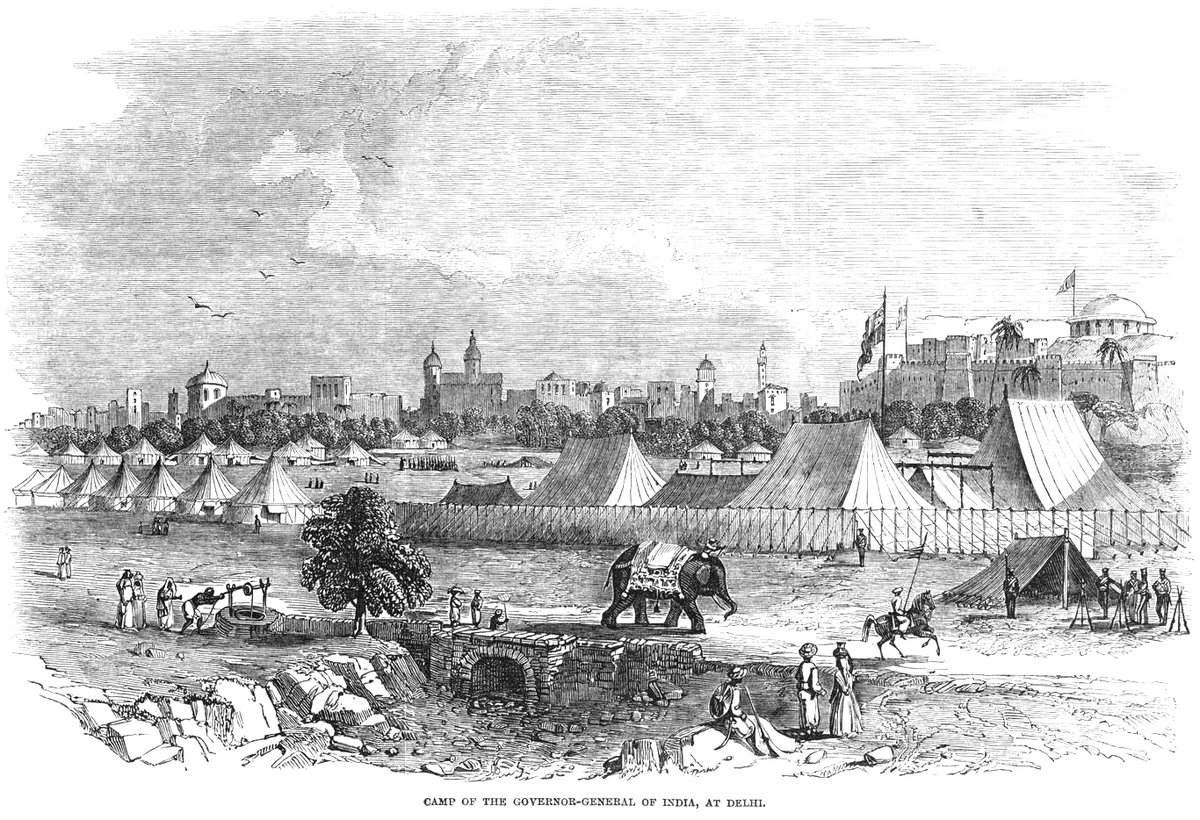
Mehrauli has been accumulating layers of Delhi's history since the 12th century, when the Slave Dynasty raised the Qutb Minar and the first sultanate mosques. By the time the British consolidated control in the 1800s, the area was already thick with tombs, step-wells, and ruined gardens. Sir Thomas Metcalfe, the British Resident at the Mughal court in the 1830s and 1840s, made Mehrauli his personal playground — converting ancient structures into follies and summer retreats.
One hillock near the Mehrauli-Badarpur road reportedly served as a battery position or signal house during Metcalfe's time. Local memory still calls it the Metcalfe Battery House, though no primary colonial record confirms the exact use. What matters is that by the late 20th century, the hill sat empty — a vantage point looking for a purpose.
Granite from Karkala: How a Southern Sculptural Tradition Landed in North India
In the late 1970s, the Digambar Jain community in Delhi commissioned a monumental Mahavira for a site that would embody ahimsa in the national capital. They turned to Karkala, a small town in coastal Karnataka where Jain sculptors had been carving colossal statues from local granite since at least 1432, when the 42-foot Bahubali was erected on a hilltop there. The craft lineage was unbroken.
The Delhi statue — 13 feet 6 inches of solid granite, seated on a lotus pedestal 2 feet 8 inches high — was quarried, carved, and finished in Karnataka, then transported roughly 2,000 kilometres north. The statue alone weighs about 30 tonnes; the pedestal adds another 17. Installed in 1980, it made Ahinsa Sthal one of the few places in northern India where the southern Jain monumental tradition is physically present.
The choice was deliberate. Karkala granite weathers slowly and takes a fine polish that holds for centuries. But the real message was continuity: the same hands that shaped devotional images for 550 years shaped this one. In a city where so much is demolished and rebuilt, that thread of craft mattered to the community that placed it here.
Mehrauli's Deep Memory
Ahimsa in Stone and Soil
Listen to the full story in the app
The whole Ahinsa Sthal,
told well.
Listen to sourced travel stories with local history and practical context — ready offline.

06 Frequently asked.
The questions travellers send us most about Ahinsa Sthal.
Is Ahinsa Sthal worth visiting?
Yes, if you value quiet over spectacle — it delivers an unexpected pocket of calm a few hundred meters from Qutb Minar. The 30-tonne granite Mahavira statue is genuinely impressive up close, and the contrast between the roaring Mehrauli-Badarpur Road outside and the hush inside the gates is striking enough to justify a short detour.
How long do you need at Ahinsa Sthal?
Thirty to forty-five minutes covers the garden, the climb to the hilltop shrine, and a quiet moment at the statue. Those who sit for meditation or study the inscribed boards about Mahavira's teachings often stay an hour.
What is Ahinsa Sthal in Delhi?
Ahinsa Sthal is a Digambar Jain temple complex in Mehrauli, South Delhi, centered on a granite statue of Mahavira — the 24th Tirthankara — seated in lotus posture on a hillock. The name means 'place of non-violence.' It was established in 1980 and the statue was carved in Karkala, Karnataka, a town long associated with monumental Jain sculpture.
Is Ahinsa Sthal free to enter?
Entry is free. Visitors are asked to remove shoes at the entrance; some sources also note that leather items should be left outside, in keeping with Jain principles of non-violence toward animals.
Is Ahinsa Sthal near Qutb Minar?
Yes — it sits in Mehrauli, immediately adjacent to the Qutb Minar complex and the Mehrauli Archaeological Park zone. You can reasonably combine both in a single half-day visit.
Can non-Jains visit Ahinsa Sthal?
Yes, the site is open to all visitors regardless of faith. Respectful dress and removing shoes are expected; loud behavior is out of step with the atmosphere, but no formal restrictions apply to non-Jains.
What is the best time to visit Ahinsa Sthal?
October through March, when Delhi temperatures are manageable and the garden stays green. Mornings are quieter for contemplation; weekday afternoons see the fewest visitors.
Verified, and shown.
Researched and written by the Audiala editorial team from historical records, architectural archives, and local expertise.
Core facts: founding year 1980, statue dimensions (13 ft 6 in, ~30 tonnes), Karkala granite origin, Digambar Jain affiliation
Additional confirmation of founding date and religious context
Local history context, '1980s' founding period, garden layout, colonial hill association, visitor atmosphere
Statue dimensions, pedestal weight (~17 tonnes), Karkala granite carving detail
Temple location details and rounded statue height figure (14 ft)
Karkala granite origin, Metcalfe Battery House local claim, visitor information
First-person visitor account; noise contrast, garden layout, shoe/leather removal, inscribed boards
Visitor photography and personal account; neighborhood calm-zone use, garden atmosphere
Visitor sentiment: families, couples, walkers using the grounds; general atmosphere
Corroboration of 1980 founding year from pilgrimage record
Built from cited sources · see the method · How we make our guides →