National Gallery of Modern Art, Mumbai

Mumbai, India

National Gallery of Modern Art, Mumbai

Housed in Sir Cowasji Jehangir Hall, NGMA Mumbai pairs Bombay modernism with a Grade I heritage shell in Fort's quieter, more serious art circuit.
1-2 hours
Rs 20 for Indian visitors / Rs 500 for foreign visitors

Introduction

The National Gallery of Modern Art in Mumbai, India wears a 1911 civic face and a 1990s museum body, which is exactly why you should visit: few places show a city arguing with its own modernity so plainly. Behind the stone shell of Sir Cowasji Jehangir Hall, the National Gallery of Modern Art, Mumbai turns a former concert venue and political stage into one of the sharpest places in the country to look at modern Indian art. Come for the paintings, yes, but stay for the building itself, because every staircase and echo carries the question of what a national museum should preserve: the old room, the new room, or the fight between them.

Records show the hall opened in 1911 on M. G. Road in Fort, funded by Sir Cowasji Jehangir with major contributions from Sir Currimbhoy Ibrahim and Sir Jacob Sassoon. That donor history matters. NGMA Mumbai stands inside a piece of civic philanthropy from colonial Bombay, the kind of public architecture that tried to make culture look permanent.

Most visitors read the facade as heritage and the galleries as heritage too. They shouldn't. NGMA's own history says only the facade survives from George Wittet's original hall, while architect Romi Khosla rebuilt the interior over roughly twelve years before the museum opened on 23 December 1996.

And the mood shifts with the light. Outside, Fort still feels like old imperial Bombay in stone and traffic fumes; inside, the galleries mute the city to footsteps, air-conditioning, and the hush that settles when a room full of people stops in front of one canvas for half a beat longer than expected.

What to See

The Sir Cowasji Jehangir Hall Facade

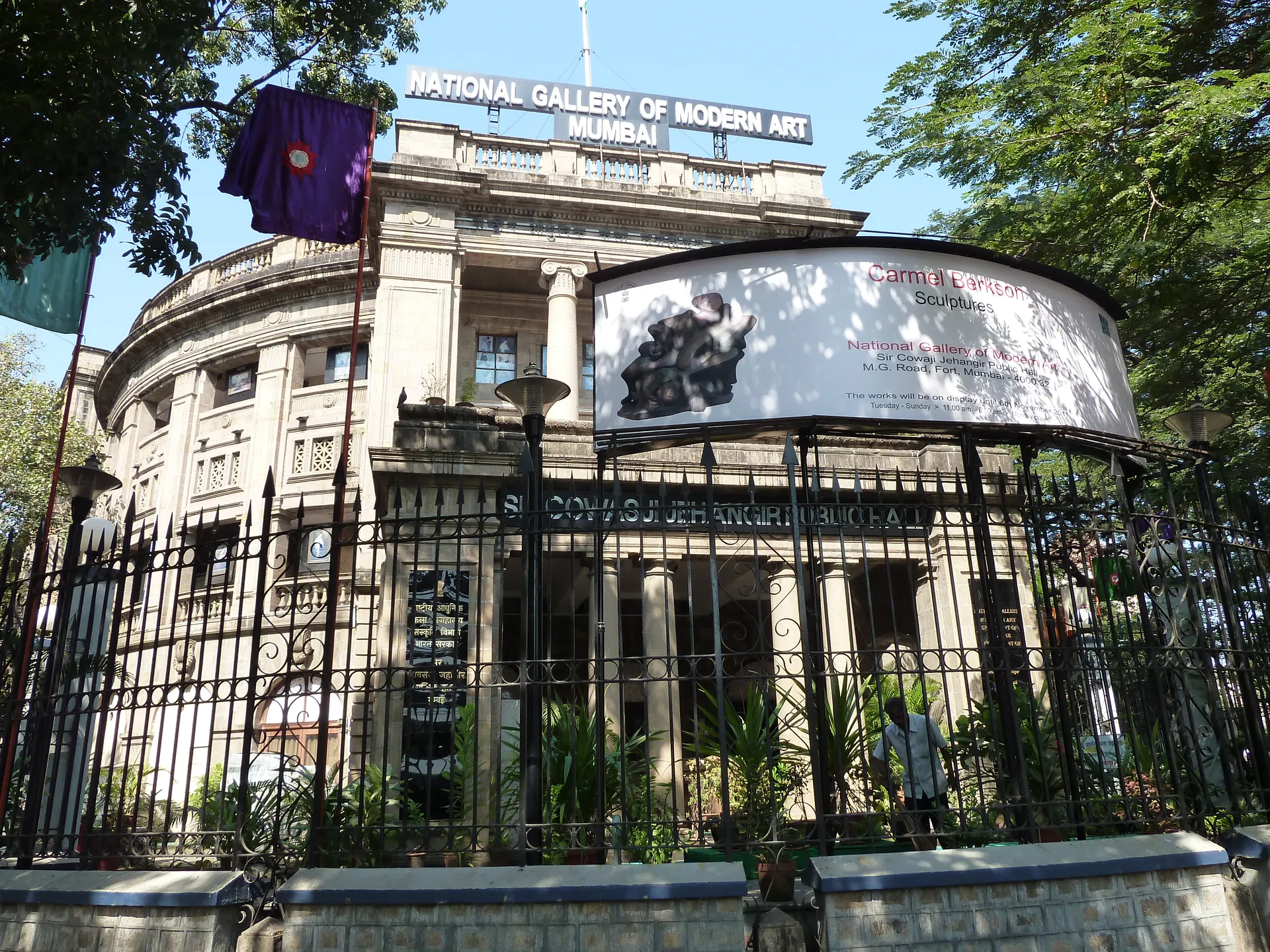
Most visitors come for paintings and miss the first work of art entirely: George Wittet's 1911 Sir Cowasji Jehangir Hall, a yellow-basalt facade on M. G. Road that still carries the civic swagger of old Bombay. Pause before you go in, find the marble bust of Sir Cowasji outside, and notice the odd sleight of hand here: the original shell survives like a stage set, while the museum you are about to enter was built inside it decades later.

Signboard and entrance area at National Gallery Of Modern Art, Mumbai, Mumbai, India, with exhibition banners visible outside the museum.
Contemporary artwork 'Arrival of a Cricket God' displayed inside National Gallery Of Modern Art, Mumbai, Mumbai, India.

The Central Stair and Semicircular Galleries

Inside, the building changes character fast. Romi Khosla's 1996 redesign turns the old hall into a vertical promenade of horse-shoe balconies, semicircular galleries, polished wood and gleaming metal railings, all circling a central stair that pulls your eye upward like the inside of a theatre. Stand at the base for a minute before looking at any canvas; the cool air, the softened echoes, and the directed light make Fort's heat feel a full city away.

Read the Building Between the Paintings

The sharpest way to see NGMA Mumbai is to treat it as two museums at once: modern Indian art on the walls, and a heritage hall hiding in plain sight behind the walls. Walk the upper levels slowly on a weekday, look down into the central void, then look out again toward the old exterior envelope; once you know that new walls were set about 2 feet inside the historic shell, every landing and railing starts to feel like a conversation between 1911 and 1996.

Look for This

Before you go in, find the marble bust of Sir Cowasji Jehangir outside the building. Most people head straight for the galleries and miss the small clue to the hall's older civic life.

Visitor Logistics

directions_bus

Getting There

NGMA Mumbai sits in Sir Cowasji Jehangir Public Hall on M. G. Road in Fort, a short walk from Regal Cinema and the Kala Ghoda galleries. As of 2026, the easiest public-transit approach is Churchgate or CSMT by suburban rail, then a 10-minute walk; Mumbai Metro Line 3 also works via Hutatma Chowk, about 0.5 km away, roughly the length of five cricket pitches laid end to end.

schedule

Opening Hours

As of 2026, the gallery opens Tuesday to Sunday from 10:00 am to 6:00 pm and closes on Mondays and national holidays. Special exhibitions sometimes stretch weekend hours, and ad hoc closures do happen, so check the current exhibition page before you set out.

hourglass_empty

Time Needed

Give it 45 to 60 minutes for the building and the headline works, especially if you're folding it into a Kala Ghoda circuit. A comfortable visit takes 1.5 to 2 hours; if you want all five floors and time to linger, allow 2 to 3 hours.

accessibility

Accessibility

Public information stays frustratingly mixed. Official pages confirm security screening and lockers, but they do not publish a clean accessibility spec, while secondary sources disagree on ramps, lifts, and accessible toilets, so wheelchair users should call ahead and verify the entrance route, elevator access, and washroom setup before visiting.

payments

Tickets

As of 2026, entry costs Rs 20 for Indian visitors and Rs 500 for foreign visitors, while students and children up to Class 12 enter free with valid ID. Regular tickets are sold at the counter; I found no official online booking system and no confirmed public free-entry day.

Tips for Visitors

checkroom
Bag Rules

Security is stricter than the calm galleries suggest. Larger bags go through scanning and then into porch lockers, and staff do not allow water bottles or food inside, so travel light unless you enjoy administrative detours.

photo_camera
Ask First

Photography rules appear to shift by exhibition and room. Ask at the entrance before you pull out your phone, and assume flash, tripods, and professional gear will be refused unless staff say otherwise.

restaurant
Eat Nearby

Skip the idea of relying on an on-site cafe. Walk out into Kala Ghoda instead: Kala Ghoda Cafe works for a mid-range pause, The Pantry Cafe is good for coffee and light plates, and Chetana near Jehangir Art Gallery suits a longer lunch.

directions_walk
Make A Circuit

NGMA makes more sense as part of Fort than as a one-off stop. Pair it with the Kala Ghoda streets, Jehangir Art Gallery, and CSMVS, then keep moving through the old city rather than backtracking toward the waterfront.

security
Street Sense

Fort feels calmer than many parts of Mumbai in daylight, but festival crowds in Kala Ghoda bring the usual phone-snatching and pickpocket risk. Use metered cabs or app rides, and be wary of inflated parking or short-hop taxi overcharging.

wb_sunny
Best Timing

Go soon after the 10:00 am opening if you want the galleries at their quietest and the old hall before the afternoon footfall builds. Late morning also gives you enough time to roll into the rest of the Mumbai art quarter without turning the day into a forced march.

Where to Eat

local_dining

Don't Leave Without Trying

Vada Pav Pav Bhaji Bhel Puri Sev Puri Bombay Sandwich Irani Chai & Bun Maska

Chotu Chai Wala

quick bite
Tea & Snacks €€ star 4.5 (22)

Order: The masala chai here is legendary—take it with a side of crispy sev or samosa.

A beloved local spot that never sleeps, perfect for a quick caffeine fix or a late-night snack.

schedule

Opening Hours

Chotu Chai Wala

Open 24 hours daily
map Maps

Tea / Special Masala Tea

cafe
Tea & Scones €€ star 5.0 (13)

Order: Their signature masala chai is rich and spiced just right—pair it with a buttery toast or a simple sandwich.

A cozy, no-frills spot where locals come for a strong cup of chai and a moment of calm.

schedule

Opening Hours

Tea / Special Masala Tea

8:30 AM–9:00 PM (Mon-Wed)
map Maps

Rahman shaikh

local favorite
Mughlai €€ star 5.0 (3)

Order: Their seekh kebabs and mutton curry are the real deal—simple, flavorful, and authentic.

A hidden gem for those who want genuine Mughlai flavors without the touristy prices or crowd.

schedule

Opening Hours

Rahman shaikh

11:30 AM–10:30 PM (Mon-Wed)
map Maps

Woodside Inn

local favorite
Bar & Snacks €€ star 4.4 (2401)

Order: Their signature cocktails and the crispy garlic fries are a must—great for an evening unwind.

A lively spot with a mix of locals and tourists, perfect for a casual drink or a light bite.

schedule

Opening Hours

Woodside Inn

11:00 AM–1:30 AM (Mon-Wed)
map Maps language Web
info

Dining Tips

  • check Bademiya is a famous late-night kebab stall near the Taj Hotel—open till very late.
  • check Dishoom is hugely popular, so expect queues, especially on weekends.
  • check The Table and Indigo are great for post-gallery dinners—reservations recommended.
  • check Samovar Café, if open, is a fantastic on-site option inside the NGMA complex.
Food districts: Colaba Causeway (casual eats, street food) Kala Ghoda (arts district with cafés and restaurants) Nariman Point (business district with upscale dining)

Restaurant data powered by Google

Historical Context

A Hall With Three Lives

Documented sources describe NGMA Mumbai as a museum, but the older story is about a public hall that kept changing jobs. George Wittet designed Sir Cowasji Jehangir Public Hall in 1911 inside the Institute of Science complex, and official histories record that it served Bombay first as a civic room for concerts, meetings, and exhibitions before anyone imagined a national gallery here.

By the 1960s and 1970s, NGMA's own account says the hall had slipped from recital venue to rental shell, hosting boxing matches, trade-union meetings, wedding receptions, and discount sales. That decline gave the building its second act. Artists began arguing that Bombay was losing more than a facade; it was losing one of the few public rooms where modern art could claim serious space.

Pilloo Pochkhanawala Fights for a Museum She Never Saw

Pilloo Pochkhanawala, the sculptor who helped push for an NGMA branch in Mumbai, had something personal at stake: whether the city that shaped her work would keep a public home for modern art or let one more cultural institution slide into commercial rent-outs. Official NGMA history and later art-historical accounts credit her, alongside Kekoo Gandhy, with protesting the hall's drift from culture to bazaar.

The turning point came when that protest became policy. Museums of India records, though on a single source for the exact year, place the transfer of the hall from the Government of Maharashtra to the Union government in 1984; NGMA's own history confirms the twelve-year conversion that followed under Romi Khosla.

Pochkhanawala died in 1986. She never saw the museum open on 23 December 1996, a decade later, which gives the place a sting most visitors miss: one of the people who fought hardest for this institution is absent from its founding photograph.

From Menuhin to Mass Meetings

Documented museum history says the hall once heard Yehudi Menuhin, Paul Robeson, and the Bombay Symphony Orchestra under Mehli Mehta. The same sources say it hosted public meetings linked to Mahatma Gandhi, Sardar Patel, Jawaharlal Nehru, and Mohammed Ali Jinnah, which means this was never just an art venue; it was one of Bombay's civic lungs, taking in music one night and politics the next.

The Facade Tells Half the Truth

Most tourists think they are walking through a preserved 1911 interior. They are not. NGMA's official history and the TIFR architecture study agree that Romi Khosla kept the historic outer shell and built new galleries roughly two feet inside it, creating a structure within a structure, so the building you admire in the stairwells and split levels is largely a 1990s argument with heritage, not a frozen colonial room.

Listen to the full story in the app

Your Personal Curator, in Your Pocket.

Audio guides for 1,100+ cities across 96 countries. History, stories, and local insight — offline ready.

smartphone

Audiala App

Available on iOS & Android

download Download Now

Join 50k+ Curators

Frequently Asked

Is National Gallery of Modern Art, Mumbai worth visiting? add

Yes, especially if you care about modern Indian art or want one quiet, intelligent stop in Fort that isn’t fighting for your attention. The real surprise is the building: George Wittet’s 1911 civic shell survives outside, but Romi Khosla rebuilt the interior as a split-level museum inside it, so you’re walking through two eras at once. Also, the collection’s Bombay Progressive Artists’ Group connection gives the place real local weight, not just national-museum branding.

How long do you need at National Gallery of Modern Art, Mumbai? add

Give it 1.5 to 2 hours for a comfortable visit. You can do a brisk pass in 45 to 60 minutes if you want the building and highlights only, but five gallery levels and temporary exhibitions reward slower looking. If a major show is on, 2 to 3 hours makes more sense.

How do I get to National Gallery of Modern Art, Mumbai from Mumbai? add

The easiest route is suburban rail or Metro Line 3 to South Mumbai, then a short walk or taxi into Fort. Official NGMA guidance names Churchgate and CSMT as the nearest rail stations, and recent transit guides place Hutatma Chowk Metro about 0.5 km away, roughly the length of five football fields. From Churchgate, many visitors walk through Kala Ghoda toward Regal Circle in about 10 minutes.

What is the best time to visit National Gallery of Modern Art, Mumbai? add

Weekday late mornings or early afternoons are best if you want the galleries at their calmest. Officially, NGMA Mumbai usually opens Tuesday to Sunday from 10:00 am to 6:00 pm, closed Mondays and national holidays, though special exhibitions can stretch weekend hours later. As of April 7, 2026, the ongoing 'Paridhrishya' show listed Saturday and Sunday hours until 8:00 pm.

Can you visit National Gallery of Modern Art, Mumbai for free? add

Yes, if you are a student or a schoolchild up to Class 12 with valid ID. Standard official admission is Rs 20 for Indian visitors and Rs 500 for foreign visitors, and I found no verified general free-entry day. Regular tickets are bought at the counter, not through an official online booking system.

What should I not miss at National Gallery of Modern Art, Mumbai? add

Don’t miss the building itself. Look for the marble bust of Sir Cowasji Jehangir outside, then step inside and stop under the central stair to read the horseshoe balconies and semicircular galleries around the void; many visitors stare at the canvases and miss the museum wrapped around them. Also pay attention to the trick of the place: the heritage facade belongs to 1911, but much of the interior belongs to the 1990s rebuild.

Is National Gallery of Modern Art, Mumbai wheelchair accessible? add

Maybe, but don’t assume full accessibility without calling first. Official NGMA pages do not publish a detailed accessibility guide, and secondary sources conflict: one accessible-travel directory reports step-free access and an elevator, while a 2019 Times of India report said surveyors found no wheelchair ramps. If access matters, call ahead and ask about the entrance, lift access to all gallery levels, accessible toilets, and drop-off options.

Sources

Last reviewed:

Map

Location Hub

Explore the Area

More Places to Visit in Mumbai

23 places to discover

Castella De Aguada star Top Rated

Castella De Aguada

Jijamata Udyaan star Top Rated

Jijamata Udyaan

Madh Fort star Top Rated

Madh Fort

Sion Hillock Fort star Top Rated

Sion Hillock Fort

Chhatrapati Shivaji Maharaj International Airport

Chhatrapati Shivaji Maharaj International Airport

Mumbai Trans Harbour Link

Mumbai Trans Harbour Link

Taj Mahal Palace Hotel

Taj Mahal Palace Hotel

photo_camera

Nehru Science Centre

photo_camera

Nhava Sheva

Portuguese Church

Portuguese Church

Prithvi Theatre

Prithvi Theatre

photo_camera

Riwa Fort

Royal Opera House

Royal Opera House

Sanjay Gandhi National Park

Sanjay Gandhi National Park

photo_camera

Sewri Fort

Siddhivinayak Temple, Mumbai

Siddhivinayak Temple, Mumbai

photo_camera

St. Thomas Cathedral, Mumbai

Wankhede Stadium

Wankhede Stadium

photo_camera

Worli Fort

Bandra–Worli Sea Link

Bandra–Worli Sea Link

Bombay Castle

Bombay Castle

photo_camera

Bombay House

Cathedral of the Holy Name

Cathedral of the Holy Name

Images: Balajijagadesh (wikimedia, cc by-sa 3.0) | DesiBoy101 (wikimedia, cc by 4.0) | Manjunath Kamath (b. 1972) (wikimedia, cc by-sa 2.0) | Arvind Iyer from Mumbai, India (wikimedia, cc by-sa 2.0)