Meerut
India Updated Apr 2026
The bugle that wakes Meerut each dawn is still made here—one of India’s last makers tunes the brass in a workshop behind Augarnath Temple, where sepoys once hashed out the 1857 mutiny over clay cups of tea. Between clanging cricket-bat lathes and the sweet smoke of sesame brittle, the city keeps reinventing itself faster than you can say “Uttar Pradesh satellite town.” Meerut, India, is a place where epic history, factory-floor commerce, and festival-night chaos share the same narrow lane.
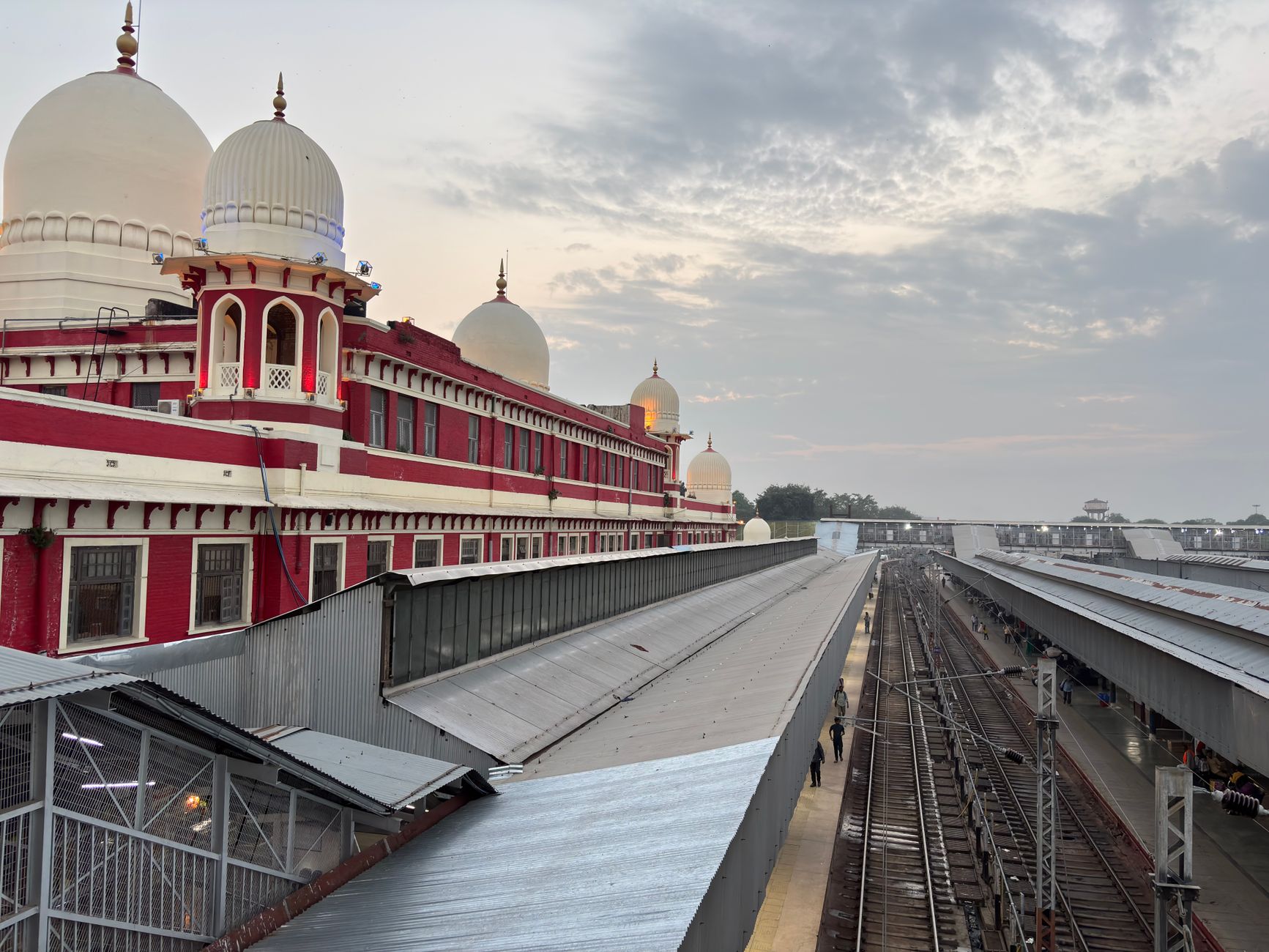
 Photo: Ravi Dwivedi · CC BY-SA 4.0
- Attractions
- 11
- Trip length
- 1–2 days
- Best season
- November–February
Why Meerut
Built from cited sources · see the method · How we make our guides →
Walk Mall Road at 7 a.m. and you’ll pass Victorian barracks turned sneaker outlets, schoolgirls in kurtas rehearsing Kathak footwork on the sidewalk, and a 200-year-old church whose pews still carry rifle slots cut the week Delhi fell. By noon the scent shifts: black-pepper chicken sputtering in kadhais, hot enough to make Delhi foodies drive 60 km for Sunday breakfast, while lassi vendors clang brass glasses against marble counters older than their grandfathers’ accounts.
Meerut’s real genius is scale. Hastinapur’s Jain temples rise like iced wedding cakes only 38 km away, yet inside the old cantonment you can stand where the first bullet of the War of Independence whizzed past a British colonel, then cycle ten minutes to Asia’s largest sports-goods bazaar and watch willow clefts become Sachin-grade bats in under an hour. Add a month-long fair that swallows 4 sq km every spring and a wildlife sanctuary where sarus cranes dance among barasingha, and the city begins to feel less like a stopover, more like a compressed continent.
Come for the rebellion lore, stay for the breakfast kachori-jalebi collision, linger for the night-long chaat crawls that turn alleyways into open-air living rooms. Meerut doesn’t beg for attention; it keeps moving, humming, frying—confident you’ll catch up.
Where the 1857 Rebellion Began
Augarnath Temple’s quiet courtyard still holds the well where sepoys refused Enfield cartridges, sparking India’s First War of Independence. The bullet-scarred clock of St John’s Church stopped at the exact moment their march began.A Roofless 1628 Tomb
Shahpeer Sahab’s dargah was never finished, leaving its red-sandstone mausoleum open to sky and monsoon. The effect is accidental poetry: starlight on carved lotus petals, rain pooling on Nur Jahan-era stone.World Capital of Cricket Bats
In Shastri Nagar’s back lanes you’ll hear the knock of willow being shaved into SG and BDM blades. Buy straight from the factory for half Delhi prices; they’ll stamp your name on the shoulder if you ask.Hastinapur’s Two-Frontier Day Trip
Thirty-eight kilometres north, barasingha deer wander grasslands where the Mahabharata’s Karna supposedly donated his armour. Between wildlife sightings you can lunch on Jain temple thalis inside a replica Mount Kailash.
Neighborhoods
Where to wander, by quarter — each with its own rhythm.
Cantonment & Mall Road
The British grid of 1806 still rules here—wide roads, 200-year-old banyans, and St. John’s Church with its clock frozen (locals swear) at the moment of the 1857 attack. Browse Victorian cemeteries before diving into Gandhi Bagh’s evening musical-fountain crowd, or step into factory-showrooms where cricket bats sell at half Delhi prices.Brahmpuri
Street-food central after dark. Stall owners ladle neon-red tomato chaat into leaf bowls, while Ramcharan’s legendary cart dishes out bhalla papdi to a line that snakes past 1980s tailoring shops. The air smells of hing and diesel; the soundtrack is clanging ladles and Bollywood bass from passing rickshaws.Shastri Nagar
Meerut’s sports-manufacturing artery. Behind unassuming steel shutters, craftsmen hand-press hockey sticks and laser-stamp SG or SS logos on bats destined for Lord’s. You can buy fresh-off-the-lathe willow for ₹1,200—just don’t expect glossy packaging; quality here speaks with the knock of mallet on wood.Begum Pul-Jama Masjid Quarter
Tangled lanes around the 17th-century Shahi Eidgah overflow with kebab smoke and the clang of copper-ware. Haji Sayeed’s restaurant serves seekh so soft it folds like cloth; outside, artisans beat brass trays that will end up in Gulf weddings. Sunset calls the faithful to Jama Masjid’s roofless courtyard—no minarets, only sky.Suraj Kund Area
A leafy tank said to date from Mahabharata days hosts Meerut’s loudest Dussehra fair. The rest of the year it’s a neighborhood park where aunties walk laps and students cram for exams under neem trees. Come evening, sugar-cane presses squeeze green juice while boys practice wrestling moves on the sandy edge.Hastinapur Road Outskirts
The city unravels into mustard fields and brick kilns before Jain temple domes start glinting on the horizon. Along the way, dhabhas advertise “Vaishnav biryani” (no onion, no garlic) and roadside pools fill with migrating duck in winter—an unexpected rural breather only 45 minutes from the center.
Plan your trip
Before you go
- Getting There
- Fly into Indira Gandhi International Airport (DEL), 70 km south-west; prepaid taxis ₹1,200–2,000, 2–3 hrs. Meerut City Jn and Meerut Cantt are the main rail stations; both sit on the Delhi–Saharanpur line. NH-34 and the new Eastern Peripheral Expressway feed cars in from Delhi and Haridwar.
- Getting Around
- The 22-station Delhi–Meerut RRTS (Namo Bharat) opened February 2026, slicing the capital run to 55 minutes; fares ₹30–120. Inside town, blue-and-yellow Vikram e-rickshaws ply fixed routes for ₹10–20, while Ola/Uber autos give metered peace of mind. No bike-share; cycling in traffic is for locals only.
- Climate & Best Time
- November–February delivers cool 7–22 °C days with morning fog. March warms to 30 °C, then May hits 43 °C before the July monsoon drowns streets. Come between Dussehra and Holi; skip June when even the lizards look exhausted.
- Language & Currency
- Hindi is default, seasoned with Khariboli dialect in the bazaars. English works at hotels and chain cafés but fails in most autos—keep Google Translate offline packs ready. India uses rupees only; carry cash for street food, UPI QR codes cover everything else.
- Safety
- Pickpockets target the Sadar Bazar crush—keep phones in front pockets and bags zipped. After 10 p.m. take app cabs instead of street autos; the cantonment area is lit, but old-city lanes dim fast. Women should dress conservatively near mosques and avoid solo night walks in Begum Pul quarter.
Where India’s First War of Independence Began
From Mahabharata battlefields to 1857 mutiny, Meerut has always been a city where empires clash
- c. 3300 BCE
Indus Farmers Settle
At Alamgirpur, on the banks of the old Yamuna, villagers stamp their pottery with the same mysterious script used in Mohenjo-daro. Their mud-brick walls, 4,000 years later, still smell of river silt when archaeologists lift them from the trench.
- c. 273 BCE
Ashoka’s Pillar Rises
A 12-metre sandstone monolith is hauled here by elephants, one of the emperor’s road-side edicts preaching mercy to travellers. Six centuries later a Sultan will drag it to Delhi; the hole where it once stood still fills with monsoon water behind the old tehsil.
- 1019 CE
Shahi Jama Masjid Built
Mahmud’s general Hasan Mahdi plants Meerut’s first mosque in stone, its arches facing the same sunrise the Hindu temples watch. The call to prayer drifts over mango orchards that will soon give way to caravanserai.
- 1399 CE
Timur’s Horde Arrives
The sky darkens with dust and the smell of burning wheat. Timur’s cavalry ride down the Grand Trunk Road, stack skulls outside the town walls, and leave the fields fallow for a generation. Survivors speak of a silence that lasted three days.
- 1628 CE
Shahpeer’s Roofless Tomb
Nur Jahan’s courtier Shahpeer dies; his widow builds a tomb of blood-red sandstone but leaves the dome unfinished. Local mothers still bring fevered children to circle the open sky at dusk, believing the cool stone drinks the sickness away.
- 1806 CE
Cantonment Grid Laid Out
East India Company surveyors stretch white tape across melon fields, plotting 14 parallel roads for cavalry lines. Within a year the bazaar smells of Bristol rum and leather instead of ghee and mango sap; the old city is now just the ‘native’ side of town.
Show the full timeline (16 moments)
- 1819–1821 CE
St John’s Consecrated
The first Anglican stone north of Delhi rises with 32-pound cannonballs buried in its foundations—symbolic, the chaplain says, of the power that rests on gospel truth. The bell still rings F-sharp; sepoys in 1857 will mistake it for the alarm to muster.
- 10 May 1857
Mutiny Ignites
At 6:30 p.m. the 3rd Light Cavalry gallops out of the parade ground firing at their officers. Within minutes the sky over the quarter-guard glows orange; British bungalows burn so hot the window glass runs like treacle. By dawn Meerut has lost the Raj, and Delhi will fall next.
- 1857 CE
Dhan Singh Leads the City
The kotwal—Meerut’s police chief—throws open the jail, arms the prisoners, and leads them against the cantonment he once guarded. His name is shouted in the lanes where he once collected taxes; the British will hang him from a peepal tree that still stands behind the collectorate.
- 1929 CE
Meerut Conspiracy Case Opens
Police drag 32 trade-unionists and communists from a printing press on Abu Lane. The trial, held inside the old cantonment jail, will run four years and gift the independence movement its most durable martyrs’ roster; the courtroom benches still bear their carved initials.
- 1935 CE
Bashir Badr Finds His Voice
A shy teenager recites ghazals under the pipal outside Meerut College; girls on bicycles slow down to listen. His verses—‘Your city is a wound on the map of my heart’—will turn the ordinary lanes of Meerut into a geography of longing.
- August 1947 CE
Union Jack Lowered
The last Union Jack on the cantonment flagpole is replaced by khadi so new its creases still show. British officers’ clubs empty out overnight; someone leaves a regimental silver cup in the rubbish heap behind the church. The city keeps both names—Meerut and ‘cantonment’—as if unsure which century it inhabits.
- May 1987 CE
Hashimpura Killings
PAC trucks pull 42 Muslim men from a lane near the Shahi Jama Masjid, drive them to the canal, and shoot them. The water runs pink for hours; survivors say even the frogs stopped croaking. The trial will crawl through courts for thirty years, reminding the city that 1857 isn’t the only date that stains its soil.
- 1990 CE
Bhuvneshwar Kumar Born
In a two-room house in Kharkhoda, midwives hear the first cry of a boy whose seam-bowling will one day dismantle Australian tail-enders. The lane where he learnt swing with a taped tennis ball still smells of mango blossoms every May.
- 11 April 2006
Victoria Park Fire
A spark from a generator turns a consumer-goods fair into an inferno; nylon tents melt onto skin. Loudspeakers recite verses from the Quran while Sikh rescuers tear open wire fencing with their turbans. The official count stops at 45; locals say the ash drifted as far as Hastinapur.
- 2022 CE
Rapid Rail Arrives
The first silver train slices the morning fog, cutting Delhi traffic to 62 minutes. College students Instagram the moment the city’s skyline—once defined by church spire and minaret—adds a third silhouette: the catenary wire that finally drags Meerut into the capital’s commuter belt.
Who lived here
-
Composer & Film-maker · born 1965
Vishal Bhardwaj
Born here
He spent childhood evenings listening to the brass band outside his grandfather’s Meerut shop—those military-marched notes later coloured the soundtrack of ‘Omkara’. Return today and he’d still recognise the bugle pitch; the city holds a GI tag for it.
-
Playback Singer · born 1973
Kailash Kher
Spent formative years here
Before Delhi and Mumbai, Kher’s voice echoed over the Suraj Kund water during college festivals. He still calls Meerut his ‘vocal gym’—the place where street qawwali taught him to hold a note longer than anyone expected.
-
Mercenary Commander & Catholic Ruler · 1753–1836
Begum Samru
Governed nearby Sardhana 14 km away
She rode from Sardhana to Meerut fort negotiating British treaties while her European mercenaries drank in the cantonment taverns. Her basilica’s dome still dominates the skyline west of the city—an easy half-day cycle from the old Idgah.
Where to Eat
Where locals actually book dinner — not the tourist menus.
Insider tips
Small things that change how the city treats you.
Museum timing
Shaheed Smarak museum locks its gates at 4:30 pm sharp and stays shut Monday; arrive by 3 pm to avoid the rush.Sunday service
St John’s 8:30 am English service lets you sit in pews still scarred with 1857 rifle slots—arrive ten minutes early for a quiet look at the frozen clock tower.Breakfast order
Ask for kachori-sabji followed by jalebi at any stall near Begum Pul; locals finish the plate before 9 am when the oil is freshest.Sports shopping
Factory-outlet cricket bats on Shastri Nagar back-lanes cost 30 % less than Delhi; carry cash—most units don’t swipe cards.RRTS trick
Book Namo Bharat tickets in the app while still in Delhi Metro—Meerut South station runs out of QR paper on festival weekends.Cemetery caution
St John’s graveyard holds 32 Europeans killed in 1857; go before dusk—snakes shelter under broken 200-year-old stones.
Gallery
The city, as it actually looks.
Watch
-
Globalecentre Meerut Street Food | Bahubali Bhatura | Ramo Ki Kachori | Rehman Ki Haleem Biryani Meerut
-
Dilsefoodie Official Ep - 2, Mohalla Aapka MEERUT | Makhan Chole Kulche, Papa Ji Dal, Pizza Patty, Pandit Rajma Chawal
-
BEYOND HUNGRY Meerut Ka 36 inch लंबा पराँठा | Meerut Food Tour |Kulhad wali Moradabadi Daal| Matar Chaat| Halwa |
-
Delhi Food Walks Best MEERUT Veg Food Tour I Kulhad Wali Muradabadi Dal & Chole + Kanji Vada + Ramu Samosa + Bedmi



Frequently asked
Is Meerut worth visiting or just a Delhi satellite?
Meerut is worth a full day if you care about 1857 history or want India’s cheapest cricket bats. The Freedom Struggle museum, Augarnath Temple and St John’s Church together tell the story of the first war of independence better than any Delhi site.
How many days should I spend in Meerut?
One packed day covers city highlights; add a second for Hastinapur’s Jain temples and wildlife sanctuary. Stay overnight only if you want the dawn bird walk or to catch the Dussehra fair at Suraj Kund.
What is the cheapest way to reach Meerut from Delhi airport?
Airport Express to New Delhi → Metro to Anand Vihar → UP Roadways bus costs under ₹200 total. Faster: share Ola to Anand Vihar then Namo Bharat train (₹120) reaches Meerut South in 55 minutes.
Are auto-rickshaws safe at night for women?
Stick to app cabs post-sunset; autos rarely use meters and old-city lanes are poorly lit. Pre-save your hotel number and share trip status with a friend—standard NCR precautions apply.
Which month avoids both heat and fog?
Late February and the whole of November give clear 22 °C days with almost no rain or fog. March warms up but is still walkable; December mornings can strand you till 10 am with dense fog.
Do I need to book Hastinapur wildlife entry in advance?
No permit needed for day visits; just hire a guide at the gate (₹400 half-day). Barasingha sightings are best at sunrise—reach by 6:30 am before the deer retreat into tall grass.
Pick up where you left off
Saved and recently read places — kept on this device only.
Photo credits (2)
- Meerut Ghantaghar — Ravi Dwivedi — CC BY-SA 4.0 (https://creativecommons.org/licenses/by-sa/4.0/) — Source: https://commons.wikimedia.org/wiki/File:Meerut_Ghantaghar.jpg
- Vedant Gupta — Pexels License (https://www.pexels.com/license/) — Source: https://www.pexels.com/photo/34621080/
Photos may have been resized or cropped.