An introduction.
Researched by the Audiala editorial team from historical records, architectural archives, and local expertise.
DDuring a famine that was starving Lucknow's citizens, one ruler's solution was to build a 60-foot gateway — taller than a five-story building — so people could eat without the shame of accepting charity. The Rumi Darwaza, India's most recognizable Nawabi monument, still stands in the heart of Lucknow as a reminder that architecture can be an act of mercy. It remains free to visit, open around the clock, and utterly impossible to walk past without stopping.
The name misleads almost everyone. Tourists assume "Rumi" honors the 13th-century Sufi poet Jalaluddin Rumi. It doesn't. The word refers to Rûm — the historical term for the Ottoman Empire and its Byzantine predecessor. Nawab Asaf-ud-Daula modeled his gate after Istanbul's Sublime Porte, planting a piece of Ottoman grandeur in the Awadhi plains. The ambition was deliberate: Lucknow as a rival to the great Islamic capitals.
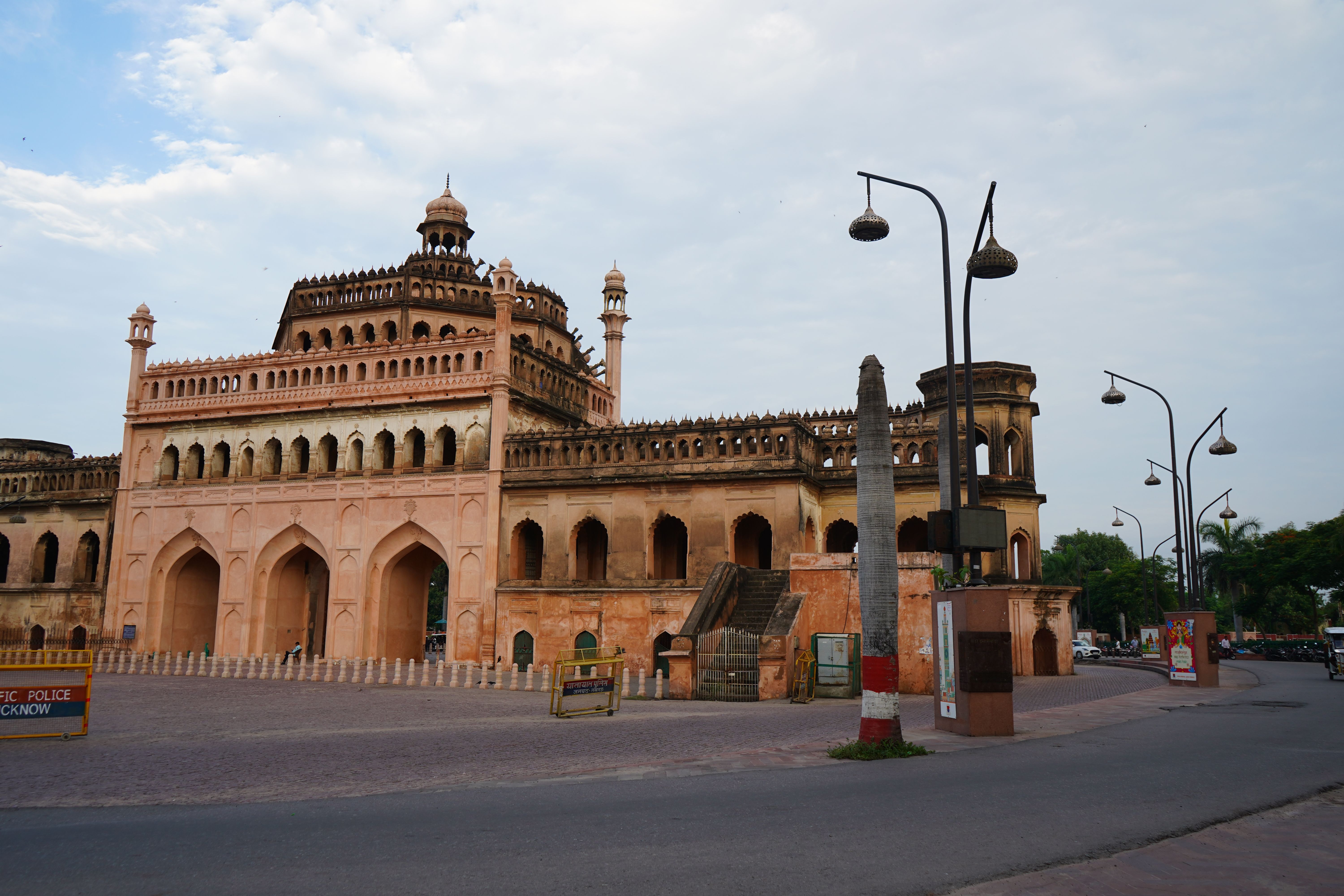
What strikes you first isn't the scale but the texture. Unlike the red sandstone of Mughal Delhi, the Rumi Darwaza is brick coated in lime plaster, which allowed the architect Kifayatullah to carve floral motifs so fine they look like lacework from a distance. Up close, the surface has the warmth of something handmade — because thousands of hands did make it, one brick at a time, in exchange for wages that kept their families fed through 1784 and beyond.
The gate sits between the Bara Imambara and the Chota Imambara, forming the ceremonial western entrance to the larger complex. Traffic still passes through its arch — auto-rickshaws threading beneath the same vault that once framed royal processions. That collision of the everyday and the monumental is what makes the Rumi Darwaza feel alive rather than preserved.
01 What to see.
The Central Arch and Its Lost Waterworks
The East Facade and the Guard Windows Above
The Octagonal Chhatri and the Missing Lantern
A Walk Through the Gate at Two Different Hours
02 In pictures.


Plan and listen to Rumi Darwaza with Audiala.
Audio guide in your pocket, itinerary in your browser. Built for the way you actually visit.
03 Visitor logistics.
The practical scaffolding for a good visit — kept short.
Getting There
Rumi Darwaza sits on a public road between Bara Imambara and Chota Imambara in Old Lucknow. The nearest metro stations — KD Singh Babu Stadium and Hazratganj — are 3–4 km away, so grab an auto-rickshaw from either for roughly ₹50–80. From Charbagh Railway Station, an auto takes about 25 minutes depending on traffic. There's no dedicated parking; street parking is scarce and stressful, so ride-hailing apps or rickshaws are your best bet.
Opening Hours
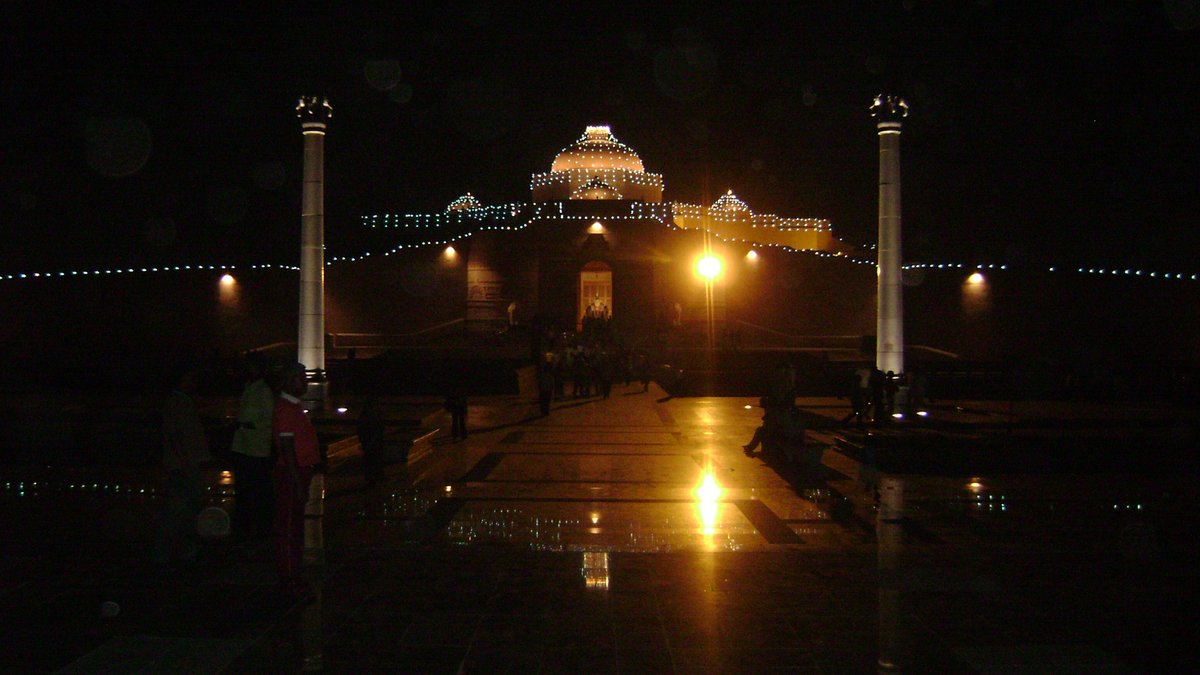
As of 2026, Rumi Darwaza is accessible 24 hours a day, every day of the year — it's a public gateway, not a ticketed monument. No gates close, no guards shoo you away. That said, the evening illumination (roughly 6:00 PM onward) transforms the structure, so plan accordingly.
Time Needed
The gate itself takes 15–20 minutes to photograph and absorb. But you'd be shortchanging yourself to stop there — budget 45 minutes to an hour if you walk through toward Bara Imambara and loop past Chota Imambara and the Husainabad Clock Tower, all within a few hundred meters.
Cost
As of 2026, entry is completely free. No tickets, no booking, no skip-the-line gimmick — because there's no line. The adjacent Bara Imambara does charge a modest entry fee (around ₹25 for Indian nationals, ₹500 for foreign visitors), so keep cash handy if you're combining sites.
Accessibility
The ground around the gate is flat road surface, but the surrounding Hussainabad heritage zone has uneven lanes, broken footpaths, and no ramps or wheelchair infrastructure. There are no elevators or accessible restrooms at or near the monument. Visitors with mobility challenges can view and photograph the gate from the road but should expect difficulty exploring the wider area.
04 Tips for visitors.
Small things that change the day.
Dress Modestly Here
Rumi Darwaza isn't a religious site, but it's flanked by mosques and Imambaras. Cover your shoulders and knees — you'll blend in better, and you'll need the coverage anyway if you step into Bara Imambara next door.
Shoot at Golden Hour
Morning light (7–9 AM) gives you the gate without traffic chaos. Evening (after 5:30 PM) brings dramatic illumination and a warm glow on the lime-coated facade — the best backdrop in Lucknow. Tripods are fine, but stay aware of passing rickshaws.
Skip Unofficial Guides
Self-appointed "guides" near the gate will offer to walk you into the Imambaras for inflated fees. Decline politely and buy tickets at the official Bara Imambara counter instead — it's clearly marked and about 100 meters away.
Eat at Tunday Kababi
Walk through the gate toward Chowk and find Tunday Kababi — the galawati kebabs here dissolve before you can chew, and a plate with sheermal bread runs under ₹200. For something cold afterward, Shri Lassi Corner nearby does thick, creamy lassi at budget prices.
Walk Through, Not Past
Most visitors photograph the facade and leave. Instead, walk through the archway toward the Chowk market — that transition from 18th-century grandeur into the aromatic chaos of old Lucknow's lanes is the real experience guidebooks skip.
Visit October to March
Lucknow's May and June heat regularly hits 45°C — standing on open tarmac beside a lime-white monument in that sun is punishing. The October–March window offers comfortable temperatures and clearer skies for photography.
Where to Eat
Don't Leave Without Trying
Mulla ji Mattha wale
local favoriteOrder: Kashmiri Chai and fresh-baked mattha (traditional cream-based pastries). The chai here is the real deal—salty, pink-hued, and perfect for evening wandering through the Old City.
This is where locals actually gather, open round-the-clock to serve the neighborhood. It's the kind of place that stays alive with the rhythm of Lucknow's historic quarter, serving chai and mattha to shopkeepers, night workers, and heritage explorers alike.
Anand Ki Chai
quick biteOrder: Strong, aromatic chai paired with local snacks. This is your morning or evening pit stop for authentic Lucknow tea culture—the kind of place where regulars have their own preferred corner.
With 42 reviews, this is the most-loved cafe in the immediate Rumi Darwaza neighborhood. It's a genuine community hub, not a tourist trap, and the extended hours (6 AM–10 PM) make it perfect for any time of day.
Haji Ji Matthe wale
quick biteOrder: Fresh mattha and traditional baked goods. Get there early—this bakery opens at 6 AM and closes by 2 PM, making it a breakfast-only destination worth planning around.
Positioned right at the Bara Imambara complex, this is heritage-adjacent eating at its finest. The 4.8 rating despite minimal reviews signals serious quality; locals know exactly what they're getting here.
Healthy Volcano Express
quick biteOrder: Despite the modern name, order what the Chowk area specializes in—this spot sits near Rumi Darwaza itself and offers a convenient stop for a quick meal while exploring the monument.
Perfect 5.0 rating and literally steps from Rumi Darwaza (near Roomi Gate). While limited reviews suggest it's still finding its audience, the location and score make it worth a try if you're monument-hopping.
Dining Tips
- check The Chowk area is extremely crowded and narrow—navigate on foot or via auto-rickshaw to move effectively through the lanes.
- check Rumi Darwaza is accessible 24/7 with no entry fee, but most restaurants in the area have limited hours; plan accordingly.
- check Evening is the best time to explore the food scene, particularly for Kashmiri Chai and street food near Akbari Gate.
- check Street food and casual eateries dominate the heritage area—embrace the informal dining style rather than expecting fine dining near the monument.
- check Most establishments in the Old City are cash-based; bring sufficient currency for small purchases.
Restaurant data powered by Google
05 Dignity Built in Brick and Lime
By 1784, Awadh was in crisis. A severe famine gripped the region, and Nawab Asaf-ud-Daula — the fourth Nawab of Awadh, a man whose generosity was legendary even by the standards of Mughal-successor courts — faced a problem that money alone couldn't solve. His subjects were starving, but many belonged to classes that considered accepting alms a disgrace worse than hunger itself.
The Nawab's answer was to commission the largest building project Lucknow had ever seen: the Bara Imambara complex, with the Rumi Darwaza as its ceremonial entrance. Construction began in 1784 and continued through 1786. The architect Kifayatullah, brought from Delhi, designed a gateway that fused Persian, Mughal, and Ottoman influences into something entirely its own — a style scholars now call the Lucknow School of Architecture.
The Nawab Who Paid Twice for the Same Wall
Nawab Asaf-ud-Daula understood something about poverty that most rulers don't: the worst part isn't the empty stomach, it's the loss of self-respect. According to tradition, he devised a system so unusual it sounds like fiction. During the day, common laborers built the Rumi Darwaza and the surrounding complex, earning wages for honest work. At night, a second shift of aristocrats — nobles and merchants who had fallen into destitution but could not be seen performing manual labor — were quietly employed to dismantle portions of what had been built during the day.
The scheme meant the project cost far more than it needed to. That was the point. Asaf-ud-Daula wasn't building a monument to efficiency; he was running a public works program disguised as architecture. Every brick laid and removed represented a meal for someone who would have otherwise starved or begged. The construction stretched across two years, long enough to outlast the famine.
What remains is a gate that carries the weight of that paradox. The floral carvings are exquisite, the proportions precise, the octagonal chhatri at the summit still elegant after nearly 250 years. But the Rumi Darwaza was always secondary to its real purpose — keeping an entire city alive with its pride intact.
An Ottoman Mirror in Awadh
After the Nawabs Fell Silent
Listen to the full story in the app
The whole Rumi Darwaza,
told well.
Audio guides for 1,100+ cities across 96 countries. History, stories, and local insight — offline ready.
06 Frequently asked.
The questions travellers send us most about Rumi Darwaza.
Is Rumi Darwaza worth visiting?
Yes, particularly if you're already heading to the Bara Imambara, which sits right next to it. The gate is 60 feet tall — roughly the height of a six-story building — and built entirely from brick and lime mortar without any iron or cement, which makes its intricate floral carvings feel almost impossible. It's free, open around the clock, and best appreciated at night when illumination turns the cream-colored plaster into something ghostly and grand.
Can you visit Rumi Darwaza for free?
Completely free, no ticket required. The gate straddles a public road, so there's no entrance point or barrier — you simply walk up to it, through it, or around it at any hour of the day or night.
How long do you need at Rumi Darwaza?
About 15 to 20 minutes if you're just photographing the gate itself. Budget 45 minutes to an hour if you want to study the asymmetric facades, spot the old guard windows in the upper arches, and then walk through to the Bara Imambara complex next door.
What is the best time to visit Rumi Darwaza?
Early morning between 7 and 10 AM gives you the best light on the ornate eastern facade and the fewest crowds. Evening from around 5:30 to 8:30 PM is when the monument is illuminated and the surrounding Old City streets come alive with food vendors. Season-wise, October through March keeps you out of the punishing summer heat that hits 45°C in May and June.
How do I get to Rumi Darwaza from Lucknow city centre?
From Hazratganj, the closest metro stations are KD Singh Babu Stadium and Hazratganj, but you'll still need an auto-rickshaw for the final 3 to 4 km into the Old City. Auto-rickshaws and e-rickshaws are cheap and plentiful from the Charbagh railway station area as well. Don't plan on driving yourself — parking near the gate is virtually nonexistent.
What should I not miss at Rumi Darwaza?
Most visitors snap a photo of the central arch and move on, missing the best details. Look up at the flower-bud carvings along the arch — these once contained water jets that sprayed mist, fed by the Gomti River. The octagonal chhatri at the very top once held a massive lantern that lit up the surrounding city like a lighthouse. And compare the two faces of the gate: the eastern side, which welcomed the Nawab's court, is lavishly carved, while the western exit side is deliberately plain — a quiet reminder that this was built during a famine, when every rupee of ornament had to be justified.
Why is it called Rumi Darwaza?
The name doesn't refer to the Sufi poet Jalaluddin Rumi, despite what many visitors assume. 'Rumi' comes from 'Rûm,' the historical term for the Eastern Roman and later Ottoman Empire. Nawab Asaf-ud-Daula modeled the gate after Istanbul's Bab-i-Humayun, the Sublime Porte, as a deliberate statement that Lucknow belonged among the great capitals of Islamic civilization.
What food should I eat near Rumi Darwaza in Lucknow?
You're steps away from some of the finest Awadhi street food on earth. Tunday Kababi in the nearby Chowk area serves galawati kebabs so soft they were originally designed for a toothless Nawab — expect to pay under ₹200 for a plate that will ruin all other kebabs for you. Pair them with sheermal, a saffron-scented naan baked in a tandoor, and finish with a thick, creamy lassi from Shri Lassi Corner.
Verified, and shown.
Researched and written by the Audiala editorial team from historical records, architectural archives, and local expertise.
Construction date (1784), dimensions (60 feet), architectural style, building materials, and the origin of the name 'Rumi'.
Famine relief context, water jet system details, lantern feature on the chhatri, and visitor access information.
Architect Kifayatullah, construction materials (brick coated in lime), and confirmation of 1784 construction date.
Architect attribution to Kifayatullah, famine anecdote details, and water jet feature.
Completion date of 1786, dual-shift famine labor anecdote, ASI restoration 2022-2024, colonial-era demolition of adjacent palace, and Ottoman architectural inspiration.
Alternative completion date of 1786 and general historical background.
Dual-shift construction anecdote and underground tunnel folklore.
24/7 access confirmation, free entry, and metro station proximity.
Best visiting times, accessibility limitations, parking information, and seasonal advice.
Dimensions, water system details, and famine context.
Local cultural significance and famine employment narrative.
Cultural soft power context and the gate's role as an emblem of Nawabi-era Lucknow.
Researched from Wikidata, Wikipedia & official sources · fact-checked · How we make our guides →