
Introduction
One of only three statues carved in France after the Lourdes apparitions ended up not in a European cathedral but in a rice-farming village in Tamil Nadu — and nobody fully agrees on how it got there. Poondi Madha Basilica, near Lalgudi in southern India, is a neo-Gothic church whose 220-foot tower rises above the Cauvery delta like a misplaced piece of Normandy. It draws over a million pilgrims a year, many of them walking barefoot from Tiruchirappalli, ten kilometers to the west.
The basilica sits in Alamelupuram-Poondi, a settlement so small that most maps skip it entirely. Yet step inside and the scale shifts. The vaulted nave stretches long enough to seat several thousand worshippers, and the light filtering through stained glass gives the interior a cool, blue-tinged hush that feels impossible in the surrounding heat. Statues of the twelve apostles line the facade, flanked by St. Francis Xavier and the Italian Jesuit poet Beschi, who according to tradition planted the first chapel here three centuries ago.
What makes Poondi unusual isn't just its architecture or its famous statue. It's the layers of story — confirmed, attributed, and frankly legendary — that have accumulated like votive candles around the altar. A priest who predicted the exact moment a roof would collapse. A relic of the True Cross tucked beneath the main statue, overlooked by most visitors. A museum stuffed with stethoscopes, gold chains, and tiny model houses left by people who believe their prayers were answered.
This is a place where faith and folklore have become so intertwined that separating them would require a kind of archaeology no one has yet attempted.
What to See
The Miraculous Statue and Main Nave
The statue of Our Lady of Poondi is one of three created in France after the Lourdes apparitions, shipped across oceans by Rev. Fr. Darras of the Paris Foreign Missions Society. It sits beneath the central dome in a nave designed to hold a thousand people, though on quiet weekday mornings you might share it with a dozen. The air inside is thick with beeswax and incense — a weight you feel in your chest before your eyes adjust to the dim, stained-glass-filtered light. What catches you off guard is the scale of devotion surrounding this single figure: the museum on the premises holds thousands of gold tokens, handwritten letters, and personal jewelry left by pilgrims who credit the statue with answered prayers. Most visitors focus on the statue and move on. Don't. The museum's collection reads like an unedited archive of human desperation and gratitude, more honest than any sermon.
The Gothic Façade and 220-Foot Tower
From the courtyard, the basilica's front announces itself in Gothic-French hybrid style: pointed arches, towering spires, and a main tower that rises 220 feet — roughly the height of a 20-story building, improbable for a church surrounded by flat Tamil Nadu farmland and the green corridors of the Kollidam and Kaveri rivers. Statues of the Twelve Apostles line the façade alongside St. Francis Xavier and Fr. Constantine Joseph Beschi, the Italian Jesuit who, according to official church records, built the original structure between 1714 and 1718. The stone carvings reward slow looking; most pilgrims pass them at walking speed, eyes already on the entrance. A staircase inside the tower leads to a vantage point that few bother to climb, offering a panoramic sweep of the river landscape — paddy fields stretching to the horizon, broken only by clusters of palm trees. The best photographs of the façade come from the courtyard in late afternoon, when the stone turns warm against a deepening sky.
The Relic of the True Cross and Fr. Lourdes Xavier's Tomb
Two things inside this basilica go almost entirely unnoticed by casual visitors. The first: tucked within the altar area is a relic believed to be a fragment of the True Cross. No fanfare, no separate ticket — just a small, solemn display that most people walk past without registering. The second: the burial site of Rev. Fr. Lourdes Xavier, the priest who in 1955 reportedly predicted the exact day and hour the central roof would collapse, then rebuilt the church into its current form. His tomb lies beneath floor markers that pilgrims step over without a downward glance. Spend time with both. Together they compress three centuries of faith — from a fragment of wood older than the building itself to the bones of the man who refused to let it fall down.
Photo Gallery
Explore Poondi Madha Basilica in Pictures

The stunning white facade and towering spire of the Poondi Madha Basilica stand prominently against a bright, clear sky in Lalgudi, India.
Gowtham Sampath · cc by-sa 4.0
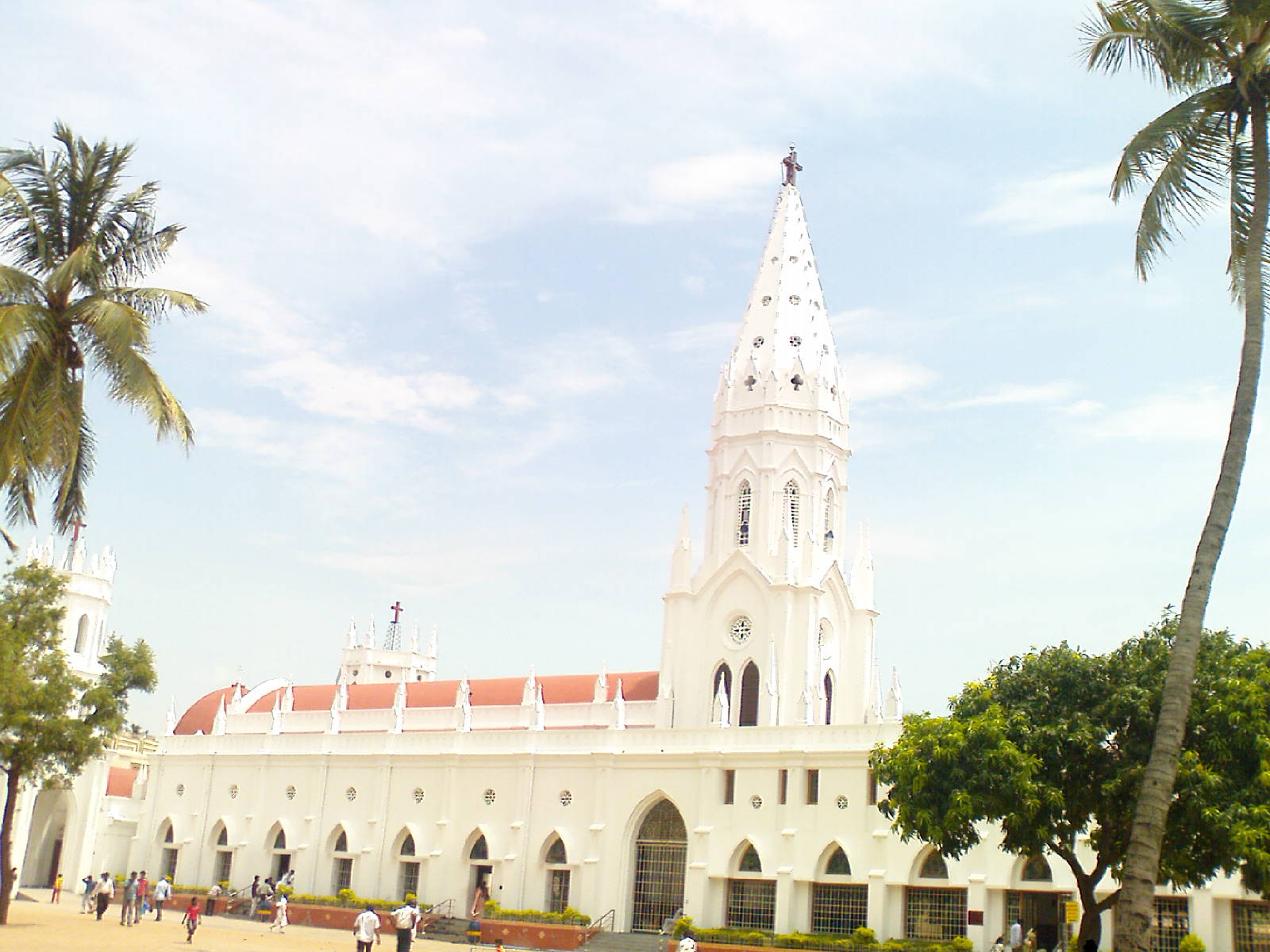
The stunning white facade and towering spire of the Poondi Madha Basilica stand out against a bright sky in Lalgudi, India.
(Photographed by) Arul · cc by-sa 3.0
On the basilica's facade, find the statue of Fr. Constantine Joseph Beschi among the Twelve Apostles and St. Francis Xavier — the Italian Jesuit who founded the shrine and became a Tamil cultural icon, rendered in stone for eternity.
Visitor Logistics
Getting There
The Basilica sits near Alamelupuram village, roughly 30 km from Tiruchirappalli (Trichy) and about 40 km from Thanjavur — each under an hour by car. The nearest railway station is Budalur (BAL), 12 km away, though most long-distance trains stop at Trichy or Thanjavur, from where you'll need a cab or local bus. Frequent state buses connect Poondi to both cities via Thirukattupalli, and large on-site parking is free.
Opening Hours
As of 2026, the Basilica grounds are open daily from 5:00 AM to 9:00 PM, with the Adoration Chapel accessible 7:00 AM to 7:00 PM. Weekday Masses run at 6:00 AM, 11:15 AM, and 5:15 PM; Sundays add 8:30 AM and a noon English-language service. Every 8th of the month, a 'Miracle Night' vigil runs from 5:15 PM until midnight — plan accordingly if you want quiet or, conversely, atmosphere.
Time Needed
A focused visit — the main sanctuary, Adoration Chapel, and the small museum — takes 1 to 2 hours. If you arrive during a Saturday healing Mass or a monthly vigil, expect 3 to 4 hours as processions and communal prayer reshape the pace entirely. The grounds reward lingering; the rural quiet between services is its own kind of attraction.
Cost
Entry is completely free, and there's no ticketing system of any kind. The Basilica also provides free drinking water, toilets, and low-cost pilgrim lodging on campus. Free meals are served on the 1st and 3rd Saturdays of each month — an unusual generosity worth knowing about.
Accessibility
The complex is mostly flat, which helps, but the main church entrance may have steps and there's no documented wheelchair ramp or elevator. Flooring is traditional stone and tile — manageable but uneven in places. Visitors with limited mobility should contact the church office in advance; staff are generally accommodating, but formal accessibility infrastructure is limited.
Tips for Visitors
Dress Modestly, Strictly
Shoulders and knees must be covered for all visitors — this is enforced, not suggested. Sleeveless tops and shorts will draw polite but firm refusal at the entrance.
No Photos During Mass
Photography is welcome in the courtyard and exterior, but strictly forbidden during Mass and religious services. Flash and drones require explicit permission from church authorities — don't assume silence means consent.
Ignore Unofficial Guides
Self-appointed 'tour guides' near the entrance may offer VIP access or special blessings for a fee. Neither exists. Stick to information from the church office and save your money.
Visit on First Saturdays
The first Saturday of every month transforms the Basilica — night-long prayers, a car procession, and free communal meals create an atmosphere no weekday visit can match. Arrive by late afternoon to catch the full arc.
Eat in Trichy or Thanjavur
The on-site canteen serves simple, clean vegetarian meals, but options in Poondi village are sparse. For anything beyond idli and dosa, head to Trichy's Srirangam area or Thanjavur's restaurant strip — both under an hour away.
Combine with Srirangam
Srirangam Temple, one of India's largest Hindu temple complexes, sits roughly 30 km north. Pairing both in a single day gives you an extraordinary cross-section of Tamil Nadu's layered religious architecture.
Where to Eat
Don't Leave Without Trying
Malgudi Coffee Palace
local favoriteOrder: Filter coffee (the regional staple) paired with fresh idly or dosa — this is where locals start their morning before visiting the Basilica.
The highest-rated spot in Poondi with a perfect perch near the Basilica. It's the kind of place where pilgrims and locals actually sit down, not just grab-and-go.
Poondi Madha canteen
quick biteOrder: Simple, authentic breakfast fare — sambar, chutney, and fresh dosa. This is pilgrim food at its most honest.
Right at the bus stop near the Basilica, this is the real deal for quick, no-frills sustenance. Opens at 5 AM for early-bird devotees.
FR.LOURDHU XAVIER CANTEEN& Rooms
cafeOrder: Coffee and light breakfast items — reliable, consistent, and perfect for a quick refuel between prayers.
The most-reviewed option in the immediate area with attached rooms, making it a solid choice if you need both a meal and a place to rest. Opens early at 7 AM.
Dining Tips
- check Filter coffee is significantly more popular than tea in this region — ask for it if you want authentic local flavor.
- check Most eateries immediately around the Basilica are simple 'tiffin' (snack) centers; don't expect sit-down multi-cuisine dining right at the shrine.
- check For pilgrims: several small stalls serve basic local snacks and refreshments directly outside the Poondi Madha Basilica.
- check Plan your main meal in nearby Lalgudi or Thanjavur if you want more variety — these Poondi spots are best for breakfast and quick bites.
Restaurant data powered by Google
Historical Context
Three Centuries of Contested Origins
The history of Poondi Madha Basilica is less a timeline than a palimpsest — each generation has written its own founding story over the last. According to tradition, the Italian Jesuit missionary Constantine Joseph Beschi built a small chapel here between 1714 and 1718, during his years as a Tamil literary scholar and evangelist. But some sources push the date back to 1622, which is awkward, since Beschi wasn't born until 1680. Others skip ahead to 1826 or even 1892 as the year a formal church first stood on the site. No parish records from the 1700s survive to settle the argument.
What is documented is the transformation. The church that stands today is largely a mid-twentieth-century construction, dressed in Gothic revival stonework that gives it an older appearance than it deserves. The real drama — the event that turned a crumbling parish church into a pilgrimage basilica — happened on a single afternoon in 1956.
The Priest Who Scheduled a Miracle
When Rev. Fr. Lourdes Xavier arrived as parish priest on September 1, 1955, he inherited a building that was trying to kill its congregation. The central dome had deteriorated beyond safe repair, but Xavier had neither the funds to fix it nor the budget to demolish it. Tearing down a church roof in rural Tamil Nadu in the 1950s was expensive work, and the diocese couldn't help.
So Xavier did something that has passed into local legend as either inspired faith or extraordinary nerve. He announced to his parishioners that he had prayed for guidance and received an answer: the roof would collapse on its own, on a specific day, at a specific hour. He told them the date — November 22, 1956 — and asked everyone to stay clear of the building that afternoon. Witnesses confirm that the central roof fell inward at almost exactly the predicted time, crashing onto the nave floor without damaging the altar or the statue of Our Lady. No one was injured.
The collapse solved Xavier's problem in the most dramatic way possible. With the old structure effectively demolished for free, donations poured in from across Tamil Nadu. A new, larger church rose on the same foundations, completed around 1964 in the neo-Gothic style visitors see today. Xavier's tomb now rests at the entrance of the chapel — the man who bet his reputation on a falling roof, and won.
The Statue from France
The centerpiece of the basilica is a statue of Our Lady of Lourdes, one of three carved in France after Bernadette Soubirous reported her visions in 1858. According to tradition, Rev. Fr. Darras of the Paris Foreign Missions Society brought it to India, though the exact date remains disputed. Legend holds that Darras was traveling by bullock cart when the animals refused to move any further at Poondi — and that he took this as a divine instruction to install the statue there. Devotees claim a mysterious brightness filled the church the night it was placed on the altar. Whether or not you credit the supernatural, the statue's presence transformed a minor parish into one of Tamil Nadu's most visited Catholic shrines.
From Parish Church to Papal Basilica
For most of the twentieth century, Poondi was a regional pilgrimage site, known mainly to Tamil Catholics. That changed on August 3, 1999, when Pope John Paul II elevated the church to the status of Minor Basilica — a designation that places it in the same canonical category as some of Europe's most celebrated churches. The elevation reflected decades of growing pilgrimage traffic, particularly during the annual feast in February, when crowds swell to several hundred thousand. Today the basilica complex includes a museum, a grotto modeled on Lourdes, and outdoor stations of the cross spread across grounds that can accommodate far more people than the building itself.
Listen to the full story in the app
Your Personal Curator, in Your Pocket.
Audio guides for 1,100+ cities across 96 countries. History, stories, and local insight — offline ready.
Audiala App
Available on iOS & Android
Join 50k+ Curators
Frequently Asked
Is Poondi Madha Basilica worth visiting? add
Yes, especially if you're drawn to places where faith has physically shaped architecture. The basilica sits between the Kollidam and Kaveri rivers in quiet Tamil Nadu farmland, and its neo-Gothic spires — the main tower rises 220 feet, roughly the height of a 20-story building — look almost hallucinatory against the flat green landscape. Beyond the spectacle, the interior holds a relic claimed to be a fragment of the True Cross, and a museum stuffed with thousands of personal votive offerings (stethoscopes, gold jewelry, house models) that tell a raw, human story no guidebook can replicate.
Can you visit Poondi Madha Basilica for free? add
Entry is completely free, with no ticketing system of any kind. The basilica also provides 24-hour drinking water, toilet facilities, and even free meals on the 1st and 3rd Saturdays of each month. Low-cost pilgrim lodging is available on the campus, though quality can be basic — check recent reviews if you plan to stay overnight.
How do I get to Poondi Madha Basilica from Trichy? add
Poondi sits about 35–40 km from Tiruchirappalli (Trichy), roughly a 60-minute drive depending on traffic. Frequent local buses run from Trichy to Poondi via Lalgudi and Thirukattupalli, or you can hire a cab for the door-to-door trip. The nearest railway station is Budalur, about 12 km from the basilica, but most travelers find a direct road trip from Trichy far simpler.
What is the best time to visit Poondi Madha Basilica? add
For atmosphere, come on the first Saturday of any month, when night-long prayers, Rosary processions, and communal meals transform the grounds into something electric. The annual feast beginning May 6 (flag hoisting) through May 15, and the Nativity of Mary celebrations from August 30 to September 8, draw the largest crowds. If you prefer silence and space to absorb the architecture, a weekday morning outside festival season — October through February, when Tamil Nadu's heat relents — gives you the nave almost to yourself.
How long do you need at Poondi Madha Basilica? add
A focused visit takes 1–2 hours, enough to see the main sanctuary, the Adoration Chapel, and the museum of votive offerings. If you want to attend Mass, explore the courtyard gardens, and climb the tower for a panoramic view of the river landscape, plan for 3–4 hours. On feast days or special Saturdays, the experience stretches well into the evening.
What should I not miss at Poondi Madha Basilica? add
Don't walk past the relic of the True Cross without stopping — it's tucked near the altar, easy to overlook, and was brought here in 1976 by Rev. Fr. Rayappa. The museum is the other thing most visitors skip: thousands of personal objects left by people who believe their prayers were answered, forming a kind of accidental folk archive. And look for the tomb of Fr. Lourdes Xavier near the chapel entrance — he's the priest who, according to local tradition, predicted the exact day and hour the old roof would collapse in November 1956, clearing the way for the basilica you're standing in.
What is the history of Poondi Madha Basilica? add
The timeline is genuinely contested. According to tradition, Italian Jesuit Fr. Constantine Joseph Beschi built the original structure between 1714 and 1718, though some sources push the date back to 1622 — a claim that doesn't hold up, since Beschi wasn't born until 1680. The current building is largely a mid-20th-century creation: after the old roof collapsed on November 22, 1956, Fr. Lourdes Xavier oversaw a reconstruction in Gothic-French style that was completed around 1964. Pope John Paul II elevated it to a Minor Basilica on August 3, 1999.
Is there a dress code for Poondi Madha Basilica? add
Yes — modest clothing covering shoulders and knees is expected for everyone. This is a working pilgrimage site, not a heritage monument, and the expectation is taken seriously. Photography is generally fine in the courtyard but prohibited during Mass; drone use requires explicit permission from church authorities.
Sources
-
verified
Poondi Madha Basilica Official Website
Official history, founding dates (1714–1718), elevation to basilica (1999), details on the miraculous statue and True Cross relic.
-
verified
Wikipedia – Basilica of Our Lady of Lourdes, Poondi
Architectural style (Gothic and French), facade statuary details, basilica elevation date, and general overview.
-
verified
Aalayam Kanden Blog
Detailed account of the 1956 roof collapse, Fr. Lourdes Xavier's role, and the True Cross relic brought in 1976.
-
verified
Catholic Tamil Church Directory
Mass timings, Adoration Chapel hours, Miracle Night schedule, and transport details (Budalur station, bus routes).
-
verified
Ramyas Hotels – Poondi Madha Basilica
Alternative founding date claim (1622 AD), general visitor overview, and the roof collapse anecdote.
-
verified
My Holiday Happiness
Opening hours (5 AM–9 PM), free entry confirmation, and recommended visit duration.
-
verified
Airial Travel – Poondi Madha Basilica
Festival dates, first Saturday observances, photography and drone restrictions, and dress code guidance.
-
verified
Tamil Wikipedia – Poondi Madha Basilica
On-site facilities: 24-hour water, toilets, ATMs, pilgrim lodging, free meal schedule, and parking.
-
verified
Peek.com – Basilica of Our Lady of Lourdes Poondi
Tower height (220 feet) and neo-Gothic architectural description.
-
verified
Trichy Market – Poondi Madha Church
Alternative founding claim (1826, Fr. Antony Mariadas) — noted as unconfirmed.
Last reviewed: