Place
India Updated Aug 2026
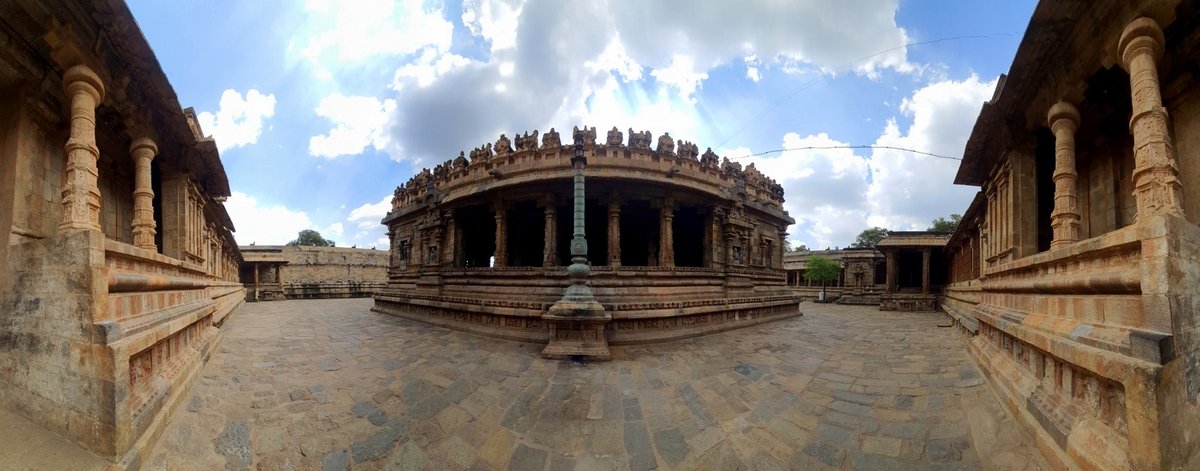
Before the first coffee arrives, Kudanthaiyan announces itself with temple bells, nadaswaram notes, and the metallic clink of brass vessels being polished for sale. This is Kumbakonam, India, a delta town where a 12th-century UNESCO Chola temple, a 6.2-acre sacred tank, and Srinivasa Ramanujan's childhood streets sit within the daily rhythm of breakfast tiffin and evening darshan. Come for the carved stone; stay long enough to hear how mathematics, bronze casting, and filter coffee belong to the same town.
 Photo: The EnforcerOffice of the secret service · CC BY 3.0
Built from cited sources · see the method · How we make our guides →
Kumbakonam's history is not behind glass; it is built into the morning route. Adi Kumbeswarar's 128-foot gopuram, Sarangapani's 147-foot chariot-shaped sanctum, and Nageswaran Temple's carefully aligned sunlight turn a walk through town into a lesson in Chola, Nayak, and Vaishnavite architecture.
Its pleasures are tactile and unapologetically local: Kadappa ladled beside hot idlis, degree coffee pulled between a brass tumbler and dabarah, jasmine threaded into temple garlands, and oil lamps stacked outside hereditary metal workshops. At Swamimalai, 8 kilometers west, artisans still shape beeswax models and cast panchaloha bronzes through the lost-wax method associated with Chola craftsmanship.
The quieter revelation is intellectual. Ramanujan studied at Town Higher Secondary School from 1898 to 1904, and his preserved house on Sarangapani Sannidhi Street brings the town's sacred geometry down to a wooden cot, family photographs, and handwritten mathematics; by the Cauvery ghats at dusk, Kudanthaiyan begins to feel less like a collection of temples than a place where devotion, trade, music, and thought have always shared the same streets.
Not every monument, just the ones we'd walk you past ourselves.

Where to wander, by quarter — each with its own rhythm.
Before you go
From a Sangam-era Chola town to modern Kumbakonam
The ancient settlement appears in Sangam-era tradition under names such as Kudanthai and Kudamukku, beside the fertile channels of the Kaveri Delta. Its position made it more than a farming town: grain, river traffic, temple ritual, and Chola authority met here in the smell of wet earth and stored paddy.
During the Bhakti movement, Shaiva Nayanars and Vaishnava Alvars brought Kudanthai's shrines into the great Tamil devotional canon. Hymns associated with temples around the town turned local stone, lamps, and processional streets into places of singing pilgrimage.
The early Cholas began replacing older religious structures around Kudanthai with granite masonry, laying foundations for the temple-rich town seen today. At Nageswaran Temple, carefully aligned openings still reveal how architecture and sunlight could be made to cooperate.
Near Kumbakonam, Aparajita Pallava and Aditya I Chola, aided by Western Ganga ruler Prithvipati I, defeated Pandya king Varagunavarman II at Sri Purambiyam. The clash weakened Pallava and Pandya power and opened the road for the Cholas to dominate the Kaveri plain.
Under rulers including Aditya I and Parantaka I, temple rebuilding gave Kudanthai a more permanent architectural body, with dressed stone replacing more fragile materials. The chisels left behind crisp cornices, columned halls, and sculpted figures that caught the hard delta light.
Rajaraja Chola II became emperor in 1146 and extended Chola patronage across the Kaveri Delta. His connection to Kudanthai is carved most clearly at nearby Darasuram, where royal power took the form of a temple rather than a fortress.
Rajaraja Chola II commissioned Airavatesvara Temple at Darasuram, west of Kumbakonam, with a vimana about 24 meters high and a mandapa shaped like a chariot. Elephants, horses, dancers, musicians, and miniature sacred scenes crowd the stone; even the famous steps are said to answer with the seven notes when struck.
The last Imperial Chola ruler was defeated in 1279, and Kumbakonam passed into the orbit of the Later Pandyas under Maravarman Kulasekara Pandyan I. The change of dynasty did not empty the temples, but it ended the political age that had made Chola authority the town's daily backdrop.
Kumara Kampana's campaigns brought the Kaveri Delta under Vijayanagara control after the period of Madurai Sultanate rule. Kumbakonam became part of a wider imperial network whose military roads, tax officials, and temple endowments reached deep into Tamil country.
Govinda Dikshitar, later minister to the Thanjavur Nayak rulers, was born around 1515 and became one of the learned administrators associated with Kumbakonam's renewal. His work joined mathematics, music, temple finance, and public construction—the sort of career that leaves its signature in both inscriptions and drainage channels.
The Thanjavur Nayaks established their rule in the mid-sixteenth century, keeping Kumbakonam within a courtly world of temple patronage and regional commerce. Processional routes widened, gopurams grew taller, and old shrines acquired the painted and sculpted additions that still distinguish the town's sacred core.
Nayak-era building works formalized the great Mahamaham Tank, its masonry ghats and sixteen surrounding mandapams giving the town a ceremonial center. Under Govinda Dikshitar and the Nayak court, water, ritual, and urban planning became one carefully staged arrangement of steps, shrines, and reflected sky.
Ekoji I, the half-brother of Shivaji, founded the Thanjavur Maratha kingdom, bringing Kumbakonam under a new dynasty from the western Deccan. Marathi court culture joined an older Tamil temple economy, while the town continued to trade in metal vessels, textiles, ritual goods, and agricultural produce.
The Second Anglo-Mysore War brought military movement, requisitions, and disruption across the Kaveri Delta. Later local accounts describe famine and damaged commerce around Kumbakonam, a reminder that even a temple town could feel distant wars through empty granaries and interrupted river trade.
After the wider upheavals of the Fourth Anglo-Mysore War, Serfoji II ceded the civil and military administration of Thanjavur territory to the British East India Company. Kumbakonam retained its temples and markets, but decisions about revenue, courts, and armed power now arrived through Company officials.
Henry John Stedman Cotton was born in Kumbakonam, where his father served in the Indian Civil Service. Cotton later became a British Liberal politician and president of the Indian National Congress in 1904, carrying memories of Madras Presidency administration into arguments for Indian self-government.
The Provincial School opened in Kumbakonam and developed into the Government Arts College in 1867. Classrooms, examinations, and English- and Tamil-language scholarship gave the temple town a second kind of prestige, measured in notebooks and public-service appointments rather than gopurams.
Kumbakonam was constituted as a municipality under the Madras District Municipalities Act. The change brought formal civic administration to streets long shaped by temple processions, tank steps, market stalls, and seasonal floods.
U. V. Swaminatha Iyer joined the teaching world of Kumbakonam Government Arts College, beginning the scholarly work that earned him the name Tamil Thatha, or Grandfather of Tamil. From palm-leaf manuscripts rescued from private homes, he reconstructed poems whose ink had faded but whose rhythms still survived.
Srinivasa Ramanujan, born in Erode, grew up in Kumbakonam and studied at Town High School before attending the Government Arts College. On Sarangapani Sannidhi Street, temple bells and household arithmetic formed the backdrop to a mind that would later reshape number theory.
The Mahamaham gathering drew roughly 300,000 pilgrims even as famine worries and bubonic plague affected the wider region. The tank's stone edges filled with wet cotton garments, brass vessels, ash, flowers, and the anxious calculations of colonial officials trying to control a crowd drawn by a twelve-year sacred cycle.
Indian independence ended British rule and placed Kumbakonam within the new Republic's political order. Municipal offices, colleges, railway commerce, and temple trusts continued, but their authority now belonged to an Indian state rather than the Madras Presidency.
On February 18, a crush during the Mahamaham bathing ritual at the town tank killed approximately 50 pilgrims. The tragedy exposed the danger of concentrating vast crowds around narrow entrances, slippery steps, and a sacred timetable that gives no one much patience.
Airavatesvara Temple at Darasuram joined the UNESCO-inscribed Great Living Chola Temples ensemble, alongside the great Chola temples at Thanjavur and Gangaikondacholapuram. International recognition gave fresh weight to the small temple's carved chariot, musical steps, and densely populated stone panels.
A fire tore through the thatched roof of Sri Krishna Middle School on July 16, killing 94 children. The deaths shocked India and prompted stronger attention to school building codes, kitchen safety, emergency exits, and the lethal consequences of treating a roof as a minor detail.
The Mahamaham festival opened on February 22 with new crowd-control measures and reports of more than four million bathers across ten days. Barricades, police routes, medical posts, and loudspeakers surrounded rituals that still centered on the old tank and its sixteen stone shrines.
Tamil Nadu upgraded Kumbakonam from municipality to City Municipal Corporation, bringing nearby panchayats and Darasuram into a larger civic unit. The administrative boundary now follows the town's lived connections—roads, markets, buses, and temple economies—more closely than the older municipal line did.
Mathematician · 1887–1920
Raised and educated here
Ramanujan grew up in Kumbakonam on Sarangapani Sannidhi Street and studied at the Town High School before attending Government Arts College. The town's temple geometry and dense old streets offer a fitting backdrop for the boy who would later turn patterns into mathematics; he might recognize today's Kumbakonam as a place where everyday life still rewards close observation.
Civil servant and politician · 1845–1915
Born here
Cotton was born in Kumbakonam in 1845 while his father served in the Indian Civil Service, then went on to argue publicly for Indian self-government and preside over the Indian National Congress in 1904. A modern walk through the town's colonial-era institutions and crowded temple streets might have reminded him how much public life had changed since his birth in the Madras Presidency.
Where locals actually book dinner — not the tourist menus.
A dark chicory-blended decoction is mixed with rich cow’s milk and poured between a brass davarah and tumbler until it carries a pale foam. Try it at a traditional coffee stall in the old town; the ritual is as revealing as the caffeine.
This mild potato-and-moong-dal stew, scented with onion and spices, is a local breakfast accompaniment for idli, dosa and poori. Its soft texture and gentle heat make it a welcome change from heavier gravies.
Start early with idli, medu vada or dosa alongside sambar, coconut chutney and a second, sharper chutney. Temple-town kitchens do this food best before the day’s heat settles over the stone streets.
A traditional vegetarian meal layers rice with sambar, rasam, kootu, poriyal, curd and often payasam on a banana leaf. Eat with the right hand if comfortable, and expect the meal to arrive in quick, fragrant servings rather than as one composed plate.
Small things that change how the city treats you.
Yes, especially if you care about Chola architecture, temple ritual, South Indian food, or craft traditions. Kudanthaiyan is the old name associated with Kumbakonam, whose nearby Airavatesvara Temple forms part of UNESCO's Great Living Chola Temples and whose streets still revolve around working shrines.
Plan on 2–3 days for Kumbakonam and its closest sights. That allows time for the central temples, Mahamaham Tank, Darasuram, Swamimalai, and a slower morning for coffee, markets, or the Cauvery Delta villages.
November through February is the most comfortable period, with milder days and less punishing heat for temple walks. April through June is much hotter, while October and November bring the heaviest Northeast Monsoon rain.
A taxi from Tiruchirappalli International Airport takes roughly 1.5–2 hours for the 85–90 km trip and commonly costs ₹1,800–₹2,500 one way. Buses are cheaper at about ₹90–₹250 but can take 2.5–3.5 hours; trains from Tiruchirappalli Junction are another option.
Use local buses for inexpensive trips to places such as Darasuram and Swamimalai, or hire an auto-rickshaw for short rides. Drivers often do not use meters, so agree on the fare before boarding; a pre-booked half-day vehicle is practical for a temple cluster.
Kumbakonam is generally considered a calm pilgrimage town, and ordinary sightseeing is usually safe. Take extra care with phones and wallets during festival crowds, and avoid accepting expensive temple services from unofficial touts.
Kumbakonam can suit a modest budget: local buses commonly cost ₹7–₹30, while general entry to major temples is usually free. Special-darshan tickets are often around ₹10–₹50, and a negotiated local vehicle for a temple circuit may cost ₹1,400–₹2,000; rates change by season and demand.
Wear modest clothing covering the shoulders and knees, such as a salwar suit, churidar, saree, dhoti, or loose trousers with a covered top. Remove footwear before entering and follow each temple's rules on leather items and photography, since inner-shrine photography is generally prohibited.
7 places to discover
Saved and recently read places — kept on this device only.
Photos may have been resized or cropped.