Girnar Ropeway
JunagadhIndia 21° N · 70° E Updated Apr 2026
Float over Girnar’s punishing first staircase, then land back in pilgrimage: Ambaji ahead, Ashoka’s rock edicts waiting below on the approach road to Girnar.
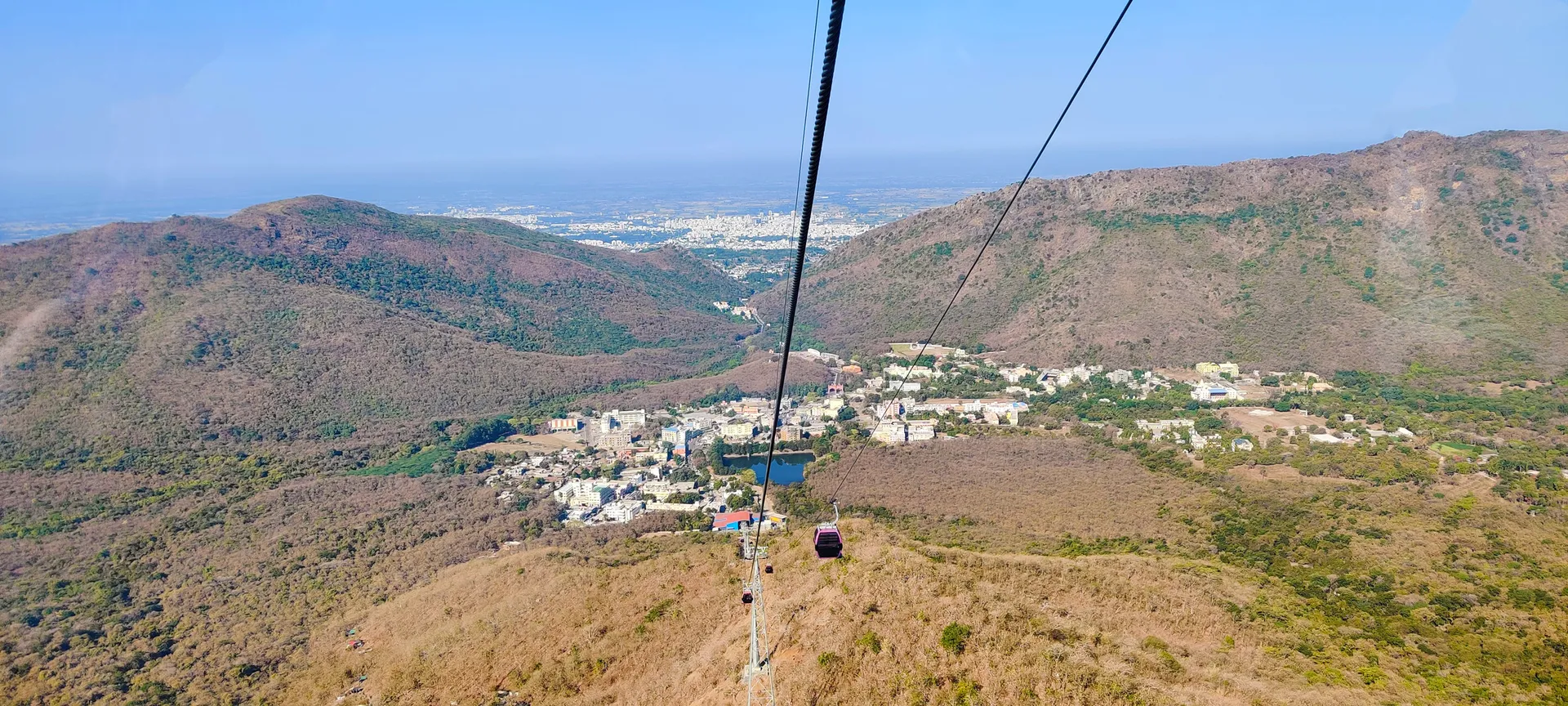 Photo: Piyush Jnd · CC BY-SA 4.0
A cable car gliding toward a goddess shrine sounds like a contradiction, which is exactly why गिरनार रोपवे in जूनागढ़, भारत stays with you. You come for the sudden lift above the stone staircase, the forested folds of Girnar, and the odd thrill of floating toward a mountain that pilgrims once had to earn entirely on foot. The ride is quick. The mountain is not.
Girnar Ropeway, officially operated as Girnar Udankhatola, rises from Bhavnath Taleti near Sudarshan Talav to the Ambaji side of the hill. That matters because it changes the first, punishing ascent into a suspended reveal: scrub forest below, wind against the cabin, and Junagadh flattening into a pale map behind you.
But the ropeway does not finish the story. It drops you closer to Amba Mata, then hands the mountain back to your legs for the shrines and paths beyond, which is why this place works best if you like pilgrimage sites with a little friction left in them.
And one more reason to come: the road toward Girnar passes the Ashokan rock edicts, inscriptions cut more than 2,200 years ago and now tied to a 2025 UNESCO Tentative List submission. Few modern rides begin with ancient empire.
What to see
-
The Ropeway Ride from Bhavnath Taleti
The surprise is how quickly Girnar changes character: one minute you are at Bhavnath Taleti near Sudarshan Talav, with ticket windows, security checks, tea stalls, and the faint smell of dust and frying snacks, and about 7 to 8 minutes later you are floating above a wall of stone steps that once meant a punishing climb of roughly 5,000 steps, a staircase long enough to wear out even cheerful pilgrims before breakfast. Then the noise drops. What stays with you is the cabin’s suspended silence, broken by the cable’s low mechanical hum and the sight of Junagadh flattening into the pale plains below, which makes the mountain feel less like an attraction than a gate. -
Ambaji Plateau and the First Sacred Threshold
The upper station does not give you the mountain; it gives you Girnar’s first confession. A short walk brings you toward the Ambaji, or Amba Mata, side, where bells carry on the wind, incense catches in the throat, and the plateau opens over Junagadh in a sweep so wide it feels like someone pulled back a curtain the length of a cricket field. This matters because many visitors assume the ropeway finishes the pilgrimage, when in fact it only delivers you to the first major sacred ledge, with the harder, older Girnar still stretching onward toward the Jain temples, Gorakhnath, and Dattatreya. -
Take the Smarter Route: Ashokan Edicts to Ambaji
Start on the approach road at the Girnar Major Rock Edicts before you board anything. The inscriptions, carved around 250 BC into a single huge stone, put Brahmi script in front of your eyes before the cable car lifts you toward shrines that still pull pilgrims uphill, and that chronological jump, more than 2,200 years in a few kilometers, is the real trick here. Ride up after that, walk on from the upper station to Ambaji, and Girnar stops being a scenic shortcut; it becomes a mountain where emperor, monk, engineer, and exhausted visitor have all left their mark.
Plan your visit
- Getting There
- The base station sits at Bhavnath Taleti, near Sudarshan Talav, about 6.5 km from Junagadh railway station and 6.2 km from the bus stand, which is a 10 to 20 minute ride in normal traffic. Auto-rickshaws usually cost ₹80 to ₹150, shared autos ₹20 to ₹30, and taxis ₹300 to ₹500; if you want the old approach, walk in from the Uparkot side via Wagheshwari Gate and Ashoka's Rock Edicts, roughly 4 km east, a heritage route more than a polished sidewalk.
- Opening Hours
- As of 2026, official Udan Khatola pages show opening at 7:00 AM, with some pages listing service until 6:00 PM. Closing is the slippery part: recent 2026 travel reporting gives 4:00 PM instead, and monsoon wind or rain can stop operations without much romance, just a shuttered gate.
- Time Needed
- Give it 1.5 to 2.5 hours for the quick version: queue, 7 to 8 minute ride each way, Ambaji stop, photos, back down. A half-day works better, 3 to 4.5 hours, because queues often stretch to an hour or two, and a full 5 to 7 hours makes sense only if you keep climbing toward the Jain temples or higher shrines after the ropeway saves you roughly the first 5,000 steps, a stair count as long as a small town's main street repeated again and again.
- Accessibility
- As of 2026, the operator says physically challenged visitors get priority boarding and wheelchairs are available at Udan Khatola sites, which makes the cabin ride far easier than the traditional climb. The relief ends at the top station: beyond it, expect steps, uneven ground, and uphill temple paths, so anyone with limited mobility should call the same day to confirm on-site assistance rather than trusting the word 'accessible' to do too much work.
- Cost & Tickets
- As of 2026, fares are in motion: one recent source gives ₹630 for adults and ₹350 for children, while other recent listings still show about ₹400 one way and ₹700 round trip. Book online through Udan Khatola if you can, but treat the time slot as a place in the system, not a magic pass through the queue.
Photo Gallery


History
A Sacred Hill Learns to Float
According to tradition, Girnar has drawn pilgrims for centuries, long before steel towers and cabins appeared above Bhavnath Taleti. The ropeway is new; the mountain's gravity is not.
What changed was access. Records cited in contemporary reporting show that a ropeway was proposed in 1983, then spent decades trapped between political ambition, forest clearances, and the uncomfortable fact that building a shortcut on a sacred hill is never just an engineering problem.
The turning point
Narendra Modi and the Promise That Would Not Move
When Narendra Modi, then Chief Minister of Gujarat, laid the foundation stone in 2007, the gesture carried more than ceremonial weight. For him, the project had become a test of political credibility in Saurashtra: could the state finally turn a proposal first floated in 1983 into something real, or would Girnar remain another grand announcement stranded at the base station?
Contemporary reports describe years of stoppages before and after that moment, with forest-land diversion, environmental objections, and administrative hesitation repeatedly halting progress. The turning point came when the project moved from symbolic promise to cleared construction after those objections were addressed, shifting Girnar Ropeway from a speech into a structure.
That long delay still shapes how the ride feels today. You are not just boarding a cable car; you are stepping into a solution that took so long to arrive that locals had time to doubt it would ever leave the ground.
Before the Cabins: Pilgrim Girnar (pre-1983)
Proposal and Delay (1983–2007)
The Ropeway Era (2007–present)
Tips for visitors
Temple Clothes
Dress for a sacred hill, not a cable-car selfie stop: cover shoulders and knees, remove shoes where required, and keep meat, alcohol, and cigarettes out of the equation. Shrine staff on Girnar take temple boundaries seriously, and recent police complaints show this is not a place to test the mood.Camera Boundaries
Photos are generally fine around the ropeway and on the outdoor route, but treat the Ambaji sanctum as ask-first territory because visitors report no photography inside the main sacred area. Leave the drone idea alone unless you have written permission; protected forest and temple airspace make casual flying a bad gamble.Queue Tricks
Online booking helps, but it doesn't always spare you the line, so go early and keep your schedule loose. Festival days bring theft complaints, slot confusion, and the sort of crowd pressure that turns a pilgrimage foothill into a human river.Bottle Rule
Don't carry food into the cabin, and skip disposable plastic bottles because visitors report they are sometimes confiscated at security. Bring water in a reusable flask instead; once you reach the top, buying a bottle can become oddly difficult for a place full of pilgrims.Where To Eat
For a quick stop, use the Girnar Food Court or Chamunda Lassi Shop near the base, both budget-friendly and built for pilgrims more than gourmands. For a proper meal afterward, Petals near the railway station and Utsav on S.T. Road are reliable mid-range vegetarian choices, while Kesar at The Fern Leo Resort is the comfortable splurge close to Girnar Darwaja.Add One Stop
Pair the ropeway with Ashoka's Major Rock Edicts on the approach road, because they shift the whole visit from scenic ride to 2,000-year-old route of faith and power. Most people rush uphill; the smarter move is to let the mountain introduce itself before you board.
Frequently asked
Is Girnar Ropeway worth visiting?
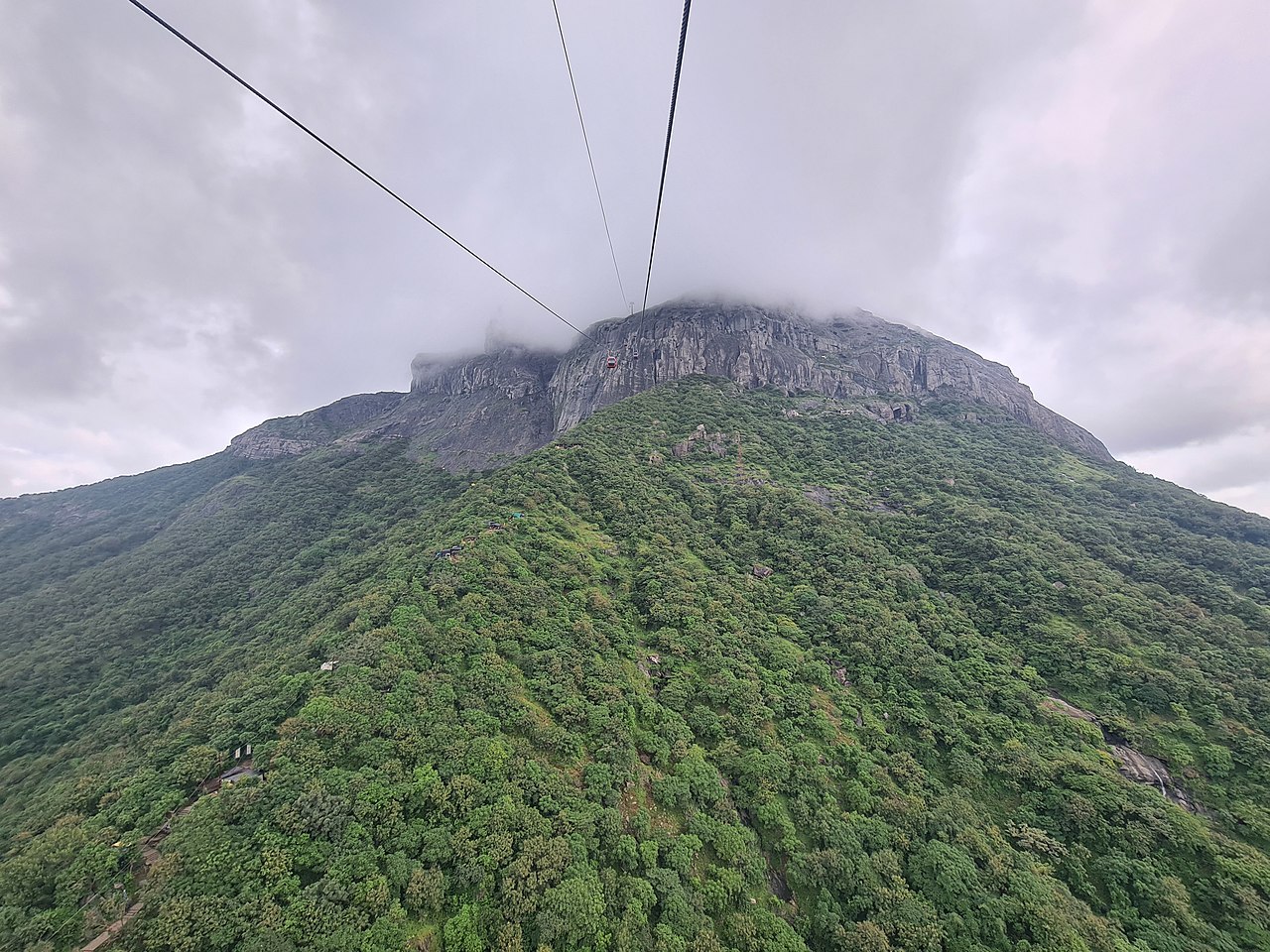
Yes, if you want Girnar’s drama without grinding through the first 5,000 steps. The cabin ride from Bhavnath Taleti lifts you over forested folds, temple spurs, and the long stair-lines that usually punish pilgrims before breakfast. Go knowing the secret: the ropeway is a shortcut to the Ambaji side, not the mountain’s final word.
How long do you need at Girnar Ropeway?
Give it 3 to 4.5 hours for a relaxed visit, or 1.5 to 2.5 hours if you only want the ride, Ambaji, and the return. Queues can stretch the visit like a rubber band, especially on weekends and holy days, and the walk after the top station is longer than the marketing glow suggests. If you continue toward the Jain temples or higher shrines, block out most of the day.
How do I get to Girnar Ropeway from Junagadh?
The easiest way is by auto-rickshaw or taxi to Bhavnath Taleti, where the ropeway base sits near Sudarshan Talav. From Junagadh railway station the ride is about 6.5 km, roughly 70 cricket pitches laid end to end, and usually takes 10 to 20 minutes depending on traffic and festival crowds. Shared autos are the cheap play; during big mela days, extra buses sometimes run, but outside festival dates they are less dependable than autos.
What is the best time to visit Girnar Ropeway?
Early morning between November and February is the sweet spot. The air is cooler, the views are clearer, and the mountain wakes slowly instead of glaring back at you in full heat; summer turns the stone harsh, while monsoon can stop operations with wind and rain. Start at 7:00 AM if you can, because official pages agree on the opening time even when closing hours drift.
Can you visit Girnar Ropeway for free?
No, the ropeway is not free, and I found no reliable official free-entry day. Current adult fares appear to sit around ₹630 to ₹700 for a return-style trip, which feels more like paying for convenience than paying for darshan. Small-child rules vary by source, so families should check the operator before turning up at the counter.
What should I not miss at Girnar Ropeway?
Do not stop at the ride itself. The mid-cabin view back over Junagadh is the cleanest reveal, Ambaji is the emotional anchor at the top, and the Ashokan Rock Edicts on the approach road are the real surprise: 3rd-century BC inscriptions cut into stone before you even start climbing. If you have the legs, keep walking beyond Ambaji, because that is where the older Girnar begins to speak.
Sources & attribution 57
- Udan Khatola - Girnar Destination — Official operator page for Girnar Udankhatola with location, route, booking basics, and note that the ropeway reaches the Ambaji side rather than the final summit.
- Gujarat Tourism - Girnar Hill — State tourism overview of Girnar’s peaks, temples, seasonal advice, and the wider pilgrimage context beyond the ropeway.
- UNESCO World Heritage Centre - Serial nomination for Ashokan Edict sites along the Mauryan Routes — Authoritative source confirming the nearby Girnar Major Rock Edicts are part of India’s UNESCO Tentative List submission dated 11 February 2025.
- Gujarat Tourism - Ashok Edicts — State tourism page on the Ashokan Rock Edicts near Girnar, used for historical context and the approach-road stop many visitors miss.
- The Indian Express - Rajkot: 33-year-long wait over, Girnar ropeway project gets green nod — Reported on the ropeway’s long approval history, including the 1983 proposal, forest diversion issues, and later delays.
- Aapdu Junagadh - Girnar Ropeway How to Reach — Local guide used for chronology, station-to-base distances, and practical access notes from Junagadh.
- The Times of India - Trial run of Girnar ropeway takes off — News report used to confirm the 2007 foundation-stone milestone and pre-opening ropeway progress.
- Udan Khatola - Contact — Official contact page used for the ropeway’s base address and operator identity.
- Udan Khatola - Amba Timing Banner — Official timing banner showing current opening hours on the operator site.
- Udan Khatola - Homepage — Operator homepage used to cross-check timing information and current destination branding.
- YatraDham - Girnar Ropeway Guide — Recent travel guide used for 2026-facing fare estimates, slot-booking details, festival exceptions, and service-hour claims.
- Udan Khatola - FAQ — Official FAQ used for online booking, parking, wheelchair availability, priority boarding, baggage rules, food restrictions, and on-site facilities.
- Vardhman Vacations - Girnar Ropeway Complete Guide — Secondary travel guide used for ride duration, fare ranges, and weather-related service disruption context.
- Ticket Price Now - Girnar Ropeway Ticket Price — Secondary source used for ride time, rough fare structure, and general visitor timing estimates.
- Tripadvisor - Girnar Ropeway — Visitor reviews used for queue realities, top-station walking effort, bottle checks, photography practice, and the feel of the ride.
- YatraDham - How to Reach Girnar — Recent access guide used for local transport costs and travel times from Junagadh to Bhavnath Taleti.
- Girnar Darshan - Trains Schedule and Local Transport — Local information page used for shared and private auto fare estimates from Junagadh station.
- The Times of India - Bhavnath Mahashivratri fair to begin on Feb 11, Gujarat State Transport to operate 195 extra buses — News source used for festival-period transport arrangements and the scale of extra bus service during the Bhavnath fair.
- Wikipedia - Girnar — Background orientation source used for the approach route past Girnar Darwaza and the Ashokan edicts.
- The Times of India - Girnar ropeway to remain shut for 7 days — Single-source report used for the April 12 to 18, 2026 annual maintenance closure note.
- Gujarat Orbit - Top 10 Restaurants Must Visit in Junagadh — Food guide used for mention of the Girnar Food Court and nearby dining suggestions.
- Tripadvisor - Restaurants Near Girnar Ropeway — Used for nearby restaurant names around Junagadh and the ropeway area.
- Tour My India - Girnar Ropeway Gujarat — Travel article used for ropeway engineering notes, scenic descriptions, and construction restart timing.
- Usha Breco - Girnar Ropeway Project — Project page used for technical details such as system type, towers, and overall engineering character.
- Wikipedia - Ambika Temple, Girnar — Background source for Ambaji temple history and the dating of the present structure.
- Wikipedia - Neminath Jain Temple, Girnar — Background source for the Neminath temple’s materials, plan, and carved details.
- Hinduism Today - Girnar Mountain: A Spiritual Journey of Ten Thousand Steps — Firsthand account used for sensory details of pre-dawn Bhavnath, sunrise on Girnar, and the feel of the higher temple zones.
- Gujarat Tourism - Damodar Kund — State tourism page used for the foothill sacred-water stop and where the traditional Girnar climb begins.
- Press Information Bureau - Prime Minister inaugurates ropeway and other Gujarat projects — Official government release confirming the ropeway inauguration on 24 October 2020.
- Wikimedia Commons - Category:Girnar ropeway — Used to confirm common public naming for the ropeway and its visual identity in general circulation.
- Gujarat Tourism - Mahashivratri Mela — State tourism page used for the Bhavnath fair’s religious importance, naga sadhu rituals, and local festival context.
- Airial Travel - Bhavnath Mahadev Temple — Secondary source used for temple etiquette and Bhavnath fair ritual details.
- The Times of India - DyCM reviews Bhavnath fair arrangements — News report used for recent fair logistics, policing, crowd management, and event infrastructure.
- The Times of India - Unseasonal rain forces suspension of Girnar Lili Parikrama — Used for the continuing importance of the foot-pilgrimage tradition around Girnar.
- Tripadvisor - Bhavnath Mahadev Temple — Used for the feel of the Bhavnath foothill zone and traveler impressions of the temple area.
- Junagadh District - Girnar — District tourism page used for Girnar’s religious importance to Junagadh and protected-area context.
- Junagadh District - Ashok Shilalekh — District page used for local framing of the Ashokan inscription site near Girnar.
- Swiggy Blog - Famous Food of Junagadh — Food article used for local dishes associated with Junagadh and the wider Girnar visit.
- Gujarat Orbit - Top 10 Foods to Try in Junagadh — Food guide used for regional snack and meal references around Junagadh.
- Restaurant Guru - Chamunda Lassi Shop Bhavnath — Used for a practical drink stop near the ropeway complex.
- Airial Travel - Damodar Kund — Secondary source used for temple-area etiquette and the sacred feel of Damodar Kund.
- The Times of India - Two complaints lodged for misconduct at temple in Girnar — News report used to show how seriously temple behavior rules are enforced on Girnar.
- DeshGujarat - Girnar ropeway service temporarily suspended due to strong winds — Single-source report used for weather-related shutdown history.
- DeshGujarat - Girnar ropeway service temporarily halted due to strong winds — Single-source report used for another instance of wind-related service suspension.
- Tripadvisor - Utsav Restaurant — Restaurant listing used for a dependable sit-down meal option in Junagadh.
- Tripadvisor - Petals Restaurant — Restaurant listing used for a mid-range vegetarian option near the railway station.
- Tripadvisor - Kesar — Restaurant listing used for an upscale meal option near Girnar Darwaja.
- Tripadvisor - The Fern Leo Resort & Club Junagadh — Hotel listing used to situate Kesar and the higher-end dining option close to Taleti Road.
- The Times of India - PM Modi inaugurates three key projects in Gujarat including Kisan Suryodaya Yojana — News source cross-checking the 24 October 2020 inauguration date.
- News Gujarat - Girnar ropeway service suspended due to high winds in Junagadh — News report used to confirm the July 2025 wind shutdown.
- Bombay Samachar English - Girnar ropeway service temporarily suspended due to strong winds — Second news source confirming the July 2025 wind shutdown.
- Wikipedia - Girnar Ropeway — Background page used for the ropeway’s long-running controversy and development history.
- The Times of India - Plastic banned in Girnar since 2012, Junagadh collector told — News report used for ongoing plastic-waste enforcement issues on Girnar.
- Gujarat Samachar English - Gujarat HC criticises govt on plastic waste, warns of action for delay — News source used to show that plastic control on Girnar remains a live administrative problem.
- The Times of India - FIR filed over planting of flags on Girnar peak — News report used for recent sect and shrine-control tensions on Girnar.
- The Times of India - 50 thieves arrested during Maha Shivratri fair — News report used for theft risks during peak Bhavnath fair crowds.
- The Times of India - Lioness scare at Bhavnath fair, rescued after 6 hours — News report used to show that sanctuary-edge wildlife is part of the real Bhavnath setting.
Built from cited sources · see the method · How we make our guides →
More in Junagadh.
10 places to discover — a few worth pairing.


Pick up where you left off
Saved and recently read places — kept on this device only.
Photo credits (10)
- M@¥u® K@D@M — Pexels License (https://www.pexels.com/license/) — Source: https://www.pexels.com/photo/30421112/
- Girnar-Ropeway — Piyush Jnd — CC BY-SA 4.0 (https://creativecommons.org/licenses/by-sa/4.0/) — Source: https://commons.wikimedia.org/wiki/File:Girnar-Ropeway.jpg
- Girnar top — Jalodiadeepak — CC BY-SA 4.0 (https://creativecommons.org/licenses/by-sa/4.0/) — Source: https://commons.wikimedia.org/wiki/File:Girnar_top.jpg
- Guj21 Girnar Peak and Ropeway full view — VasuVR — CC BY-SA 4.0 (https://creativecommons.org/licenses/by-sa/4.0/) — Source: https://commons.wikimedia.org/wiki/File:Guj21_Girnar_Peak_and_Ropeway_full_view.jpg
- Guj21 Girnar Peak view from Ropeway — VasuVR — CC BY-SA 4.0 (https://creativecommons.org/licenses/by-sa/4.0/) — Source: https://commons.wikimedia.org/wiki/File:Guj21_Girnar_Peak_view_from_Ropeway.jpg
- Guj21 Girnar Peak and Ropeway view — VasuVR — CC BY-SA 4.0 (https://creativecommons.org/licenses/by-sa/4.0/) — Source: https://commons.wikimedia.org/wiki/File:Guj21_Girnar_Peak_and_Ropeway_view.jpg
- Girnar Ropeway — Standing Alone — CC BY-SA 4.0 (https://creativecommons.org/licenses/by-sa/4.0/) — Source: https://commons.wikimedia.org/wiki/File:Girnar_Ropeway.jpg
- Shiva Lingam Mahadev blink through clouds@Girnar Mountains — VIMAL HOTHI(vicky rajpoot) — CC BY-SA 4.0 (https://creativecommons.org/licenses/by-sa/4.0/) — Source: https://commons.wikimedia.org/wiki/File:Shiva_Lingam_Mahadev_blink_through_clouds@Girnar_Mountains.png
- Rope way girnar — Jalodiadeepak — CC BY-SA 4.0 (https://creativecommons.org/licenses/by-sa/4.0/) — Source: https://commons.wikimedia.org/wiki/File:Rope_way_girnar.jpg
- Guj21 Girnar Ropeway view of Bhavnath — VasuVR — CC BY-SA 4.0 (https://creativecommons.org/licenses/by-sa/4.0/) — Source: https://commons.wikimedia.org/wiki/File:Guj21_Girnar_Ropeway_view_of_Bhavnath.jpg
Photos may have been resized or cropped.