
An introduction.
Researched by the Audiala editorial team from historical records, architectural archives, and local expertise.
AA mosque that took so long to finish that the dynasty which began it never saw the end still holds Friday prayer beside the traffic roar of Hyderabad, India. Mecca Masjid repays a visit because few buildings show the city so honestly: Qutb Shahi ambition, Mughal conquest, Nizam memory, anti-colonial anger, and the raw wound of 2007 all sit in one stone precinct. Step in from the old city's crush and the air changes. Granite cools, pigeons circle the tank, and the scale lands a second late.
Most visitors come because the mosque stands beside Charminar and because its prayer hall is immense. Fair enough. But the better reason is that Mecca Masjid refuses the tidy version of history: sources dispute when work began, disagree on who deserves first credit, and even argue over why the mosque carries the name "Mecca."
Records and later summaries agree on the broad shape of the story. Qutb Shahi rulers began the project in the 17th century, Aurangzeb finished it after he conquered Golconda, and later Nizams chose the southern edge as a burial ground, turning a congregational mosque into a dynastic stage as well.
Look closely and the place keeps changing under your eyes. Sunlight slides across stone broad enough to feel quarried rather than built, prayer echoes under a ceiling that still works as architecture rather than backdrop, and the grave gallery at the south end reminds you that rulers wanted their memory tied to this mosque long after the first masons were gone.
01 What to see.
The Five-Arched Facade and Prayer Hall
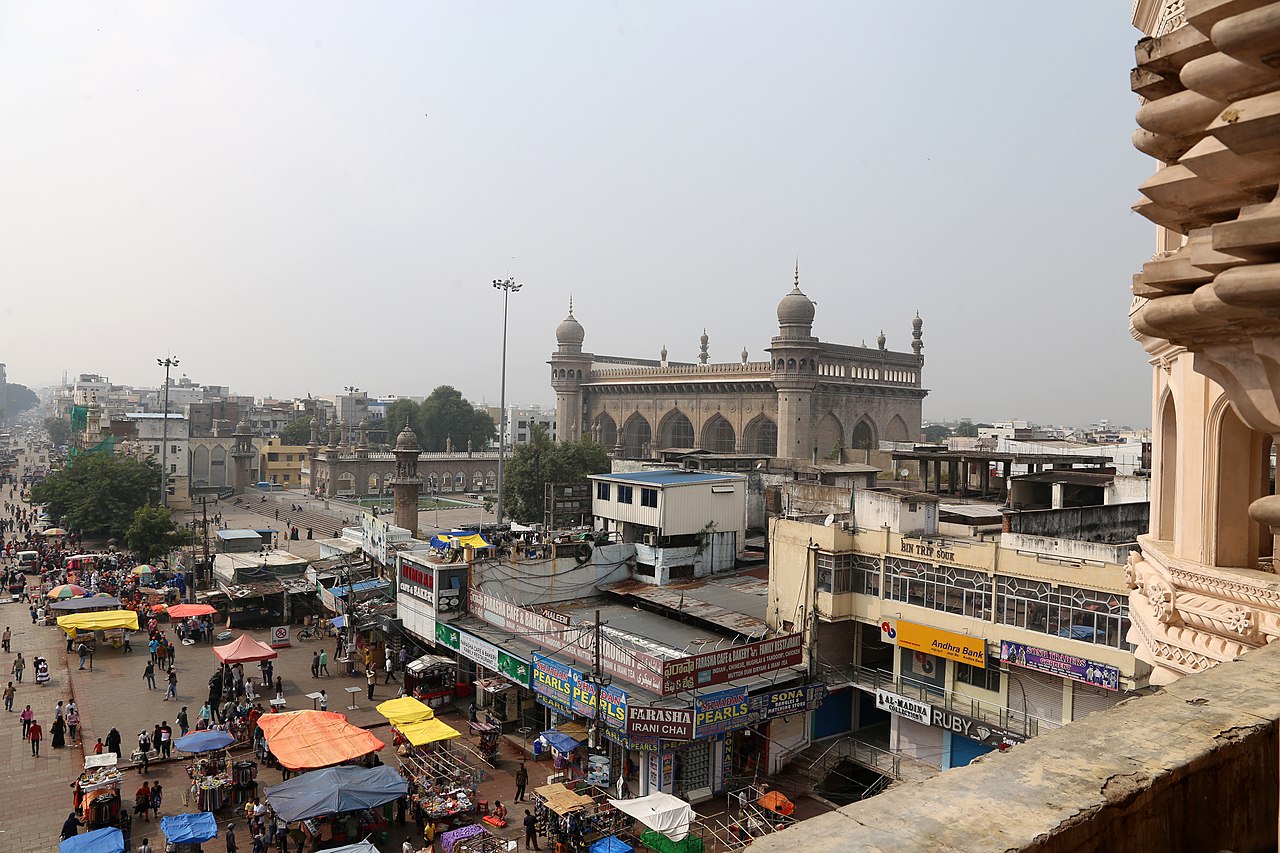
Mecca Masjid looks heavier than the nearby Charminar, and that surprise is half the pleasure: five immense arches cut into a wall of granite, a facade that feels less built than quarried from the earth. Scholars dispute whether construction began in 1614 or 1617, but the best-supported date for completion is 1694 under Aurangzeb, and the scale still lands with force when you step inside and hear your footsteps flatten into a cool, stone echo.
Look up slowly. The hall can hold around 10,000 worshippers, which means the interior opens out like a covered plaza, while the mihrab and the great columns carry the kind of weight that makes carved ornament feel almost secondary; according to tradition, bricks made from soil brought from Mecca were set into the central arch, giving the mosque its name, though that belongs to tradition rather than documented record.
The Courtyard, Tank, and South-Side Tombs
The courtyard does the opposite of the street outside. Laad Bazaar noise fades, pigeons clatter up from the steps, and the ablution tank holds a patch of bluish water edged with stone slab seats worn smooth by generations of waiting, washing, and sitting still for a minute longer than planned.
Most visitors stop at the facade, which is a mistake. Walk south and the complex grows stranger and more intimate: a sundial that many people miss entirely, traces of the old hammam, and the marble tomb enclosure of the Asaf Jahi rulers, where dynastic history stops pretending to be finished and still feels present.
Best Combined Experience: From Charminar to the Quiet South End
Start outside, facing the mosque from the Charminar side, because that view explains the building's power better than any plaque could: market pressure, traffic, hawkers, then this broad stone court holding its ground beside the old city's most photographed monument. Then cross the threshold, pause by the tank, study the Quranic inscriptions over the arches and doors, and keep walking until the south end thins into tombs and shade.
That short route changes the mosque from postcard to lived place. You begin with spectacle and leave thinking about temperature, silence, dynasties, and the labor of stonecutters who raised a congregational mosque that still works exactly as intended.
02 In pictures.




Plan and listen to Mecca Masjid with Audiala.
Audio guide in your pocket, itinerary in your browser. Built for the way you actually visit.
Tickets & tours.
These are guided options from our partners — same price as booking direct.
Prices are indicative — final pricing and availability are confirmed at checkout. Audiala may earn a commission from bookings made through these links.
03 Visitor logistics.
The practical scaffolding for a good visit — kept short.
Getting There
Mecca Masjid sits beside Charminar in Hyderabad’s Old City, about 100 meters away, so most people pair the two and walk over in 2 to 3 minutes. From Secunderabad Railway Station, TSRTC buses 1C, 2, 2C, 2V, 2Z, 8A, 8C, 8M, 8U, and 57S serve the area; from Nampally, routes include 8M, 8R, 8U, 9, 9D, 9F, 9K, 9L, 9M, 9N, 9Q, 9R, 9X, 9Y/F, 41M, 65M, and 65S. As of 2026, the easiest rail option is Hyderabad Metro to Osmania Medical College, then an auto-rickshaw for the last 1.3 kilometers, because driving into the Charminar zone on Fridays or in Ramzan can feel like pushing a car through a market crowd.
Opening Hours
As of 2026, current visitor listings show Mecca Masjid open daily from 4:00 AM to 9:30 PM. I found no confirmed summer-winter timetable split, but access can tighten sharply on Friday noon prayers and during Ramzan, when police traffic controls and security checks often reshape the whole area between morning and late afternoon.
Time Needed
Give the mosque 20 to 30 minutes if you’re stepping in from Charminar for a quick look. A slower visit, with time for the courtyard, the tomb enclosure, and a quiet pause under those huge granite arches, takes 45 to 60 minutes; folded into an Old City outing with Hyderabad, Laad Bazaar, and Chowmahalla, you’ll want 2.5 to 4 hours.
Accessibility
As of 2026, no official site page gives a full accessibility map. Ground-level access to the compound appears possible, and the metro network itself has lifts and disabled-friendly features, but the hard part is the last stretch: crowded streets, uneven surfaces, and prayer-time congestion can turn a short approach into a slow, shoulder-brushing shuffle, so wheelchair users should avoid peak periods and confirm facilities locally.
Cost & Tickets
Entry is free as of 2026, and I found no official booking system, timed ticket, or skip-the-line option. Recent visitor reports mention small cash fees of about ₹20 for bag storage and ₹20 for shoe keeping, which sounds plausible on the ground but does not function as an admission ticket.
05 Tips for visitors.
Small things that change the day.
Dress Properly
Dress modestly and treat this as a working mosque, not a backdrop. Cover shoulders and knees, remove your shoes, and if you’re a woman, carry a scarf for your head; clothing judged too short can get you turned away.
Pick Your Hour
Go early on a non-Friday morning if you want calm, light, and room to look up at the prayer hall without being hustled along. Friday noon and late Ramzan evenings bring the opposite: crowds, barricades, and the full Old City crush.
Shoot Carefully
Courtyard and exterior photos are usually fine, but interior prayer areas are more sensitive and rules can tighten without warning. Keep your phone on silent, skip flash, don’t bring a drone, and never point a camera at worshippers unless someone clearly says yes.
Watch The Crowd
The main risk here is not dramatic crime but pressure: pickpockets, rough crowding, traffic chaos, and unofficial parking collectors around Charminar in busy periods. Carry little, keep your phone zipped away, and don’t count on a quick escape once the lanes fill up.
Eat Next Door
Nimrah Cafe & Bakery is the obvious stop for Irani chai, Osmania biscuits, and that famous view across to the mosque; budget around ₹200 to ₹600 for two as of 2026. For a fuller meal, Hotel Nayaab is a good mid-range Old City option, and Arfath Juice Centre opposite the mosque works well for a cheap cold drink when the heat starts pressing down.
Pair It Right
Mecca Masjid works best as part of one compact Old City walk, not as a standalone detour. Start with Charminar, cross over to the mosque, then continue into Laad Bazaar or back toward central Hyderabad; the route is short on a map, but the mood changes block by block.
Where to Eat
Don't Leave Without Trying
Dining Tips
- check Try the dum biryani at Shadab or Nayaab for an authentic Hyderabadi experience
- check Visit Pista House for seasonally available haleem during Ramadan
- check Nimrah Cafe is the go-to spot for Irani chai and Osmania biscuits
- check Explore Laad Bazaar for street snacks and local treats near Mecca Masjid
Restaurant data powered by Google
04 A history of reinvention.
A Mosque Built Across Broken Regimes
Mecca Masjid belongs to the old ceremonial heart of Hyderabad, but its history is less neat than guidebooks like to pretend. Scholars date the start to either 1614 or 1617, popular retellings often credit Muhammad Quli Qutb Shah, and the later date points more cleanly to Muhammad Qutb Shah. That tension matters.
The mosque records a political reversal in stone. Qutb Shahi rulers began it for their capital; Aurangzeb, the emperor who destroyed their kingdom, finished it in the 1690s according to modern secondary sources, while older material points to 1692. Later Asaf Jahi rulers buried their dead here, so one monument came to hold conquest, prayer, and dynastic afterlife at once.
Moulvi Syed Alauddin Turns Prayer into Revolt
On 17 July 1857, Mecca Masjid stopped being only a royal monument and became a launch point for rebellion. Times of India reporting based on archival committee records says a large gathering assembled here before moving toward the British Residency, with Moulvi Ibrahim, Moulvi Syed Alauddin, and Turrebaz Khan tied to the action.
For Alauddin, the stake was personal and absolute. He used a sacred congregational space to preach resistance against British power in Hyderabad, and when that choice failed, the punishment did not mean a brief spell in jail; imperial authorities sent him for transportation for life to the Andamans, which meant removal from city, allies, and cause.
That turning point changes how the mosque reads today. The courtyard still feels measured and grave, but one corner of its past is all motion: men gathering after prayer, voices hardening into resolve, then a march out into the streets. Mecca Masjid was never just background.
Why the Name Stays Slippery
The Graves at the South End
Listen to the full story in the app
The whole Mecca Masjid,
told well.
Audio guides for 1,100+ cities across 96 countries. History, stories, and local insight — offline ready.

06 Frequently asked.
The questions travellers send us most about Mecca Masjid.
Is Mecca Masjid worth visiting?
Yes, especially if you want the part of Hyderabad that the postcard leaves out. The mosque stands beside Hyderabad's Charminar quarter, but it feels heavier, older, and more lived-in: a granite prayer hall, a wide stone courtyard, Nizam tombs at the south end, and a history that runs from Qutb Shahi ambition to the 18 May 2007 blast. Go for the architecture, stay for the shift in mood when the bazaar noise drops behind you.
How long do you need at Mecca Masjid?
Give it 30 to 60 minutes. Half an hour covers the courtyard, tank, facade, and tomb enclosure; an hour gives you time to sit by the stone slabs around the ablution tank and actually watch the place breathe. If you pair it with Charminar, Laad Bazaar, and the Old City lanes, plan 2.5 to 4 hours.
How do I get to Mecca Masjid from Hyderabad?
The easiest route is to head for Charminar and walk the last few minutes. Hyderabad district officials list direct TSRTC bus routes from Secunderabad Railway Station, Nampally, and MGBS, while the most practical metro option is Osmania Medical College station followed by an auto-rickshaw or a 17-minute walk. Driving works badly on Fridays and during Ramzan, when traffic controls and parking chaos take over the Old City streets.
What is the best time to visit Mecca Masjid?
Early morning on a non-Friday gives you the best visit. The stone stays cooler, the courtyard feels calmer, and you avoid the crowd pressure that builds around Friday noon prayers and Ramzan evenings, when the mosque turns into one of Hyderabad's biggest congregational spaces. If you want spectacle rather than quiet, go near iftar in Ramzan and accept the crush.
Can you visit Mecca Masjid for free?
Yes, entry is generally free. I found no official ticketing system, no online booking, and no legitimate skip-the-line option; you simply walk in, subject to security, dress rules, and prayer-time restrictions. Recent visitor reports mention small charges for shoe or bag keeping, so carry little.
What should I not miss at Mecca Masjid?
Do not miss the stone seats around the ablution tank, the five-arched granite facade, and the south-end tomb enclosure where several Nizams lie buried. Also look up: Quranic inscriptions over the arches and doors reward slow looking more than wide-angle photos do. And if you rush past the courtyard sundial, you miss the sly little object that turns this huge mosque back into a place measured by hours, not dynasties.
Verified, and shown.
Researched and written by the Audiala editorial team from historical records, architectural archives, and local expertise.
Official visitor access page with location context near Charminar and bus routes from major city transport hubs.
Official mosque-visit guidance for dress, footwear, silence, and respectful behavior.
Festival context confirming major Ramzan congregations at Mecca Masjid.
Current practical listing for opening hours, free entry, and distance from Charminar.
Official metro network information used to identify relevant stations for reaching the Old City.
Official train timing information for planning metro-based visits.
Current last-mile estimates for walking distance and nearest transit stops.
Recent visitor timing estimates, practical notes, and on-the-ground reports about bag and shoe keeping.
Secondary visitor guidance on access limits around prayer areas and dress expectations.
Historical overview of the mosque's disputed chronology, Mughal completion, and 2007 blast.
Archival metadata supporting the commonly cited 1617 to 1694 construction span.
Archival description of the mosque's stone construction, scale, and architectural features.
Older historical text used for contested naming and completion-date traditions.
Reporting on Mecca Masjid's role in the 17 July 1857 anti-British uprising in Hyderabad.
Recent reporting confirming the continued burial association of the Nizam family at the mosque.
Secondary architectural details on the ablution tank, stone slab seating, arches, and columns.
Visitor-focused detail on inscriptions, views toward Charminar, and the feel of the site.
Recent traffic restrictions showing how Friday and Ramzan prayer events affect access.
Recent Ramzan coverage showing how the mosque functions during major prayer nights.
Local reporting on weak public toilet infrastructure around the Charminar precinct.
Nearby food stop used for practical visitor planning after or before the mosque.
Last reviewed
Researched from Wikidata, Wikipedia & official sources · fact-checked · How we make our guides →


