Flat street approach; interior inaccessible (private property)
Best season
October to February (cooler, cleaner light for photography)
Behind a screen of old trees in Hyderabad's Nampally neighbourhood, a 30,000-square-foot European facade stares back at you like a guest who arrived at the wrong party and decided to stay. Gyan Bagh Palace, built for Raja Dhanrajgirji around 1890, is one of India's least-visited noble residences — not because it lacks grandeur, but because it remains private property and the grandeur is slowly losing its argument with time.
The palace sits in Joshiwada Colony, technically in Hyderabad though old records sometimes file it under its twin city Secunderabad. That confusion is fitting. Gyan Bagh has always been slightly out of place — a limestone-and-marble mansion styled after European country estates, planted in the heart of a Deccan city where Mughal and Indo-Saracenic architecture set the rules.
You cannot walk through its rooms. No ticket office, no audio guide, no gift shop selling miniature domes. What you can do is stand at the gate and look at a building that Lala Deen Dayal — the Nizam's court photographer and one of the finest lens artists of the 19th century — considered worth documenting. His photograph survives in MIT's digital archive. The palace survives too, though less completely.
For anyone drawn to places where the story matters more than the selfie, Gyan Bagh rewards the detour. Its walls carry traces of Nizam-era nobility, 1970s Bollywood glamour, and the slower drama of a family estate quietly coming apart.
Researched by the Audiala editorial team from historical records, architectural archives, and local expertise.
What to see
The European Facade from Joshiwada Colony
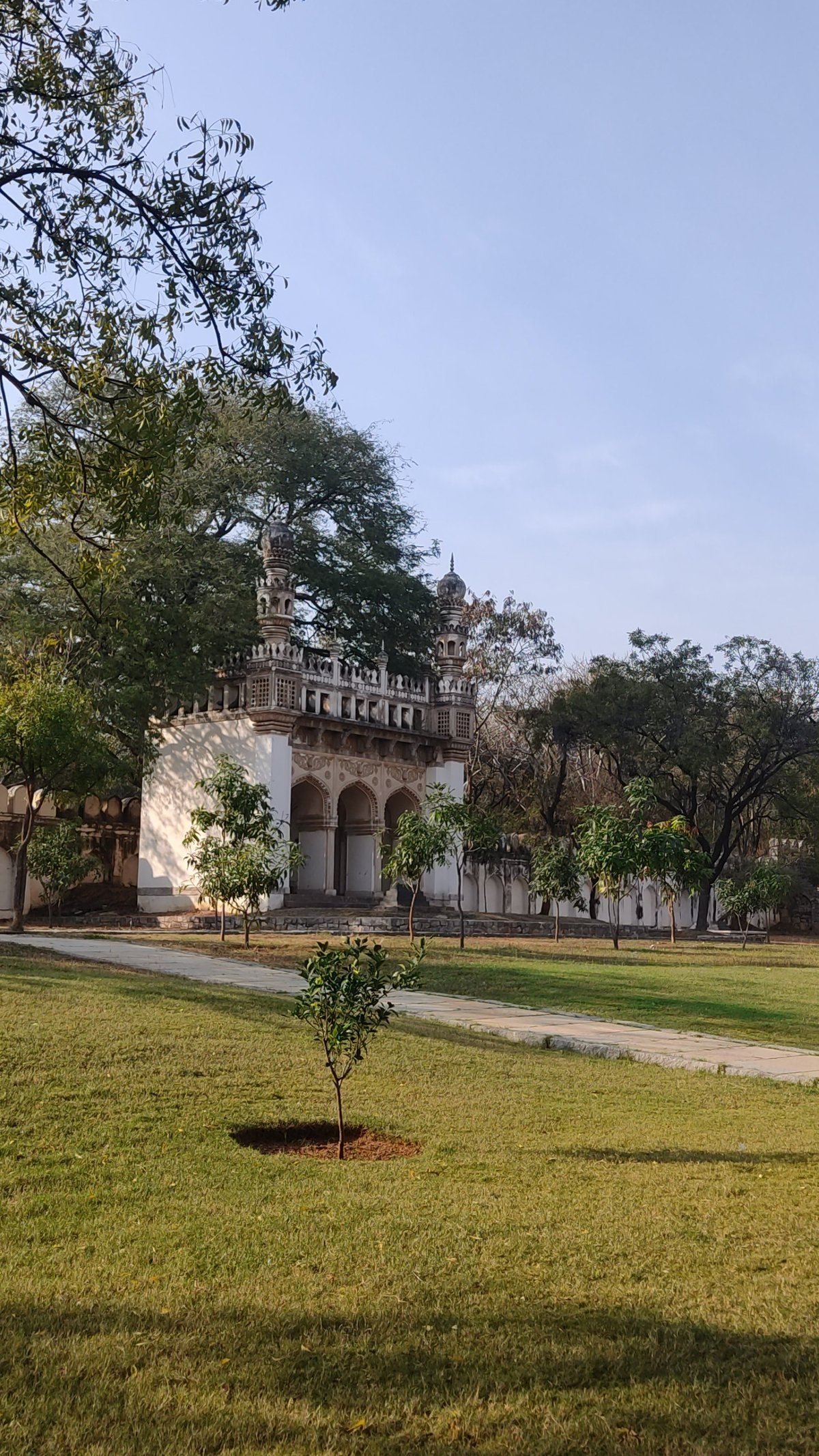
Since the palace is private and closed to visitors, the main event is the exterior — and it delivers more than you might expect from a public road. The facade follows European symmetry: evenly spaced windows, classical columns, and proportions that echo Italianate villa design, all rendered in local limestone and marble that has aged into a colour somewhere between cream and exhaustion. Mature trees crowd the perimeter, so the best views come through gaps in the foliage and at the main gate. Morning light is kinder to the stonework than afternoon glare. Bring a telephoto lens if you have one; the details reward closer inspection than the gate allows.
The Wooded Grounds
Even from outside, the density of old trees surrounding Gyan Bagh sets it apart from Hyderabad's other heritage buildings. Where most Nizam-era palaces now sit in cleared urban plots, Gyan Bagh retains a canopy thick enough to muffle traffic noise from a few metres away. The trees — many of them older than the 1947 independence — create a microclimate that drops the temperature noticeably as you approach the compound. In a city where summer hits 42°C, that shade is not decorative. It is architectural.
A Palace You Visit with Your Imagination
Gyan Bagh is, honestly, a place where what you cannot see matters more than what you can. The interiors — where Lala Deen Dayal may have set up his tripod, where Rajesh Khanna's crew reportedly ran cables across marble floors, where a raja once hosted dignitaries in rooms spanning 30,000 square feet — remain behind locked gates. This is not a polished heritage attraction. It is an unfinished sentence, a building caught between its past and an uncertain future. For travellers who find that more compelling than a restored showpiece, Gyan Bagh is worth the twenty-minute detour from Nampally station.
Plan your visit
Getting There
The palace sits in Joshiwada Colony near Nampally, on Hyderabad's older side. Nampally Metro station (Blue Line) drops you within a 10-minute walk; Nampally Railway Station (Hyderabad Deccan) is roughly 1–2 km away — a quick autorickshaw ride for ₹30–50. TSRTC buses serve Nampally extensively, and any driver in the city knows the neighborhood.
Opening Hours
As of 2026, Gyan Bagh Palace is private property with no public visiting hours. The gates stay closed to walk-in visitors. There are no official tours, no ticket counters, and no seasonal openings — this is someone's estate, not a museum.
Time Needed
Since access is limited to exterior viewing from surrounding streets, 15–20 minutes is enough to take in the European facade and wooded grounds through the perimeter. If you're combining it with the Nampally neighborhood's other heritage buildings, budget an hour for the wider walk.
History
A Raja's European Dream in the Nizam's City
Hyderabad in the late 19th century was the wealthiest princely state in India, ruled by a Nizam whose fortune rivalled that of entire European nations. The city's nobles competed in architecture the way they competed in everything else — by building bigger, more ornate, and more eclectic. Raja Dhanrajgirji chose to go European, commissioning a palace around 1890 that borrowed freely from Palladian and Italianate traditions while being constructed from local limestone and marble.
The result was Gyan Bagh — literally "Garden of Knowledge" — a name that suggests the Raja saw his estate as more than a residence. Three separate sources cited by Wikipedia support the 1890 date, and the palace's documentation by Lala Deen Dayal during his active period confirms it existed before the century turned.
The turning point
The Photographer and the Palace: Lala Deen Dayal at Gyan Bagh
Lala Deen Dayal was not a man who wasted glass plates. As official photographer to the sixth Nizam, Mir Mahbub Ali Khan, he documented the court, the architecture, and the power structures of Hyderabad with a precision that borders on obsessive. His surviving archive — now partially held at MIT — is one of the most important visual records of late 19th-century India. When Deen Dayal turned his camera toward Gyan Bagh Palace, he was making a statement about the building's standing among the city's noble residences.
The photograph, catalogued in MIT's DOME archive as the "Gyan Bagh Palace of Raja Dhanrajgirji," shows a European-style facade that would not look out of place in Naples or Nice. Columns, symmetrical windows, formal proportions — roughly the footprint of half a football pitch. That a Deccan raja built this while the Nizam's own architects were perfecting Indo-Saracenic style tells you something about the cosmopolitan ambitions of Hyderabad's elite.
Deen Dayal died in 1905. His photographs outlasted many of the buildings they captured. Gyan Bagh is one of the survivors, though whether it will remain one is an open question.
Bollywood Behind the Gates
Local residents recall that Rajesh Khanna's 1971 film Mahboob Ki Mehndi used the palace grounds for shooting — an unverified but persistent claim that places Gyan Bagh in the orbit of Hindi cinema's golden era. Bollywood actor Feroz Khan reportedly visited the estate through a friendship with a Dhanrajgir descendant, and neighbours describe the 1970s as a period when film stars and fading royalty mixed freely behind the compound walls. The palace, by these accounts, served as a kind of salon — a private world where celebrity met aristocracy over long afternoons.
The Slow Unravelling
Independence in 1947 and the annexation of Hyderabad State in 1948 stripped the Nizam's nobles of their political standing, and economic pressures followed. By the 1980s, portions of the Gyan Bagh estate were reportedly being sold or subdivided. A renovation in February 2017 offered a brief reprieve — the Deccan Chronicle covered the facelift — but visitors today describe a building where peeling plaster and overgrown grounds have become the dominant aesthetic. The palace still stands, as a local heritage chronicler put it, though much of its old grandeur has faded due to lack of upkeep.
Tips for visitors
Shoot From the Street
The palace exterior and ornate gates are visible and photographable from public roads — this is apparently what most of the 256 Google reviewers are doing. Morning light from the east side catches the limestone and marble facade best.
Respect the Privacy
Locals are explicit: this is private property and entry is not permitted. Don't try to talk your way past the gates or climb walls. The family still owns the estate, and trespassing won't win you anything except trouble.
Combine With Nampally
The palace sits in Hyderabad's historic core. Walk south to the Nizam-era buildings around Nampally Station, or head 2 km east to Charminar and the Laad Bazaar — a far more rewarding afternoon than staring at one locked gate.
Eat Nearby
Shah Ghouse on Nampally Road serves Hyderabadi biryani that locals actually eat (budget, ₹200–300 for two). For something quieter, Café Bahar on Basheer Bagh Road is a 10-minute rickshaw ride and has been doing reliable kebabs and chai since the 1970s.
Best Time to Visit
October through February keeps the heat manageable — Hyderabad's summers push past 40°C, and standing on a shadeless street admiring architecture loses its appeal fast. Early mornings year-round offer the softest light on the pale stonework.
Where to Eat
local_dining
Don't Leave Without Trying
Hyderabadi Biryani — slow-cooked chicken or mutton rice, the city's signature dishHaleem — tender meat and lentil stew, especially beloved during RamadanMirchi Ka Salan — spiced green chili curry, the perfect biryani companionDouble Ka Meetha — Hyderabadi bread pudding dessert, rich and indulgentLukhmi — crispy savory pastry with minced meat filling, street food goldOsmania Biscuits — iconic Hyderabad biscuits, best dunked in Irani chaiIrani Chai — milky, slightly sweet tea, a Secunderabad institution
Cream.and.crust
cafe
Bakery & Cafe€€star4.5(2)directions_walkWalking distance from Gyan Bagh Palace
Order: Fresh pastries and baked goods with Irani chai — the perfect pairing for morning or late-night cravings. Their 24-hour availability makes it ideal for any time.
Literally in Gyan Bagh Colony, this is your closest option to the palace and operates round-the-clock. A genuine neighborhood bakery where locals grab fresh bread and sweets.
Cafe€€star4.6(33)directions_walkShort drive from Gyan Bagh Palace
Order: Pan (betel leaf preparations) and local cafe snacks — this is a genuine neighborhood spot where locals gather for their daily fix. Pair with chai for the authentic Secunderabad experience.
With a solid 4.6 rating and 33 reviews, Lucky Pan Shop is a trusted local favorite. It's the kind of place where you'll see regulars, not tourists, which is exactly where the real food happens.
checkGeneral Bazar is the closest food hub to Gyan Bagh Palace — a busy local market with street food stalls, chaat, and authentic snacks where you'll find real Secunderabad eating culture.
checkIrani chai is not just a drink; it's a social ritual. Grab a cup at any local cafe and you'll understand the city's morning rhythm.
checkStreet food in General Bazar is fresh and affordable — the chaat and savory snacks are where locals actually eat, not in tourist restaurants.
Food districts:General Bazar — the closest and most authentic food zone, walking distance from Gyan Bagh Palace area, packed with local stalls and neighborhood eateriesParadise Circle / M.G. Road — Secunderabad's main dining cluster with broader restaurant options and fast food
Restaurant data powered by Google
Frequently asked
Is Gyan Bagh Palace open to the public?
No — Gyan Bagh Palace is private property and is not open to the public. Locals confirm that visitors are not permitted inside. You can view and photograph the European-style facade and wooded grounds from the surrounding streets in Joshiwada Colony.
Who built Gyan Bagh Palace in Hyderabad?
The palace was built by Raja Dhanrajgirji, a nobleman of the Nizam era. Wikipedia cites 1890 as the construction date, supported by three sources including MIT's digital archive, where a photograph by Lala Deen Dayal — court photographer to the Nizam — documents the estate. A conflicting source suggests an earlier date, but 1890 is the better-evidenced claim.
What is the connection between Gyan Bagh Palace and Lala Deen Dayal?
Lala Deen Dayal, one of 19th-century India's most celebrated photographers and official court photographer to the Nizam of Hyderabad, photographed Gyan Bagh Palace — the image is preserved in MIT's DOME archive. His documentation places the palace within Hyderabad's royal photographic record, making it one of the few privately held estates with that kind of archival provenance.
How long do you need at Gyan Bagh Palace?
Thirty minutes is enough for an exterior visit, which is all that's typically possible given the palace's private status. The wooded grounds and colonial facade are best appreciated on a slow walk around the perimeter, ideally in the morning light before city traffic builds.
Was any Bollywood film shot at Gyan Bagh Palace?
Local accounts suggest the 1971 Rajesh Khanna film Mahboob Ki Mehndi was partially shot on the palace grounds. This is unconfirmed and comes from a single resident's recollection, but it fits the era when Hyderabad's noble estates were frequently used as film locations.
Where exactly is Gyan Bagh Palace in Hyderabad?
The palace sits in Joshiwada Colony near Nampally, on the older Hyderabad side of the twin-city agglomeration. The nearest metro station is Nampally on the Blue Line; autorickshaws from Nampally Railway Station (Hyderabad Deccan) take under five minutes.
What architectural style is Gyan Bagh Palace?
The palace is built in European style — typical of Hyderabad's Nizam-era noble residences, which blended Palladian, Italianate, and colonial influences. Accounts suggest the structure spans roughly 30,000 square feet, about the footprint of a small city block, in limestone and marble.
Sources & attribution6
Researched and written by the Audiala editorial team from historical records, architectural archives, and local expertise. Last updated April 2026.
Wikipedia — Gyan Bagh Palace — Construction date (1890), architectural style, Lala Deen Dayal connection, MIT DOME archive citation
Strictly necessary cookies keep the site working. Analytics (PostHog, Google Analytics) measures how each visitor uses our pages. Marketing loads YouTube videos and walking-route maps without a tap and lets Google Analytics set advertising cookies. We never sell your data. You can change this any time from the footer.
Analytics and marketing cookies are optional and only load if you agree. Details under Customize.
Privacy
Cookie preferences
Pick what you're okay with. You can change this any time from the footer.
Strictly necessary
Always on
Sign-in, language, navigation. Always on.
Product analytics
PostHog (EU) and Google Analytics record which pages you view and how you use them, under a random identifier stored in your browser. Helps us see which pages work and which need fixing. Google's ad personalisation stays off. No selling.
Marketing
Loads YouTube videos and the walking-route maps (OpenFreeMap) without a tap; without it, they load only when you tap them. If analytics is also on, Google Analytics may set advertising cookies. Ad personalisation stays off.