An introduction.
Researched by the Audiala editorial team from historical records, architectural archives, and local expertise.
TThe reason your smartphone can count past nine traces back to a worn stone inscription inside Gwalior Fort, where someone carved the numeral zero as a positional digit around 876 CE — roughly six centuries before Europe caught on. Rising 90 metres above the plains of Gwalior, India, this sandstone plateau stretches nearly three kilometres end to end, longer than most airport runways, and holds fifteen centuries of architecture on its back. Babur called it the "pearl amongst the fortresses of Hind." He was not exaggerating.
What makes Gwalior Fort unusual isn't just age or scale — plenty of Indian forts offer both. It's the density of contradiction packed onto a single hilltop. Duck-egg blue ceramic tiles from a Hindu palace sit within walking distance of Mughal dungeons where emperors sent princes to die quietly. Jain colossi carved into the cliff face bear the scars of deliberate mutilation. A temple that rewired mathematics gets less foot traffic than the sound-and-light show.
The fort isn't one building but an entire walled city on a mesa. Man Mandir Palace, with its polychrome tile facades of elephants, crocodiles, and parrots, is the structure most visitors photograph. But the plateau also holds the Teli ka Mandir — an 8th-century temple taller than a seven-storey building — along with Sikh gurudwaras, Jain caves, royal cenotaphs, and water tanks that have held water since before the English language existed.
Gwalior city wraps around the base of the rock like a moat made of traffic. From below, the fort's sheer walls look impregnable, which is mostly the point. From the top, the view stretches flat in every direction, and the wind carries the sound of auto-rickshaws honking far below. The contrast between the stillness up here and the city's noise down there is part of the experience — you feel, physically, what it meant to hold the high ground.
01 What to see.
Man Mandir Palace
Most Indian forts wear their age in shades of brown. Man Mandir wears turquoise, cobalt blue, canary yellow, and emerald green — glazed ceramic tiles set into warm ochre sandstone by artisans working for Raja Man Singh Tomar in the late 15th century. The tiles form bands of peacocks, ducks, elephants, and geometric interlace across a facade taller than a six-storey building. No other fort in northern India has anything like it. The effect is less military architecture, more jewellery at architectural scale.
Inside, stone lattice screens — jali — break incoming sunlight into shifting geometric grids on the floor. Between 9 and 11 AM, when the sun angle is right, these shadow-patterns move as clouds pass overhead. Most visitors look through the screens at the city panorama beyond. Turn around instead. The floor behind you is the better show.
Below the palace, a steep staircase drops into underground chambers where Mughal rulers imprisoned political enemies, including the sixth Sikh Guru, Hargobind Sahib Ji. The temperature falls perhaps 10°C in a few steps — the air turns cool and close, the walls sweat faintly, and voices carry in strange directions. After the blinding plateau sun, the darkness takes a full minute to resolve. The contrast is the point: the same building that dazzles with colour above was designed to erase every sensation below.
The Jain Colossi of the Urwahi Cliff
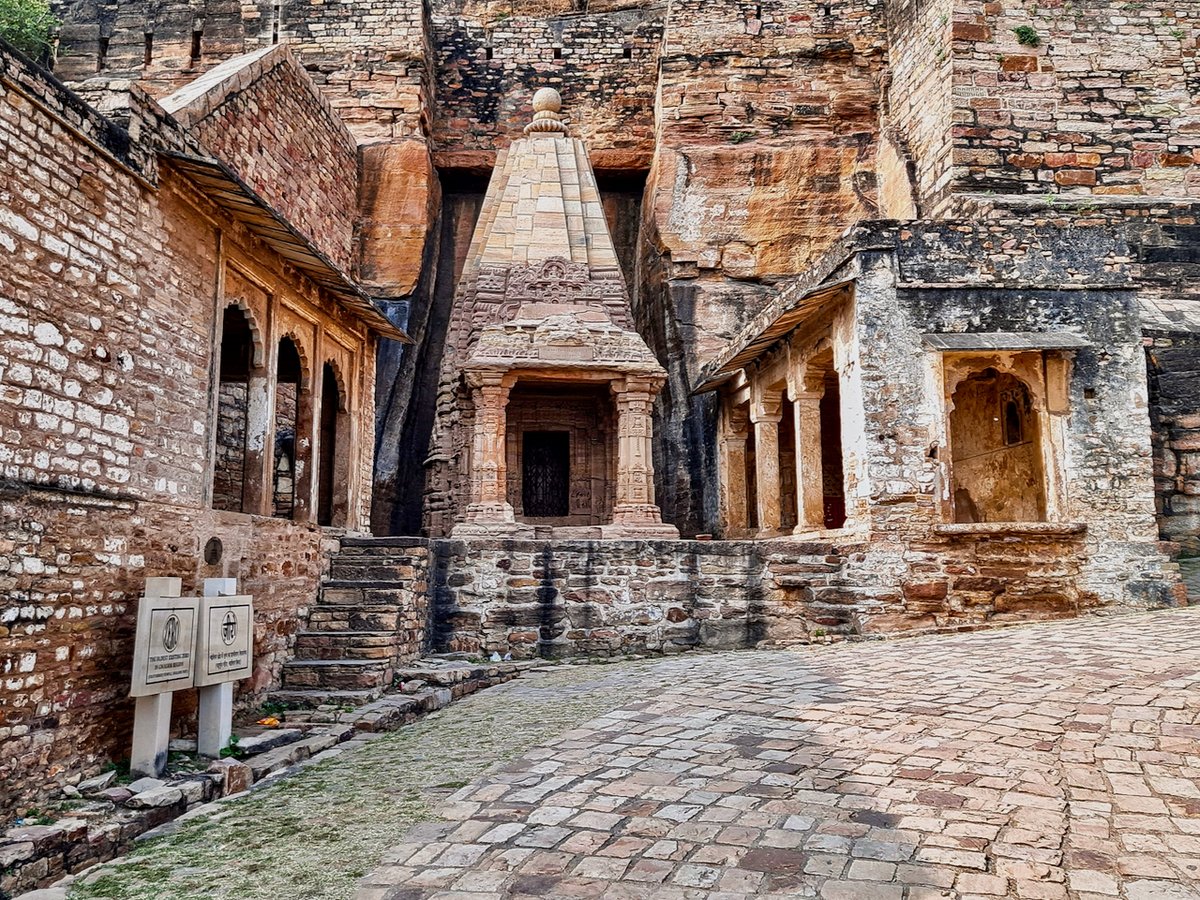
Walking up the narrow Urwahi Gate road toward the fort's southwest entrance, the cliff face begins to confess its secrets gradually — first as dark recesses in the sandstone, then as shoulders, then as faces of immense calm. Carved directly into the living rock between the 7th and 15th centuries, these Tirthankara figures range from modest eye-level niches to giants that dwarf everything around them. The standing Parshwanath, at 19 metres, rises roughly as tall as a six-storey apartment block, a cobra hood fanning above its head. Beside it, the 17-metre Adinath. Your head reaches approximately to their ankles.
The scale gets all the attention, but the intimacy is better. Dozens of smaller carvings — some only 50 centimetres tall — fill niches at eye level in the shadow of the colossi. Lean in close. A few still hold traces of original pigment in protected cavities: faded reds and golds that survived a thousand monsoons because the cliff overhang shielded them from direct rain. The carving quality at this intimate scale is extraordinarily fine, and almost nobody stops to look.
Morning light is essential here. The amber sandstone of the cliff and the darker carved figures create a strong tonal contrast before about 10 AM. By midday the carvings fall into deep, flat shadow and lose their depth. Late afternoon recovers some drama, but dawn is the revelation.
Teli Ka Mandir and the Carved Zero
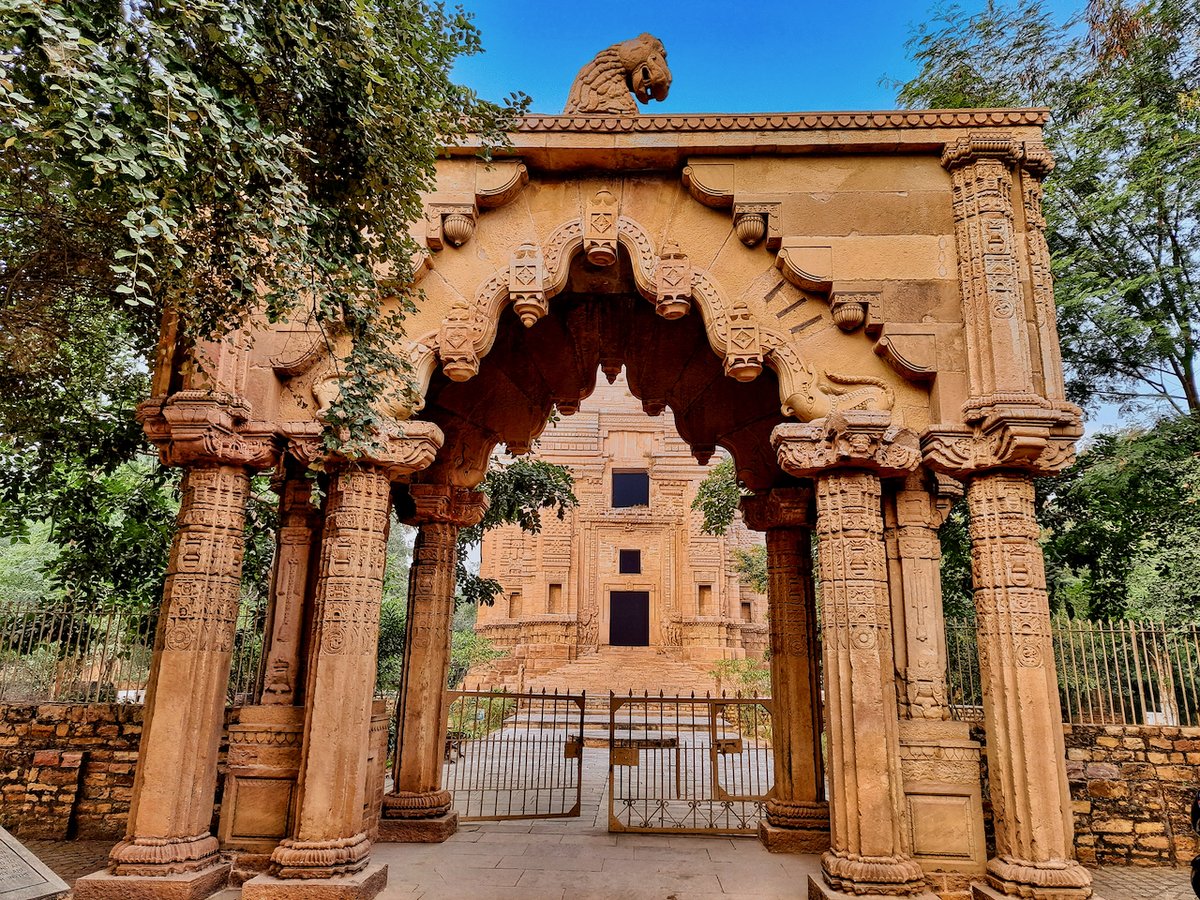
Two structures on the plateau, easy to combine in a single walk, will quietly rearrange your sense of what this fort contains. Teli Ka Mandir, an 8th-century Vishnu temple funded by oil merchants (teli), stands 23 metres high — roughly the height of a seven-storey building — with a barrel-vaulted oblong tower unlike any other in central India. From the south, it looks almost like an inverted boat hull. The British used it as a soda-water factory, which stripped the interior bare; that emptiness, framed by the extraordinarily dense doorway carvings outside, creates a silence that feels deliberate even though it was accidental.
Then walk to the smaller Chaturbhuj Temple nearby. Somewhere on its stone surface — easy to miss, no dramatic signage — sits a circular incision roughly the diameter of a large coin. This is the world's earliest known carved inscription of the numeral zero, part of a 9th-century dedicatory text about a garden's measurements. The symbol that made positional notation possible, that underlies every calculation your phone performs, carved into sandstone the colour of weak tea. Run your fingertip around its edge. The most consequential mark in the history of mathematics, and it's the size of a bottle cap.
02 In pictures.


Plan and listen to Gwalior Fort with Audiala.
Audio guide in your pocket, itinerary in your browser. Built for the way you actually visit.
03 Visitor logistics.
The practical scaffolding for a good visit — kept short.
Getting There
From Gwalior Railway Station (about 5 km), an auto-rickshaw costs ₹80–150 and takes 15–20 minutes — negotiate the fare before climbing in, or book via Ola/Rapido for a fixed price. The main vehicle approach winds up the northeast escarpment through the Gwalior Gate; your driver can drop you near Man Mandir Palace at the top. If you're coming from Agra, the drive is roughly 3 hours south on NH-44, making the fort a realistic day trip.
Opening Hours
As of 2026, the outer fort grounds generally open from 6:00 AM to 6:00 PM, while Man Mandir Palace and the ASI museum sections operate from roughly 8:00 AM to 5:30 PM. Hours conflict across sources, so verify directly with ASI (asi.nic.in) or call the Gwalior circle office before planning a tight schedule. The evening Light & Sound Show runs at approximately 7:30 PM (Hindi) and 8:45 PM (English), with seasonal timing shifts.
Time Needed
A quick pass through Man Mandir Palace and the main viewpoints takes 1.5–2 hours, but you'll miss most of what makes this place extraordinary. A proper visit — Man Mandir, Teli ka Mandir, Sas-Bahu Temples, the Gopachal Jain sculptures, and the Gurdwara — demands 4–5 hours. The plateau stretches nearly 3 km, about the length of 30 football pitches laid end to end, so pace yourself.
Accessibility
The fort sits 90 metres above the city on a rocky plateau — roughly the height of the Statue of Liberty. Vehicles can drive up the main ramp road, but once inside, paths between monuments involve uneven stone, steep steps, and exposed gradients with no elevators or ramps. Wheelchair users will need a strong companion and should expect that several sections, particularly the Jain sculptures on the western escarpment, remain inaccessible.
Cost & Tickets
As of 2026, expect ASI standard rates: approximately ₹35–50 for Indian nationals and ₹300–600 for foreign visitors, with children under 15 free — but confirm at asi.nic.in, as the exact Gwalior Fort page was not retrievable during research. Free entry applies on Republic Day (Jan 26), Independence Day (Aug 15), and World Heritage Day (Apr 18). The Light & Sound Show requires a separate ticket, typically ₹100–200.
04 Tips for visitors.
Small things that change the day.
Arrive After Four
The plateau is fully exposed sandstone with almost no shade — midday between March and October can hit 45°C. Locals recommend arriving after 4 PM for softer light, cooler air, and the best photography conditions on Man Mandir's polychromatic tilework.
Cover Up for Shrines
The Gurdwara Data Bandi Chhor inside the fort requires head covering and shoe removal (scarves are provided at the entrance). Hindu temples like Teli ka Mandir and Sas-Bahu also expect shoes off and covered shoulders — modest dress throughout saves you the awkward shuffle at each threshold.
Check Reel Restrictions
The Gwalior Collector issued a ban on reel-making and commercial videography at the fort area in 2024–2025. Scope and enforcement remain unclear, so ask at the ASI ticket counter before setting up a tripod or filming anything beyond casual phone snaps.
Skip Unofficial Guides
Touts at the entry gates offer "special tours" that route through overpriced shops. ASI-licensed guides are available at the main ticket counter — they know the difference between the Chaturbhuj Temple's 9th-century zero inscription and a random carving, and they won't steer you into a souvenir trap.
Eat at Fort Road
Fort View Cafe by MP Tourism (mid-range, ₹300–600) is the most reliable option near the top. For budget thalis, try Anand Bhoj or Jain Family Restaurant on Fort Road at the base — both under ₹250. Skip 7 Spice Restaurant entirely (2.9/5 rating for a reason).
Don't Miss Gopachal
Over 1,500 Jain rock-cut figures carved between 1450 and 1480 cover the western escarpment — entire cliff faces of tirthankaras taller than a person. Most guidebooks give them one line. They deserve thirty minutes and your best camera lens.
Where to Eat
Don't Leave Without Trying
Fort View Cafe by MP Tourism
quick biteOrder: Light snacks and fresh tea or coffee — the real draw here is sipping your drink while gazing out at the fort's ancient stone walls.
This is the only verified dining spot with a direct connection to the fort itself, making it the most convenient pit stop after exploring the monument. The location trumps the menu, but that's precisely why locals and visitors alike grab a break here.
Dining Tips
- check Most restaurants are clustered 2–5 km downhill from the fort in Lashkar and City Centre areas; plan transport accordingly.
- check Visit the fort in early morning or late afternoon to avoid heat, then head to nearby restaurants for a meal.
- check Street food hubs like Gwalior Chaupati and Khau Galli offer authentic local bites at budget prices.
- check Auto-rickshaws and taxis are readily available from the fort base to transport you to dining areas in the city.
Restaurant data powered by Google
05 Fifteen Centuries on a Single Rock
The earliest documented reference to this hilltop dates to around 525 CE, when an inscription records a sun temple built during the reign of the Huna emperor Mihirakula. The inscription calls the place Gopgiri — "cowherd's hill" — not yet Gwalior. Legend holds that a sage named Gwalipa healed a local chieftain named Suraj Sen with sacred water from a pond on the plateau, and the grateful ruler named the city after his healer. The pond, Suraj Kund, still exists inside the fort. The dates attached to this story range from the 3rd century to the 8th century CE depending on which source you trust, which means nobody really knows.
What the documentary record does confirm is a parade of conquerors that reads like a syllabus for South Asian history. The Gurjara-Pratihara dynasty held the fort from the 8th to the 10th century. The Kachchhapaghatas followed. Mahmud of Ghazni besieged it in 1022 — according to one chronicle, he left after receiving a tribute of 35 elephants, meaning the fort held. The Delhi Sultanate took it in 1196. The Tomars seized it in 1398 and built its most famous buildings. The Mughals turned it into a prison. The Marathas, the Jats, the British — each left marks on the stone. The fort changed hands so many times that its walls became a palimpsest of power.
Man Singh Tomar and the Palace He Built While the World Closed In
Man Singh Tomar ruled from 1486 to 1516, and he knew the Delhi Sultanate wanted him dead. The Lodi sultans had been pressing the Tomar kingdom for decades, and Man Singh's hilltop was the last major Hindu-Rajput stronghold in the region. What he did with that pressure was strange and magnificent: he built. The Man Mandir Palace, with its facade of blue, yellow, and green ceramic tiles arranged in patterns of ducks, elephants, crocodiles, and banana trees, went up during his reign. So did the Gujari Mahal, which according to tradition he constructed for his ninth wife, Mrignayani — a woman from the Gurjar community whose lower-caste origins made the marriage scandalous. The story goes that she agreed to marry him only if he piped water from her home river to the palace. He did.
In 1505, Delhi Sultan Sikandar Lodi attacked the fort and failed. But his son Ibrahim Lodi came back in 1516 with a larger army and a longer timeline. Man Singh Tomar died during the assault — the exact circumstances remain unclear from available sources, whether he fell in a single battle or during the grinding siege that followed. After his death, the Tomars surrendered the fort. The dynasty effectively ended with him.
The turning point was not military but aesthetic. Man Singh had spent his reign creating something so beautiful that Babur, the Mughal conqueror who took the fort a decade later, wrote about it with genuine awe. The Mughals then used Man Singh's palace as a prison. The blue tiles that a besieged king commissioned to face down annihilation became the walls of dungeons. That irony — beauty built under existential threat, then repurposed for captivity — is the emotional core of the fort's history.
The Mughal Prison Years
Rani Lakshmibai's Last Charge
Listen to the full story in the app
The whole Gwalior Fort,
told well.
Audio guides for 1,100+ cities across 96 countries. History, stories, and local insight — offline ready.

06 Frequently asked.
The questions travellers send us most about Gwalior Fort.
Is Gwalior Fort worth visiting?
Yes — it's one of India's most historically layered sites and far less crowded than comparable forts in Rajasthan or Agra. The Man Mandir Palace alone, with its turquoise-and-yellow ceramic tilework from the 1490s, has no visual equivalent anywhere in north India. Add the colossal Jain rock carvings on the cliff face, a temple containing one of the world's oldest carved zeros, and a Sikh gurdwara with an extraordinary liberation story, and you have a place that rewards four to six hours without repeating itself.
How long do you need at Gwalior Fort?
Plan three to four hours for a solid visit covering Man Mandir Palace, the Jain sculptures, and the main temples. The fort stretches nearly 3 km along its plateau — about the length of 30 football pitches end to end — so a thorough exploration including the Chaturbhuj Temple's zero inscription, Teli ka Mandir, and the Gurdwara Data Bandi Chhor takes five to six hours. If you want to catch the evening sound-and-light show, split your visit into a morning session and a return at sunset.
How do I get to Gwalior Fort from Gwalior railway station?
The fort is about 5–6 km from Gwalior Junction, reachable in 15–20 minutes by auto-rickshaw (₹80–150, negotiate before boarding) or app cab via Ola or Uber (₹100–180). The main vehicle approach winds up through the Gwalior Gate on the northeast side, and an auto driver can drop you near the top at Man Mandir Palace — agree on this in advance so you don't get left at the base.
What is the best time to visit Gwalior Fort?
October through March gives comfortable temperatures and the clearest light for photography. Summer heat in Gwalior regularly hits 45°C, turning the exposed sandstone plateau into a griddle — if you visit between April and June, arrive before 9 AM or after 4 PM. Winter mornings sometimes produce ground mist in the city below, making the fort appear to float above the plain, which is worth the early alarm.
Can you visit Gwalior Fort for free?
The outer fort grounds are accessible without a ticket, but the main monuments like Man Mandir Palace charge an ASI entry fee — roughly ₹35–50 for Indian nationals and ₹300–600 for foreign visitors. ASI opens all centrally protected monuments free on Republic Day (January 26), Independence Day (August 15), and World Heritage Day (April 18). Verify current prices at the ASI e-ticketing portal or the gate, as rates shift.
What should I not miss at Gwalior Fort?
The Man Mandir Palace's ceramic-tiled exterior — peacocks, elephants, and crocodiles rendered in cobalt and yellow on 15th-century walls — is the signature sight. Don't skip the Urwahi Gate approach, where Jain tirthankaras up to 19 metres tall (roughly a six-storey building) are carved directly into the cliff face. Inside the small Chaturbhuj Temple, a stone inscription from around 876 CE contains one of the earliest known carvings of the numeral zero — the size of a bottle cap, easy to walk past, and arguably the most consequential mark on any wall in the fort.
Is Gwalior Fort accessible for wheelchair users?
Accessibility is very limited. A vehicle can drive up the main road to the plateau, but the paths between monuments involve uneven stone surfaces, steep steps, and rocky gradients with no ramps or elevators. A wheelchair user with a strong companion could reach Man Mandir Palace by vehicle but would not be able to access the Jain rock sculptures on the Urwahi escarpment or many of the interior temple complexes.
Is there a sound and light show at Gwalior Fort?
Yes — the Man Mandir Palace facade serves as the projection surface for a nightly son et lumière narrated by Amitabh Bachchan in Hindi and Kabir Bedi in English. The Hindi show typically starts around 7:30 PM and the English version around 8:20 PM, though timings shift seasonally. Tickets run approximately ₹250 for Indian adults and ₹700 for foreign visitors. Bring a layer — the plateau temperature drops fast after sunset, even in October.
Verified, and shown.
Researched and written by the Audiala editorial team from historical records, architectural archives, and local expertise.
UNESCO Tentative List entry (February 2024) providing fort dimensions, historical chronology, ancient names, and significance of Chaturbhuj Temple zero inscription.
General history of Gwalior, Mihirakula inscription dating (~525 CE), and Babur's 'pearl amongst fortresses' attribution.
Monument descriptions, sound-and-light show timings and prices, Gujari Mahal and Gurdwara Data Bandi Chhor details.
Detailed chronology of rulers and sieges, Man Singh Tomar's reign (1486–1516), Mughal prison use, Jain sculpture details, and the zero inscription.
City history, 1857 uprising events, Rani Lakshmibai's death at Gwalior (June 1858), Scindia dynasty context.
Architectural analysis of the 8th–9th century temple, hybrid Nagara-Valabhi style, British-era repurposing.
Details of the 6th-century Sanskrit inscription recording a Surya temple, found by Alexander Cunningham in 1861.
Tour operator description noting the fort as the only substantially intact pre-Mughal palace complex in India; UNESCO Creative City of Music designation.
Travel logistics confirming Gwalior is approximately 3 hours by road south of Agra.
Restaurant ratings and reviews for dining options near the fort.
Safety information for neighborhoods near the fort, solo female travel cautions, and scam warnings.
Local heritage activist group documenting illegal construction near Sas Bahu Temple and ASI management controversies.
Post confirming the Chaturbhuj Temple rock-face inscription as containing one of the earliest known carved zeros.
ASI Bhopal Circle virtual tour of the Gwalior Fort Museum with audio guide option.
Photography viewpoints and approach route descriptions.
Local resident perspectives on Gwalior's underdevelopment relative to its historical significance.
Babur's 'pearl amongst fortresses' quote attribution and general fort overview.
Researched from Wikidata, Wikipedia & official sources · fact-checked · How we make our guides →