Introduction
The first surprise in Cooch Behar, India is the skyline: a white, domed palace that looks like it drifted in from imperial Europe and decided to stay in a small north Bengal town. Then your nose catches mustard oil, temple incense, and hot jilapi syrup in the same morning, and the place suddenly makes perfect sense. Cooch Behar is regal without being stiff, devotional without being performative, and far more textured than its quiet reputation suggests.
This was the seat of the Koch dynasty for roughly four centuries, and that history is still legible in daily life. The 1887 Cooch Behar Palace (Victor Jubilee Palace), now under the ASI, anchors the city with Italianate Baroque symmetry, while the 1889 Madan Mohan Temple keeps the emotional center beating through ritual, bells, and festival crowds. Come during Ras Mela or Rath Yatra and you will see how royal memory, pilgrimage, and street life still braid together here.
What makes Cooch Behar memorable is not only what you visit, but what you overhear and taste. Rajbongshi culture runs deep: Bhawaiya songs of longing, tea-stall addas that stretch for hours, and a kitchen where duck curry, dried fish, pitha, and river catch sit comfortably beside Bengali classics. Evenings at Sagar Dighi are all soft light and low conversation—children circling the promenade, vendors tossing jhalmuri, temple loudspeakers dissolving into bird calls.
If you usually measure cities by nightlife districts and curated experiences, Cooch Behar will gently rearrange your criteria. Here, the best hours are early: fish markets at dawn, chai glasses clinking near Station Road, sunlight hitting palace plaster before the heat rises. It is a city that rewards patience, local timing, and a willingness to let public space—rather than venues—tell you who people are.
Places to Visit
The Most Interesting Places in Cooch Behar
Baneshwar Shiva Temple
A Shiva linga sits 3.1 meters below ground at Baneswar Temple in Cooch Behar, where a sacred tank of rare turtles shapes the visit as much as prayer.
Cooch Behar Palace
Nestled in the vibrant city of Cooch Behar in West Bengal, India, the Cooch Behar Palace stands as an exquisite emblem of royal heritage, architectural…
What Makes This City Special
A Palace Built for Empire-Era Ambition
Cooch Behar Palace (1887), designed by Charles Moore, borrows the grammar of Buckingham Palace but lands in Bengal light: white stucco, long colonnades, and a dome that glows at dusk. Inside, the museum still carries the texture of princely life—carriages, portraits, and hunting-era memorabilia.
Temple City Rhythm
Madan Mohan Temple is the city’s spiritual pulse, especially during Rath Yatra when the streets fill with chariots, brass bells, and flower sellers before sunrise. Around it, Sagar Dighi’s promenade gives the old royal core a lived-in, everyday grace.
Rajbongshi Identity, Heard as Much as Seen
This is one of the best places to feel Rajbongshi culture in daily speech, market rituals, and Bhawaiya songs that carry longing across flat river plains. The former princely capital still reads like a cultural borderland between Bengal and Assam, not just another district town.
Wetlands and Forest at the Doorstep
Within easy day-trip range, Rasikbeel fills with migratory birds in winter, while Chilapata and Jaldapara open into Dooars forests and grassland wildlife. Cooch Behar works beautifully as a slow base for birds at dawn and heritage walks by late afternoon.
Historical Timeline
Where a Forest Kingdom Learned to Speak in Marble and Borders
From Kamarupa frontier to princely capital to post-enclave India
Kamarupa Enters Recorded History
The region around present-day Cooch Behar appears in the political world of the Allahabad Pillar inscription, tied to the wider Kamarupa sphere. It was still a riverine frontier of marsh, forest, and shifting authority, but no longer invisible. This early mention matters because Cooch Behar's story begins not as an isolated town, but as a hinge between the Brahmaputra valley and Bengal.
Kamata Kingdom Rises at Kamatapur
After Kamarupa fragmented, power consolidated around Kamatapur, identified with the Gosanimari-Cooch Behar zone. Fortifications in brick and earth began to anchor rule in this wet alluvial landscape. The new Kamata polity gave the region its first long-lived courtly center.
Husain Shah Sacks Kamatapur
Sultan Alauddin Husain Shah of Bengal crushed Kamata's Khen ruler Nilambar and sacked the capital. The conquest was brutal and decisive in dynastic terms, but thin in practical control beyond core routes. In the forests and floodplains, local Koch chiefs survived and reorganized.
Biswa Singha Founds Koch Rule
Biswa Singha unified Koch clans and established a new kingdom centered on what became Cooch Behar. He paired military consolidation with political reinvention, adopting Hindu court idioms to legitimize a rising frontier power. This is the city's true dynastic birth moment.
Naranarayana's Court Becomes a Magnet
Under Naranarayana, Cooch Behar grew from a stronghold into a polished royal court. Diplomats, priests, and poets moved through its halls, while Vaishnavite intellectual life deepened. The city began to project power culturally as much as militarily.
Chilaray Expands the Frontier State
General Chilaray, Naranarayana's brother, drove campaigns across Assam and adjoining hill states, giving Cooch Behar strategic depth and tribute networks. His cavalry reputation traveled faster than royal proclamations. In local memory, he remains the city's sharpest sword.
Koch Kingdom Splits in Two
After Naranarayana's death, succession conflict hardened into geography: Koch Bihar in the west and Koch Hajo in the east. The Sankosh frontier became a political fault line. Cooch Behar kept the main dynastic seat, but lost the seamless expanse that had fueled its peak.
Mughal Suzerainty Accepted
Lakshmi Narayan accepted Mughal overlordship, sending tribute while preserving local rule in Cooch Behar. It was a pragmatic deal: autonomy in exchange for deference. The city became a frontier court balancing imperial pressure and regional survival.
Mir Jumla Seizes Cooch Behar
Mughal general Mir Jumla stormed into Cooch Behar, and Maharaja Pran Narayan fled as the capital was occupied. For residents, it was the sound of marching boots, requisitioned grain, and sudden uncertainty. The occupation was brief, but it burned itself into local political memory.
Pran Narayan's Defiant Legacy
Pran Narayan died after years of resistance and recovery in the Mughal shadow. His reign made Cooch Behar's identity clearer: small state, stubborn spine. Later generations remembered him less for palace ritual than for refusing to disappear.
Treaty Brings Company Protection
After Bhutanese domination and royal captivity, Cooch Behar signed a treaty with the East India Company on 5 April 1773. British troops expelled Bhutanese forces, but protection came with a heavy fiscal price and loss of sovereignty. The city exchanged one overlord for another, more bureaucratic one.
Bogle Mission Passes Through
George Bogle's mission to Bhutan and Tibet moved through Cooch Behar, placing the town on an imperial diplomatic corridor. Suddenly, this northern court was part of conversations that stretched to Calcutta, Lhasa, and London. The city felt the early pulse of global geopolitics.
Nripendra Narayan Inherits a State
As an infant ruler under regency, Nripendra Narayan inherited Cooch Behar at a time when old court forms were giving way to modern administration. His later reign would redraw the city's physical and institutional map. In many ways, modern Cooch Behar is his long shadow.
Sunity Devi Enters the Palace
Nripendra Narayan's marriage to Sunity Devi linked Cooch Behar to reformist Bengal and the Brahmo world. She brought a cosmopolitan confidence that reshaped elite social life in the capital. Through her, the city learned to speak both court protocol and modern public voice.
Cooch Behar Palace Completed
The Victor Jubilee Palace rose in white stucco and Italianate Baroque lines, with a grand central dome and long symmetrical facades. Built at roughly Rs. 10 lakhs, it translated princely ambition into brick, plaster, and imported style. Even today, its scale feels startling against the small-town horizon.
Victoria College Opens Its Doors
The founding of Victoria College signaled that Cooch Behar wanted modern education, not just royal ceremony. Classrooms and examinations began producing a new administrative and professional class for northern Bengal. The city was becoming a learning center, not merely a former capital.
Madan Mohan Temple Rebuilt
The rebuilt Madan Mohan Temple anchored royal patronage to everyday devotion. During festivals, the area filled with conch calls, incense smoke, and packed processional routes. It remains the spiritual heart of the city, where dynasty and neighborhood life still meet.
Great Assam Earthquake Strikes
The massive June 1897 earthquake shook Cooch Behar hard, cracking masonry and unsettling river courses across the region. For a city proud of new construction, the tremor was a brutal reminder of tectonic reality. Reconstruction deepened attention to infrastructure and resilience.
Sunity Devi Writes from Experience
With her memoir, Sunity Devi turned Cooch Behar's princely life into a text read far beyond Bengal. She documented the negotiations between tradition, reform, empire, and womanhood from inside the palace itself. The city gained a literary self-portrait in her voice.
Partition Creates Enclave Labyrinth
At independence, Cooch Behar stood as a princely state amid a violently redrawn map, while nearby Rangpur went to East Pakistan. The border produced dozens of enclaves and counter-enclaves tied to old revenue boundaries. Families found themselves suddenly separated by fences that did not match lived geography.
Merger with India Finalized
Maharaja Jagaddipendra Narayan signed the merger agreement in August 1949, and by October Cooch Behar was integrated into West Bengal. Royal sovereignty ended, district administration began. The city shifted from court capital to democratic periphery, carrying both identities at once.
Palace Reopens as Public Museum
The former royal residence reopened under archaeological stewardship, turning private dynastic space into public memory. Visitors now walk galleries of portraits, weapons, and court objects where protocol once limited access. It was an architectural afterlife: from throne room to archive.
Enclaves Exchanged at Midnight
On 31 July 2015, India and Bangladesh exchanged 162 enclaves, ending a 68-year territorial puzzle rooted in Cooch Behar's princely past. Residents finally chose citizenship with legal clarity after generations in limbo. Few map corrections anywhere have changed so many everyday lives so quickly.
Sitalkuchi Poll Violence Shocks District
During West Bengal assembly elections, firing in Sitalkuchi killed four civilians and pushed Cooch Behar into national headlines. The event exposed how tense electoral competition had become in this border district. Contemporary politics here still carries the weight of historical fault lines.
Notable Figures
Biswa Singha
c. 1480–1540 · Founder of the Koch kingdomHe welded scattered Koch clans into a kingdom and set Cooch Behar on the political map in the early 16th century. The city’s royal axis—palace, temple patronage, ceremonial roads—begins with his state-building legacy. He would still recognize the pride locals carry about being heirs to a distinct kingdom, not just a district town.
Nara Narayan
c. 1528–1587 · Koch ruler and patronUnder him, Cooch Behar became a court of power and culture, not merely a frontier capital. He expanded influence across large parts of northeast India and backed Vaishnav cultural institutions that still echo in the region’s religious life. During Ras and Rath festivities, the ceremonial confidence of the old court still feels like his era’s afterglow.
Chilarai (Sukladhwaj)
c. 1510–1571 · General and military strategistChilarai, the famed commander of the Koch kingdom, gave Cooch Behar its martial legend. His fast campaigns across Assam and adjoining regions made him a folk hero beyond modern state boundaries. In today’s city, his memory survives less in statues than in the stories people still tell about speed, courage, and frontier intelligence.
Maharaja Nripendra Narayan
1862–1911 · Modernizing ruler of Cooch BeharHe remade Cooch Behar’s skyline with the 1887 Victor Jubilee Palace, importing European design into a north Bengal courtly world. His reign tied local royalty to global imperial circuits while funding civic modernization at home. Every visitor who steps into the palace museum is walking through his attempt to make a small capital think internationally.
Maharani Sunity Devi
1864–1932 · Author and reform-minded royalSunity Devi brought reformist Brahmo ideas into a princely court and wrote one of the era’s most vivid royal memoirs. Her life bridged Cooch Behar and London, zenana protocol and public modernity. The city’s long conversation between tradition and social reform bears her imprint.
Gayatri Devi
1919–2009 · Royal figure and parliamentarianBefore she became the iconic Maharani of Jaipur, she was a princess shaped by Cooch Behar’s cosmopolitan royal household. Her political career later turned inherited prestige into democratic mandate, one of modern India’s sharpest royal-to-republic arcs. In Cooch Behar, she represents how this small city produced figures who moved easily on global stages.
Photo Gallery
Explore Cooch Behar in Pictures
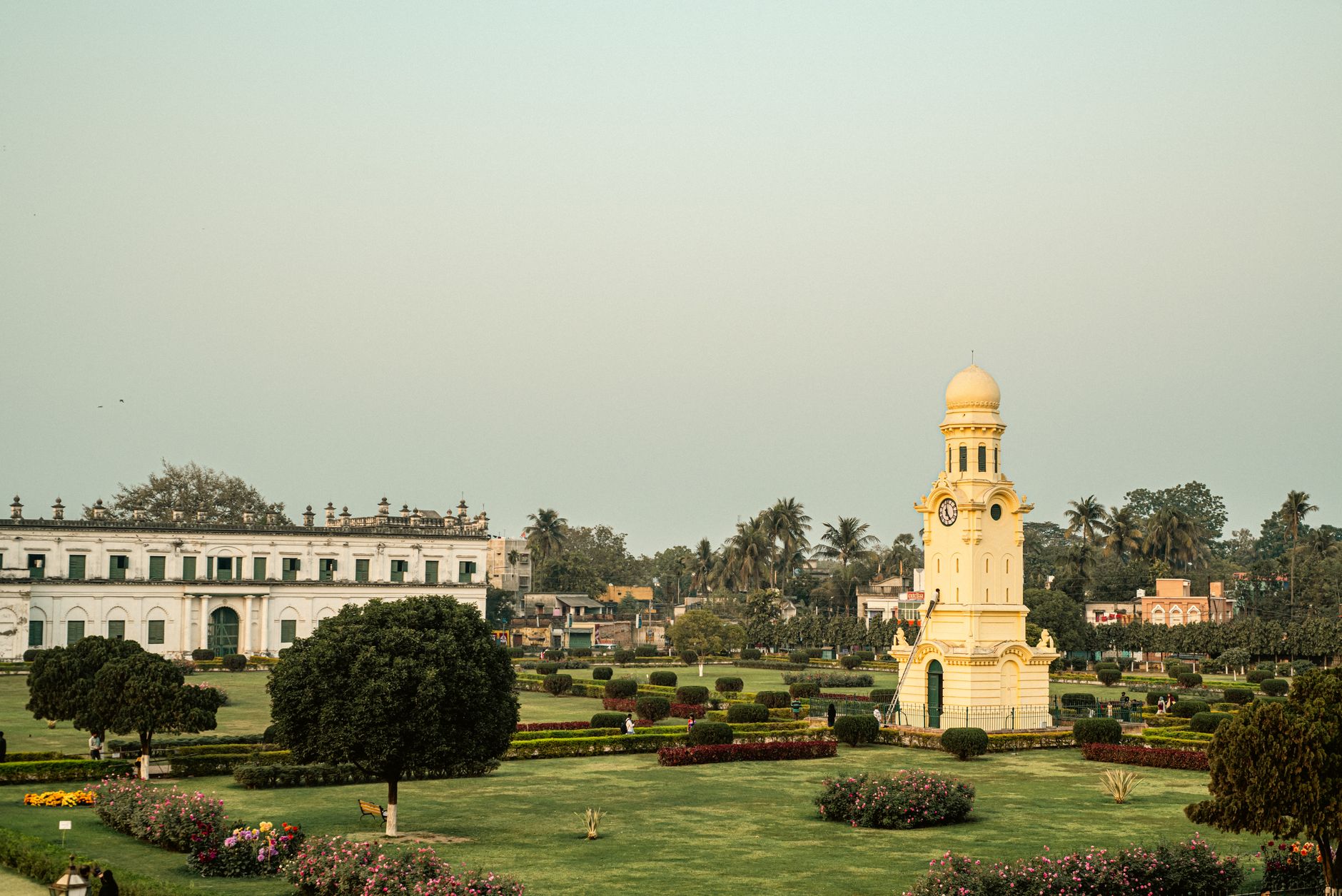
A beautiful example of colonial-era architecture set within a peaceful garden in Cooch Behar, India.
Amitabha Gupta · cc by 4.0
A beautifully preserved etched glass panel featuring heraldic lions and a fruit motif, found within the historic architecture of Cooch Behar, India.
Kingshuk Mondal · cc by-sa 4.0
The elegant white facade of a historic building in Cooch Behar, India, showcasing traditional colonial architecture and a well-maintained garden courtyard.
Amitabha Gupta · cc by 4.0
The elegant entrance to the Anandamayi Dharmashala in Cooch Behar, India, showcases traditional arched architecture framed by tall, mature trees.
Amitabha Gupta · cc by 4.0
The ornate entrance gate of the historic Anandamayi Dharmashala in Cooch Behar, India, showcases classic colonial-era architectural details.
Amitabha Gupta · cc by 4.0
The elegant entrance to the Anandamayi Dharmashala in Cooch Behar, India, showcasing traditional colonial-era architectural details under soft evening light.
Amitabha Gupta · cc by 4.0
The elegant white facade of a heritage building in Cooch Behar, India, showcasing classic colonial architecture and a central garden.
Amitabha Gupta · cc by 4.0
The historic white architecture of a colonial-era building in Cooch Behar, India, set against a clear blue sky.
Amitabha Gupta · cc by 4.0
The elegant white facade of a colonial-era building in Cooch Behar, India, showcases intricate architectural details and arched corridors.
Amitabha Gupta · cc by 4.0
The elegant white arches of a colonial-era building stand in contrast to the modern residential skyline of Cooch Behar, India.
Amitabha Gupta · cc by 4.0
A historic, weathered building nestled among dense trees in Cooch Behar, India, featuring a gated entrance and traditional architectural details.
Kingshuk Mondal · cc by 4.0
A historic, weathered colonial building nestled among dense trees in Cooch Behar, India, viewed through an old iron gate.
Kingshuk Mondal · cc by 4.0
Practical Information
Getting There
Nearest practical airports in 2026 are Bagdogra Airport (IXB, about 135 km) and Lokpriya Gopinath Bordoloi Airport, Guwahati (GAU, about 175 km); Cooch Behar Airport (COH) has had intermittent commercial service, so check live status before planning around it. Main rail access is via New Cooch Behar Junction and Cooch Behar station, with overnight links from Kolkata and connections through New Jalpaiguri (NJP). By road, the city connects to the NH 27 east-west corridor and regional routes toward Alipurduar, Jalpaiguri, and Siliguri.
Getting Around
There is no metro or suburban rail system in Cooch Behar (0 lines), and no city tram network; movement is mostly by toto (electric rickshaw), auto-rickshaw, cycle rickshaw, and local buses. Shared toto/auto rides are usually low-cost on fixed routes, while private rickshaw hops inside the core are quick for palace-temple-lake circuits. NBSTC and private buses handle inter-town travel, and as of 2026 there is no dedicated tourist transport pass or city mobility card.
Climate & Best Time
Winter (Nov-Feb) is the sweet spot, roughly 8-26°C, with clearer skies and comfortable walking weather; summer (Mar-May) rises to about 32-34°C with humidity and pre-monsoon storms. Monsoon (Jun-Sep) is very wet, often 300-550 mm/month in peak weeks, and flooding can disrupt day trips. For 2026 travel, target November to February, with November especially lively during Ras-period festivities.
Language & Currency
You will hear Rajbongshi/Kamtapuri, Bengali, and Hindi; English is workable in hotels and with younger residents but patchy in markets. Currency is Indian Rupee (INR), and UPI QR payments are widespread in 2026 even at small shops, though cash is still useful for rickshaws and temple-area vendors. Keep backup notes during festivals when ATMs can run low.
Safety
Cooch Behar is generally calm for visitors, with most issues being petty theft risk in crowded fairgrounds and transport hubs rather than violent crime. Use mosquito repellent at dusk (dengue risk in the wider North Bengal belt), and avoid late-night walks on poorly lit peripheral roads. If you are heading toward border-adjacent rural zones, ask locally about any current movement restrictions.
Where to Eat
Don't Leave Without Trying
KFC
quick biteOrder: Hot & Crispy chicken with a Zinger burger combo when you need a reliable, quick meal.
This is the busiest dependable chain stop in town, especially useful for families and late-evening hunger. Service is usually fast even during peak shopping hours.
The Customised
cafeOrder: Designer custom cake and a box of fresh pastries for take-home.
If you need birthday or celebration cakes, locals mention this place first. Quality is consistent and the finish on custom orders stands out in Cooch Behar.
MIO AMORE
quick biteOrder: Chicken patty, cream pastry, and a tea for a classic quick stop.
A practical all-day bakery counter on a key road, good for fast snacks between errands. It is one of the easiest no-fuss options in central Cooch Behar.
The Hot Box
cafeOrder: Chicken roll, chilli chicken, and fried rice for a full evening plate.
Good pick when your group wants street-style comfort food without spending too much. The menu fits Cooch Behar’s strong roll-chowmein-cafe culture.
Ice Bar
local favoriteOrder: Ask for their popular bar snacks with your drinks, especially chilli-style starters.
One of the better-known casual drinking spots in town with long operating hours. Useful when you want a laid-back evening instead of a full sit-down dinner.
Cakes 'N' Crumbs
cafeOrder: Signature fresh cream cake slices and a custom occasion cake order.
This is the highest-rated bakery in this list and locals trust it for quality sweet work. Great for gifting, celebrations, and polished dessert boxes.
Hum Tum Fast Food Restaurant
quick biteOrder: Egg-chicken roll and spicy chowmein for a classic Cooch Behar evening snack run.
Strong ratings and a focused evening service window make it a local quick-bite favorite. This is exactly the kind of place that matches the town’s street-food rhythm.
THE SECRET SPACE CAFE
cafeOrder: Coffee with loaded fries or a burger combo for a long hangout session.
A hangout-style first-floor cafe where students and young locals linger over snacks and conversation. Good atmosphere for a slower, social evening.
Raju Momo Shop
quick biteOrder: Steamed chicken momos first, then a plate of fried momos with spicy chutney.
Open 24 hours, which is rare and genuinely useful in Cooch Behar. If you want the town’s momo side of the food culture, this is a strong late-night stop.
Kancha da Momo Center - Khalashipatti
quick biteOrder: Pork or chicken momos with extra chutney during the evening rush.
A compact, local momo stop in Khalasi Patti where regulars come for fast, hot plates. Best visited early evening when turnover is high and batches are freshest.
Sprout and Brew
cafeOrder: Cold coffee with a grilled sandwich or pasta for a relaxed cafe meal.
One of the better-rated newer cafe-style options, good for couples and small groups. The menu leans modern while staying affordable by local standards.
CHA HUT
cafeOrder: Masala chai with light fried snacks for a proper adda-style break.
Cooch Behar runs on tea-and-talk culture, and this spot fits that vibe perfectly. Best as a casual pause between market runs and evening errands.
Dining Tips
- check UPI payments are common, but keep cash for smaller momo and tea stalls.
- check Tipping is modest: round up or leave around 5-10% in sit-down places.
- check Many local favorites are busiest from about 7:30 PM onward; go earlier for faster service.
- check Bengali lunch places often feel strongest at lunch rather than late dinner.
- check Reservations are uncommon except for larger groups or celebration cake pickups.
- check Ask directly for Bengali-style fish or mutton preparations if available off-menu.
- check Street momo and fast-food counters can sell out of popular items by late evening.
- check Card acceptance is inconsistent at smaller outlets, so do not rely on cards alone.
Restaurant data powered by Google
Tips for Visitors
Use Rail First
For most travelers, trains are the most reliable way in. Book IRCTC tickets early for Kolkata–Cooch Behar routes, especially in festival season when sleeper and AC quotas fill fast.
Check Airport Status
Cooch Behar Airport has had intermittent commercial service, so verify live schedules before planning flights. Bagdogra (IXB) plus train or road transfer is usually the safer plan.
Time Your Visit
Come between November and February for cool weather and clearer skies. Monsoon months (June–September) can bring heavy rain and flooding that slows local travel.
Walk The Core
The palace, Sagar Dighi, temple zone, and markets are close enough to combine on foot in one loop. Start early or near sunset to avoid humid midday heat.
Carry Small Cash
UPI is common, but rickshaws, temple stalls, and small eateries still run best on cash. Keep ₹10–₹100 notes for short rides, snacks, and quick purchases.
Eat Local Lunch
Order a simple Bengali thali at busy local lunch houses around Tower More rather than hunting for chain restaurants. Ask for duck curry or shutki dishes if you want flavors specific to this region.
Border-Area Caution
Town areas are generally calm, but don’t casually wander into remote border-adjacent zones without local advice. For evening outings, stick to lit central roads and use mosquito repellent.
Explore the city with a personal guide in your pocket
Your Personal Curator, in Your Pocket.
Audio guides for 1,100+ cities across 96 countries. History, stories, and local insight — offline ready.
Audiala App
Available on iOS & Android
Join 50k+ Curators
Frequently Asked
Is cooch behar worth visiting? add
Yes—especially if you like layered history over checklist tourism. The 1887 Cooch Behar Palace, the living temple culture around Madan Mohan, and the Rajbongshi identity give the city a character you won’t get in bigger Bengal cities. It’s compact, affordable, and feels genuinely local.
How many days in cooch behar? add
Two days is enough for the city highlights, and three days is better if you add a wetland or forest day trip. Day 1 can cover the palace, Sagar Dighi, and markets; Day 2 fits Madan Mohan Temple plus Gosanimari or Rasikbeel. Add one more day for Chilapata or Jaldapara.
How do I reach cooch behar from Kolkata? add
Overnight train is usually the best option. Direct services on the Northeast Frontier route typically take around 10–12 hours, and seats can sell out early. You can also fly to Bagdogra and continue by road or rail.
Can I fly directly to cooch behar? add
Sometimes, but do not assume it’s available year-round. Cooch Behar Airport has had stop-start commercial operations, so confirm current airline listings before you commit. Most travelers still use Bagdogra as the dependable gateway.
Is cooch behar safe for tourists and families? add
Generally yes, with normal small-city precautions. Central areas are active and straightforward to navigate, but traffic can be messy and peripheral roads get quiet at night. Use trusted transport after dark and carry repellent for mosquitoes.
What is the best time to visit cooch behar? add
November to February is the sweet spot. The weather is cooler, walks are easier, and festival energy peaks around Ras Mela season. Monsoon can be beautiful but often disrupts transport and outdoor plans.
Is cooch behar budget friendly? add
Yes, very. Palace entry is low-cost by Indian standards, local transport is cheap, and simple hotels and thali meals can keep daily expenses modest. You can have a culturally rich trip here without high spend.
What local food should I try in cooch behar? add
Start with a fish or duck-based Bengali thali, then ask for regional staples like hanser mangsho (duck curry) and shutki preparations. In winter, look for nolen gur sweets and pitha. The best meals are usually in busy local eateries, not polished dining rooms.
Sources
- verified West Bengal Tourism (Official) — State tourism reference for Cooch Behar attractions, festival listings, and travel planning context.
- verified Archaeological Survey of India (ASI) — Authority for monument management details such as Cooch Behar Palace access rules and conservation status.
- verified Indian Railways / IRCTC — Primary source for train routes, schedules, and ticket booking to Cooch Behar.
- verified Encyclopaedia Britannica – Cooch Behar — Historical background on the former princely state and its regional significance.
Last reviewed: