Introduction
The foundation inscription of the Triplicane Big Wallajah Mosque in Chennai, India, was written by a Hindu — and that single fact tells you more about this place than any architectural survey could. Completed in 1795 from grey granite, without a single piece of wood or iron in its frame, the mosque stands on Triplicane High Road as a monument to a kind of political imagination that feels almost radical today. It's the sort of building that rewards those who look past the obvious.
Triplicane is one of Chennai's oldest neighborhoods, a place where the ancient Parthasarathy Temple and the Nawab's Islamic court existed within shouting distance of each other. The Big Wallajah Mosque was the architectural exclamation point of that coexistence — commissioned by the family of Nawab Muhammad Ali Khan Wallajah, who ruled the Carnatic from nearby Chepauk and saw no contradiction in trusting his most intimate affairs to men of different faiths.
Step through the entrance and the noise of Triplicane High Road drops away. A wide granite courtyard, open to the sky, stretches before you. Pigeons wheel above the twin minarets, their golden finials catching the late-afternoon sun. The stone underfoot is cool even in Chennai's punishing heat, and the arches overhead hold themselves together through nothing but the precision of their cutting — no mortar reinforced by metal, no hidden timber supports. Just stone against stone, still standing after more than two centuries.
The mosque remains an active place of worship, free to enter, and draws both the devout and the curious. Its connection to the Nawabs of Arcot — whose descendants still reside at Amir Mahal a few kilometers away — makes it one of the last physical links to a court that once rivaled the British in influence over South India.
What to See
The All-Granite Prayer Hall
Here is a building that confesses its engineering secret the moment you touch it. Completed in 1795 for the family of Nawab Muhammad Ali Khan Wallajah, the prayer hall is constructed entirely of grey granite — no wood, no iron, no steel. The structure holds itself together through gravity and the precision of stone-on-stone masonry, each block cut to interlock with its neighbor like a three-dimensional puzzle spanning a hall wider than a cricket pitch. Run your hand along the main pillars and you'll feel the seams almost vanish, a smoothness that took 18th-century masons years to achieve. Walk barefoot across the floor, as you must, and even in Chennai's punishing midday heat the granite stays cool underfoot — a thermal trick that no air conditioner can replicate. Above the entrance, most visitors stride past a Persian chronogram without a second glance. They shouldn't. It was inscribed by Raja Makhhan Lal Bahdur Khirat, the Nawab's Hindu personal secretary, a detail that quietly demolishes any assumption about who built what for whom in this city.


The Courtyard and Ottoman Consulate
The courtyard is nearly as large as the prayer hall itself — a vast open expanse of stone where pigeons wheel overhead and the noise of Triplicane High Road fades to a murmur. During Ramadan and Eid, this space fills with thousands of worshippers and the surrounding streets transform into an Iftar bazaar thick with the smell of biryani and haleem. On ordinary mornings, it's just you and the echo of your footsteps. But the real surprise sits to the right of the courtyard: an elegant white building that most people assume is an administrative office. It was, in fact, the 19th-century consulate of the Ottoman Empire. Chennai had a direct diplomatic link to Istanbul, and this small, dignified structure is the physical proof. The Nawabs of Arcot, whose descendants still reside at the nearby Amir Mahal, maintained connections that stretched far beyond South India. Stand in the courtyard's center, face the main entrance, and you'll get the best photograph of the complex — twin minarets capped with golden finials added during the reign of Azam Jah, framing a staircase as wide as the building behind it.
A Quiet Walk: The Mausoleum and Morning Light
West of the main sanctum, shaded and set apart from the courtyard's openness, lies the mausoleum complex. The graves here belong to the Nawab's family, a Persian scholar named Barool who was brought from Lucknow to educate the royal household, and Qaid-e-Millat M. Muhammad Ismail Sahib, a 20th-century political leader. The atmosphere shifts here — cooler, more contemplative, the kind of stillness that makes you lower your voice without being asked. Visit in the early morning, before 7 AM, when the Triplicane market hasn't yet cranked into gear and the granite glows a soft silver in the low-angled light. Non-Muslim visitors are welcome outside prayer times; modest dress is expected, and shoes come off at the entrance. There is no entry fee, no audio guide, no gift shop. The building simply stands, as it has for 230 years, and lets you figure out what it means on your own.
Photo Gallery
Explore Triplicane Big Mosque in Pictures
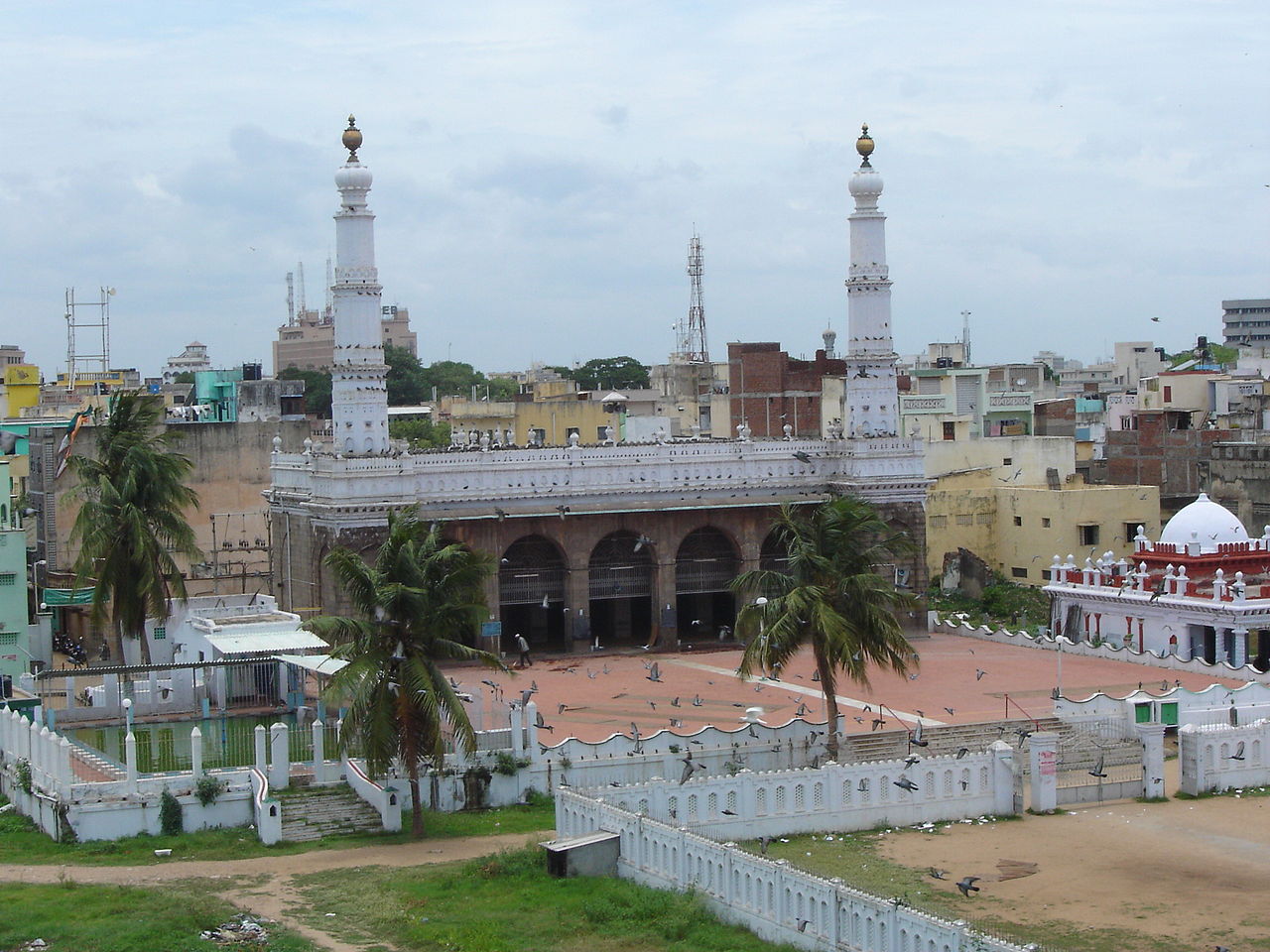
The historic Triplicane Big Wallajah Mosque in Chennai, India, stands as a prominent architectural landmark with its distinctive white minarets and expansive courtyard.
BishkekRocks · cc by-sa 3.0

An intricate historical engraving of the Triplicane Big Wallajah Mosque in Chennai, showcasing its grand arched architecture and twin minarets.
E. Therond · public domain

A wide view of the historic Triplicane Big Wallajah Mosque in Chennai, India, with a large flock of pigeons gathering in the open courtyard.
RAJUKHAN SR RAJESH · cc by-sa 3.0

The historic Triplicane Big Wallajah Mosque in Chennai, India, glows at night during a vibrant outdoor event held in its courtyard.
SINHA · cc by-sa 3.0

A bustling crowd gathers outside the historic Triplicane Big Wallajah Mosque in Chennai, India, showcasing its iconic minarets and traditional architectural design.
SINHA · cc by-sa 3.0

A peaceful view of the historic Triplicane Big Wallajah Mosque in Chennai, India, with its iconic twin minarets overlooking a spacious courtyard.
RAJUKHAN SR RAJESH · cc by-sa 3.0

A vibrant night scene at the Triplicane Big Wallajah Mosque in Chennai, India, where festive lighting illuminates the architecture and a large outdoor gathering.
SINHA · cc by-sa 3.0

The majestic Triplicane Big Wallajah Mosque in Chennai, India, stands as a prominent architectural landmark with its striking twin minarets.
RAJUKHAN SR RAJESH · cc by-sa 3.0

The elegant white minaret of the Triplicane Big Wallajah Mosque rises above lush palm trees in Chennai, India.
Richard Mortel from Riyadh, Saudi Arabia · cc by 2.0

The historic Triplicane Big Wallajah Mosque in Chennai, India, showcases traditional Indo-Saracenic architecture with its iconic twin minarets.
Richard Mortel from Riyadh, Saudi Arabia · cc by 2.0

A view of the striking white minarets and traditional stone masonry of the historic Triplicane Big Wallajah Mosque in Chennai, India.
Richard Mortel from Riyadh, Saudi Arabia · cc by 2.0

A large flock of pigeons takes flight in the courtyard of the historic Triplicane Big Wallajah Mosque in Chennai, India.
RAJUKHAN SR RAJESH · cc by-sa 3.0
At the entrance to the prayer hall, look up for the Persian chronogram carved into the stone — written not by a Muslim scholar, but by Raja Makhhan Lal Bahadur Khirat, the Nawab's Hindu personal secretary. It is easy to walk past without realising its authorship, which makes it one of the most quietly remarkable inscriptions in Chennai.
Visitor Logistics
Getting There
The mosque sits on Triplicane High Road, about 200 meters from Adams Market Bus Stop — MTC routes 22, 27B, 29A, and 45B all stop there. Government Estate Metro Station on the Blue Line is the nearest metro; from there, a quick auto-rickshaw ride covers the remaining distance. Skip driving yourself — the Triplicane bazaar lanes are narrow and parking is essentially nonexistent, so Uber or Ola drop-offs work best.
Opening Hours
As of 2026, the mosque is open daily from 5:00 AM to 12:30 PM and again from 3:30 PM to 9:00 PM. Access for non-worshippers may be restricted during the five daily prayer times, so plan around those windows. During Ramadan the area stays active well into the night, but the mosque itself can be harder to visit casually.
Time Needed
Thirty to forty-five minutes covers the granite courtyard, the minarets, the Persian chronogram above the prayer hall entrance, and the Dargah of Maulana Abdul Ali. If you're combining it with a walk through the Triplicane bazaar and street food stops — and you should — budget closer to two hours for the whole neighborhood.
Accessibility
The courtyard is flat stone paving and manageable for wheelchair users, but the entrance involves small steps with no formal ramp. Interior prayer halls lack elevators or dedicated accessible routes. If mobility is a concern, the exterior architecture and open courtyard still reward a visit.
Cost
Entry is completely free — no tickets, no booking, no audio guides for sale. This is a functioning mosque, not a ticketed monument. Keep some small cash for auto-rickshaws and the street food that will inevitably tempt you on the walk over.
Tips for Visitors
Dress Modestly, Strictly
Shoulders and legs must be covered for both men and women. Women should bring a headscarf — this isn't optional, and you won't get past the entrance without one.
Photography Etiquette
Exterior and courtyard shots are generally fine, but never photograph worshippers without explicit permission. Drones are strictly prohibited, and pointing a camera into the prayer hall during salah will draw sharp disapproval.
Eat on Triplicane High Road
The surrounding bazaar is one of Chennai's best street food corridors. During Ramadan, stalls near the mosque sell extraordinary Haleem and Paya for budget prices. Year-round, Basha Halwawala does traditional sweets worth the detour.
Visit Early Morning
Arrive just after the 5:00 AM opening for the quietest experience and the best light on the grey granite. Friday afternoons draw the largest prayer congregations — avoid that window unless you specifically want the atmosphere of a packed mosque.
Pair With Nearby Heritage
The Parthasarathy Temple is a short walk away, making for a powerful pairing — one Hindu, one Islamic, both ancient anchors of the same neighborhood. The Nawab's descendants still reside at Amir Mahal, about 2 km south, which connects directly to this mosque's story.
Skip Unofficial Guides
Self-appointed "guides" occasionally approach tourists near the entrance offering paid tours. The mosque has no official guide program — politely decline and explore independently or ask the mosque caretakers, who are often happy to share the building's history for free.
Where to Eat
Don't Leave Without Trying
Suttakari
local favoriteOrder: This is where locals go for authentic Triplicane flavors — expect traditional curries and rice dishes that reflect the neighborhood's Mughlai heritage. The biryani and meat curries are consistent crowd-pleasers.
Suttakari sits right in the heart of Zam Bazaar with a perfect 5-star rating and is a genuine local haunt, not a tourist trap. It's the kind of place where you'll see families and regulars, not guidebook crowds.
SRI TIRUMALA FOODS
quick biteOrder: Stop here for fresh South Indian bakery items in the morning — think murukku, chakkuli, and traditional sweets. The early opening hours make it perfect for pre-mosque-visit breakfast or takeaway snacks.
This is a genuine neighborhood bakery that opens early and stays open late, serving the local community with homemade sweets and savory items. It's the real deal — minimal frills, maximum authenticity.
La Lamcy Cafe
cafeOrder: A small, intimate cafe perfect for coffee and light bites. Order a traditional South Indian filter coffee and pair it with a light snack — ideal for a quiet moment away from the Triplicane bustle.
La Lamcy Cafe is a hidden gem in Padupakkam with a perfect rating, offering a calm refuge for visitors who want to escape the energy of the main bazaar area without leaving the neighborhood.
MOON LIGHT CAFE
quick biteOrder: A neighborhood spot for casual refreshments — perfect for lassi, chai, or light snacks. Come here to experience how locals actually unwind in the area.
Moon Light Cafe is a true local favorite on Oil Monger Street, serving the community with no pretense. It's exactly the kind of place you stumble upon when you wander off the main tourist path.
Dining Tips
- check Triplicane is famous for its 'Khau Galli' (food street) atmosphere — expect busy, lively environments, especially during peak hours. Go early or be prepared for crowds.
- check Many local eateries are cash-preferred; while some accept cards, carrying cash is recommended for street food vendors and smaller establishments.
- check Ramadan brings special seasonal dishes like Mutton Haleem to the area around the Big Wallajah Mosque — time your visit accordingly if you want to try these specialties.
- check Street food vendors line Triplicane High Road — vendors like Sri Vinayaka Sandwich Stall and Gharwaala Tiffin offer authentic, affordable options for quick bites.
- check Diamond Bazaar (Jaffersha Street) is known for diverse food options including North Indian and local snacks if you want variety beyond the immediate mosque area.
Restaurant data powered by Google
Historical Context
The Nawab Who Built in Stone and Trust
Muhammad Ali Khan Wallajah was not born to rule unchallenged. He fought his way through the Carnatic Wars, survived the political machinations of both French and British colonial powers, and emerged in 1765 with something rare: recognition from the Mughal Emperor Shah Alam II as the legitimate Nawab of the Carnatic. Three years later, in 1768, he moved his court to the Chepauk-Triplicane area of Madras, planting his flag just a few kilometers from the British garrison at Fort St. George.
The mosque that bears his family's name was completed in 1795, likely finished after his death in 1795. But its design — a massive granite structure built to outlast the corrosive salt air of the Bay of Bengal coast — reflects the Nawab's ambitions exactly. He wasn't building for a season. He was building for permanence, in a city where political power shifted with the monsoon winds.
A Hindu Secretary and a Persian Inscription
Raja Makhhan Lal Bahdur Khirat held one of the most sensitive positions in the Nawab's court: chief personal secretary, or Munshi. He was Hindu. In an era when political legitimacy across South India was often inseparable from religious identity, Khirat's role was a deliberate statement — not just about tolerance, but about where real power lay. The Nawab trusted him with correspondence, finances, and the daily machinery of governance.
When the prayer hall of the Big Wallajah Mosque neared completion, it was Khirat who composed the Persian chronogram inscribed above the entrance. A chronogram is a text where specific letters also encode a date — an act of literary precision that requires deep fluency in Persian poetic convention. That a Hindu scholar authored the founding inscription of one of South India's most prominent mosques was not an accident. It was policy made visible in stone.
The inscription still sits above the prayer hall entrance today. Most visitors walk beneath it without a second glance. But for anyone who pauses to consider what it represents — a Muslim sovereign entrusting the sacred text of his mosque to a Hindu intellectual — it remains the most quietly powerful object in the building.
From Warlord to Sovereign
Muhammad Ali Khan Wallajah spent the first decades of his career in near-constant conflict. The Carnatic Wars — a series of proxy battles between French and British interests, fought largely with Indian armies — left the region's political map redrawn multiple times between the 1740s and 1760s. Wallajah allied with the British East India Company, a pragmatic choice that gave him military backing but also tethered his sovereignty to a foreign power. His official recognition by the Mughal Emperor on 26 August 1765 was the culmination of years of diplomatic maneuvering. By the time he relocated to Chepauk in 1768, he was determined to build a court that projected stability — mosques, palaces, and gardens that said: this dynasty is here to stay.
Legacy in Granite and Gold
The Nawab's line continued after his death, though with diminishing political power as the British tightened control over the Carnatic. His descendant Azam Jah later renovated the mosque, modifying the twin minarets and adding the golden finials that now catch the light above Triplicane. The Wallajah name persists across Chennai — in Wallajah Road, Wallajah Gate, and in the family's continued residence at Amir Mahal. The mosque itself endures as one of the few buildings in the city constructed entirely without iron or wood, a material choice that has proven remarkably prescient: while colonial-era structures nearby have rusted and rotted, the granite of the Big Wallajah Mosque looks much as it did in 1795.
Listen to the full story in the app
Your Personal Curator, in Your Pocket.
Audio guides for 1,100+ cities across 96 countries. History, stories, and local insight — offline ready.
Audiala App
Available on iOS & Android
Join 50k+ Curators
Frequently Asked
Is Triplicane Big Wallajah Mosque worth visiting? add
Yes, especially if you care about architecture or Chennai's layered history. The entire structure is built from grey granite without a single piece of wood or iron — an 18th-century engineering decision designed to outlast the city's salt-heavy coastal air. It sits in one of Chennai's oldest neighborhoods, steps from the ancient Parthasarathy Temple, making the area itself a lesson in how Hindu and Islamic cultures shaped the same streets for centuries.
Can you visit Triplicane Big Mosque for free? add
Entry is completely free. There are no tickets, no booking systems, and no fees. It's a functioning mosque, so visit outside of prayer times and dress modestly — shoulders and knees covered, and women should bring a headscarf.
How long do you need at Triplicane Big Wallajah Mosque? add
Thirty minutes to an hour is enough to appreciate the courtyard, the granite masonry, and the mausoleum complex. If you combine it with street food in the Triplicane bazaar and a walk to the nearby Parthasarathy Temple, budget a full morning.
What is the best time to visit Triplicane Big Mosque? add
Early morning, just after the 5 AM opening, when the granite floors are cool and the courtyard is quiet. Avoid Friday afternoons, when the mosque fills for congregational prayers. During Ramadan, the surrounding streets transform into an Iftar food market at dusk — a completely different experience, worth seeing if you don't mind serious crowds.
How do I get to Triplicane Big Mosque from Chennai? add
The mosque sits on Triplicane High Road, about 200 meters from Adams Market Bus Stop, served by MTC routes 22, 27B, 29A, and 45B. The nearest metro station is Government Estate on the Blue Line, from which an auto-rickshaw ride takes roughly ten minutes. On-street parking is nearly impossible in the dense bazaar area, so skip driving and take an Uber, Ola, or auto.
What should I not miss at Triplicane Big Wallajah Mosque? add
Look for the Persian chronogram inscribed at the prayer hall entrance — it was written by a Hindu secretary named Raja Makhhan Lal Bahdur Khirat, a detail that says more about the Nawab's pluralistic court than any plaque could. The white building in the courtyard is easy to walk past, but it once served as the Ottoman Empire's consulate in 19th-century Madras. And run your hand along the granite pillars: the joints are so tight they feel monolithic, because gravity and precision cutting do all the structural work.
Who built Triplicane Big Mosque in Chennai? add
The mosque was completed in 1795 by the family of Nawab Muhammad Ali Khan Wallajah, the Nawab of Arcot, who moved his court to the Chepauk area in 1768. The Nawab was formally recognized as sovereign by Mughal Emperor Shah Alam II on 26 August 1765. His family's connection to Chennai is also visible at Amir Mahal, the ancestral palace of the Nawab's descendants.
Is photography allowed at Triplicane Big Wallajah Mosque? add
Photographing the exterior and courtyard is generally fine. Inside the prayer hall and around the Dargah, ask before shooting — it's a place of active worship, not a monument. Never photograph worshippers without their permission, and drones are strictly prohibited.
Sources
-
verified
Wikipedia: Triplicane Big Mosque
Core historical facts including 1795 completion date, Nawab Muhammad Ali Khan Wallajah, architectural details, and renovation history under Azam Jah.
-
verified
Usthadian: Wallajah Big Mosque Restoration and Historical Significance
Confirmation of granite-only construction, the 26 August 1765 recognition date, and details about the Nawab's Hindu secretary Raja Makhhan Lal.
-
verified
Times of India: Triplicane Big Mosque — Prayer Calls to the Past
Historical narrative about the mosque's role in Triplicane and confirmation of no-wood, no-iron construction.
-
verified
Trawell.in: Wallajah Mosque
Visitor information including free entry, visit duration, and general access details.
-
verified
Tamil Nadu Tourism: Wallajah Mosque
Official tourism source for opening hours and dress code requirements.
-
verified
The Hindu: Links with a Royal Past
Coverage of the heritage roofing controversy and conservation debates surrounding the mosque's open courtyard.
-
verified
Local Guides Connect: Wallajah Big Mosque
Details about the Dargah of Maulana Abdul Ali Baharul Uloom and its significance for pilgrims.
-
verified
Facebook: StoryTrails — Wallajah
Historical context about the Wallajah name and its presence across Chennai's geography.
-
verified
Facebook: Madras Trends
Local cultural perspective on Triplicane's syncretic identity and the mosque's role in the neighborhood.
-
verified
Hexahome: Triplicane Chennai Overview
Neighborhood context, nearby amenities, and public transport options.
-
verified
Airial Travel: Wallajah Big Mosque
Accessibility information and photography guidelines for visitors.
-
verified
Indian Columbus: Wallajah Mosque
Architectural details including the Ottoman consulate building and spatial layout of the complex.
-
verified
S. Muthiah (2008) — Madras Rediscovered
Published historical account confirming renovation details under Azam Jah and golden finial additions.
Last reviewed: