An introduction.
Researched by the Audiala editorial team from historical records, architectural archives, and local expertise.
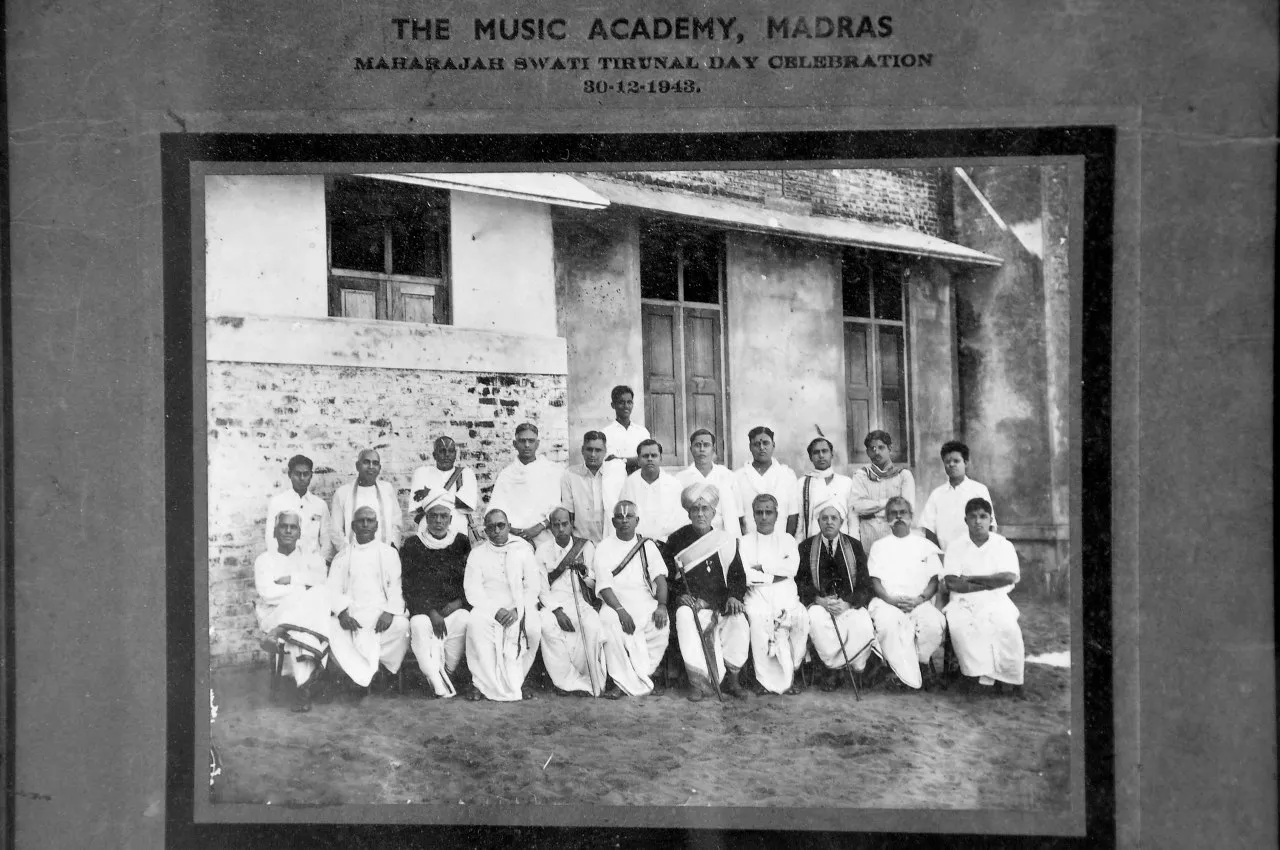
AA Brahmin lawyer once put on a sari and danced before a scandalized audience — and that single act of defiance helped rescue one of India's oldest art forms from extinction. The Madras Music Academy on T.T.K. Road in Chennai, India, is the institution that act built. Every December, during the Margazhi music season, this unassuming building becomes the gravitational center of Carnatic music, drawing performers and connoisseurs from across the world to a festival roughly as old as the Academy itself.
The Academy was formally inaugurated on August 18, 1928, making it younger than many of the musical traditions it preserves — some stretching back over a thousand years. But what it lacks in age it compensates for in influence. The Sangita Kalanidhi award, bestowed here annually, is the closest thing Carnatic music has to a Nobel Prize.
What makes the Academy worth visiting isn't the building — a functional mid-century hall that won't win architecture prizes. It's the fact that you're standing where a handful of people decided, against fierce opposition, that classical Indian dance and music belonged to everyone. That decision reshaped Indian culture in ways that are still unfolding.
During the December-January Margazhi season, the Academy hosts hundreds of concerts across five weeks. The rest of the year, it's quieter but still active — a working institution rather than a museum, which is precisely what makes it interesting.
01 What to see.
The Main Auditorium
A Brahmin lawyer danced on this stage in 1931 — and it changed Indian art forever. E. Krishna Iyer, the Academy's founding Secretary, presented devadasi dancers here when polite society considered their art obscene. The uproar was enormous. He won. A year later, in this same hall, he proposed renaming "sadir" as "Bharatanatyam," severing a classical dance form from centuries of stigma in a single vote.
The auditorium seats roughly 1,200 people, and during the December Margazhi season every one of those seats fills by 5 AM for morning concerts. The acoustics favor the unamplified human voice — a deliberate choice that forces audiences into a quality of silence you rarely encounter anymore. Ceiling fans turn slowly overhead while vocalists work through ragas that can stretch past ninety minutes. No intermission. The audience knows when to breathe.
The Sangita Kalanidhi Legacy
Since 1934, the Academy has awarded the Sangita Kalanidhi — the closest thing Carnatic music has to a lifetime Nobel. Recipients don't apply. A panel of past laureates selects them, and the announcement each October sends ripples through the classical music world from Chennai to California's Bay Area diaspora. The award carries no cash prize worth mentioning. It carries something musicians value more: the right to inaugurate the December conference.
Photographs and memorabilia from nearly a century of laureates line the Academy's interior spaces. M.S. Subbulakshmi received it in 1968 — the same voice that became the first Indian musician to perform at the United Nations. The collection functions less as a museum and more as a family album for an entire art form, each face connected to the next by the chain of guru-shishya tradition that predates the Academy by centuries.
The Margazhi Season Walk
Every December and January, T.T.K. Road transforms into something between a pilgrimage route and an open-air conservatory. The Academy's annual conference — running since 1929 — anchors a season where over a thousand concerts happen across Chennai in roughly six weeks. Performers spill out of halls into temple courtyards and community spaces within walking distance of the Academy.
Start at the Academy's morning session around 8 AM, where young musicians audition in the smaller halls while established artists perform in the main auditorium. Step outside by midmorning and the pavement becomes an informal marketplace: instrument sellers, music book vendors, and food stalls serving filter coffee strong enough to keep you alert through an afternoon raga. Walk south along T.T.K. Road toward the Theosophical Society Adyar campus — the contrast between the dense musical energy of the Academy quarter and the Society's sprawling silence under banyan trees is Chennai distilled into a single afternoon.
02 In pictures.

Plan and listen to Madras Music Academy with Audiala.
Audio guide in your pocket, itinerary in your browser. Built for the way you actually visit.
03 Visitor logistics.
The practical scaffolding for a good visit — kept short.
Getting There
The Academy sits on T.T.K. Road in the heart of Chennai's cultural district. The nearest MRTS station is Kasturba Nagar, about a 10-minute walk south along the road. By auto-rickshaw from Chennai Central, expect 30–40 minutes and roughly ₹150–200; from Chennai Airport, a taxi takes about 45 minutes via the Inner Ring Road.
Opening Hours
As of 2026, the Academy office is open Monday through Saturday, 9:00 AM to 5:30 PM. During the annual December Music Season (mid-December through mid-January), concerts run from early morning until past 9 PM daily, including Sundays. Outside the season, check musicacademymadras.in for the current month's event schedule — performances happen year-round but on irregular dates.
Time Needed
For a single concert during the Margazhi season, plan for 2–3 hours including intermission. If you want to browse the mini auditorium recitals and the main hall performance in one evening, set aside 4–5 hours. Outside the December season, a visit to the building and a scheduled lecture-demonstration takes about 1–1.5 hours.
Tickets & Costs
Many concerts during the December season are free or require nominal tickets (₹20–₹100) available at the Academy box office. Premium seats for headline Sangita Kalanidhi concerts cost ₹300–₹500. Season passes covering the full month of performances offer the best value — check the Academy website by early November, as they sell out fast.
04 Tips for visitors.
Small things that change the day.
Dress Conservatively
This is a traditional Carnatic music institution, and audiences tend toward formal South Indian attire — sarees, dhotis, or smart casuals. Shorts, sleeveless tops, and beachwear will earn you sideways glances from regulars who've been attending since before you were born.
Silence During Ragas
Phones off, not silent — off. Carnatic music builds through micro-tonal improvisation where a single misplaced ringtone can shatter 20 minutes of atmospheric tension. Applause follows specific conventions too: clap after a piece concludes, not during the alapana.
Come for Margazhi Season
The December–January Margazhi season is when Chennai becomes the world capital of classical music, with over 1,500 concerts across the city. The Academy is the gravitational center. Arrive by 7 AM for the morning slots — the queue outside the main hall on T.T.K. Road stretches longer than a cricket pitch by 8 AM.
Eat Nearby
Saravana Bhavan on Cathedral Road, a 5-minute walk north, serves reliable South Indian thalis for ₹150–250. For filter coffee between concerts, the Academy's own canteen sells strong, frothy cups for ₹20 — the unofficial fuel of the Margazhi season. Splurge option: Amethyst on Whites Road, a 10-minute rickshaw ride, does modern Indian plates in a restored colonial warehouse.
Combine with Nearby Sites
The Theosophical Society Adyar is a 15-minute drive south — its 450-year-old banyan tree and quiet gardens make a good counterpoint to the concert hall intensity. The Kapaleeshwarar Temple in Mylapore, a 10-minute auto ride, pairs well for an afternoon of temple architecture before an evening raga.
Book Early in November
If visiting during December season, book accommodation by early November at the latest. Hotels within walking distance of T.T.K. Road double their rates, and guesthouses in Mylapore and Alwarpet fill weeks ahead. The Academy publishes its full concert schedule by late November — plan your evenings around the Sangita Kalanidhi award concert, the season's marquee event.
05 The Lawyer Who Danced
E. Krishna Iyer was born on August 9, 1897, in Kallidaikurichi, a small town in the Madras Presidency. He trained as a lawyer and joined the independence movement — conventional enough for an ambitious young Brahmin man. What was not conventional: he studied and performed sadir, the classical dance practiced almost exclusively by devadasis, women dedicated to temple service.
For a male Brahmin lawyer to perform this dance publicly cut across every line of caste, gender, and respectability. His twin commitments — to Indian self-governance and to Indian performing arts — converged in December 1927, when the Indian National Congress held its All India Session in Madras. Eight months later, on August 18, 1928, the Music Academy opened its doors with Krishna Iyer as its founding Secretary.
The Night Sadir Became Bharatanatyam
In 1931, Krishna Iyer did something that could have destroyed the Academy before it turned four. He invited two celebrated devadasi dancers, Jeevaratnam and Rajalakshmi, to perform sadir on the Academy's stage. The backlash was immediate — reformers saw it as glorifying exploitation, orthodox Brahmins were outraged that temple dancers had been given a prestigious platform.
Krishna Iyer and his supporters held their ground. The confrontation forced a question that had simmered for years: could the art be separated from the social system that produced it? At a Music Academy meeting in 1932, he proposed a resolution that would change Indian cultural history — the dance would be renamed from sadir to Bharatanatyam, literally "Indian dance," stripping away its devadasi associations and reclaiming it as a national art form.
The resolution passed. Bharatanatyam went on to become India's most widely practiced classical dance, taught in schools and performed on global stages. But the devadasi women whose families had preserved the tradition for centuries found themselves written out of the story they had authored.
Krishna Iyer served as the Academy's Secretary for roughly a decade, shaping its mission until his death in January 1968. The institution he built remains the single most important venue for Carnatic music in the world.
A Freedom Fighter's Other War
Legacy and the Margazhi Season
Listen to the full story in the app
The whole Madras Music Academy,
told well.
Listen to sourced travel stories with local history and practical context — ready offline.
06 Frequently asked.
The questions travellers send us most about Madras Music Academy.
Is the Madras Music Academy worth visiting?
Yes — if you have any interest in Indian classical music or dance, this is where both were preserved and redefined. The Academy is where Bharatanatyam was formally renamed and rescued from extinction in 1932, and where the annual Margazhi music season draws performers and audiences from across the world every December. Even outside festival season, the building and its small museum offer a window into nearly a century of Carnatic music history.
What is the best time to visit the Madras Music Academy?
The Margazhi season, running mid-December through mid-January, is when the Academy comes alive with hundreds of concerts and dance recitals — some free, some ticketed. If you want to experience the full intensity of Chennai's classical arts scene, this six-week window is unmatched. Outside this period the Academy hosts occasional concerts and events, but the atmosphere is far quieter.
Can you visit the Madras Music Academy for free?
The building itself can be visited during open hours at no charge, and some Margazhi season concerts are free to attend. However, premium performances — particularly the prestigious Sangita Kalanidhi concerts — require tickets that sell out quickly. Check the Academy's website (musicacademymadras.in) for the current season's schedule and pricing.
How do I get to the Madras Music Academy from Chennai city centre?
The Academy sits on T.T.K. Road in the Royapettah area, roughly 3 km south of Chennai Central station. An auto-rickshaw or taxi from the central business district takes about 15–20 minutes depending on traffic. The nearest bus stop is well-served by MTC buses, and ride-hailing apps like Ola and Uber work reliably in this part of the city.
What is the Margazhi music season in Chennai?
Margazhi is the Tamil month (mid-December to mid-January) when Chennai transforms into the world's largest classical music festival. The Madras Music Academy is the epicentre — it hosts over 300 concerts and dance performances across six weeks. The tradition dates to 1927, when the All India Music Conference ran alongside the Indian National Congress session, and the season has grown every decade since.
What should I not miss at the Madras Music Academy?
The Sangita Kalanidhi award ceremony, held during the Margazhi season, is the single most prestigious moment in Carnatic music — equivalent to a lifetime achievement honour. If you visit during the season, catch an evening concert in the main hall, where the acoustics and the audience's rapt silence create something electric. Outside the season, the Academy's archives and photographs documenting its founding in 1928 are worth a look.
What is the history of the Madras Music Academy?
The Academy was born from the 1927 All India Music Conference held alongside the Indian National Congress session in Madras, and formally inaugurated on August 18, 1928 by Sir C.P. Ramaswami Iyer. Its founding secretary, E. Krishna Iyer — a Brahmin lawyer who had scandalously studied and performed the devadasi dance form sadir — championed the renaming of that art as 'Bharatanatyam' at an Academy meeting in 1932, rescuing it from social stigma. The Academy wandered without a permanent home until 1954, but grew into India's foremost institution for Carnatic music and South Indian performing arts.
How long do you need at the Madras Music Academy?
Outside of concert season, 30–45 minutes is enough to see the building and its small exhibition space. During the Margazhi season, you could spend an entire evening — concerts typically run two to three hours, and the atmosphere in the surrounding streets, with food stalls and impromptu gatherings of musicians, extends the experience well beyond the auditorium walls.
Verified, and shown.
Researched and written by the Audiala editorial team from historical records, architectural archives, and local expertise.
Official history page confirming founding date (August 18, 1928), founding members, and the 1927 All India Music Conference origins
General history, founding details, address, Sangita Kalanidhi award information, and institutional milestones
Biography of founding secretary, his role in the Bharatanatyam renaming, and his advocacy for devadasi dancers at the Academy
Multiple articles covering the 1931 devadasi performance controversy, E. Krishna Iyer's legacy (August 9, 2018 feature), and Margazhi season coverage
Background on the 1927 Indian National Congress session in Madras and its connection to the founding of the Music Academy
Academic source confirming the 1932 renaming of sadir to Bharatanatyam and the Music Academy's role in the classical arts revival
Historical accounts of the 1931 controversy when devadasi dancers performed at the Music Academy
Built from cited sources · see the method · How we make our guides →