Destinations Bhart बीकानेर

बीकाने.

28° N · 73° E Bhart

The desert air in बीकानेर smells first of camel saddles, then of hot gram flour and red-chili smoke curling from a kadai at 6 a.m. This is Bhart’s snack capital, a city that built a reputation on fried noodles of bhujia and a fort no one ever managed to storm. Jaipur has the pink walls; Bikaner has the flavor you can’t wash off your fingers.

Listen to audio guide — 47 min Open the map
बीकानेर, Bhart
बीकानेर · Bhart
15
attractions
2–3 days
days suggested
November–February
best season
EN · EN
narration

03 Top tickets in बीकानेर.

Book ahead

Curated from places in this city. Same price as official sites.

Full-Day Private Bikaner Sightseeing with English speaking Guide
Junagarh Fort
Full-Day Private Bikaner Sightseeing with English speaking Guide
5.0 from €41.49
Visit Junagarh Fort and Karni Mata Temple with Jodhpur Drop from Bikaner
Junagarh Fort
Visit Junagarh Fort and Karni Mata Temple with Jodhpur Drop from Bikaner
4.0 from €50.71
Jaisalmer Drop with Visit Junagarh Fort and Rat Temple from Bikaner
Junagarh Fort
Jaisalmer Drop with Visit Junagarh Fort and Rat Temple from Bikaner
from €50.71
Visit Bikaner in Private Car with Guide Service
Junagarh Fort
Visit Bikaner in Private Car with Guide Service
from €50.71
Private Transfer From Bikaner To Jaisalmer
Junagarh Fort
Private Transfer From Bikaner To Jaisalmer
from €52.49
Guided Bikaner City Tour With Drop Off at Jodhpur
Junagarh Fort
Guided Bikaner City Tour With Drop Off at Jodhpur
from €62.98

Prices shown are indicative — final pricing and availability are confirmed at checkout. Audiala may receive a commission from bookings made via these links.

01 An introduction

synthesized from 240+ sources ·

The desert air in बीकानेर smells first of camel saddles, then of hot gram flour and red-chili smoke curling from a kadai at 6 a.m. This is Bhart’s snack capital, a city that built a reputation on fried noodles of bhujia and a fort no one ever managed to storm. Jaipur has the pink walls; Bikaner has the flavor you can’t wash off your fingers.

Junagarh Fort squats at street level, no hill to help it, 986 m of sandstone and marble that simply refused to surrender. Inside, Rai Singh’s 1591 Karan Mahal ceiling is a midnight-blue atlas of gilt constellations—an astronomer-king’s riposte to the desert sky. Walk fifteen minutes north and the merchant quarter begins: Rampuria havelis carved from dulmera stone the color of dried blood, their balconies Victorian, their brackets pure Rajput, their basements cool enough to store ghee in July.

Food here is geography. Lack of fresh vegetables bred a cuisine of pulses, papad, mango powder, and 14-day pickles; scarcity of water produced khakhra and bhujia that last a camel march. At Chhotu Motu Joshi, Station Road, pooris puff in mustard oil while a neon sign from 1953 hums overhead—order the dana-methi sabzi, sweetened with jaggery to cut the desert chill. Evening brings the clap of brass plates as Jasnathji fire dancers spin in nearby Katariasar village; sparks land on drums skinned with goat hide smoked until it sounds like thunder.

Budget Friendly Photography Hotspot Family Friendly

02 Why बीकानेर.

What makes this place worth slowing down for.

A Fort That Never Fell

Junagarh Fort sits on flat desert ground, yet no army ever breached its 12-meter-thick walls in 500 years. Inside, 37 palaces layer Rajput balconies, Mughal marble, and Victorian stained glass into one continuous red-sandstone maze.

Snack Capital of Rajasthan

Bikaneri bhujia was born in 1877 when a halwai fried moth-dal dough through a pepper sieve. The smoky, peppery strands still leave the city by the tonne—follow your nose to Station Road at 6 a.m. for the warmest batch.

Jain Mirror Maze

Bhandasar Temple’s 15th-century ceiling is a kaleidoscope of gold leaf and lapis mirrors; step inside and candlelight multiplies into infinity. The architects mixed jaggery and lentils into the mortar—locals swear you can still smell caramel on hot afternoons.

The Rat Palace

Karni Mata Temple at Deshnok houses 20,000 revered rats that scurry over silver doors and marble dados; spotting a white one is considered jackpot-luck. The 16th-century shrine is 30 km south—arrive before dawn to watch priests sweep the courtyard while rodents dart between your ankles.


03 Places to Visit.

Not every monument, just the ones we'd walk you past ourselves.

Junagarh Fort
Editor's pick
01 · Place

Junagarh Fort

Built on flat desert ground when most Rajput forts climbed hills, Junagarh hides lacquered rooms, temple rituals, and Bikaner's royal memory behind walls.

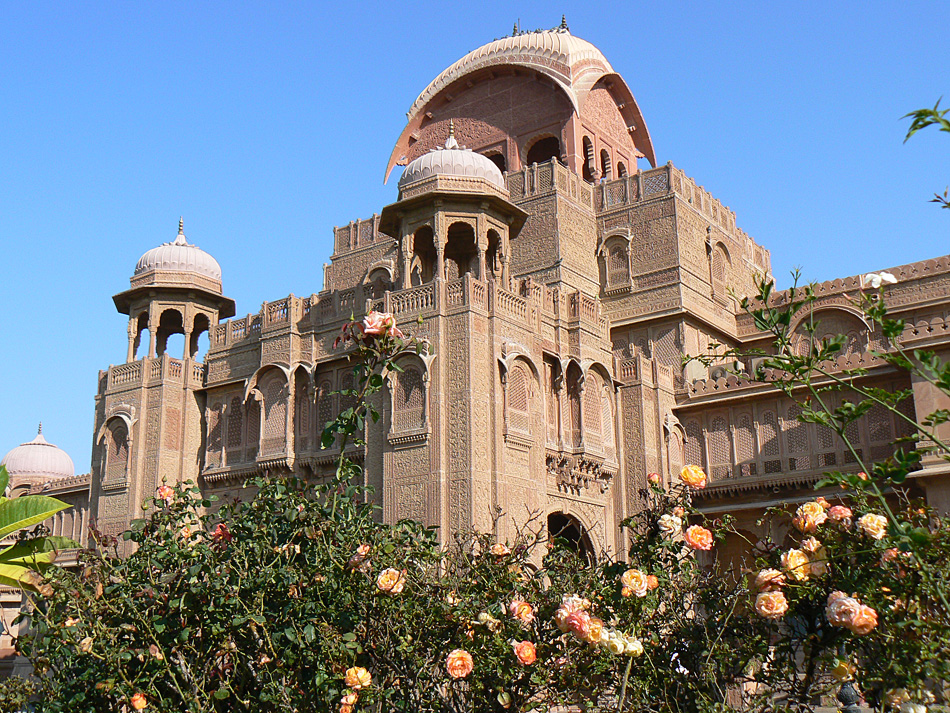
Lalgarh Palace
02 Place

Lalgarh Palace

The Shree Sadul Museum, nestled within the magnificent Lalgarh Palace in Bikaner, Rajasthan, is a testament to the rich cultural and historical legacy of the…

All 2 places in बीकानेर

04 Neighborhoods.

Where to wander, by quarter — each with its own rhythm.

01

Kote Gate / Station Road

The city’s breakfast artery. Sweet-shop neon competes with spice-grinder exhaust; by 7 a.m. the air is half ghee, half diesel. Stock up on warm rasgullas at Chhotu Motu Joshi, then duck into the cloth bazaars where tailors stitch camel-wool shawls on foot-powered Singers.

02

Rampuria Haveli Quarter

A lattice of lanes walled in 19th-century merchant pride. Carved jharokhas overhang streets barely two meters wide; knock on any oak door and a caretaker will show you courtyards paved with Belgian tile shipped through Bombay in 1898. Light changes hourly—ochre at dawn, blood-orange at dusk.

03

Junagarh Fort Enclave

Palace turned museum complex. Audio-guide voices echo off 1.2 m thick stone; peacocks walk the moat now dry. Outside the gate, Gallops restaurant serves lal maas under a 1930s ceiling fan whose blades still say ‘Made in Birmingham’.

04

Sadul Ganj / Cantonment

Where Bikaner’s twenty-somethings escape the old city. Brewberrys pours single-origin Karnataka filter, and rooftop cafés project Premier League matches onto whitewashed walls. Expect hoodies, Royal Enfields, and thali-priced lattes.

05

Rani Bazaar

A working market, not a curated one. Pyramids of Bikaneri papad sit beside mobile-phone covers; jewellers weigh silver on balances older than independence. After 8 p.m. the lane behind Chhappan Bhog turns into an impromptu street-food court—kachori, mirchi vada, foam plates that biodegrade before you finish eating.

06

Lalgarh Palace Precinct

Sandstone Indo-Saracenic spread set in 24 hectares of peacock lawns. Part hotel, part private royal residence; guests sip gin in the Trophy Bar beneath stag heads shot by Maharaja Ganga Singh in 1905. Camel-cart polo is still played on the back field every January.

Historical Timeline

Where Desert Wind Met Mughal Gold

From Rao Bika’s tent to camel-corps glory—five centuries of sandstone, spice, and survival

Pre-urban Thar
c. 4000 BCE

First hearths in Jangladesh

Pottery shards and ash layers found north-east of today’s city show herders camping by seasonal salt lakes. The dunes looked much the same then—only the camels were wild. These scattered camps are the earliest trace of people who would later call the place Bikaner.

Rathore Founding
1488

Rao Bika plants the flag

The Rathore prince dismounted at a dried-up lakebed, drove his lance into the crust, and declared, ‘Here we stay.’ Within weeks a mud-brick fort rose; within months caravans paid tolls. The settlement was named, simply, Bika-ner—Bika’s place.

1534

Mughal prince stays one day

Kamran Mirza, Babur’s rebellious son, stormed the mud fort, accepted gifts, and rode on. Local bards still time their songs to that single sunset—long enough to brag, too short to rule. The raid convinced Bika’s heirs they needed stronger walls.

Mughal Alliance
1589

Junagarh Fort rises from plain

Raja Rai Singh broke with Rajput tradition: no hill, just flat desert. Red sandstone arrived on camel-back; artisans carved marble balconies that never saw rain. Finished in 1594, the fort’s 37 bastions still bear the polish of Mughal gold he brought back from Akbar’s campaigns.

1612

Rai Singh dies, empire mourns

The general who could sweet-talk Akbar and outride the Deccan died at 71. Court painters froze his funeral procession on paper—elephants, Qur’an bearers, Rajput swords crossed in salute. Bikaner lost the man who turned sand into salary.

1669

Anup Singh opens the library

He returned from Aurangzeb’s southern wars with camel-loads of Sanskrit manuscripts. Inside Karan Mahal he shelved 1,400 palm-leaf texts—astronomy, erotics, veterinary science. Scholars still quote the colophon: ‘Knowledge, like water, must travel.’

British Paramountcy
1818

Treaty signed, Union Jack flutters

Maharaja Surat Singh pressed his seal into warm wax, handing foreign policy to the East India Company. In exchange he kept his guns and his throne. The camel caravans now carried British passes; the desert stopped at the border British cartographers drew.

1888

Ganga Singh ascends at thirteen

A telegram reached the teenage prince while he was learning fractions in Ajmer. Within a decade he would wire his city for electricity, drill a canal through blistering stone, and send camels to China. Bikaner’s modern age began with a boy who barely needed to shave.

1900

Famine carves population by a third

No rain for four years. The 1899 harvest weighed less than the seed sown. People sold their bronze pots for a handful of millet; vultures grew too fat to fly. Census takers in 1901 counted 250,000 fewer souls than a decade before.

1902

Lalgarh Palace bricks cool in desert night

Red sandstone from the same quarries as Junagarh met European pressed brick. Swinton Jacob’s drawings arrived by train; local masons added latticed jharokhas wide enough for a Rajputana breeze. Electric bulbs glimmered where oil lamps once feared the wind.

1918

Influenza kills one in ten

The Spanish flu rode the troop trains home from Europe. In Bikaner state 61,000 died—more than the camel corps had seen on French battlefields. Grave-diggers worked under kerosene lamps; the desert, used to drought, learned the smell of quicklime.

1927

Gang Canal water kisses the desert

Maharaja Ganga Singh turned the valve; Sutlej water foamed 93 km through new-cut sandstone. Farmers who had never seen a river tasted silt on their tongues. Within five years wheat replaced millet, and Bikaner stopped importing grain for the first time in memory.

1937

Ganga Bhishen fries first bhujia batch

In a tiny shop near Kote Gate he strained moth-dal through a cloth, twisted it into hot ghee, sprinkled desert salt. The crisp strands—named Bikaneri to distinguish them from lesser imitations—would travel farther than any Rathore sword. A snack became identity.

End of Princely Rule
7 Aug 1947

Last Maharaja lowers the Union Jack

Sadul Singh stood on the palace balcony as the flag came down and the tricolor climbed. In the courtyard below, camel regiments saluted both standards within the same minute. Bikaner’s 459-year sovereignty ended with a handshake and a telegram to Delhi.

30 Jun 1946

Police bullet finds Birbal Singh

The Praja Parishad rally at Raisinghnagar demanded responsible government. One shot echoed; a 24-year-old teacher fell. His funeral procession back in Bikaner turned into the city’s first open protest against royal rule—proof that even desert stone can spark.

Modern Rajasthan
1984

National Camel Research Centre opens

Scientists moved into barracks once meant for cavalry. They measured milk yield, sequenced desert bloodlines, built air-conditioned stalls for the ships of the sand. Tourists now watch calves race while researchers figure how to keep the Thar’s proudest export alive.

1995

University renamed for Ganga Singh

The old Bikaner University took the name of the ruler who once imported professors by train. Under the sandstone arch students now swipe ID cards instead of doffing turbans. The camel corps is gone; the campus hosts startup weekends instead.

2023

Usta art earns GI tag

After 400 years of painting camel-hide book covers and gold-leaf ceilings, the craft finally gets legal armour. Artisans posted smartphone videos of embossed flowers catching desert light. The same motifs that once dazzled Mughal emperors now ship worldwide—packed between layers of Bikaneri bhujia.
Present Day

06 Who lived here.

The people who shaped the city — and were shaped by it.

Founder of Bikaner 1438–1504

Rao Bika

Founded the city in 1488

He rode north from Jodhpur with 300 horsemen, dug a well here, and told his men the sand would feed them. Today his name marks every city signboard; he’d smirk at the traffic but recognise the same desert wind.

Modernising ruler 1880–1943

Maharaja Ganga Singh

Reigned 1887–1943, built Lalgarh Palace

He took Bikaner to the Versailles table, piped canal water into the old city, and still found time to taste-test every batch of camel-milk sweets. Walk the marble corridors he commissioned; portraits show him holding a tennis racket like a sword.

Rajasthani folk singer 1902–1992

Allah Jilai Bai

Court singer to Ganga Singh

Her voice carried ‘Kesaria Balam’ across sand dunes long before Spotify. She sang for maharajas at Laxmi Niwas Palace; today the same courtyard hosts heritage dinners—background music lifted straight from her 1935 78-rpm discs.

Snack industrialist 1908–1985

Ganga Bhishen Agarwal ‘Haldiram Ji’

Born here, started Haldiram’s in 1937

He turned his grandmother’s gram-flour recipe into a ₹40-billion empire from a tiny shop near Station Road. Drop by the original storefront; the current owners still weigh bhujia on brass scales he imported from Lahore.

08 Where to Eat.

Where locals actually book dinner — not the tourist menus.

Oh Shakes® Oh Shakes®
Quick bite €€

Oh Shakes®

4.9 View
Magic Baker Magic Baker
Quick bite €€

Magic Baker

5 View
Ashok Bakers Ashok Bakers
Quick bite €€

Ashok Bakers

4.9 View
Gaytri Bakery Gaytri Bakery
Quick bite €€

Gaytri Bakery

5 View
Guru dev Tea and cold drinks Guru dev Tea and cold drinks
Quick bite €€

Guru dev Tea and cold drinks

5 View
Friends Cafe Friends Cafe
Cafe €€

Friends Cafe

5 View

09 Insider tips.

Small things that change how the city treats you.

Breakfast like locals

Skip the hotel buffet. Walk to Chhotu Motu Joshi on Station Road before 9 a.m. for hot poori-sabzi and a rasgulla still warm from the syrup.

Buy bhujia at source

Get Bikaneri bhujia from Bhikharam Chandmal’s original shop behind Kote Gate; it’s cheaper, fresher, and they’ll vacuum-seal it for your flight.

Carry desert cash

ATMs vanish outside the city. Withdraw rupees before heading to Kolayat, Deshnok or Gajner—no one accepts cards in the dunes.

Fort light hack

Junagarh’s red sandstone glows amber for twenty minutes after sunrise. Guards open the gates at 10 a.m.—arrive early, shoot from the courtyard before crowds enter.

Temple silence rule

At Karni Mata, devotees hiss instead of clapping. Copy them; loud noises startle the 20,000 sacred rats and you’ll get glares.

10 Watch.

A few films to set the scene before you go.

Bikaner Food Ep 1 | Winter Spcl Ghewar, Kanji Vada, Rabri & More | Veggie Paaji
Veggie Paaji

Bikaner Food Ep 1 | Winter Spcl Ghewar, Kanji Vada, Rabri & More | Veggie Paaji

BIKANER CITY बीकानेर शहर Bikaner Rajasthan Bikaner Jila Bikaner
Dhroov empire

BIKANER CITY बीकानेर शहर Bikaner Rajasthan Bikaner Jila Bikaner

Bikaner Travel Guide 2026 | Itinerary Budget & Tourist Places in Bikaner Junagarh Fort to Karni Mata
Distance between

Bikaner Travel Guide 2026 | Itinerary Budget & Tourist Places in Bikaner Junagarh Fort to Karni Mata

INSANE Street Food of Bikaner | World Famous Dal Kachori, Ghevar, Rabdi | Indian Food
Food Pandits

INSANE Street Food of Bikaner | World Famous Dal Kachori, Ghevar, Rabdi | Indian Food

12 Frequently Asked

Is बीकानेर worth visiting compared to Jaipur or Jodhpur?

Yes—if you want Rajasthan without the tour-bus traffic. Bikaner keeps its lanes chaotic, its palaces uncrowded, and its snack shops family-run since 1937. You’ll trade postcard perfection for living desert culture.

How many days do I need in बीकानेर?

Two full days covers Junagarh, haveli walks, camel farm and a rat-temple half-day. Add a third if you want to bird Jorbeed at dawn or camp on Raisar dunes.

Can I reach बीकानेर by overnight train from Delhi?

Absolutely. The 12457 Bikaner Express leaves Old Delhi at 11:35 p.m. and rolls into Bikaner Junction 7:20 a.m.—perfect for a sunrise rasgulla.

Is बीकानेर safe for solo female travellers?

Yes, but dress code matters. Long sleeves and a scarf silence most stares; after 9 p.m. stick to hotel bars like Trophy Bar—city streets empty fast.

What does a heritage walk cost?

Malang Folk Foundation runs pay-what-you-wish walks starting at Kote Gate—₹300 is polite. Private guides quote ₹1,200; bargain hard.

Ready to book?

03 Top tickets in बीकानेर.

Book ahead

Curated from places in this city. Same price as official sites.

Full-Day Private Bikaner Sightseeing with English speaking Guide
Junagarh Fort
Full-Day Private Bikaner Sightseeing with English speaking Guide
5.0 from €41.49
Visit Junagarh Fort and Karni Mata Temple with Jodhpur Drop from Bikaner
Junagarh Fort
Visit Junagarh Fort and Karni Mata Temple with Jodhpur Drop from Bikaner
4.0 from €50.71
Jaisalmer Drop with Visit Junagarh Fort and Rat Temple from Bikaner
Junagarh Fort
Jaisalmer Drop with Visit Junagarh Fort and Rat Temple from Bikaner
from €50.71
Visit Bikaner in Private Car with Guide Service
Junagarh Fort
Visit Bikaner in Private Car with Guide Service
from €50.71
Private Transfer From Bikaner To Jaisalmer
Junagarh Fort
Private Transfer From Bikaner To Jaisalmer
from €52.49
Guided Bikaner City Tour With Drop Off at Jodhpur
Junagarh Fort
Guided Bikaner City Tour With Drop Off at Jodhpur
from €62.98

Prices shown are indicative — final pricing and availability are confirmed at checkout. Audiala may receive a commission from bookings made via these links.

13Before you go

Practical Information

Flight

Getting There

Fly into Bikaner Airport (BKB), 13 km south of the old city; IndiGo runs daily Delhi flights, Alliance Air links Jaipur twice weekly. By rail, Bikaner Junction sits on the Jodhpur–Delhi broad-gauge line with overnight expresses from Delhi (7h) and Jaipur (5h). NH-62 and NH-11 slice through town if you’re driving from Jaisalmer (5h) or Jodhpur (4h).

Directions transit

Getting Around

No metro, no trams, no public bike scheme—just amber auto-rickshaws that quote ₹50–100 for inner-city hops. RSRTC city buses exist but lack tourist-friendly route maps; most visitors hire a tuk-tuk by the hour (₹400) or walk the compact old quarter. Negotiate hard and carry exact change—drivers claim to never have any.

Thermostat

Climate & Best Time

Winter (Nov–Feb) is cool and hazy: 8–24 °C, perfect for fort rooftops at sunset. March heats to 32 °C; by May the mercury kisses 42 °C and sandstorms sting. Monsoon is stingy—92 mm in July—but sticky; October’s 20–36 °C shoulder works if you can handle warm afternoons. Peak visitor months are December and January—book heritage hotels early.

Shield

Safety

Bikaner is low-violence but high-traffic: look both ways even on one-way lanes; motorcycles ignore direction. After dark, autos rarely use meters—pre-agree a fare or use your hotel’s vetted driver. Dial 100 for police, 1363 for multilingual tourist help; the RTDC reception counter at Hotel Dholamaru keeps English-speaking staff until 8 p.m.

Take बीकानेर with you

47 minutes of बीकानेर,
downloaded once.

2 places, one continuous walking route. Free with your first city.

Get this guide on the app Open in browser

All Places to Visit.

2 places to discover

Junagarh Fort
Place

Junagarh Fort

Lalgarh Palace
Place

Lalgarh Palace