
An introduction.
Researched by the Audiala editorial team from historical records, architectural archives, and local expertise.
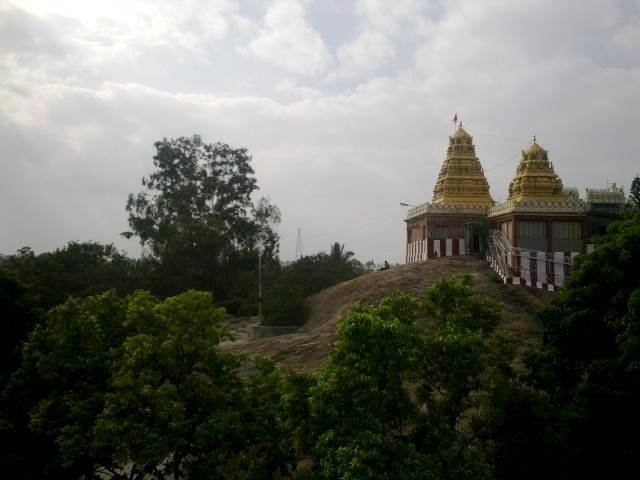
AA hill made of millet sounds like folklore until you climb Ragigudda Anjaneya Temple and feel Bengaluru fall away beneath you. In Bengaluru, India, this modern Hanuman shrine sits on a rocky rise in Jayanagar 9th Block, where wind, incense, and traffic noise meet in the same breath. Visit for the calm face of Prasanna Anjaneyaswamy, for the city views, and for the odd pleasure of finding a sacred hill in the middle of one of India's busiest tech capitals.
Ragigudda means "hill of ragi," and the name carries the place's central story. According to tradition, a devout woman named Sudharma offered freshly harvested finger millet to three divine visitors; when she refused to take it back, the grain became a hillock and the gods remained as stone. Myth first. Then concrete steps under your feet.
The present temple is much younger than the legend. Records on the temple's own site place its modern beginning in 1969, with formal registration in 1972, which means this hilltop shrine is newer than many apartment blocks around it and yet feels older because ritual has a way of compressing time.
Come early or come at dusk. Noon heat sits hard on the exposed rock, while mornings bring cooler air and the smell of camphor drifting through the mandap; if you're mapping out more of the city, pair this stop with the wider Bengaluru page rather than treating the temple as a quick checkbox.
01 What to see.
The Hilltop Hanuman Shrine
The Trimurti Stones and the Story Under Your Feet
Hanuman Dhara, the Pushkarni, and the Lower Complex
02 In pictures.




Plan and listen to Ragigudda Anjaneya Temple with Audiala.
Audio guide in your pocket, itinerary in your browser. Built for the way you actually visit.
03 Visitor logistics.
The practical scaffolding for a good visit — kept short.
Getting There
Ragigudda Anjaneya Temple sits on Ragigudda Temple Road in Jayanagar 9th Block, south Bengaluru. By car or cab, plan about 10-15 minutes from Jayanagar 4th Block and 35-50 minutes from MG Road, because Bengaluru traffic can stretch a 9-kilometer run into the length of a short film. BMTC buses along Bannerghatta Road and the Jayanagar side roads get you close, then the last approach is an uphill walk over exposed rock.
Opening Hours
As of 2026, official temple hours are Monday to Friday 8:00-11:30 and 17:00-20:00, then Saturday and Sunday 8:00-12:30 and 17:00-20:30. Saturday draws the thickest crowds because the Mahamangalarathi is held around 11:00-11:30 and again 20:00-20:30, so the hill feels much tighter than its 5-acre footprint suggests.
Time Needed
Give it 30-45 minutes if you want darshan, a walk up the hill, and a slow look at the shrine complex. Plan 60-90 minutes on a Saturday or festival day, when queues swell and the inner areas compress fast. If you're coming for Hanuman Jayanti, think in hours, not minutes.
Accessibility
The setting is beautiful and not especially forgiving: the final approach includes sloped paths and rocky sections that can feel harsh in the noon heat, like climbing a sun-warmed stone griddle. Visitors with limited mobility may find the lower parts of the complex easier than the hilltop sections, and quieter weekday visits leave more room to move.
05 Tips for visitors.
Small things that change the day.
Temple Etiquette
Dress modestly, remove your shoes before entering the worship areas, and keep your voice low near the sanctum. This is an active temple first, not a lookout with a shrine attached.
Beat The Heat
Go early morning or after 17:00 if you want the hill breeze instead of reflected heat off the rock. Midday sun here can feel sharper than the air temperature suggests because the stone holds it like a cast-iron pan.
Skip Peak Aarti
Avoid the Saturday aarti windows if you dislike tight crowds. The pressure builds near the inner sanctum, and a place that feels open on the outer paths can turn shoulder-to-shoulder very quickly.
Use The Hill
Don't rush straight to the main shrine and back down. Walk the terraces and secondary shrines slowly; the temple makes more sense when you feel the climb, catch the wind, and see how this hillock survives inside a dense Bengaluru neighborhood.
Pair It Well
This works best as part of a south-city day rather than a cross-town sprint. If you're building a wider Bengaluru itinerary, keep nearby neighborhoods together and leave the northern sights for another day.
Festival Strategy
During Hanuman Jayanti, arrive earlier than you think you need to. Local sources describe peak-day attendance around 35,000 people, which means the temple stops feeling like a hill shrine and starts moving like a railway platform.
Where to Eat
Don't Leave Without Trying
Dining Tips
- check JP Nagar and KSRTC Layout are residential neighborhoods — expect authentic local eating, not tourist-oriented restaurants. Prices are honest and portions generous.
- check Most cafes and food courts open early (7–10 AM) for breakfast — this is when you'll find the best filter coffee and fresh South Indian breakfast items.
- check Cash is still widely accepted and often preferred in neighborhood spots, though digital payments are becoming common.
- check Lunch rush (12:30–2 PM) can get busy at food courts; go slightly earlier or later for a more relaxed experience.
- check Many local restaurants close between 3–5 PM (post-lunch, pre-dinner) — plan accordingly if you're eating outside standard meal times.
Restaurant data powered by Google
04 A history of reinvention.
The Hill That Began as an Offering
Ragigudda's past moves on two tracks at once. One belongs to legend, where grain turns into stone and the Trimurti pause long enough to bless a woman who chose devotion over household pressure; the other belongs to modern Bengaluru, where local youth in 1969 turned a rocky rise into an organized temple complex.
That split matters because the place never pretends myth and administration are the same thing. The story gives the hill its charge, while the documented dates explain how a neighborhood shrine became a five-acre complex with halls, subsidiary shrines, and a festival that can pull crowds around 35,000 strong, roughly the population of a small town pressed onto one hill.
Sudharma, the Ragi, and the Birth of a Sacred Hill
Legend holds that a pious woman named Sudharma welcomed three strangers and offered them freshly harvested ragi. When her family objected and asked her to withdraw the gift, she refused. That refusal is the hinge of the whole place.
Local accounts say the visitors were the Trimurti in disguise, and the offered grain rose into a hillock while the three divine forms remained behind as stones. You can still feel how neatly the story fits the terrain: this is not a mountain but a sudden rocky swelling in the city, the kind of landform that almost asks for a sacred explanation.
The legend survives because the temple built after 1969 never pushed it aside. Instead, the modern shrine to Prasanna Anjaneyaswamy was laid over it like a new layer of faith, formalized in 1972, giving Bengaluru one of those rare places where recent masonry and old belief stand together without apology.
From Local Youth Effort to Registered Trust
Hanuman Jayanti on a City Scale
Listen to the full story in the app
The whole Ragigudda Anjaneya Temple,
told well.
Audio guides for 1,100+ cities across 96 countries. History, stories, and local insight — offline ready.

06 Frequently asked.
The questions travellers send us most about Ragigudda Anjaneya Temple.
Is Ragigudda Anjaneya Temple worth visiting?
Yes, especially if you want a temple that still feels tied to neighborhood life rather than staged for tourists. The hillock setting gives you wind, open sky, and a break from Bengaluru traffic, while the legend of a hill made from ragi gives the place a story you won't mistake for any other shrine.
How long do you need at Ragigudda Anjaneya Temple?
Most people need 45 minutes to 1.5 hours. Give it longer if you want to climb slowly, visit the smaller shrines, sit through aarti, or come on a Saturday when the complex moves at a more patient, crowded rhythm.
What is special about Ragigudda Anjaneya Temple?
Its oddest secret is right in the name: according to local tradition, this hill was formed from ragi grain offered to three divine visitors. That legend sits beside a very modern history, with the present temple founded in 1969 and formally registered in 1972, which makes it feel less ancient and more lived-in.
What are the timings of Ragigudda Anjaneya Temple?
The official timings are 8:00-11:30 and 17:00-20:00 from Monday to Friday, and 8:00-12:30 and 17:00-20:30 on Saturday and Sunday. Saturday Mahamangalarathi is listed on official pages at 11:00-11:30 and 20:00-20:30, so that is the slot to avoid if you dislike crowds.
Is there an entry fee for Ragigudda Anjaneya Temple?
No, entry is generally free. Bring small cash only if you want to make an offering, buy prasadam, or use nearby parking and local stalls without negotiating digital payment glitches.
How do I reach Ragigudda Anjaneya Temple in Bengaluru?
The temple sits in Jayanagar 9th Block, in south Bengaluru, and is easiest to reach by cab, auto-rickshaw, or local bus. Early morning is the saner choice because the roads around Jayanagar clog quickly, and the exposed rock feels much harsher once the midday heat settles in.
Can you see the city from Ragigudda Anjaneya Temple?
Yes, and that is part of the appeal. The hill is modest rather than dramatic, but in a dense part of Bengaluru even a small rise can feel like a rooftop peeled off the city, especially in the evening light when the breeze starts doing half the work.
Verified, and shown.
Researched and written by the Audiala editorial team from historical records, architectural archives, and local expertise.
Basic entity data, coordinates, official website, and location in Jayanagar, Bengaluru.
Official overview of the temple, visitor-facing details, and general context for worship spaces and timings.
Official history page covering the Sudharma legend, the 1969 foundation, 1972 registration, temple expansion, and festival traditions.
Official contact page used for current darshan timings and practical visitor information.
Official site used for broader context on the complex, facilities, halls, and community functions.
Cross-check for naming, history, timing references, and commonly cited features of the temple complex.
Government tourism profile used for architectural highlights, footprint, and general visitor framing.
Secondary source used for details on shrines, marble mandap, pushkarni, waterfall, and festival scale.
Secondary source used to corroborate the 1969 foundation timeline.
Visitor-impression source used for sensory notes about the rocky approach, views, and heat exposure.
Travel write-up used to support visitor-experience notes on ambience and crowding.
Secondary timing reference used to corroborate official opening hours.
Secondary timing and entry-fee reference used to cross-check practical visitor details.
Last reviewed
Researched from Wikidata, Wikipedia & official sources · fact-checked · How we make our guides →

