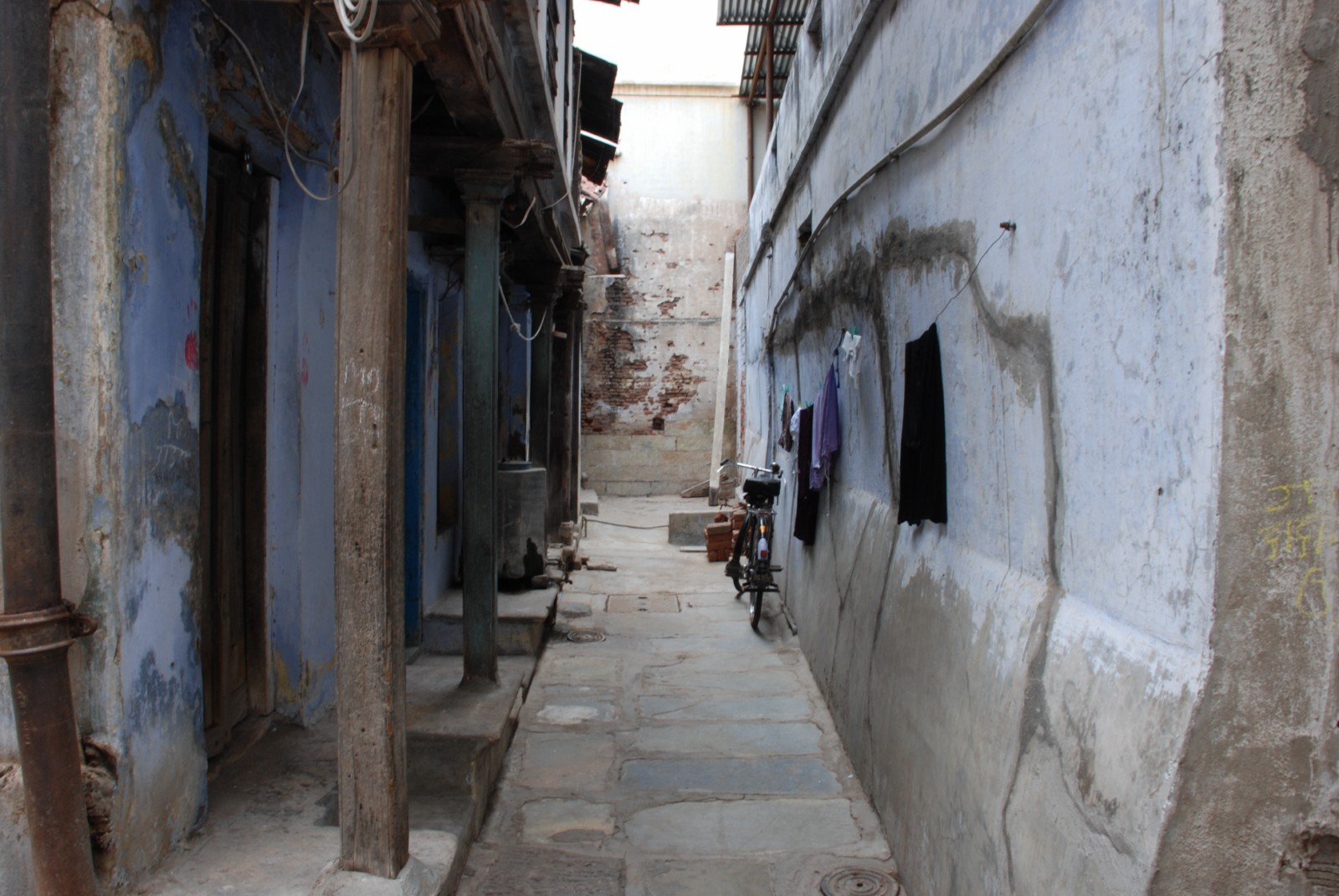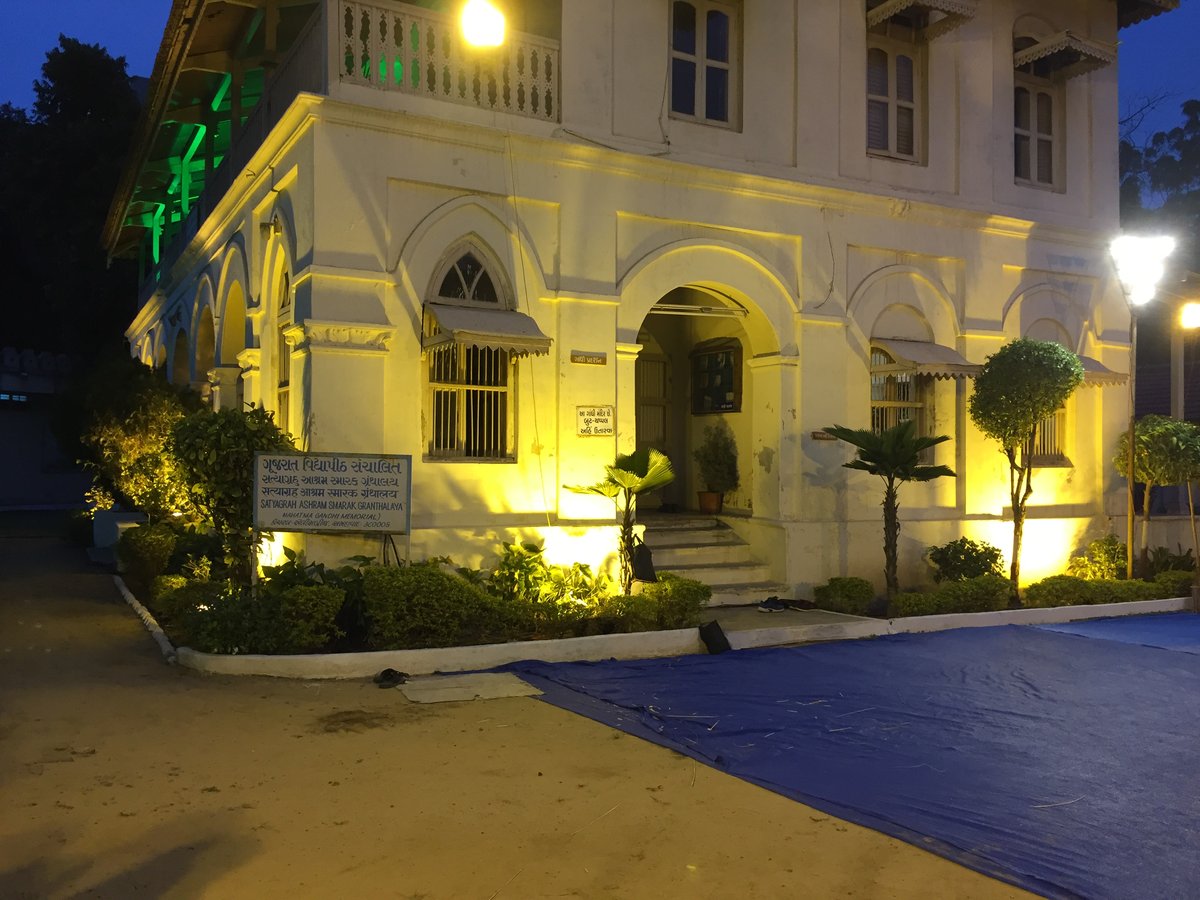
AA wooden cupboard sits in a storeroom at Kochrab Ashram that no one can remove — it is wider than the door, built inside the room sometime around 1915, and has outlasted every renovation since. This quiet detail captures something essential about this place in Ahmedabad, India: what Gandhi started here was never meant to be moved easily. The ashram where he launched his first Indian experiment in communal living spans just 5,000 square metres — smaller than a football pitch — yet the moral crises that unfolded within its walls still reverberate through Indian society.
Kochrab Ashram sits near Paldi on what is now called Ashram Road, a name the street owes to this very compound. Gandhi rented the bungalow from barrister Jivanlal Desai, a friend from his London law-school days, for one rupee per year. The building was designed for a comfortable colonial-era family. Gandhi packed it with 25 people on the first day, and the number soon swelled past 40.
What happened here between May 1915 and June 1917 — the caste confrontation, the financial near-collapse, the fasts over a boy's lie and a stolen bidi — compressed the contradictions of Indian reform into a single courtyard. The ashram that tourists now visit in fifteen minutes was the testing ground for ideas that would shape a century.
Today the compound is free to enter and managed by Gujarat Vidyapith, the university Gandhi himself founded in 1920. Visitor numbers hover around 19,500 a year — a fraction of what Sabarmati Ashram draws. That relative quiet is the point. You can stand in the upstairs room where Gandhi slept, hear the brass bell he rang at 4 AM still hanging from the balcony eaves, and be alone with the details.
01 What to See
Gandhi's Room and the Ground Floor
The Upper Floor and the 4 AM Bell
The Kitchen, the Trapped Cupboard, and the Prayer Ground
02 Explore Kochrab Ashram in pictures.

Plan and listen to Kochrab Ashram with Audiala
Audio guide in your pocket, itinerary in your browser. Built for the way you actually visit.
03 Visitor logistics.
The practical scaffolding for a good visit — kept short.
Getting There
From Ahmedabad Junction, the ashram is 6 km southwest — about 15 minutes by auto-rickshaw (₹60–100) or Ola/Uber (₹80–130). Tell your driver "Kochrab Ashram, Paldi" specifically; saying "Gandhi Ashram" will land you at Sabarmati instead. Gheekanta metro station on Line 1 is a 5-minute walk away. AMTS buses 31, 47, and 58 stop at Pritamnagar (112 m from the gate) or Paldi (164 m), with service running from roughly 5:15 AM to 11:37 PM.
Opening Hours
As of 2026, the most authoritative source — the AMC Heritage City portal — lists hours as Tuesday to Sunday, 10:00 AM to 6:00 PM, closed Mondays. Some travel sites still show 9 AM–5 PM daily, likely reflecting pre-renovation schedules. Treat Monday as a closure day and verify by calling Gujarat Vidyapith at +91-79-26306234 if your trip depends on it.
Time Needed
The AMC Heritage City listing suggests 30 minutes, which covers a brisk walk through the ground floor and garden. A proper visit — both floors of the bungalow, the kitchen building, wall panels excerpting Gandhi's autobiography, and the Khadi shop — takes 45–60 minutes. If you use the Audiala audio guide and explore the 2024 Activities Centre, budget 90 minutes.
Accessibility
The grounds are flat, and Google Maps confirms a wheelchair-accessible car park and entrance. Ramps connect the garden paths and the ground-floor rooms of the main bungalow. The upper floor — housing a conference room and library — is reachable only by a wooden staircase, with no elevator in any building on site.
Cost
Entry is free for everyone, no ticket or booking required. Donations are welcomed but nobody solicits at the gate. The on-site Khadi shop sells cotton kurtas, jute bags, pickles, and mouth-fresheners at government-fixed prices — a few rupees, not tourist markup.
05 Tips for visitors.
Small things that change the day.
Remove Your Shoes
You must take off shoes before entering the main bungalow. The stone floor can get scorching between April and June — visit in the morning or bring socks if you're here in summer.
Photography Is Allowed
No restrictions on photography in the garden or main rooms, and no permit required. The light is best in the late afternoon when it filters through the bungalow's wooden window frames onto Gandhi's original spinning wheel display.
Eat in Paldi After
Udipi Cafe at Paldi Cross Road serves solid South Indian and Gujarati thalis for ₹150–300 — locals rate the filter coffee above the famous Honest chain. For street-food farsan, Das Khaman House (₹130 average) does exceptional dhokla and khandvi about 10 minutes' walk away.
Visit November to February
Ahmedabad hits 42°C in May; the ashram's garden and partly outdoor layout make summer visits punishing. Winter mornings (15–22°C) let you linger on the veranda where Gandhi held his daily prayer meetings without wilting.
Pair with Sabarmati Ashram
Kochrab is where Gandhi's Indian experiment began in 1915; Sabarmati Ashram, 6 km north, is where it grew into a mass movement from 1917 onward. Visiting Kochrab first gives Sabarmati's Hriday Kunj cottage a richer emotional context — you'll understand what came before the icon.
NID Is Next Door
The National Institute of Design campus sits roughly 100 metres from the ashram gate. Its public gallery of Indian design history makes a natural 30-minute addition, and the campus café is a good backup if Paldi restaurants are crowded.
04 Historical Context
One Rupee, One Well, and the Argument That Nearly Ended Everything
Gandhi returned to India from South Africa on 9 January 1915. Several cities competed for his presence — Haridwar, Calcutta, Rajkot — but Ahmedabad won for practical reasons Gandhi stated plainly in his autobiography: he was Gujarati, the city was an ancient centre of handloom weaving ideal for reviving hand-spinning, and its wealthy mill owners could fund his work. He arrived with a vision for a communal settlement governed by truth-seeking — Satyagraha — and needed a roof fast.
The founding unfolded across three dates that scholars still debate. Gandhi's personal diary records a vastu puja on 20 May 1915. Records show the first residents moved in on 22 May. Gandhi's own autobiography gives 25 May as the formal establishment. Gujarati tradition treats the vastu puja as the birth; English-language sources prefer Gandhi's stated date. All three are documented. What is certain: by late May 1915, Gandhi, Kasturba, and roughly two dozen companions occupied a rented bungalow in the village of Kochrab, paying Jivanlal Desai the symbolic rent of one rupee per year.
Fasts, Lies, and a Stolen Bidi
Life inside the bungalow was not serene. Gandhi fasted at least four documented times during the ashram's two-year existence, each time as self-imposed penance for someone else's transgression. On 1 June 1915, a boy lied; Gandhi fasted for half a day. In September 1915, a resident smoked a bidi in secret; Gandhi fasted again. On 12 June 1916, his son Manilal secretly sent money to his estranged elder brother Harilal; Gandhi fasted for three days. These were not symbolic gestures — they were acts of coercion through self-harm, and they terrified the small community. The ashram's discipline ran to every hour: the brass bell on the first-floor balcony rang at 4 AM, prayers began at 5:30, meals were fixed, lights went out at 9 PM. Forty people shared a bungalow built for one family, and the friction was constant.
Why They Left — and What the Plague Obscures
The standard explanation for the ashram's closure in June 1917 is a plague outbreak in Kochrab village. This is true but incomplete. Gandhi himself wrote that "an ashram without an orchard, a farm or cattle would not be a complete unit," and the rented bungalow had none of these. The new site on the banks of the Sabarmati river offered open land between a jail and a crematorium — a pairing Gandhi appreciated, since "jail-going was understood to be normal for Satyagrahis." The plague accelerated a departure that the ashram's own inadequacies had made inevitable. Morarji Desai, then Chief Minister of Bombay State, declared Kochrab a historic memorial on 4 October 1953. Management passed to Gujarat Vidyapith in 1954, where it remains today.
Listen to the full story in the app
06 Frequently asked.
Is Kochrab Ashram worth visiting?
Yes — if you want the story before the story everyone knows. Kochrab is where Gandhi established his first ashram on Indian soil in May 1915, two years before the more famous Sabarmati Ashram even existed. The bungalow is small enough to feel intimate rather than monumental, and the 2024 renovation has added a proper interpretation centre. You'll share the grounds with maybe a dozen other visitors instead of the hundreds at Sabarmati, and the caretaker Bhim Bahadur — 22 years on site — will unlock rooms and tell you things no wall panel mentions.
Can you visit Kochrab Ashram for free?
Completely free, no ticket or booking required. The ashram is managed by Gujarat Vidyapith and charges no entry fee. Donations are welcomed but nobody solicits them at the gate.
How long do you need at Kochrab Ashram?
The official estimate is 30 minutes, but give yourself 45 to 60 if you want to read the wall panels quoting Gandhi's autobiography in the rooms where he actually wrote it. A thorough visit including the new Activities Centre, the prayer ground platform, and the Khadi souvenir shop takes about 90 minutes. The site covers 5,000 square metres — roughly the footprint of a football pitch — so you won't be walking far.
How do I get to Kochrab Ashram from Ahmedabad city centre?
The quickest option is an auto-rickshaw to "Kochrab Ashram, Paldi" — about 6 km from Ahmedabad Junction station, costing ₹60–100 and taking 15–20 minutes. Say "Kochrab Ashram" specifically; if you just say "Gandhi Ashram" the driver will take you to Sabarmati. The nearest metro stop is Gheekanta on Line 1, roughly a 5-minute walk away. Multiple AMTS bus routes (31, 35, 47, 58) stop at Pritamnagar or Paldi, both within 2–3 minutes on foot.
What is the best time to visit Kochrab Ashram?
November through February, when Ahmedabad temperatures stay between 15°C and 28°C, is most comfortable for the partly outdoor grounds. Visit in the morning between 10 and 11 AM for the best light on the white limestone façade and a quiet compound. Gandhi Jayanti on October 2 brings charkha demonstrations and bhajan sessions if you want atmosphere — but if you visit in the 40°C heat of April or May, pressing your hand against the century-old limestone walls and feeling them stay cool is its own kind of revelation.
What should I not miss at Kochrab Ashram?
Three things most visitors walk past. First: a heavy brass bell hanging from the ornate eaves of the upstairs balcony — Gandhi rang it at 4 AM every morning to wake the community, and it still hangs in its original position. Second: in the kitchen building's storeroom, a wooden cupboard so large it can't fit through the door, meaning someone built it inside that room during Gandhi's time and it hasn't moved in over a hundred years. Third: the portraits of Leo Tolstoy, John Ruskin, and Shrimad Rajchandra hanging alongside Gandhi and Kasturba — they map the Russian, British, and Jain intellectual origins of India's independence movement in a single glance.
Is Kochrab Ashram open on Mondays?
The Ahmedabad Municipal Corporation's official heritage portal lists Kochrab Ashram as closed on Mondays, open Tuesday through Sunday from 10 AM to 6 PM. Some travel sites still list daily hours of 9 AM to 5 PM, but the AMC source is the most authoritative local government listing. If you're planning a Monday visit, call Gujarat Vidyapith at +91-79-26306234 to confirm before going.
What is the difference between Kochrab Ashram and Sabarmati Ashram in Ahmedabad?
Kochrab came first — Gandhi lived here from May 1915 to June 1917 in a rented bungalow, paying just one rupee per year. He moved to Sabarmati Ashram partly because plague broke out in Kochrab, but also because the bungalow lacked space for farming and cattle. Sabarmati is where the Dandi March began in 1930 and where the famous museum sits today; Kochrab is where Gandhi first tested communal living, admitted a Dalit family against his own wife's objections, and nearly lost all his donors in the process. Sabarmati gets the school trips. Kochrab gets the quiet.
Researched and written by the Audiala editorial team from historical records, architectural archives, and local expertise.
Founding dates, building dimensions, floor area, visitor count, room descriptions, founding history, Dudhabhai Dafda story, and move to Sabarmati
Detailed 2024 renovation report, caretaker Bhim Bahadur quotes, cupboard-in-storeroom detail, Ramesh Trivedi booklet, Rizwan Kadri diary research, Ambalal Sarabhai identity, road expansion history
Official opening hours (closed Mondays, 10:00–18:00), free entry confirmation, audio/video guide availability, heritage listing details
State tourism authority listing with hours (9 AM–5 PM) and free entry confirmation
First-person visitor account confirming free entry, Khadi shop products (kurtas, jute bags, pickles, mouth-fresheners), shoe removal requirement
Detailed Gujarati-language account of daily ashram routine, food regime, Kasturba's charkha, brass bell, founding date sequence (May 20/22/25), Gandhi's fasts
Bus routes (AMTS 31, 32, 34/4, 35, 40, 47, 49, 58, 401, 900), nearest stops (Pritamnagar 112m, Paldi 164m), metro station distances (Gheekanta 265m)
Gandhi's own account of choosing Ahmedabad, May 25 founding date, anonymous donor story, reasons for leaving Kochrab
Timeline confirmation of May 22, 1915 move-in date and September 11, 1915 Dudhabhai Dafda admission
Detailed account of Ambalal Sarabhai's anonymous donation, Sarabhai's own confirmation to Erikson, analysis of caste crisis at the ashram
Details on PM Modi's virtual inauguration March 12, 2024, Activities Centre with ~10 rooms, multi-language interpretation centre
Wedding sangeet controversy at the ashram, Gujarat Vidyapith defense citing historical precedent of Maganlal Gandhi's wedding
Additional reporting on the January 2026 DJ wedding controversy and political reactions
Gujarati-language reporting on founding date sequence and 2026 wedding controversy
Confirmation that Kochrab Ashram is on India's UNESCO Tentative List (submitted April 15, 2014, Ref. 5899) but not yet inscribed as World Heritage
Hindi-language visitor account describing the prayer ground platform, library access restrictions, yellow bungalow appearance, contrast with Sabarmati crowd levels
Google reviewer quotes including Bhavesh Sheta's note about the Canada Visa Centre proximity, wheelchair accessibility data, parking confirmation
Account of the shared well now located across the road due to Ashram Road expansion, site of the Dudhabhai Dafda water-carrier confrontation
Visitor experience description noting quiet atmosphere and historical significance
Night lighting details from 2024 renovation, heritage illumination of the bungalow
Book by local historian cross-referencing Gandhi's personal diary with ashram events; September 17, 1915 diary entry identifying Ambalal Sarabhai; grandfather Nooruddin Kadri's personal encounters with Gandhi
Last reviewed