account_balance
Copan's Maya Record
Copán Ruinas holds one of the most ambitious archives in stone anywhere in the Americas. The Hieroglyphic Stairway alone turns a royal dynasty into something you can read step by step.
Honduras is the rare Central American trip where a Maya dynastic capital, reef diving, Garifuna cooking, and mountain towns all fit into the same week without feeling forced.
EntryMany travelers can enter visa-free for up to 90 days; CA-4 rules apply.
HA Honduras travel guide starts with a surprise: this country packs a UNESCO Maya capital, 30-meter reef visibility, and cloud-forest peaks into one compact trip.
Honduras works best for travelers who want range without constant airport time. In the west, Copán Ruinas gives you one of the Maya world's great archaeological sites: the Hieroglyphic Stairway, carved around AD 755, and stelae so intricate they feel almost overconfident. A few days later you can be in Comayagua, where the cathedral clock is often described as one of the oldest still working in the Americas, or in Tegucigalpa, where mountain light and steep streets make the capital feel more vertical than grand. The country is smaller than Mexico, but the shifts come fast.
Then the Caribbean takes over. Roatán and Utila sit on the Mesoamerican Barrier Reef, with warm water, strong visibility, and dive prices that undercut much of the region. La Ceiba is the mainland hinge between coast and jungle, the place that sends you toward ferries, rafting on the Río Cangrejal, or Garifuna communities along the north shore. Tela and Trujillo move at a slower pace, with beaches, coconut-heavy food, and a sense that the country's story is as Afro-Caribbean as it is Central American. That mix is the point.
Maya Copán, c. 250-900 CE
Morning mist lifts slowly from the Copán Valley, and the first thing that emerges is not a pyramid but a face. A king in stone, jeweled and severe, stands in what is now Copán Ruinas as if he still expects the court to gather. This was Copán at its height: not the biggest Maya city, but one of the most eloquent, a place where power liked to explain itself in sculpture.
What survives here is almost indecently personal. In about 755, the Hieroglyphic Stairway was carved with roughly 2,200 glyphs over 63 steps, a royal chronicle written on the rise of a staircase. Imagine that vanity. Every ascent became a lesson in dynasty. Ce que l'on ignore souvent, c'est que the staircase reached the modern world in pieces after earthquake damage and centuries of collapse; scholars spent decades trying to put a royal memory back into order.
Then comes the drama worthy of any court chronicle. In 738, the great king known as 18 Rabbit, patron of the finest stelae at Copán, was captured by Cauac Sky of Quiriguá, a smaller city that had once lived in his shadow. He was beheaded. Just like that. A ruler who had dressed himself as a god discovered that vassals, too, can nurse ambition.
The last act is quieter, which makes it sadder. Altar Q, commissioned under Yax Pasaj Chan Yopaat, shows 16 rulers passing the symbols of power from one to the next, as though legitimacy itself might hold the city together. It did not. By the 9th century, strain on land, social fracture, and political weakness were already pulling the court apart. The carved kings remained. The people drifted away, and the valley fell silent until Spaniards and then archaeologists arrived to misunderstand it all over again.
18 Rabbit ruled for 43 years, posed as a divine being in carved stone, and still could not protect himself from a humiliated subordinate with better timing.
When a Spanish official described Copán in the 16th century, he wondered whether Romans or men from Atlantis had built it; the descendants of the actual builders were living nearby.
Conquest and Colonial Founding, 1524-1821
A letter on a table, a helmet still damp from rain, a mountain fortress holding out beyond the reach of impatient men: this is how Spanish Honduras begins. Not with smooth conquest, but with quarrels, rival expeditions, and long marches through mud. Hernán Cortés came south partly to discipline his own mutinous captains, and his expedition through the forests of the region accomplished one ghastly thing with certainty: the execution of Cuauhtémoc, the last Aztec emperor, hanged far from his own capital under suspicion and fear.
The figure Honduras chose to remember was not a conqueror but a resister. Lempira, a Lenca leader, gathered communities that the Spaniards had expected to defeat one by one. From the stronghold of Cerquín he held them off for months in 1537 and 1538. According to later accounts, he was killed not in fair battle but during a deceitful parley. Empires often prefer paperwork to heroism when heroism belongs to the other side.
Then the colony settled into its peculiar geography. Comayagua became the conservative ecclesiastical center, all bells, cloisters, and dignified authority; Tegucigalpa grew through silver mining, harder-edged and more mercantile. One looked toward altar and crown, the other toward ore and opportunity. Their rivalry was not decorative. It shaped politics for generations.
Along the Caribbean, another Honduras was taking form. Trujillo served as an exposed colonial port, coveted, raided, and never quite secure, while the north coast remained a zone of smuggling, mixed populations, and imperial anxiety. Inland towns such as Gracias carried the institutions of Spanish rule westward, yet beyond them local worlds persisted. That is the hinge into the next era: a colony too divided by terrain and habit to become a calm republic the moment independence was declared.
Lempira became the face of the national currency, a rare case in which the martyr, not the victor, ended up on the money.
The first capital was not fixed with any serenity; for years, the old rivalry between Comayagua and Tegucigalpa felt less like administration than a family feud with church bells.
Federal Dreams and Banana Republics, 1821-1932
Independence arrived in 1821 on paper before it arrived in daily life. Honduras passed briefly through the Mexican Empire, then into the Federal Republic of Central America, that elegant liberal dream in which the old kingdom might become a modern union. Francisco Morazán, born in Tegucigalpa, believed in it with the conviction of a man who can already hear posterity applauding. Posterity, alas, was busy sharpening knives.
The federation collapsed into civil wars, coups, and regional suspicion. Honduras remained poor, thinly governed, and brutally vulnerable to outsiders with ships, loans, and patience. By the late 19th century, foreign capital saw what local states could not control: bananas on the north coast, rail concessions, customs revenues, ports. Towns like La Ceiba and, later, San Pedro Sula grew in the orbit of export agriculture rather than old colonial ceremony.
This is where the phrase "banana republic" stops being a cartoon and becomes biography. The United Fruit Company and the Cuyamel Fruit Company acquired land, influence, and the unnerving ability to make and unmake politicians. Presidents came and went. Contracts remained. On the Caribbean coast, entire districts were reorganized around plantations, rail lines, and company docks, while Garifuna and other local communities watched a foreign commercial order remake the shoreline.
And yet the country was not only exploited; it was transformed. San Pedro Sula became the industrial hinge of the north, the coast turned outward to the Caribbean, and the state learned the dangerous habit of tying its future to a small number of export commodities. When General Tiburcio Carías Andino took power in 1933, he inherited a republic already trained to confuse stability with obedience.
Francisco Morazán remains the tragic gentleman of Honduran history: brilliant, liberal, admired, and defeated by the provincial realities he thought reason could outvote.
The novelist O. Henry popularized the phrase "banana republic" after drawing on Honduran realities, but the real absurdity was sharper than fiction: fruit companies sometimes wielded more reliable authority than the state.
Dictatorship, Coups, and the Long Democratic Strain, 1933-2009
Picture the presidential desk under a ceiling fan, the ink drying slowly in the heat while dissent is filed away as inconvenience. Tiburcio Carías Andino ruled from 1933 to 1949 with the patience of a man who understands that fear can be made administrative. He brought order of a sort, but it was the order of narrowed politics, imprisoned opponents, and a country taught to lower its voice.
The mid-20th century brought workers onto the stage with startling force. In 1954, the great banana strike spread across the north coast and shook the authority of companies that had behaved like tropical principalities. This matters enormously. It was one of those moments when ordinary people, not presidents, changed the national script. Wages, labor rights, and political expectation all shifted because plantation workers refused to keep the old rhythm.
Military influence never vanished. Honduras became strategically useful during the Cold War, especially in the 1980s, when it served as a rear base for regional conflicts and U.S. operations tied to Nicaragua and El Salvador. Barracks, airstrips, advisers, and secret wars left their residue even where no battle was visibly underway. In places like Tegucigalpa, policy and paranoia often seemed to share the same office.
Democratic institutions did deepen, but not enough to remove the old reflexes. The 2009 coup that ousted President Manuel Zelaya proved how unfinished the transition remained. One could still, in the 21st century, wake up to find the armed forces deciding the pace of constitutional life. That rupture opened the final chapter: a Honduras in which civil society, corruption scandals, migration, and democratic fatigue would compete to define the future.
Tiburcio Carías Andino sold himself as the guardian of order, yet the bill for that calm was paid in silence, censorship, and the habit of fearing politics.
The 1954 banana strike involved tens of thousands of workers and forced negotiations that company executives had long assumed were beneath them.
Resistance, Memory, and an Unfinished Present, 2009-present
A river at dawn, mist hanging above the water, community leaders arguing over maps and concessions: modern Honduran history often begins far from the presidential palace. After the 2009 coup, trust in institutions thinned further, and public life became a contest between formal democracy and private power. Elections continued. So did the suspicion that too much of the country was still being decided in rooms the public never entered.
Ce que l'on ignore souvent, c'est que some of the bravest chapters of recent Honduras were written by people defending places most outsiders could not point to on a map. Berta Cáceres, a Lenca activist from La Esperanza, opposed the Agua Zarca dam because for her community the Gualcarque River was not scenery or a utility corridor. It was living inheritance. Her murder in 2016 turned a local struggle into an international scandal and exposed, with grim clarity, the intimacy between business interests, political protection, and violence.
Meanwhile, another Honduras kept insisting on itself. Women organized. Journalists investigated. Anti-corruption movements drew crowds. On the Caribbean side, Garifuna communities defended land and culture from dispossession; in the west, memory of Lenca resistance acquired new political life; on the islands of Roatán and Utila, tourism brought money and pressure in equal measure. A country can modernize and still fail to become fair. Honduras knows that contradiction intimately.
The election of Xiomara Castro in 2021, taking office in 2022 as the first woman president of Honduras, carried the charge of correction, even of family saga, since she was also the wife of the deposed Zelaya. History does enjoy a dynastic echo. But the real story is larger than one household. The argument now is over institutions, extraction, migration, and whether the state can finally belong more to citizens than to patrons. That struggle is still underway, which is why the past in Honduras never feels settled.
Berta Cáceres spoke of rivers as beings with memory, and in Honduras that was not metaphor but political fact.
When Berta Cáceres won the Goldman Environmental Prize in 2015, she used the platform not to soften her message but to accuse global finance directly.
Honduras begins in the mouth. Not with a speech. With a greeting. A clean "buenos días" placed before the request like a plate before the meal, and suddenly the room opens a few centimeters.
The country has a fine ear for social distance. "Usted" is not frost here. It is elegance. It dresses the sentence properly when you speak to an elder, a shopkeeper, the woman selling oranges at a bus terminal in Tegucigalpa, the man counting change in Comayagua, the receptionist who has already guessed you are lost. "Vos" comes later, if it comes at all, and when it does the air changes: quicker, warmer, amused. Grammar can flirt.
Then come the words that refuse export. "Catracho" is not simply Honduran; it carries a small civic drumbeat in its chest. "Maje" can caress or insult in the same syllable. "Pulpería" names a tiny store, yes, but also a neighborhood's bloodstream, where credit, gossip, detergent, and soft drinks stand shoulder to shoulder under one corrugated roof. A country is a table set for strangers.
On the Caribbean side, in La Ceiba, Tela, Roatán, and Utila, Spanish loosens its collar. English drifts in, Garifuna rhythm crosses the sentence, and the coast sounds less like an institution than a band warming up. Inland, the speech can feel more buttoned, more measured, especially around Copán Ruinas or Santa Rosa de Copán. Honduras does not speak in one voice. That is its honesty.
Honduran food does not perform. It feeds. This distinction is moral. The plate respects labor, weather, appetite, and the human hand, which is why tortillas matter so much: they are not decoration but equipment.
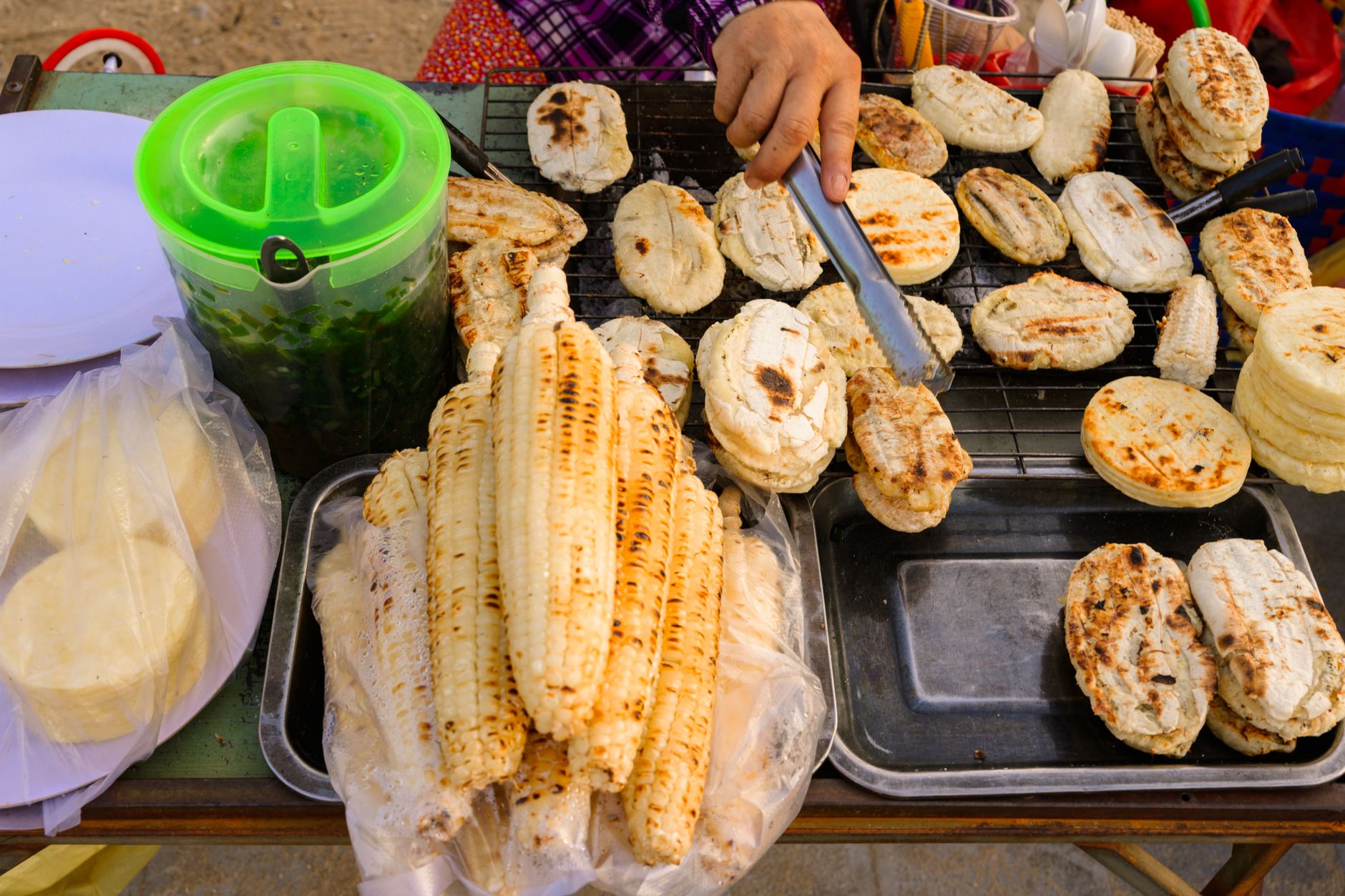
A baleada looks modest until you bite it and realize modesty was the disguise. A flour tortilla, folded over beans, crumbly white cheese, mantequilla, sometimes egg, avocado, meat, becomes breakfast, late dinner, bus-station salvation. In San Pedro Sula, it is street logic. In Tegucigalpa, it is routine elevated to tenderness. You eat it warm, by hand, while the tortilla still yields at the crease. Knives belong elsewhere.
Then the coast changes the grammar. In La Ceiba, Tela, Trujillo, and the Bay Islands, coconut enters like velvet carrying a knife. Sopa de caracol, machuca, hudutu, tapado: these are dishes that smell of sea salt and coconut fat before they say anything else. Green plantain, cassava, fish, shellfish, coriander. The spoon works, but the fingers understand faster.
Western Honduras answers with maize and patience. Ticucos in Lenca country near La Esperanza. Nacatamales unwrapped slowly because the banana leaf has perfumed the whole afternoon. Rosquillas beside coffee in Gracias or Comayagua, dry enough to demand a sip, stern enough to earn respect. This cuisine knows that abundance is not luxury. It is timing.
Music in Honduras is not one inheritance but several, and they do not ask permission to coexist. The highlands keep brass bands, church bells, amplified cumbia, ranchera sorrow from a passing pickup. The north coast answers with drums. Real ones. Skins, hands, repetition, insistence.
Garifuna music on the Caribbean shore does not merely accompany a gathering; it alters the blood chemistry of everyone within hearing distance. Punta is the famous ambassador, yes, but the deeper lesson is rhythmic authority: call and response, percussion with spine, voices that sound as if memory itself had learned to dance. In Tela or La Ceiba, one hears not a performance for visitors but a continuity older than the stage.
Even silence has percussion in Honduras. Listen in Copán Ruinas at dusk, when a distant loudspeaker, a dog, a motorbike, and a church bell accidentally compose a village fugue. Listen in Roatán, where bars throw reggae and punta into the same humid night as if genre were a bureaucratic nuisance. Islands hate paperwork.
The country likes songs you can inhabit physically. You do not stand outside them analyzing structure. You clap, sway, answer, drink, laugh too loudly, miss the beat, find it again. Music here is less an object than a permission slip.
Honduran politeness has shape. It is not decorative niceness scattered around the day like confetti. It is sequence. Greet first. Ask second. Thank properly. Do not march into a conversation as if efficiency were a virtue in itself. Sometimes it is a vice with a wristwatch.
Respect is audible. Titles still matter. Elders are greeted with care. Shopkeepers are not treated like furniture. If you enter a small place, especially a pulpería or family-run comedor, you acknowledge the room before you attempt commerce. The omission is noticed. Not dramatically. Worse: precisely.
The beautiful complication is that formality and warmth are not enemies here. A person may call you "usted" and still laugh with you, feed you, warn you against the wrong taxi, tell you where to find the good nacatamales on a Sunday morning in Comayagua or the proper yuca con chicharrón near San Pedro Sula. Distance can be kind.
On the coast the etiquette bends, but it does not disappear. In Garifuna communities, in island spaces like Utila or Roatán, the codes feel more relaxed, more breezy, yet attention still counts: how you greet, whether you listen, whether you arrive acting as if service were tribute owed to your passport. Bad manners travel faster than luggage.
Religion in Honduras is crowded. Catholic processions, evangelical certainty, household saints, inherited Indigenous cosmologies, Garifuna ritual memory, all occupying the same national body without the courtesy of blending into one theology. Good. Uniformity is overrated.
Comayagua makes this visible with particular elegance. Colonial churches, bells, processions, polished ritual. During Holy Week the sawdust carpets appear underfoot with the fragility of colored breath, and devotion becomes an art form destined to be stepped on. The lesson is brutal and perfect: beauty is not exempt from use.
But Christian vocabulary did not erase what came before. In Lenca regions around Gracias and La Esperanza, rivers and mountains still carry more than scenery; they keep personhood in cultural memory, even when the language used around them has changed. On the Caribbean coast, Garifuna ceremonial life preserves another archive entirely, one in which drumming, ancestry, and the invisible are still on speaking terms.
Honduras does not treat the sacred as abstract. It gets embedded in candles, water, bread, graves, family promises, processions delayed by rain, and a grandmother's certainty that a certain prayer must be said in a certain order. Theology can live in books. Faith prefers choreography.
Honduran architecture is a conversation between climate and power. Stone, adobe, tile, painted stucco, timber, corrugated improvisation, all arguing with heat, rain, status, and time. Nothing honest in the tropics can ignore ventilation for long.
In Copán Ruinas the most famous architecture is, naturally, older than the country itself. The Maya of Copán carved dynastic ambition into stairways, altars, and stelae with a level of ornamental obsession that feels almost impolite in its brilliance. The Hieroglyphic Stairway is not content to support movement. It insists on becoming literature while you climb. Vanity, when done at this level, becomes civilization.
Colonial Honduras took another route. Comayagua and Gracias still offer low-slung facades, inner courtyards, thick walls built not for picturesque effect but for shade and endurance. Santa Rosa de Copán has the restrained dignity of a place that understands proportion without advertising it. A courtyard is a climate machine. A corridor is a philosophy.
Then the Caribbean and the islands reopen the material question. In La Ceiba, Tela, Roatán, and Utila, wood and color take over, buildings lifted to breathe, porches behaving as social organs rather than decorative appendages. Rain dictates terms. Salt edits everything. A house near the sea must know how to survive being touched by weather every day of its life.
Copán Ruinas holds one of the most ambitious archives in stone anywhere in the Americas. The Hieroglyphic Stairway alone turns a royal dynasty into something you can read step by step.
Roatán and Utila give you direct access to the Mesoamerican Barrier Reef, the world's second-largest coral system. Visibility often pushes past 30 meters, and the price-to-quality ratio stays hard to beat.
On the north coast near Tela, La Ceiba, and Trujillo, Honduras sounds different and tastes different. Garifuna communities shape the rhythm, language, and coconut-rich cooking in ways most first-time visitors do not expect.
This is not just a beach country. Honduras stretches from the wet lowlands of La Mosquitia to cloud-forest highlands and Cerro Las Minas at 2,870 meters, the country's highest point.
A good Honduras trip is measured in baleadas, anafres, fried plantain, and late coffee from the western hills. The food is built on corn, beans, cassava, coconut, and appetite, and it rarely wastes time on presentation.
La Ceiba, San Pedro Sula, Comayagua, and the Bay Islands make route planning simpler than many travelers assume. You can mix archaeology, coast, and diving without losing days to awkward transfers.
12 cities — start with the ones we'd send you to first.
A small colonial town where you can walk to a UNESCO Maya site in the morning and eat baleadas under the park's ceiba trees by noon.
The Mesoamerican Barrier Reef runs so close to shore that certified divers reach world-class walls within a ten-minute boat ride from West End.
A capital folded into steep ravines where 18th-century baroque churches and chaotic market streets occupy the same hillside without apology.
The industrial engine of Honduras — hot, fast, and underestimated — where the best carne asada in the country often comes from a roadside grill, not a restaurant.
The cheapest place on the Mesoamerican reef to get PADI-certified, with a backpacker economy that has kept the island deliberately rough around the edges since the 1990s.
The north coast's party capital earns its reputation once a year during the Carnaval Internacional de la Amistad in May, when the entire city moves to punta and Garifuna drumbeat.
Honduras's first colonial capital has a cathedral clock that was already old when it arrived from the Alhambra in 1636, still ticking in the main square.
A drowsy Caribbean beach town that sits on the edge of Jardín Botánico Lancetilla, the largest tropical botanical garden in the Americas.
A cool highland city where premium hand-rolled cigars are still made by family workshops and the cobblestone streets have barely changed in a century.
Western Honduras feels older, cooler, and more self-contained than the coast. Copán Ruinas gives you the country's great archaeological draw, while Santa Rosa de Copán and Gracias add coffee country, cigar culture, church squares, and mountain roads that make distances look short on a map and longer in real life.
San Pedro Sula is not a postcard city, which is part of why it matters. It is the country's commercial engine and the place where many travelers land before fanning out to Tela, Lago de Yojoa, or the Bay Islands; the coast beyond it shifts from factories and highways to beaches, mangroves, and Garifuna kitchens.
The Bay Islands run on reef time rather than mainland time. Roatán has the broadest mix of resorts, beaches, and direct flights, while Utila stays scrappier, cheaper, and more dive-centered; both sit on the Mesoamerican Barrier Reef, where water clarity can make even a short snorkel feel worth planning your week around.
Central Honduras is where practical travel meets the country's older political spine. Comayagua gives you the strongest colonial center in the region, Tegucigalpa brings the capital's museums and traffic in equal measure, and the corridor between them works well for travelers who want churches, markets, and short hops rather than long overland slogs.
This is the part of Honduras where mornings run cold enough for jackets and pottery still points back to older Indigenous traditions. La Esperanza and nearby Intibucá sit high, move slowly, and make good sense for travelers who care more about markets, craft, and mountain weather than about ticking off famous sights.
Trujillo feels far from the capital in every sense that matters. The old Spanish fort, the broad bay, and the surrounding Garifuna communities give this coast a layered history of empire, trade, and migration, but the atmosphere stays rough-edged rather than polished, which is exactly why some travelers remember it.
From Copán's scribes to modern civic struggles, Honduras has rarely been quiet for long.
The city of Copán begins its rise in the fertile valley near today's Copán Ruinas. Courts, temples, and dynastic ritual turn this western corner of Honduras into one of the intellectual capitals of the Maya world.
A new royal line is established at Copán, probably with links to larger Maya power networks to the north and west. Later kings would trace legitimacy back to him with almost obsessive care.
Copán's most dazzling ruler, 18 Rabbit, is taken by Cauac Sky of Quiriguá and beheaded. The shock is political as much as personal: a great court discovers that prestige can collapse in a single afternoon.
Royal masons create the longest known Maya inscription, a dynastic history spread across a monumental staircase. It is propaganda, scholarship, and vanity all in one stone composition.
One of Copán's last great monuments shows 16 kings in sequence, passing authority from founder to heir. It reads like a final insistence that order still exists, which is often how declining courts speak.
Population decline, ecological strain, and elite fragmentation weaken the city beyond recovery. The dynasty disappears, and the ceremonial center falls into silence while nearby communities continue their lives.
Competing Spanish expeditions push into the region from different directions. Honduras enters the imperial record through conflict, rivalry, and the steady violence of occupation.
The Lenca leader Lempira unites resistance in western Honduras and fortifies mountain strongholds. For months, Spanish forces struggle to crush a rebellion they had expected to scatter easily.
According to long-standing accounts, Lempira dies during a deceptive truce encounter rather than in open battle. His death breaks the rebellion's momentum but turns him into the country's enduring symbol of resistance.
Colonial authorities report the monumental remains of Copán to the Spanish crown. Their descriptions marvel at the workmanship while refusing, absurdly, to credit the ancestors of the people living nearby.
Like much of Central America, Honduras breaks with Spanish rule in the crisis of empire. Independence arrives quickly in legal terms, but stable self-government proves much harder to invent.
The new state enters a larger Central American federation built on liberal ambition and regional compromise. It is a noble experiment, though not one destined for serenity.
Herrera represents the first serious attempt to build constitutional government in Honduras. His career shows how fragile republican institutions were when military force remained the sharper instrument.
Morazán, born in Tegucigalpa, becomes the great liberal champion of Central American union. His brilliance is real; so is the provincial resistance that will eventually defeat him.
Honduras emerges as a fully separate republic as the federation breaks apart under war and regional distrust. The failure leaves a lasting scar on political imagination across the isthmus.
Late 19th-century liberal governments push secular reforms, land changes, and export-oriented development. The old colonial balance tilts toward commerce, concession, and stronger foreign influence.
Foreign fruit firms acquire land, rail rights, and extraordinary political leverage along the Caribbean. Places such as La Ceiba and San Pedro Sula are drawn into a new commercial order built on export agriculture.
Carías comes to power promising order after years of instability. He delivers continuity, but through authoritarian control that narrows public life and teaches the state to distrust dissent.
Tens of thousands of workers across the north coast strike against the banana companies. Their action forces concessions and marks one of the most important social turning points in modern Honduran history.
The so-called Football War lasts only days, but it exposes deep tensions over migration, land, and nationalism. Brief wars can leave very long memories.
The country serves as a strategic platform for U.S. regional operations tied to Nicaragua and El Salvador. Military influence, aid, and covert politics leave deep marks on national life.
Mitch kills thousands and destroys roads, crops, bridges, and homes on a staggering scale. It becomes one of the great human and political ruptures of late 20th-century Honduras.
The removal of Zelaya by the armed forces shocks the hemisphere and exposes how fragile constitutional order remains. Modern institutions prove less settled than many had hoped.
The murder of the Lenca environmental leader draws global outrage and focuses attention on land conflicts, corporate power, and violence against activists. A local struggle becomes an international indictment.
Castro becomes the first woman president of Honduras, carrying both reformist expectation and the memory of the 2009 rupture. Her inauguration feels, to supporters and critics alike, like the opening of a new argument rather than the end of an old one.
Maya Copán
18 Rabbit ruled for 43 years, posed as a divine being in carved stone, and still could not protect himself from a humiliated subordinate with better timing.
Morning mist lifts slowly from the Copán Valley, and the first thing that emerges is not a pyramid but a face. A king in stone, jeweled and severe, stands in what is now Copán Ruinas as if he still expects the court to gather. This was Copán at its height: not the biggest Maya city, but one of the most eloquent, a place where power liked to explain itself in sculpture.
What survives here is almost indecently personal. In about 755, the Hieroglyphic Stairway was carved with roughly 2,200 glyphs over 63 steps, a royal chronicle written on the rise of a staircase. Imagine that vanity. Every ascent became a lesson in dynasty. Ce que l'on ignore souvent, c'est que the staircase reached the modern world in pieces after earthquake damage and centuries of collapse; scholars spent decades trying to put a royal memory back into order.
Then comes the drama worthy of any court chronicle. In 738, the great king known as 18 Rabbit, patron of the finest stelae at Copán, was captured by Cauac Sky of Quiriguá, a smaller city that had once lived in his shadow. He was beheaded. Just like that. A ruler who had dressed himself as a god discovered that vassals, too, can nurse ambition.
The last act is quieter, which makes it sadder. Altar Q, commissioned under Yax Pasaj Chan Yopaat, shows 16 rulers passing the symbols of power from one to the next, as though legitimacy itself might hold the city together. It did not. By the 9th century, strain on land, social fracture, and political weakness were already pulling the court apart. The carved kings remained. The people drifted away, and the valley fell silent until Spaniards and then archaeologists arrived to misunderstand it all over again.
When a Spanish official described Copán in the 16th century, he wondered whether Romans or men from Atlantis had built it; the descendants of the actual builders were living nearby.
Conquest and Colonial Founding
Lempira became the face of the national currency, a rare case in which the martyr, not the victor, ended up on the money.
A letter on a table, a helmet still damp from rain, a mountain fortress holding out beyond the reach of impatient men: this is how Spanish Honduras begins. Not with smooth conquest, but with quarrels, rival expeditions, and long marches through mud. Hernán Cortés came south partly to discipline his own mutinous captains, and his expedition through the forests of the region accomplished one ghastly thing with certainty: the execution of Cuauhtémoc, the last Aztec emperor, hanged far from his own capital under suspicion and fear.
The figure Honduras chose to remember was not a conqueror but a resister. Lempira, a Lenca leader, gathered communities that the Spaniards had expected to defeat one by one. From the stronghold of Cerquín he held them off for months in 1537 and 1538. According to later accounts, he was killed not in fair battle but during a deceitful parley. Empires often prefer paperwork to heroism when heroism belongs to the other side.
Then the colony settled into its peculiar geography. Comayagua became the conservative ecclesiastical center, all bells, cloisters, and dignified authority; Tegucigalpa grew through silver mining, harder-edged and more mercantile. One looked toward altar and crown, the other toward ore and opportunity. Their rivalry was not decorative. It shaped politics for generations.
Along the Caribbean, another Honduras was taking form. Trujillo served as an exposed colonial port, coveted, raided, and never quite secure, while the north coast remained a zone of smuggling, mixed populations, and imperial anxiety. Inland towns such as Gracias carried the institutions of Spanish rule westward, yet beyond them local worlds persisted. That is the hinge into the next era: a colony too divided by terrain and habit to become a calm republic the moment independence was declared.
The first capital was not fixed with any serenity; for years, the old rivalry between Comayagua and Tegucigalpa felt less like administration than a family feud with church bells.
Federal Dreams and Banana Republics
Francisco Morazán remains the tragic gentleman of Honduran history: brilliant, liberal, admired, and defeated by the provincial realities he thought reason could outvote.
Independence arrived in 1821 on paper before it arrived in daily life. Honduras passed briefly through the Mexican Empire, then into the Federal Republic of Central America, that elegant liberal dream in which the old kingdom might become a modern union. Francisco Morazán, born in Tegucigalpa, believed in it with the conviction of a man who can already hear posterity applauding. Posterity, alas, was busy sharpening knives.
The federation collapsed into civil wars, coups, and regional suspicion. Honduras remained poor, thinly governed, and brutally vulnerable to outsiders with ships, loans, and patience. By the late 19th century, foreign capital saw what local states could not control: bananas on the north coast, rail concessions, customs revenues, ports. Towns like La Ceiba and, later, San Pedro Sula grew in the orbit of export agriculture rather than old colonial ceremony.
This is where the phrase "banana republic" stops being a cartoon and becomes biography. The United Fruit Company and the Cuyamel Fruit Company acquired land, influence, and the unnerving ability to make and unmake politicians. Presidents came and went. Contracts remained. On the Caribbean coast, entire districts were reorganized around plantations, rail lines, and company docks, while Garifuna and other local communities watched a foreign commercial order remake the shoreline.
And yet the country was not only exploited; it was transformed. San Pedro Sula became the industrial hinge of the north, the coast turned outward to the Caribbean, and the state learned the dangerous habit of tying its future to a small number of export commodities. When General Tiburcio Carías Andino took power in 1933, he inherited a republic already trained to confuse stability with obedience.
The novelist O. Henry popularized the phrase "banana republic" after drawing on Honduran realities, but the real absurdity was sharper than fiction: fruit companies sometimes wielded more reliable authority than the state.
Dictatorship, Coups, and the Long Democratic Strain
Tiburcio Carías Andino sold himself as the guardian of order, yet the bill for that calm was paid in silence, censorship, and the habit of fearing politics.
Picture the presidential desk under a ceiling fan, the ink drying slowly in the heat while dissent is filed away as inconvenience. Tiburcio Carías Andino ruled from 1933 to 1949 with the patience of a man who understands that fear can be made administrative. He brought order of a sort, but it was the order of narrowed politics, imprisoned opponents, and a country taught to lower its voice.
The mid-20th century brought workers onto the stage with startling force. In 1954, the great banana strike spread across the north coast and shook the authority of companies that had behaved like tropical principalities. This matters enormously. It was one of those moments when ordinary people, not presidents, changed the national script. Wages, labor rights, and political expectation all shifted because plantation workers refused to keep the old rhythm.
Military influence never vanished. Honduras became strategically useful during the Cold War, especially in the 1980s, when it served as a rear base for regional conflicts and U.S. operations tied to Nicaragua and El Salvador. Barracks, airstrips, advisers, and secret wars left their residue even where no battle was visibly underway. In places like Tegucigalpa, policy and paranoia often seemed to share the same office.
Democratic institutions did deepen, but not enough to remove the old reflexes. The 2009 coup that ousted President Manuel Zelaya proved how unfinished the transition remained. One could still, in the 21st century, wake up to find the armed forces deciding the pace of constitutional life. That rupture opened the final chapter: a Honduras in which civil society, corruption scandals, migration, and democratic fatigue would compete to define the future.
The 1954 banana strike involved tens of thousands of workers and forced negotiations that company executives had long assumed were beneath them.
Resistance, Memory, and an Unfinished Present
Berta Cáceres spoke of rivers as beings with memory, and in Honduras that was not metaphor but political fact.
A river at dawn, mist hanging above the water, community leaders arguing over maps and concessions: modern Honduran history often begins far from the presidential palace. After the 2009 coup, trust in institutions thinned further, and public life became a contest between formal democracy and private power. Elections continued. So did the suspicion that too much of the country was still being decided in rooms the public never entered.
Ce que l'on ignore souvent, c'est que some of the bravest chapters of recent Honduras were written by people defending places most outsiders could not point to on a map. Berta Cáceres, a Lenca activist from La Esperanza, opposed the Agua Zarca dam because for her community the Gualcarque River was not scenery or a utility corridor. It was living inheritance. Her murder in 2016 turned a local struggle into an international scandal and exposed, with grim clarity, the intimacy between business interests, political protection, and violence.
Meanwhile, another Honduras kept insisting on itself. Women organized. Journalists investigated. Anti-corruption movements drew crowds. On the Caribbean side, Garifuna communities defended land and culture from dispossession; in the west, memory of Lenca resistance acquired new political life; on the islands of Roatán and Utila, tourism brought money and pressure in equal measure. A country can modernize and still fail to become fair. Honduras knows that contradiction intimately.
The election of Xiomara Castro in 2021, taking office in 2022 as the first woman president of Honduras, carried the charge of correction, even of family saga, since she was also the wife of the deposed Zelaya. History does enjoy a dynastic echo. But the real story is larger than one household. The argument now is over institutions, extraction, migration, and whether the state can finally belong more to citizens than to patrons. That struggle is still underway, which is why the past in Honduras never feels settled.
When Berta Cáceres won the Goldman Environmental Prize in 2015, she used the platform not to soften her message but to accuse global finance directly.
Honduras begins in the mouth. Not with a speech. With a greeting. A clean "buenos días" placed before the request like a plate before the meal, and suddenly the room opens a few centimeters.
The country has a fine ear for social distance. "Usted" is not frost here. It is elegance. It dresses the sentence properly when you speak to an elder, a shopkeeper, the woman selling oranges at a bus terminal in Tegucigalpa, the man counting change in Comayagua, the receptionist who has already guessed you are lost. "Vos" comes later, if it comes at all, and when it does the air changes: quicker, warmer, amused. Grammar can flirt.
Then come the words that refuse export. "Catracho" is not simply Honduran; it carries a small civic drumbeat in its chest. "Maje" can caress or insult in the same syllable. "Pulpería" names a tiny store, yes, but also a neighborhood's bloodstream, where credit, gossip, detergent, and soft drinks stand shoulder to shoulder under one corrugated roof. A country is a table set for strangers.
On the Caribbean side, in La Ceiba, Tela, Roatán, and Utila, Spanish loosens its collar. English drifts in, Garifuna rhythm crosses the sentence, and the coast sounds less like an institution than a band warming up. Inland, the speech can feel more buttoned, more measured, especially around Copán Ruinas or Santa Rosa de Copán. Honduras does not speak in one voice. That is its honesty.
Honduran food does not perform. It feeds. This distinction is moral. The plate respects labor, weather, appetite, and the human hand, which is why tortillas matter so much: they are not decoration but equipment.
A baleada looks modest until you bite it and realize modesty was the disguise. A flour tortilla, folded over beans, crumbly white cheese, mantequilla, sometimes egg, avocado, meat, becomes breakfast, late dinner, bus-station salvation. In San Pedro Sula, it is street logic. In Tegucigalpa, it is routine elevated to tenderness. You eat it warm, by hand, while the tortilla still yields at the crease. Knives belong elsewhere.
Then the coast changes the grammar. In La Ceiba, Tela, Trujillo, and the Bay Islands, coconut enters like velvet carrying a knife. Sopa de caracol, machuca, hudutu, tapado: these are dishes that smell of sea salt and coconut fat before they say anything else. Green plantain, cassava, fish, shellfish, coriander. The spoon works, but the fingers understand faster.
Western Honduras answers with maize and patience. Ticucos in Lenca country near La Esperanza. Nacatamales unwrapped slowly because the banana leaf has perfumed the whole afternoon. Rosquillas beside coffee in Gracias or Comayagua, dry enough to demand a sip, stern enough to earn respect. This cuisine knows that abundance is not luxury. It is timing.
Music in Honduras is not one inheritance but several, and they do not ask permission to coexist. The highlands keep brass bands, church bells, amplified cumbia, ranchera sorrow from a passing pickup. The north coast answers with drums. Real ones. Skins, hands, repetition, insistence.
Garifuna music on the Caribbean shore does not merely accompany a gathering; it alters the blood chemistry of everyone within hearing distance. Punta is the famous ambassador, yes, but the deeper lesson is rhythmic authority: call and response, percussion with spine, voices that sound as if memory itself had learned to dance. In Tela or La Ceiba, one hears not a performance for visitors but a continuity older than the stage.
Even silence has percussion in Honduras. Listen in Copán Ruinas at dusk, when a distant loudspeaker, a dog, a motorbike, and a church bell accidentally compose a village fugue. Listen in Roatán, where bars throw reggae and punta into the same humid night as if genre were a bureaucratic nuisance. Islands hate paperwork.
The country likes songs you can inhabit physically. You do not stand outside them analyzing structure. You clap, sway, answer, drink, laugh too loudly, miss the beat, find it again. Music here is less an object than a permission slip.
Honduran politeness has shape. It is not decorative niceness scattered around the day like confetti. It is sequence. Greet first. Ask second. Thank properly. Do not march into a conversation as if efficiency were a virtue in itself. Sometimes it is a vice with a wristwatch.
Respect is audible. Titles still matter. Elders are greeted with care. Shopkeepers are not treated like furniture. If you enter a small place, especially a pulpería or family-run comedor, you acknowledge the room before you attempt commerce. The omission is noticed. Not dramatically. Worse: precisely.
The beautiful complication is that formality and warmth are not enemies here. A person may call you "usted" and still laugh with you, feed you, warn you against the wrong taxi, tell you where to find the good nacatamales on a Sunday morning in Comayagua or the proper yuca con chicharrón near San Pedro Sula. Distance can be kind.
On the coast the etiquette bends, but it does not disappear. In Garifuna communities, in island spaces like Utila or Roatán, the codes feel more relaxed, more breezy, yet attention still counts: how you greet, whether you listen, whether you arrive acting as if service were tribute owed to your passport. Bad manners travel faster than luggage.
Religion in Honduras is crowded. Catholic processions, evangelical certainty, household saints, inherited Indigenous cosmologies, Garifuna ritual memory, all occupying the same national body without the courtesy of blending into one theology. Good. Uniformity is overrated.
Comayagua makes this visible with particular elegance. Colonial churches, bells, processions, polished ritual. During Holy Week the sawdust carpets appear underfoot with the fragility of colored breath, and devotion becomes an art form destined to be stepped on. The lesson is brutal and perfect: beauty is not exempt from use.
But Christian vocabulary did not erase what came before. In Lenca regions around Gracias and La Esperanza, rivers and mountains still carry more than scenery; they keep personhood in cultural memory, even when the language used around them has changed. On the Caribbean coast, Garifuna ceremonial life preserves another archive entirely, one in which drumming, ancestry, and the invisible are still on speaking terms.
Honduras does not treat the sacred as abstract. It gets embedded in candles, water, bread, graves, family promises, processions delayed by rain, and a grandmother's certainty that a certain prayer must be said in a certain order. Theology can live in books. Faith prefers choreography.
Honduran architecture is a conversation between climate and power. Stone, adobe, tile, painted stucco, timber, corrugated improvisation, all arguing with heat, rain, status, and time. Nothing honest in the tropics can ignore ventilation for long.
In Copán Ruinas the most famous architecture is, naturally, older than the country itself. The Maya of Copán carved dynastic ambition into stairways, altars, and stelae with a level of ornamental obsession that feels almost impolite in its brilliance. The Hieroglyphic Stairway is not content to support movement. It insists on becoming literature while you climb. Vanity, when done at this level, becomes civilization.
Colonial Honduras took another route. Comayagua and Gracias still offer low-slung facades, inner courtyards, thick walls built not for picturesque effect but for shade and endurance. Santa Rosa de Copán has the restrained dignity of a place that understands proportion without advertising it. A courtyard is a climate machine. A corridor is a philosophy.
Then the Caribbean and the islands reopen the material question. In La Ceiba, Tela, Roatán, and Utila, wood and color take over, buildings lifted to breathe, porches behaving as social organs rather than decorative appendages. Rain dictates terms. Salt edits everything. A house near the sea must know how to survive being touched by weather every day of its life.
Lempira is not remembered because he won; he is remembered because he refused to kneel on the timetable the Spaniards had prepared for him. From the heights near present-day Gracias, he turned a mountain war into a national myth, and the republic later put his name on its currency as if to admit that dignity can outlast defeat.
Morazán was the elegant, doomed apostle of a united Central America, the kind of man who believed constitutions and intelligence might beat provincial jealousy. Born in Tegucigalpa, he spent his life trying to hold together a federation that kept slipping into local loyalties, and he died by firing squad before the dream had properly cooled.
Herrera belongs to that fragile generation asked to invent republican government where colonial habits still ran the room. He tried to build institutions instead of merely occupying them, which is exactly why rivals and military men found him inconvenient.
Cabañas is one of those honorable figures history rarely rewards enough. A soldier with reformist instincts, he fought for liberal causes in a century that preferred caudillos, and his political defeats tell you almost as much about Honduras as any victory could.
Carías offered order, and many accepted the bargain because disorder had become exhausting. Yet the calm came with prisons, censorship, and the slow training of a country to treat opposition as danger rather than citizenship.
If you want the human truth behind the plantation era, Amaya Amador is indispensable. His novel "Prisión verde" gave literary shape to the world of foreign fruit companies, workers, heat, mud, and humiliation, turning economic history into something you can smell on the page.
Berta Cáceres made the old Honduran question brutally current: who gets to decide what land and rivers are for. From La Esperanza she linked Indigenous rights, ecology, and state violence with a clarity that frightened powerful men, which is why her assassination struck the country like a confession.
Xiomara Castro entered office in 2022 carrying both a program and a family history, since the coup against Manuel Zelaya had already turned her household into national theater. Her rise matters beyond dynasty: it marked a break in a political culture long choreographed by men in suits and, too often, men in uniform.
This short western loop keeps the distances reasonable and the history dense. Start in Copán Ruinas for the Maya site, then move east into Santa Rosa de Copán for cigars, coffee, and a more lived-in highland pace without wasting half the trip in transit.
This route runs along Honduras's north coast, then out to the reef. Begin in La Ceiba for ferries and river trips, continue to Utila for budget diving, and finish in Roatán for easier logistics, better beaches, and a broader hotel range.
This inland route makes sense if you want churches, mountain air, and a clearer sense of how central and western Honduras fit together. Start in Tegucigalpa, overnight in Comayagua for the colonial core, then head west through La Esperanza to Gracias for cloud forest hikes and slower, cooler evenings.
This is the broadest mainland circuit here, moving from Honduras's industrial north into its softer Caribbean edge. Fly into San Pedro Sula, continue to Tela for beaches and Garifuna food, then push east to Trujillo for fort walls, sea views, and one of the least polished but most interesting historic ports in the country.
Breakfast, late-night meal, bus-stop rescue. Warm flour tortilla, refried beans, mantequilla, white cheese, egg, avocado; folded, held in both hands, eaten standing or leaning on a counter.
Midday table with family or coworkers. Beef, rice, beans, fried plantain, fresh cheese, chimol, avocado, tortillas; each bite assembled by hand, not arranged by the kitchen.
Lunch near the Caribbean, never rushed. Conch, coconut milk, green plantain, yuca, coriander; spoon for the broth, tortillas for the rest, silence for the first minute.
Garifuna table, coastal rhythm. Mashed green and ripe plantains with seafood broth; tear, dip, lift, swallow, repeat, preferably with people who talk loudly.
Market food, roadside food, craving food. Boiled cassava, fried pork, curtido, sauce; best eaten hot, with fingers and napkins already losing.
Night street ritual in San Pedro Sula. Fried chicken over tajadas, then cabbage and sauces; plastic table, fluorescent light, appetite without manners.
Weekend food, holiday food, family food. Banana leaf unwrapped slowly, masa and meat steaming into the room, coffee nearby, no one pretending to eat lightly.


US travelers can enter Honduras visa-free for up to 90 days, and that 90-day limit is shared across the CA-4 countries: Guatemala, El Salvador, Nicaragua, and Honduras. Your passport should be valid for at least six months, and immigration may ask for proof of onward travel; rules differ for some nationalities, so check before booking.
The local currency is the Honduran lempira (HNL). US dollars are easy to exchange and widely understood in Roatán, Utila, Copán Ruinas, and larger hotels, but everyday spending in Tegucigalpa, San Pedro Sula, Comayagua, and Gracias is simpler in lempiras; restaurant tips of 5 to 10 percent are normal if service is not already included.
Most international arrivals use Palmerola International Airport near Comayagua for central Honduras, Ramón Villeda Morales Airport in San Pedro Sula for the north, or Juan Manuel Gálvez Airport in Roatán for island trips. Honduras has no practical passenger rail network, so flights, ferries, and road transfers do the real work.
Domestic flights save serious time between Tegucigalpa, San Pedro Sula, La Ceiba, and Roatán, while ferries from La Ceiba are the standard route to Roatán and Utila. On the mainland, use reputable direct buses or private shuttles by day; official advisories warn against casual use of local buses and against night driving.
December to April is the easiest all-round season for first trips, with drier weather in the highlands around Copán Ruinas, Gracias, La Esperanza, and Tegucigalpa. The Caribbean coast and Bay Islands stay warm year-round but get wetter from September to January, and hurricane risk is highest from August to October.
Mobile coverage is solid in Tegucigalpa, San Pedro Sula, La Ceiba, Roatán, and most major tourist corridors, but it drops fast in mountain areas and on remote stretches toward Gracias or La Esperanza. Hotels and dive shops usually have Wi-Fi, though speeds on Utila and in smaller mainland towns can be patchy when the weather turns.
Travel in Honduras rewards planning, not improvisation. Stick to known transport operators, avoid displaying phones or cash in transit hubs, take registered taxis or app rides where available in Tegucigalpa, and keep island nights in Roatán or Utila for busy, well-lit areas rather than empty roads or beaches.
Carry small lempira notes for taxis, pulperías, and market snacks. Cards work in Roatán and larger hotels, but in Gracias, La Esperanza, and roadside stops, cash keeps the day moving.
Do not build a Honduras plan around rail. The country has no usable intercity passenger train system, so compare flights, ferries, direct buses, and private transfers instead.
Reserve Roatán and Utila flights, ferry seats, and dive accommodation early for December to April and around La Ceiba carnival week in May. Weather delays also ripple through island transport, so leave a buffer before your international flight home.
Start with 'buenos días' or 'buenas' before asking a question. In Honduras that small courtesy reads as basic respect, and skipping it can make you sound abrupt even when your Spanish is correct.
Plan long road moves for the morning. You avoid the worst visibility, reduce security risk, and still have room for delays on mountain roads between places like Santa Rosa de Copán, Gracias, and La Esperanza.
Download maps before leaving San Pedro Sula, Tegucigalpa, or La Ceiba. Signal can weaken fast outside cities, and island Wi-Fi is often slower than hotel listings suggest.
Choose hotel-booked drivers, reputable shuttle firms, or registered taxis rather than improvising at terminals. This matters most after dark and in big-city arrival zones such as Tegucigalpa and San Pedro Sula.
Explore Honduras with a personal guide in your pocket
Audio guides for 1,100+ cities across 96 countries. History, stories, and local insight — offline ready.

No, US citizens can usually enter Honduras without a visa for up to 90 days. That limit is part of the shared CA-4 system with Guatemala, El Salvador, and Nicaragua, so time spent in those countries counts against the same total.
No, Honduras is affordable by regional standards, but the Bay Islands cost noticeably more than the mainland. Budget travelers can manage on roughly USD 35 to 70 a day inland, while Roatán can jump quickly once you add diving, transfers, and resort meals.
February and March are the safest all-round picks for weather. Those months usually bring drier conditions in Copán Ruinas, Comayagua, Tegucigalpa, and Gracias, while still giving good sea conditions around Roatán and Utila.
Yes, but only selectively. Reputable direct operators used by day are a different proposition from casual local buses, which official advisories describe as unsafe and unreliable in some areas.
The standard route is by ferry from La Ceiba. Roatán crossings take about 75 minutes in normal conditions, while Utila services vary by operator and weather, so same-day international connections are a bad idea.
You need both, but cash matters more. Cards are common in Roatán, San Pedro Sula, and established hotels, while smaller towns, local eateries, taxis, and market stalls usually work best in lempiras.
Utila is usually better for lower-cost dive training and a backpacker scene, while Roatán suits travelers who want easier logistics, broader hotel choice, and more comfort between dives. Both sit on the same reef system, so the decision is more about budget and pace than underwater quality alone.
It is better to avoid tap water unless your hotel explicitly confirms it is filtered. Bottled or properly purified water is the safer default, especially on the mainland and during hotter months.
Last reviewed