volcano
Volcano Country
Guatemala packs 37 volcanoes into a country smaller than Tennessee. From Antigua Guatemala, you can watch Fuego throw sparks at night or hike Acatenango for one of Central America's sharpest dawns.
Guatemala fits more drama into 108,889 square kilometers than many countries manage in a continent: active volcanoes, living Maya cultures, rainforest temples, and markets that still feel tied to the old calendar.
Entry90 days visa-free for US, EU, UK, and Canada; CA-4 rules apply
GA Guatemala travel guide starts with a surprise: this small country holds 37 volcanoes, Maya cities in rainforest, and market towns where ceremony still interrupts the day.
Guatemala rewards travelers who want more than a checklist. In one trip, you can walk the ash-gray streets of Antigua Guatemala under the shadow of Fuego, cut through modern traffic above buried Maya earthworks in Guatemala City, then wake to lake light in Panajachel or San Pedro La Laguna with three volcanoes standing over Lake Atitlan. Distance lies to you here. The map looks compact, but altitude, weather, and mountain roads keep each region distinct, which is exactly why the country feels bigger, stranger, and more memorable than first-time visitors expect.
History stays above ground in Guatemala. In Flores, the road north leads to Tikal, where Temple IV rises 64 meters above the Peten canopy and howler monkeys start before sunrise. In Chichicastenango, incense and pine needles still frame market days around Santo Tomas, where Maya and Catholic ritual share the same steps without pretending to be the same thing. Quetzaltenango brings colder air, coffee country, and highland heft; Coban opens the door to cloud forest and Q'eqchi' foodways that change what a bowl of broth can do.
Origins and the First Courts, c. 2000 BCE-900 CE
Dawn comes up damp over Peten, smoke rising from fields cut out of thin tropical soil, and long before anyone spoke of lost cities, Guatemala was already a place of experiment. Maize cultivation and controlled burning are documented here well before 2000 BCE; the first drama was agricultural, almost domestic, yet it changed everything. A field became a village, a village became a court, and power learned to dress itself as ritual.
Ce que l'on ignore souvent, c'est que modern Guatemala City sits over one of the oldest great Maya centers in the region. Kaminaljuyu controlled trade routes and obsidian from El Chayal, that black volcanic glass sharper than metal and almost as valuable. Much of it was built in adobe, which is why so much disappeared under modern streets, shopping centers, and traffic; a capital quite literally paved over an older capital.
Then the Maya imagination grows theatrical. At San Bartolo, painters covered walls with myth and kingship centuries before the Classic age reached its full splendor; at Nakbe and El Mirador, causeways and ceremonial platforms announced that political power could be staged on a colossal scale. The newly identified Peten site nicknamed Los Abuelos has already altered the picture again: two ancestral sculptures, a ceremonial core, and the suggestion of an urban triangle scholars had not fully grasped.
This matters because Guatemala was never a provincial waiting room for greatness arriving from elsewhere. Here, the script of Maya rulership was being written in real time, with maize, blood, plaster, jade, and memory. And from that laboratory of power would rise a city whose name still carries thunder: Tikal.
The painters of San Bartolo remain anonymous, yet their murals reveal court artists who already knew that politics works best when it borrows the language of gods.
A 4-kilometer Maya earthwork, the Monticulo de la Culebra, still cuts across parts of Guatemala City; many people pass it without realizing they are beside ancient engineering.
Classic Maya Ascendancy, 378-900
Imagine the scene at Tikal in 378 CE: a royal court deep in the forest, a day heavy with heat, scribes watching the calendar, and suddenly a stranger enters the story with a name that sounds like an omen. Siyaj K'ak', "Fire is Born," arrives from the orbit of Teotihuacan, and the same day Tikal's reigning king dies. The inscriptions are dry; the effect is operatic.
For a long time, people preferred a polite version of this episode, a tale of influence and cultural exchange. The newer reading is harsher. Archaeology and epigraphy now point toward intervention, elite replacement, and a local dynasty forced to continue under foreign pressure, local faces perhaps, but under another hand on the shoulder.
Yet Tikal did not remain anyone's puppet forever. Later rulers turned recovery into spectacle, and one of them, Jasaw Chan K'awiil I, helped restore the city's prestige through war and monumental building. Those famous temple crests rising above the canopy were not quaint ruins when they were built; they were public arguments in stone, victory made visible.
Ce que l'on ignore souvent, c'est how slow the ending was. Courts thinned, monuments ceased, alliances broke down, and the forest began its patient counter-conquest branch by branch. But decline in the lowlands did not mean the end of Maya politics. It meant power would shift, harden, and reappear elsewhere, especially in the highlands.
Siyaj K'ak' is one of history's great dark arrivals: a man who steps out of the inscriptions and leaves an entire kingdom reordered.
A 2025 excavation at Tikal uncovered a 1,600-year-old altar with children's remains, strengthening the darker reading of Teotihuacan-linked power in the city.
Highland Kingdoms and the Spanish Conquest, 900-1697
In the highlands, after the great southern lowland courts weakened, power did not vanish. It put on different clothes. Capitals such as Q'umarkaj, seat of the K'iche', ruled through tighter military structures, sharper rivalries, and memories preserved not only in stone but in chronicles, grievances, and lineage.
The conquest, when it came, was not a simple meeting of Spain and "the Maya," as if each were a single body. Pedro de Alvarado marched into a landscape already alive with enmities, negotiations, and old injuries. Indigenous allies mattered. Betrayal mattered. Disease mattered. The battlefield was political before it was military.
Here enters Tecun Uman, half history, half national legend, and therefore perhaps more revealing than a document alone. Pedro de Alvarado records the death of a great K'iche' leader; later tradition gave him a name, a horse-rider to oppose, and the aura of a fallen prince. Legend holds that he attacked not the man but the horse, never having seen such a beast in battle. Whether every detail is true matters less than what the story preserves: bewilderment, courage, and a catastrophe so large it had to become myth.
And still Spain did not finish the story quickly. In the north, the Itza kingdom around Nojpeten, on Lake Peten Itza near today's Flores, remained independent until 1697, astonishingly late. That long resistance explains much about Guatemala: conquest here was never one blow, but a chain of incomplete victories whose wounds would survive into the colonial world.
Tecun Uman endures because Guatemala needed more than a defeated commander; it needed a face for dignity at the moment of disaster.
The last independent Maya kingdom in the region did not fall in the 16th century but in 1697, when Spanish forces finally took Nojpeten in Peten.
Colonial Splendor, Liberal Upheaval, and the Long 20th Century, 1543-1996
A convent cell, a cracked vault, a letter written after another tremor: colonial Guatemala was built with ceremony and fear side by side. Antigua Guatemala became the jeweled capital of the Kingdom of Guatemala, full of baroque facades, cloisters, silk, saints, and gossip, yet always under the shadow of earthquakes. Churches rose magnificently and then split open. Piety here had very practical reasons.
The Santa Marta earthquakes of 1773 changed the map of power. The Spanish Crown decided to abandon the ruined capital and move the seat of authority to what became Guatemala City, a colder administrative gesture than any romantic ruin-lover likes to admit. Antigua Guatemala survived almost by misfortune, left behind with its broken monasteries and grand facades, which is one reason it still feels like a stage after the actors have gone.
Independence came in 1821, but the republic that followed was anything but settled. Liberal reformers such as Justo Rufino Barrios remade landholding, weakened the Church, pushed coffee outward across the country, and tied national wealth to export agriculture with brutal efficiency. Ce que l'on ignore souvent, c'est who paid for elegance and progress: Indigenous communities stripped of communal lands, labor turned into obligation, and a countryside made to serve other people's fortunes.
Then the 20th century turned the screw. The democratic opening of 1944 brought hope under Juan Jose Arevalo and Jacobo Arbenz, only to be shattered by the 1954 coup. After that came decades of civil war, massacres, disappearance, and state terror, especially against Maya communities in the highlands around places such as Chichicastenango, Coban, Huehuetenango, and Quetzaltenango. Peace accords were finally signed in 1996, but peace is not amnesia; modern Guatemala still lives with the cost of land, race, memory, and silence.
Jacobo Arbenz was not the cardboard radical of Cold War caricature but a modernizing officer who believed a republic could be fairer, and paid dearly for that belief.
The relocation from Antigua Guatemala to Guatemala City after the 1773 earthquakes preserved Antigua almost by administrative abandonment; ruin became heritage because power moved away.
Guatemala speaks in layers. Spanish runs through buses, bakeries, courtrooms, and radio jingles, yet in the highlands it often sits lightly on older foundations: K'iche', Kaqchikel, Q'eqchi', Mam. In Chichicastenango or around Cobán, a pause at a market stall can mean many things, and one of them is this: the first language in the room may not be the one you brought.
What seduces me is not noise but courtesy. Guatemala is lavish with small verbal bows. Permiso. Con permiso. Disculpe. Perdone. Muchas gracias. One hears them while someone reaches past a basket of avocados, steps off a bus, slips behind a chair, or asks for six tortillas and a little more recado. Civility here is not polish. It is traffic law for the soul.
And then there is the music of the chapin idiom. Cabal means exactly, yes, that fits, that lands where it should. Púchica can mourn, admire, curse, or laugh, depending on the mouth that throws it into the air. Chilero approves with style. Muchá gathers people the way a shawl gathers shoulders. A country reveals itself in slang. Guatemala does it with unusual grace.
Even formality has tenderness. Usted often comes before intimacy, not after distance. That is rare. In much of the world, warmth rushes forward and calls itself sincerity; here, respect arrives first, sets the table, and only then lets affection sit down.
A Guatemalan table understands hierarchy. Breakfast consoles, dinner negotiates, lunch reigns. Almuerzo is where the day admits what it wants: beans with gloss, rice with discipline, tortillas kept warm under cloth like living things, a recado dark enough to look almost secret. Pepián does not ask for your attention. It takes it.
The cuisine is built from elements so old they feel less invented than remembered: maize, black beans, tomato, tomatillo, chile, pumpkin seed, sesame, herbs, banana leaf. But old ingredients do not produce old food. They produce exact food. Kak'ik stains the spoon red and perfumes the air with coriander and turkey. Jocón moves in the opposite register, green and soft and herbal, the sort of sauce that makes speech unnecessary for several minutes.
What moves me most is the seriousness of wrapping. A tamal colorado sealed in banana leaf does not merely cook; it absorbs. Steam carries leaf, masa, meat, olive, maybe a raisin if the family believes in pleasure without apology. Chuchitos belong to the street, paches to Thursday, fiambre to the dead and therefore to memory. Every dish seems to know the hour, the feast day, the cousin, the grandmother, the mood.
In Antigua Guatemala, the plate often arrives framed by convent walls and baroque ruin; in Panajachel, by lake light; in Guatemala City, by traffic and appetite; in Livingston, by the Caribbean turning the sentence another way entirely. A country is a table set for strangers. Guatemala sets it with corn and keeps the fire low.
Guatemala is an expert in the art of not colliding. Streets narrow, buses fill, markets spill, saints process, and still people make room for one another with language before they make room with the body. Watch closely in Guatemala City at rush hour or in the lanes of Antigua Guatemala: someone passes with a sack of limes, someone shifts a plastic chair by three centimeters, someone apologizes for existing in your orbit. It is magnificent.
This etiquette has nothing servile about it. The point is not submission. The point is mutual survival with dignity intact. Crowded life can make people brutal; in Guatemala it often makes them precise. A vendor does not paw your sleeve. A customer does not bark. A greeting comes first. A refusal can be gentle. Even bargaining, where it exists, tends to happen with words that still remember they were raised indoors.
And yet the politeness is not soft. That would be the foreign misunderstanding. The country feels alert, almost watchful, as if everyone knows that ceremony is a form of structure and structure is what prevents chaos from entering through the side door. One says good morning. One asks permission. One thanks the person who has just handed over coffee, change, bread, directions, time.
I admire societies that spend their manners on ordinary moments. Anyone can be gracious at a wedding. The test is the bus step, the market elbow, the doorway. Guatemala passes that test several hundred times a day.
Religion in Guatemala does not stay inside buildings. It spills, smokes, kneels, bargains, sings, and carries weight through the street. Catholic processions, Maya offerings, evangelical certainty, candles in impossible colors, saints dressed for public emotion: the country treats the invisible as something with logistics. During Semana Santa in Antigua Guatemala, alfombras of dyed sawdust and pine needles appear underfoot like temporary theology, then vanish beneath the feet of the procession that justified their existence for one splendid hour.
What fascinates me is the coexistence of systems that never fully dissolved into one another and never fully separated either. In highland churches, a candle may burn in a Catholic nave while the gesture around it belongs to an older cosmology, one that still grants mountains, ceiba trees, and ancestors their offices. The result is not confusion. It is density.
At Chichicastenango, the steps of Santo Tomás hold smoke the way memory holds contradiction. Incense rises. Pine needles crackle. Vendors call. Prayer persists. Christianity arrived with conquest, but devotion in Guatemala long ago became too local to remain imported. The saints learned the terrain or they would not have lasted.
A religion reveals its character by what it does with matter. Guatemala uses flowers, fire, cloth, wood, resin, brass bands, and human shoulders. Belief here is tactile. You smell it before you name it.
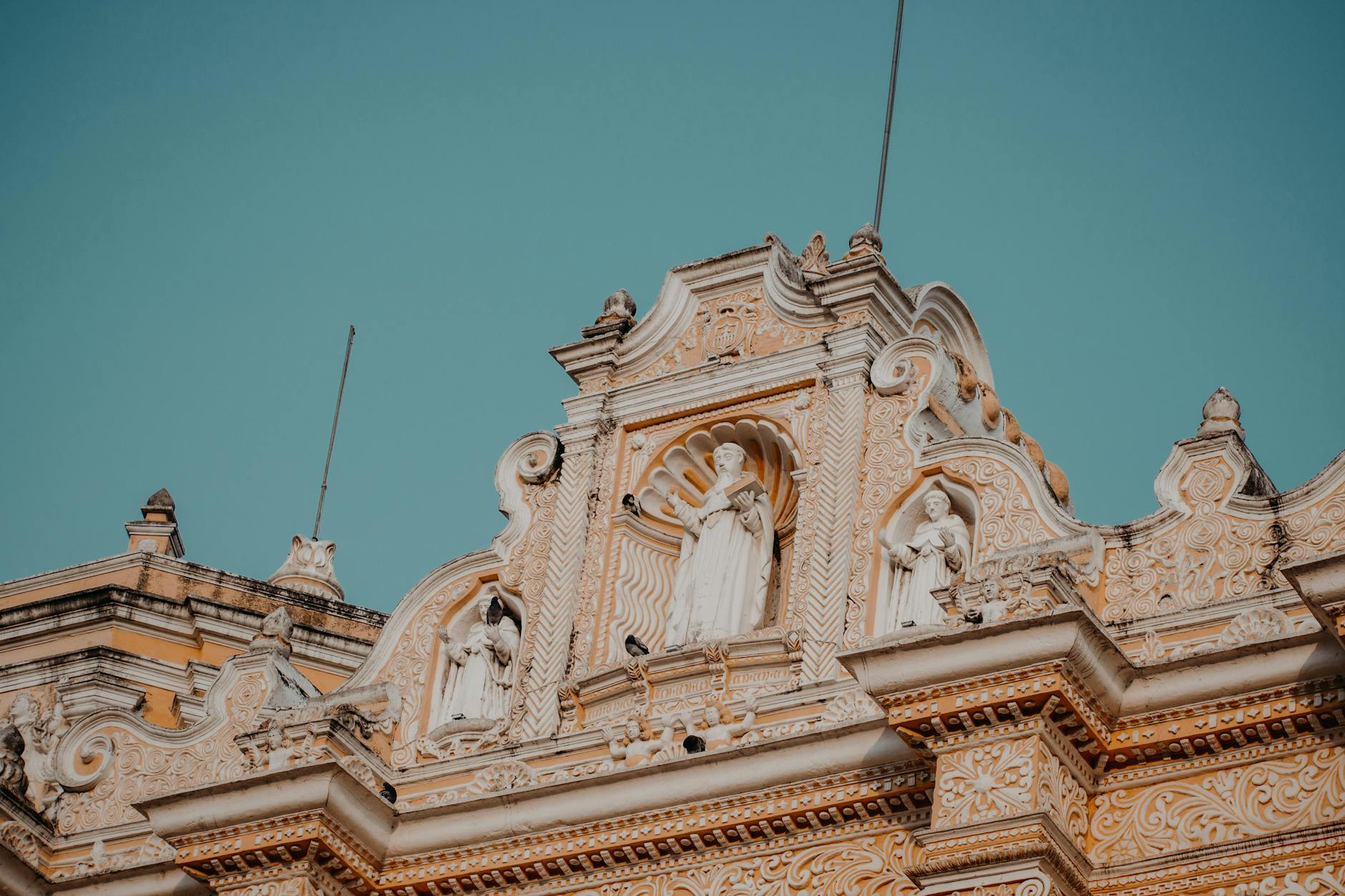
Guatemalan architecture has the decency not to pretend that history was stable. Antigua Guatemala wears its fractures openly: convent facades split by earthquakes, arcades rebuilt after ruin, domes that seem to have survived by wit rather than engineering. The city is colonial, yes, but the more interesting truth is that it is colonial architecture repeatedly corrected by seismic reality. Stone gives orders. Volcanoes revise them.
This is why the streets feel so dramatic. A baroque church front can rise at the end of a plain cobbled line as if theater had mistaken itself for masonry, and behind it Fuego or Acatenango may decide to enter the composition without asking anyone's permission. In Antigua Guatemala, the built world and the volcanic world conduct a long marriage of resentment and admiration.
Guatemala City tells another story. Much of Kaminaljuyú, one of the oldest Maya capitals in the region, disappeared beneath modern growth because adobe is mortal and real-estate pressure has poor manners. Yet fragments remain, and even the Montículo de la Culebra still cuts through the metropolis like an old sentence refusing deletion. Modern Guatemala has ancient foundations under its traffic.
Then the country opens toward Tikal, where architecture stops behaving like shelter and becomes vertical argument. Temple IV rises 64 meters above Petén forest, which is to say higher than many people can imagine until they see the canopy lying beneath it like green fur. Stone can pray. It can also dominate.
Guatemalan art is often worn before it is framed. The huipil is not decoration. It is text, territory, code, memory, and, in many communities, an argument for continuity made in thread. Colors do not merely flatter the eye. They identify a town, a lineage, a set of habits, the patience of the weaver, the discipline of repetition. Fashion elsewhere often advertises novelty. Here, cloth can advertise belonging.
That does not mean it is frozen. Quite the opposite. Markets in Chichicastenango and around Panajachel show tradition behaving like a living language: older motifs reworked for new buyers, ceremonial grammar translated into bags, belts, table runners, blouses, and compromises. Some pieces feel destined for a suitcase. Others have too much dignity for export.
Jade adds another register. Guatemala was the only source of jade in ancient Mesoamerica, which gives every polished green pendant a geological arrogance I find delightful. The stone carries pre-Columbian prestige into the present without ever becoming discreet. It wants to be seen. Quite right.
Even wooden masks, ceramics, and painted saints share this refusal of neutrality. Guatemalan art likes function, but it does not accept invisibility. It sits on the body, the altar, the wall, the market table. It says: this life had form, and someone cared enough to make it exact.
Guatemala packs 37 volcanoes into a country smaller than Tennessee. From Antigua Guatemala, you can watch Fuego throw sparks at night or hike Acatenango for one of Central America's sharpest dawns.
Tikal is the headline, and it earns it: 64-meter temples, toucans at dawn, and stone rising through Peten rainforest. But Guatemala's Maya story also runs through Guatemala City, where Kaminaljuyu survives inside the capital.
Chichicastenango is not quaint market theater. It is a working highland trading town where textiles, candles, masks, and ritual objects still move through a space shaped by K'iche' life.
Panajachel, San Pedro La Laguna, and Rio Dulce show how water organizes travel in Guatemala. One gives you volcanic lake villages and boats as public transport; the other leads into jungle canyon and the Caribbean.
Pepian, jocon, kak'ik, tamales in banana leaf, cardamom coffee, and Garifuna seafood give Guatemala a sharper food identity than most travelers expect. The country cooks with smoke, herbs, seeds, and patience.
Handwoven huipiles, carved masks, jade jewelry, and market ceramics are not souvenir wallpaper here. They carry regional codes, family labor, and techniques that still mark who made them and where.
12 cities — start with the ones we'd send you to first.
Baroque churches crumble photogenically into cobblestone streets where, during Semana Santa, entire neighborhoods spend days laying intricate sawdust-and-flower alfombras only to watch a procession of hundreds grind them
The sprawling capital holds the country's best museums, a walkable Art Nouveau zona viva, and the buried remnants of the ancient Maya city of Kaminaljuyú beneath its modern neighborhoods.
The main gateway to Lake Atitlán sits at the edge of a caldera where three volcanoes — San Pedro, Tolimán, and Atitlán — frame a lake so improbably beautiful that Aldous Huxley ran out of superlatives.
A lakeside village on the slopes of Volcán San Pedro where language schools, coffee cooperatives, and Maya Tz'utujil weavers occupy the same steep lanes as backpacker hostels.
Every Thursday and Sunday, K'iche' Maya traders fill the market around the Santo Tomás church, where copal smoke drifts past stalls selling textiles, vegetables, and ritual offerings in a commerce that has run continuous
Guatemala's second city — locals call it Xela — is a highland university town at 2,333 metres where the Spanish-language school scene is serious, the indigenous K'iche' culture is unapologetic, and the nearness of Volcán
A small colonial island town connected by causeway to the Petén mainland, Flores is the last comfortable bed most travelers sleep in before the 5 a.m. drive into the jungle to watch the sun rise over Tikal's Temple IV.
Howler monkeys wake the ruins before the guides arrive, and Temple IV — 64 metres of stacked limestone — breaks above the rainforest canopy in a view that requires no historical context to stop the breath.
Reachable only by boat at the mouth of the Río Dulce, this Garifuna town runs on punta music, coconut-based tapado stew, and a Caribbean tempo that feels like a different country from the highland Maya world four hours a
This is Guatemala's most legible first chapter: baroque ruins, cobbled streets, coffee farms and volcanoes that never let you forget where you are. Antigua Guatemala carries the colonial weight, while Guatemala City supplies the airport, museums, markets and the country's busiest urban pulse.
Lake Atitlan looks serene from a terrace and turns logistical the moment you start moving between villages. Panajachel is the transport hub, San Pedro La Laguna is the backpacker-social shore, and the whole basin runs on boats, market days, steep roads and weather that can shift within an hour.
The western highlands are cooler, denser and less polished than the Antigua circuit. Quetzaltenango has student energy, language schools and serious cafés; Chichicastenango and Huehuetenango pull you toward market towns, mountain roads and some of the country's strongest textile traditions.
Peten runs on heat, distance and early starts. Flores is the practical base, but Tikal is the reason most people come: 64-meter Temple IV above rainforest, howler monkeys before sunrise, then long roads or flights back to the rest of the country.
This is Guatemala's humid eastern corridor, where river transport matters more than road romance. Rio Dulce is the junction, Livingston brings Garifuna culture and seafood, and the shift in language, food and music is immediate once you reach the water.
Cobán anchors a greener, wetter interior where cloud forest, cardamom country and Q'eqchi' food traditions shape the trip. This region rewards travelers who do not mind curves, rain and slower transport, because the landscapes are lush and the pace is less stage-managed for outsiders.
From early Maya statecraft to the peace accords, Guatemala keeps every layer close to the surface.
Lake-core and environmental evidence in Peten points to early maize cultivation and controlled burning well before the great dynasties. Guatemala's first revolution was agricultural, and it made later cities possible.
In the valley of today's Guatemala City, Kaminaljuyu grows into a major center tied to obsidian trade and early political power. The modern capital will one day sit on top of this older one.
Sites such as Nakbe, El Mirador, and later San Bartolo show Guatemala as a workshop of early Maya kingship. Causeways, murals, and ceremonial architecture announce power on a startling scale.
A foreign-linked strongman called Siyaj K'ak', or Fire is Born, enters Tikal's history on the same day its ruler dies. It reads less like diplomacy than a takeover.
Nun Yax Ayin I is installed after the 378 upheaval, likely tied to Teotihuacan's ruling orbit. Tikal becomes local and foreign at once, a court under altered supervision.
Tikal's comeback begins under a ruler who will restore prestige through war and monument-building. The famous skyline later visitors admire is also a statement of recovered authority.
Late Classic inscriptions thin out and then cease. The forest does not conquer in one dramatic gesture; it advances slowly as courts weaken and ceremony loses its patrons.
After the lowland Classic age, strong states such as the K'iche' and Kaqchikel dominate the highlands. Power shifts rather than disappears, and rivalry becomes sharper.
The K'iche' capital emerges as one of the most formidable centers in the region. Its political weight is remembered with both pride and fear in later traditions.
Pedro de Alvarado's campaign breaks major K'iche' resistance, and later memory turns the fallen leader into Tecun Uman. History and legend meet on the battlefield.
Colonial administration consolidates the region within the Spanish imperial system. Church, crown, tribute, and urban planning begin to reorder daily life.
A series of destructive earthquakes devastates Santiago de Guatemala, today's Antigua Guatemala. The city's elegance survives, but political power will not stay.
The Spanish Crown shifts the capital after the earthquakes, creating the nucleus of modern Guatemala City. Antigua Guatemala is left with its ruins, cloisters, and ghostly grandeur.
Guatemala declares independence as imperial authority collapses across the region. Freedom arrives quickly on paper, but a stable republic proves far harder to build.
The Federal Republic of Central America fractures, and Guatemala moves toward a separate political destiny. Regional union gives way to local power struggles and caudillos.
Carrera turns military and rural support into durable authority. He will dominate Guatemalan politics for years and prove that control of the countryside matters more than constitutional elegance.
The Liberal Revolution transforms church-state relations, landholding, and export priorities. Coffee wealth expands, but so does coercion in the countryside.
Barrios, the great liberal strongman, dies while trying to force Central American reunification. His ambitions were imperial in scale; his reforms had already changed the country at a human cost.
A popular movement ends the Ubico dictatorship and opens a rare democratic spring. For a brief moment, reform looks possible without military tutelage.
Arbenz pushes agrarian reform and a more modern social contract. He becomes the central figure in Guatemala's most consequential Cold War confrontation.
A U.S.-backed intervention topples the government and ends the reformist experiment. The consequences echo for decades through repression, fear, and war.
Armed conflict erupts and will last for thirty-six years. The violence will fall with particular force on Maya communities and rural regions.
Her recognition gives international visibility to Indigenous suffering, memory, and demands for justice. Guatemala's buried pain becomes impossible to ignore abroad.
The formal end of the civil war closes one chapter but resolves far less than the ceremony suggests. Guatemala enters peace carrying graves, silences, and unfinished arguments.
The inscription recognizes a site that shows the transition between Olmec and Maya worlds. Guatemala's earliest layers continue to reshape how the country tells its own beginnings.
Origins and the First Courts
The painters of San Bartolo remain anonymous, yet their murals reveal court artists who already knew that politics works best when it borrows the language of gods.
Dawn comes up damp over Peten, smoke rising from fields cut out of thin tropical soil, and long before anyone spoke of lost cities, Guatemala was already a place of experiment. Maize cultivation and controlled burning are documented here well before 2000 BCE; the first drama was agricultural, almost domestic, yet it changed everything. A field became a village, a village became a court, and power learned to dress itself as ritual.
Ce que l'on ignore souvent, c'est que modern Guatemala City sits over one of the oldest great Maya centers in the region. Kaminaljuyu controlled trade routes and obsidian from El Chayal, that black volcanic glass sharper than metal and almost as valuable. Much of it was built in adobe, which is why so much disappeared under modern streets, shopping centers, and traffic; a capital quite literally paved over an older capital.
Then the Maya imagination grows theatrical. At San Bartolo, painters covered walls with myth and kingship centuries before the Classic age reached its full splendor; at Nakbe and El Mirador, causeways and ceremonial platforms announced that political power could be staged on a colossal scale. The newly identified Peten site nicknamed Los Abuelos has already altered the picture again: two ancestral sculptures, a ceremonial core, and the suggestion of an urban triangle scholars had not fully grasped.
This matters because Guatemala was never a provincial waiting room for greatness arriving from elsewhere. Here, the script of Maya rulership was being written in real time, with maize, blood, plaster, jade, and memory. And from that laboratory of power would rise a city whose name still carries thunder: Tikal.
A 4-kilometer Maya earthwork, the Monticulo de la Culebra, still cuts across parts of Guatemala City; many people pass it without realizing they are beside ancient engineering.
Classic Maya Ascendancy
Siyaj K'ak' is one of history's great dark arrivals: a man who steps out of the inscriptions and leaves an entire kingdom reordered.
Imagine the scene at Tikal in 378 CE: a royal court deep in the forest, a day heavy with heat, scribes watching the calendar, and suddenly a stranger enters the story with a name that sounds like an omen. Siyaj K'ak', "Fire is Born," arrives from the orbit of Teotihuacan, and the same day Tikal's reigning king dies. The inscriptions are dry; the effect is operatic.
For a long time, people preferred a polite version of this episode, a tale of influence and cultural exchange. The newer reading is harsher. Archaeology and epigraphy now point toward intervention, elite replacement, and a local dynasty forced to continue under foreign pressure, local faces perhaps, but under another hand on the shoulder.
Yet Tikal did not remain anyone's puppet forever. Later rulers turned recovery into spectacle, and one of them, Jasaw Chan K'awiil I, helped restore the city's prestige through war and monumental building. Those famous temple crests rising above the canopy were not quaint ruins when they were built; they were public arguments in stone, victory made visible.
Ce que l'on ignore souvent, c'est how slow the ending was. Courts thinned, monuments ceased, alliances broke down, and the forest began its patient counter-conquest branch by branch. But decline in the lowlands did not mean the end of Maya politics. It meant power would shift, harden, and reappear elsewhere, especially in the highlands.
A 2025 excavation at Tikal uncovered a 1,600-year-old altar with children's remains, strengthening the darker reading of Teotihuacan-linked power in the city.
Highland Kingdoms and the Spanish Conquest
Tecun Uman endures because Guatemala needed more than a defeated commander; it needed a face for dignity at the moment of disaster.
In the highlands, after the great southern lowland courts weakened, power did not vanish. It put on different clothes. Capitals such as Q'umarkaj, seat of the K'iche', ruled through tighter military structures, sharper rivalries, and memories preserved not only in stone but in chronicles, grievances, and lineage.
The conquest, when it came, was not a simple meeting of Spain and "the Maya," as if each were a single body. Pedro de Alvarado marched into a landscape already alive with enmities, negotiations, and old injuries. Indigenous allies mattered. Betrayal mattered. Disease mattered. The battlefield was political before it was military.
Here enters Tecun Uman, half history, half national legend, and therefore perhaps more revealing than a document alone. Pedro de Alvarado records the death of a great K'iche' leader; later tradition gave him a name, a horse-rider to oppose, and the aura of a fallen prince. Legend holds that he attacked not the man but the horse, never having seen such a beast in battle. Whether every detail is true matters less than what the story preserves: bewilderment, courage, and a catastrophe so large it had to become myth.
And still Spain did not finish the story quickly. In the north, the Itza kingdom around Nojpeten, on Lake Peten Itza near today's Flores, remained independent until 1697, astonishingly late. That long resistance explains much about Guatemala: conquest here was never one blow, but a chain of incomplete victories whose wounds would survive into the colonial world.
The last independent Maya kingdom in the region did not fall in the 16th century but in 1697, when Spanish forces finally took Nojpeten in Peten.
Colonial Splendor, Liberal Upheaval, and the Long 20th Century
Jacobo Arbenz was not the cardboard radical of Cold War caricature but a modernizing officer who believed a republic could be fairer, and paid dearly for that belief.
A convent cell, a cracked vault, a letter written after another tremor: colonial Guatemala was built with ceremony and fear side by side. Antigua Guatemala became the jeweled capital of the Kingdom of Guatemala, full of baroque facades, cloisters, silk, saints, and gossip, yet always under the shadow of earthquakes. Churches rose magnificently and then split open. Piety here had very practical reasons.
The Santa Marta earthquakes of 1773 changed the map of power. The Spanish Crown decided to abandon the ruined capital and move the seat of authority to what became Guatemala City, a colder administrative gesture than any romantic ruin-lover likes to admit. Antigua Guatemala survived almost by misfortune, left behind with its broken monasteries and grand facades, which is one reason it still feels like a stage after the actors have gone.
Independence came in 1821, but the republic that followed was anything but settled. Liberal reformers such as Justo Rufino Barrios remade landholding, weakened the Church, pushed coffee outward across the country, and tied national wealth to export agriculture with brutal efficiency. Ce que l'on ignore souvent, c'est who paid for elegance and progress: Indigenous communities stripped of communal lands, labor turned into obligation, and a countryside made to serve other people's fortunes.
Then the 20th century turned the screw. The democratic opening of 1944 brought hope under Juan Jose Arevalo and Jacobo Arbenz, only to be shattered by the 1954 coup. After that came decades of civil war, massacres, disappearance, and state terror, especially against Maya communities in the highlands around places such as Chichicastenango, Coban, Huehuetenango, and Quetzaltenango. Peace accords were finally signed in 1996, but peace is not amnesia; modern Guatemala still lives with the cost of land, race, memory, and silence.
The relocation from Antigua Guatemala to Guatemala City after the 1773 earthquakes preserved Antigua almost by administrative abandonment; ruin became heritage because power moved away.
Guatemala speaks in layers. Spanish runs through buses, bakeries, courtrooms, and radio jingles, yet in the highlands it often sits lightly on older foundations: K'iche', Kaqchikel, Q'eqchi', Mam. In Chichicastenango or around Cobán, a pause at a market stall can mean many things, and one of them is this: the first language in the room may not be the one you brought.
What seduces me is not noise but courtesy. Guatemala is lavish with small verbal bows. Permiso. Con permiso. Disculpe. Perdone. Muchas gracias. One hears them while someone reaches past a basket of avocados, steps off a bus, slips behind a chair, or asks for six tortillas and a little more recado. Civility here is not polish. It is traffic law for the soul.
And then there is the music of the chapin idiom. Cabal means exactly, yes, that fits, that lands where it should. Púchica can mourn, admire, curse, or laugh, depending on the mouth that throws it into the air. Chilero approves with style. Muchá gathers people the way a shawl gathers shoulders. A country reveals itself in slang. Guatemala does it with unusual grace.
Even formality has tenderness. Usted often comes before intimacy, not after distance. That is rare. In much of the world, warmth rushes forward and calls itself sincerity; here, respect arrives first, sets the table, and only then lets affection sit down.
A Guatemalan table understands hierarchy. Breakfast consoles, dinner negotiates, lunch reigns. Almuerzo is where the day admits what it wants: beans with gloss, rice with discipline, tortillas kept warm under cloth like living things, a recado dark enough to look almost secret. Pepián does not ask for your attention. It takes it.
The cuisine is built from elements so old they feel less invented than remembered: maize, black beans, tomato, tomatillo, chile, pumpkin seed, sesame, herbs, banana leaf. But old ingredients do not produce old food. They produce exact food. Kak'ik stains the spoon red and perfumes the air with coriander and turkey. Jocón moves in the opposite register, green and soft and herbal, the sort of sauce that makes speech unnecessary for several minutes.
What moves me most is the seriousness of wrapping. A tamal colorado sealed in banana leaf does not merely cook; it absorbs. Steam carries leaf, masa, meat, olive, maybe a raisin if the family believes in pleasure without apology. Chuchitos belong to the street, paches to Thursday, fiambre to the dead and therefore to memory. Every dish seems to know the hour, the feast day, the cousin, the grandmother, the mood.
In Antigua Guatemala, the plate often arrives framed by convent walls and baroque ruin; in Panajachel, by lake light; in Guatemala City, by traffic and appetite; in Livingston, by the Caribbean turning the sentence another way entirely. A country is a table set for strangers. Guatemala sets it with corn and keeps the fire low.
Guatemala is an expert in the art of not colliding. Streets narrow, buses fill, markets spill, saints process, and still people make room for one another with language before they make room with the body. Watch closely in Guatemala City at rush hour or in the lanes of Antigua Guatemala: someone passes with a sack of limes, someone shifts a plastic chair by three centimeters, someone apologizes for existing in your orbit. It is magnificent.
This etiquette has nothing servile about it. The point is not submission. The point is mutual survival with dignity intact. Crowded life can make people brutal; in Guatemala it often makes them precise. A vendor does not paw your sleeve. A customer does not bark. A greeting comes first. A refusal can be gentle. Even bargaining, where it exists, tends to happen with words that still remember they were raised indoors.
And yet the politeness is not soft. That would be the foreign misunderstanding. The country feels alert, almost watchful, as if everyone knows that ceremony is a form of structure and structure is what prevents chaos from entering through the side door. One says good morning. One asks permission. One thanks the person who has just handed over coffee, change, bread, directions, time.
I admire societies that spend their manners on ordinary moments. Anyone can be gracious at a wedding. The test is the bus step, the market elbow, the doorway. Guatemala passes that test several hundred times a day.
Religion in Guatemala does not stay inside buildings. It spills, smokes, kneels, bargains, sings, and carries weight through the street. Catholic processions, Maya offerings, evangelical certainty, candles in impossible colors, saints dressed for public emotion: the country treats the invisible as something with logistics. During Semana Santa in Antigua Guatemala, alfombras of dyed sawdust and pine needles appear underfoot like temporary theology, then vanish beneath the feet of the procession that justified their existence for one splendid hour.
What fascinates me is the coexistence of systems that never fully dissolved into one another and never fully separated either. In highland churches, a candle may burn in a Catholic nave while the gesture around it belongs to an older cosmology, one that still grants mountains, ceiba trees, and ancestors their offices. The result is not confusion. It is density.
At Chichicastenango, the steps of Santo Tomás hold smoke the way memory holds contradiction. Incense rises. Pine needles crackle. Vendors call. Prayer persists. Christianity arrived with conquest, but devotion in Guatemala long ago became too local to remain imported. The saints learned the terrain or they would not have lasted.
A religion reveals its character by what it does with matter. Guatemala uses flowers, fire, cloth, wood, resin, brass bands, and human shoulders. Belief here is tactile. You smell it before you name it.
Guatemalan architecture has the decency not to pretend that history was stable. Antigua Guatemala wears its fractures openly: convent facades split by earthquakes, arcades rebuilt after ruin, domes that seem to have survived by wit rather than engineering. The city is colonial, yes, but the more interesting truth is that it is colonial architecture repeatedly corrected by seismic reality. Stone gives orders. Volcanoes revise them.
This is why the streets feel so dramatic. A baroque church front can rise at the end of a plain cobbled line as if theater had mistaken itself for masonry, and behind it Fuego or Acatenango may decide to enter the composition without asking anyone's permission. In Antigua Guatemala, the built world and the volcanic world conduct a long marriage of resentment and admiration.
Guatemala City tells another story. Much of Kaminaljuyú, one of the oldest Maya capitals in the region, disappeared beneath modern growth because adobe is mortal and real-estate pressure has poor manners. Yet fragments remain, and even the Montículo de la Culebra still cuts through the metropolis like an old sentence refusing deletion. Modern Guatemala has ancient foundations under its traffic.
Then the country opens toward Tikal, where architecture stops behaving like shelter and becomes vertical argument. Temple IV rises 64 meters above Petén forest, which is to say higher than many people can imagine until they see the canopy lying beneath it like green fur. Stone can pray. It can also dominate.
Guatemalan art is often worn before it is framed. The huipil is not decoration. It is text, territory, code, memory, and, in many communities, an argument for continuity made in thread. Colors do not merely flatter the eye. They identify a town, a lineage, a set of habits, the patience of the weaver, the discipline of repetition. Fashion elsewhere often advertises novelty. Here, cloth can advertise belonging.
That does not mean it is frozen. Quite the opposite. Markets in Chichicastenango and around Panajachel show tradition behaving like a living language: older motifs reworked for new buyers, ceremonial grammar translated into bags, belts, table runners, blouses, and compromises. Some pieces feel destined for a suitcase. Others have too much dignity for export.
Jade adds another register. Guatemala was the only source of jade in ancient Mesoamerica, which gives every polished green pendant a geological arrogance I find delightful. The stone carries pre-Columbian prestige into the present without ever becoming discreet. It wants to be seen. Quite right.
Even wooden masks, ceramics, and painted saints share this refusal of neutrality. Guatemalan art likes function, but it does not accept invisibility. It sits on the body, the altar, the wall, the market table. It says: this life had form, and someone cared enough to make it exact.
He stands at the hinge between document and legend. Spanish accounts confirm the death of a major K'iche' leader in 1524; later memory turned him into Tecun Uman, the prince who charged at conquerors and became the country's most enduring face of resistance.
He enters Guatemalan history in armor and leaves it covered in lawsuits, grudges, and blood. His campaigns succeeded not by Spanish steel alone but by exploiting rivalries among Indigenous polities already locked in hard politics.
Old, indignant, and determined to correct everyone else's version, he wrote much of his great chronicle in Santiago de Guatemala, today's Antigua Guatemala. Thanks to him, conquest survives not only as imperial triumph but as complaint, vanity, memory, and self-justification.
A former pig herder became the man who broke liberal dreams and built a conservative order that lasted decades. Carrera understood something his rivals did not: in Guatemala, power belongs to the person who can command the countryside, not merely write constitutions in Guatemala City.
Barrios liked progress in uniform, and he pushed it hard. Roads, exports, and secular reform moved forward under him, but so did land seizures and labor coercion; the modern state he strengthened was paid for by people who never appeared in the official portrait.
She wrote with wit sharp enough to trouble powerful men, which is usually a sign of real talent. In a political world crowded with generals, she reminds you that Guatemalan history was also shaped in salons, on paper, and through ridicule.
Asturias took Maya cosmology, urban unease, and political brutality and made them sing in prose. His Guatemala is never folklore for export; it is feverish, proud, wounded, and alive with the voices official history prefers to tidy away.
He tried to do the dangerous thing in Latin America: modernize land ownership without asking permission from entrenched power. His fall in 1954 became one of the great Cold War turning points, and Guatemala paid the bill for decades.
She forced the world to hear what many in Guatemala had long tried not to hear. Her life and testimony made the suffering of Maya communities during the civil war impossible to dismiss as rumor, abstraction, or collateral damage.
This is the short, sensible first trip: land in Guatemala City, sleep lightly, then shift to Antigua Guatemala for walkable streets, churches and easy volcano views. It works best if you want history, food and logistics that do not waste half the trip in transit.
Start on the lake in Panajachel, cross to San Pedro La Laguna for slower days and big volcano silhouettes, then finish with market and highland city time in Chichicastenango and Quetzaltenango. This route gives you Maya market culture, cooler air and the kind of bus-and-boat rhythm that feels distinctly Guatemalan.
Begin in Flores, go early to Tikal before the heat rises, then swing southeast to Rio Dulce and Livingston for jungle water, Garifuna cooking and a completely different coast. The jump from temple plazas to river canyons is the point. Guatemala changes fast when you cross regions.
This is the overland route for travelers who do not need the obvious circuit. Cobán gives you cool coffee-country weather and access to Alta Verapaz food traditions, while Huehuetenango opens a tougher, less polished corner of the western highlands. Distances are longer, but the payoff is a trip that feels closer to lived Guatemala than to a standard shuttle loop.
Midday table. Spoon first, tortilla next. Family circles, sauce collects, talk slows.
Feast bowl, turkey broth, white tamalitos. Broth sips, meat follows, elders linger.
Thursday dusk. Banana leaf unwraps. Hands tear, coffee follows, office or family gathers.
November 1. Cold plate, long table, cousins compare, dead relatives return in conversation.
Market noon, bus stop, plaza bench. Husk opens, fingers eat, salsa drips, cheese falls.
Morning ritual. Eggs, black beans, plantain, crema, cheese, tortillas, coffee. Families begin again.
Merienda hour. Sweet plantain splits, bean paste hides, sugar dusts, children wait, mouths burn.



U.S., Canadian, U.K. and EU passport holders can usually enter Guatemala visa-free for up to 90 days. That 90-day limit is shared across the CA-4 countries: Guatemala, El Salvador, Honduras and Nicaragua. Carry proof of onward travel, your first hotel address and a passport with at least 6 months left to avoid arguments at check-in.
Guatemala uses the quetzal, written GTQ. Cards work in Guatemala City, Antigua Guatemala, Panajachel and Flores, but markets, tuk-tuks, lake boats and many small guesthouses still want cash. Restaurant bills often include 12% IVA already; check whether servicio is included before adding a 10% tip.
Most international arrivals land at La Aurora International Airport in Guatemala City. Mundo Maya Airport in Flores is the useful shortcut if your trip is really about Tikal and the Peten lowlands. For short holidays, flying straight to Flores can save a full day of bus time.
Guatemala has no passenger rail network, so your real choices are shared tourist shuttles, long-distance buses, domestic flights, boats and private drivers. Tourist shuttles work well on the classic routes linking Antigua Guatemala, Panajachel, Cobán and Flores. Chicken buses are cheap and memorable, but they are the slowest, roughest option if you have luggage.
Weather here is ruled by altitude more than latitude. Antigua Guatemala, Panajachel and Quetzaltenango stay mild for most of the year, while Tikal and Livingston run hot and humid. Dry season from November to April is the easiest window for volcano hikes, road travel and clear mornings at ruins.
4G coverage is solid in cities and on the main tourist circuit, with Tigo and Claro the two names you will see everywhere. Expect weaker service on mountain roads, in some lake villages and inside parts of Peten. Download maps before long transfers and keep some cash in case card terminals drop offline.
The workable rule is simple: move in daylight, use booked transport for long distances and do not flash phones or cash in bus terminals. Guatemala City needs more caution than Antigua Guatemala or Flores, especially after dark. For volcano hikes, lake crossings and remote ruins, go with registered operators and ask locally about current road and weather conditions.
Break larger quetzal notes in supermarkets or chain cafés before heading to markets, boats or bus stations. Drivers and stallholders often do not have change for GTQ 200 notes early in the day.
If you have 10 days or less and Tikal is non-negotiable, fly between Guatemala City and Flores. The flight costs more, but it saves an overnight bus or a punishing full day on the road.
Shared tourist shuttles between Antigua Guatemala, Panajachel, Cobán and Flores do fill up in dry season and around Semana Santa. Reserve at least a day ahead if you need a specific departure time.
Guatemala does not have a functioning passenger rail system. If an online planner suggests a train, you are looking at outdated data or a historical curiosity, not a real option.
Start formal in Spanish, especially with older people, hotel staff and drivers. Guatemala leans polite, and a quick "buenos dias" and "con permiso" will smooth more interactions than casual slang.
The best-value set meals usually appear at lunch, not dinner. If you want pepian, jocon or kak'ik without restaurant markups, look for comedores serving the midday menu.
Antigua Guatemala during Semana Santa is not a place for last-minute improvisation. Rooms can disappear months ahead, and prices jump hard across the city and nearby villages.
Explore Guatemala with a personal guide in your pocket
Audio guides for 1,100+ cities across 96 countries. History, stories, and local insight — offline ready.

No, most U.S. citizens can enter Guatemala visa-free for up to 90 days. That stay is counted across the CA-4 countries, so time spent in El Salvador, Honduras or Nicaragua uses the same 90-day clock.
No, by regional standards Guatemala is still fairly affordable. Budget travelers can get by on about US$25-45 a day, while mid-range trips with private rooms, shuttles and a few tours usually land around US$60-100 a day.
Yes, sometimes, but you should not rely on it outside tourist-facing businesses. Hotels and some tour operators may quote in U.S. dollars, while markets, local restaurants, tuk-tuks and small transport almost always work better in quetzales.
Antigua Guatemala is better for atmosphere, walkability and a short leisure trip; Guatemala City is better for first-night logistics, business and museum time. Many travelers do one night near the airport, then move to Antigua Guatemala the next morning.
Most people go by shuttle, private transfer or organized dawn tour from Flores. The road trip usually takes about 1.5 to 2 hours each way, which is why early departures matter if you want cooler temperatures and wildlife activity.
Yes, if your schedule is tight. Flying from Guatemala City to Flores saves a huge amount of time and makes Tikal realistic even on a 7- to 10-day trip, while the bus only makes sense if you are on a tighter budget or want the overland route.
January and February are the easiest all-round months for most travelers. They sit in the dry season, which means clearer mornings in Antigua Guatemala, better hiking conditions and less risk of transport delays in Peten and the highlands.
Yes, with judgment and daylight logistics. Independent travel is common on the Antigua Guatemala, Panajachel, Flores and Tikal circuit, but bus terminals, late-night arrivals and remote roads deserve more care than the postcard towns do.
Yes, absolutely. Panajachel has ATMs and wider card acceptance, but boats, small cafés, market stalls and many guesthouses in villages around the lake still work best in cash.
Last reviewed