Plan and listen to Hamza Bey Mosque with Audiala.
Audio guide in your pocket, itinerary in your browser. Built for the way you actually visit.
Introduction
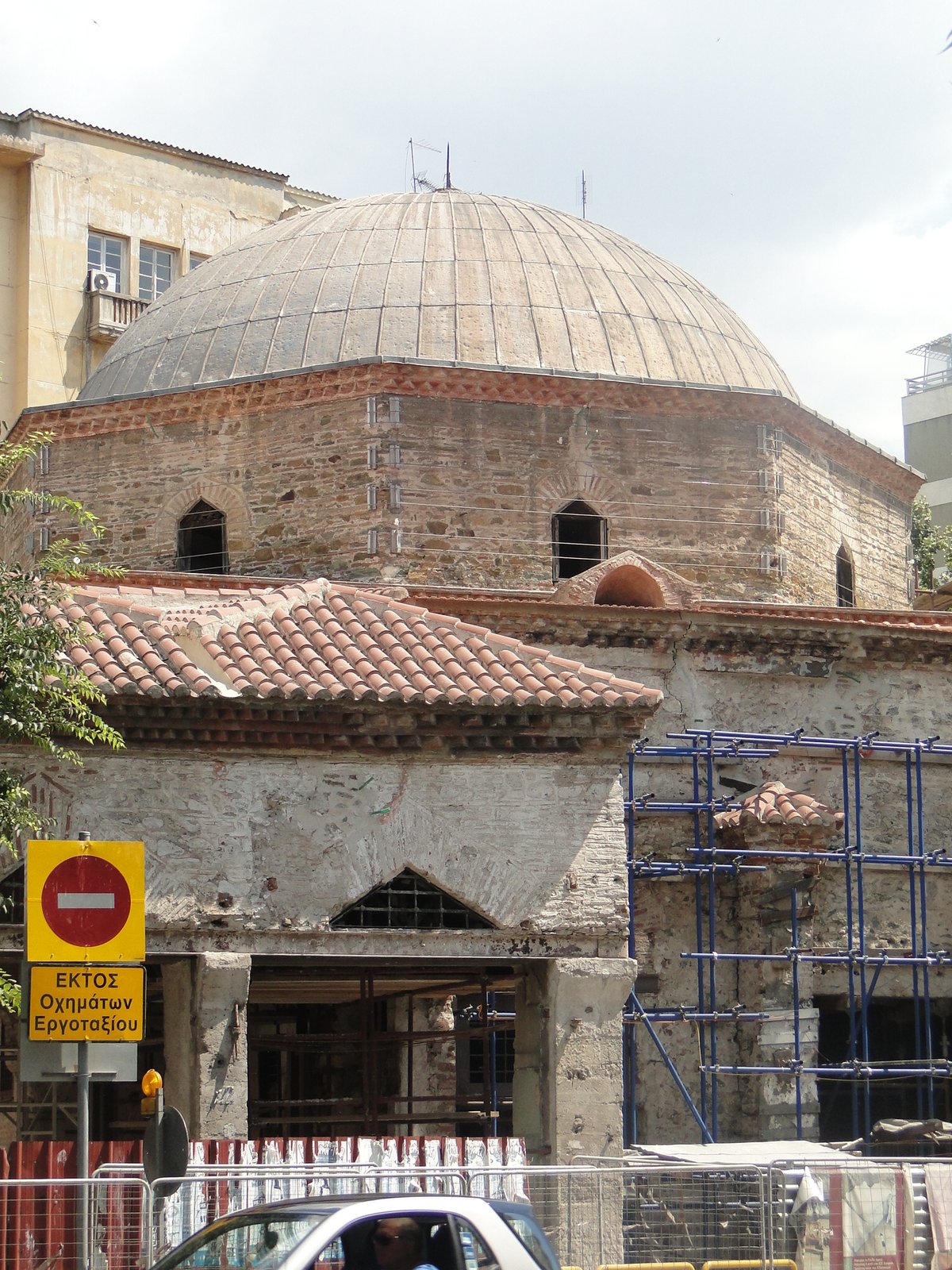
At the bustling intersection of Egnatia and Venizelou streets, the Hamza Bey Mosque stands as Thessaloniki’s most significant Ottoman monument and the largest surviving Ottoman mosque in Greece. Erected in 1467, this architectural landmark—locally called "Alkazar"—captures centuries of the city’s multicultural history, having served as a religious, educational, and social center for the Ottoman community and later as a cinema. Today, ongoing restoration aims to transform the mosque into a museum and cultural venue, offering visitors a vivid connection to Thessaloniki’s layered past (Greek Ministry of Culture; Greek City Times).
This guide provides an in-depth look at the Hamza Bey Mosque’s history, architecture, cultural significance, visitor information, and restoration journey, equipping travelers and history enthusiasts with everything needed to appreciate this emblematic Thessaloniki historical site (Visit Central Macedonia; UNESCO).

Origins and Foundation
Commissioned in 1467 by Hafsa Hatun, daughter of Ottoman commander Hamza Bey, the mosque marked the transformation of Thessaloniki into an Ottoman urban hub. As one of the earliest Islamic religious structures in Thessaloniki, it was central to the city’s Muslim community, serving both spiritual and civic functions through its original complex, which included a madrasa (Islamic school), shops, and a fountain (Greek Ministry of Culture).
Architectural Significance
Design and Structure
Hamza Bey Mosque exemplifies early Ottoman religious architecture, fusing Byzantine influences with distinctive Ottoman elements. The main square prayer hall measures approximately 11.54 x 11.54 meters and is crowned by a 16-meter diameter dome set upon an octagonal drum, allowing ample natural light. The original layout also included a colonnaded courtyard and a portico (revak) with small domes, which mediated the transition from the bustling street to the serene prayer hall (Thessaloniki Tourism; Visit Central Macedonia).
Decorative Elements
Although many decorative features have not survived, the mosque originally boasted intricate tilework, calligraphic inscriptions, and stone carvings. The marble mihrab and minbar remain as testaments to the artisanship of the era. The mosque’s slender minaret, visible in early photographs, was demolished in the 20th century (Ephorate of Antiquities of Thessaloniki).
Historical Transformations
Ottoman Era
The mosque was the focal point of Thessaloniki’s Muslim community, strategically located on Egnatia Street. Its endowment supported a complex urban center, integrating religious, educational, and commercial functions (Greek Ministry of Culture).
Post-Ottoman Uses
With Thessaloniki’s incorporation into Greece in 1912 and the population exchange of 1923, the mosque was deconsecrated. In 1928, it became the "Alkazar" cinema, leading to significant interior modifications (Thessaloniki Tourism).
Damage and Restoration
The mosque suffered during WWII and sustained serious damage from the 1978 earthquake. It was declared a protected monument in 1926, with restoration efforts commencing in the early 2000s to stabilize the structure and reveal original features (Greek Ministry of Culture).
Cultural Heritage and Contemporary Role
Hamza Bey Mosque stands as a monument to Thessaloniki’s multicultural and cosmopolitan identity. Its presence in the cityscape is a reminder of centuries marked by coexistence among Greeks, Jews, and Ottomans (UNESCO). Today, the mosque serves as a venue for cultural events and exhibitions, fostering public understanding of the city’s Ottoman legacy (Thessaloniki Tourism). Ongoing archaeological research continues to uncover the site’s complex historical layers (Ephorate of Antiquities of Thessaloniki).
Visiting Information
Hours & Tickets
- Opening Hours: Tuesday to Sunday, 9:00 AM – 5:00 PM. Closed on Mondays and public holidays.
- Admission: Free of charge as a protected monument; donations are welcome.
Accessibility & Tours
- Accessibility: The mosque is wheelchair accessible, with ramps and smooth pathways. Assistance is available upon request.
- Guided Tours: Available by arrangement through the Thessaloniki Tourism office. Audio guides and virtual tours are also becoming available.
Location & Nearby Sites
- Address: Intersection of Egnatia and Venizelou streets, central Thessaloniki.
- How to Get There: Easily accessible by metro (Venizelou station), city bus, or on foot from main city squares.
- Nearby Attractions: The Rotunda, Arch of Galerius, White Tower, Byzantine Walls, and the Archaeological Museum of Thessaloniki.
Special Events
The mosque hosts cultural exhibitions and events year-round. For a current schedule, check the Thessaloniki Tourism website.
Restoration Timeline & Adaptive Reuse
A €11 million restoration project launched in 2023—funded by the Recovery and Resilience Fund—aims for completion in 2026 (ekathimerini.com; milletnews.com). Restoration activities include structural stabilization, removal of non-original additions, and conservation of historical features (cosmosphilly.com; Greek Reporter). The completed project will see the mosque function as a museum and cultural venue, with exhibitions featuring artifacts from nearby metro excavations and interpretive displays on Ottoman Thessaloniki (middleeasteye.net).
FAQs
Q: What are the current visiting hours?
A: Tuesday to Sunday, 9:00 AM–5:00 PM. Closed Mondays and public holidays.
Q: Is there an entry fee?
A: No, admission is free.
Q: Are guided tours available?
A: Yes, by contacting Thessaloniki Tourism. Audio and virtual guides are also available.
Q: Is the mosque accessible for people with disabilities?
A: Yes, with ramps and accessible facilities.
Q: What other historical sites are nearby?
A: The Rotunda, Arch of Galerius, White Tower, and the Archaeological Museum of Thessaloniki.
Q: Can I take photos inside?
A: Photography is allowed, but flash and tripods may be restricted during restoration.
Key Facts at a Glance
- Date of Construction: 1467
- Original Patron: Hafsa Hatun, daughter of Hamza Bey
- Dome Diameter: 16 meters
- Protected Status: Declared a monument in 1926
- Restoration: Ongoing, with museum opening projected for 2026
- Admission: Free; guided tours available
- Accessibility: Wheelchair accessible
- Nearby Attractions: Rotunda, Arch of Galerius, White Tower
Listen to the full story in the app
The whole Hamza Bey Mosque,
told well.
Audio guides for 1,100+ cities across 96 countries. History, stories, and local insight — offline ready.
Verified, and shown.
Researched and written by the Audiala editorial team from historical records, architectural archives, and local expertise.
Researched from Wikidata, Wikipedia & official sources · fact-checked · How we make our guides →