An introduction.
Researched by the Audiala editorial team from historical records, architectural archives, and local expertise.
OOver 107,000 Cretans were conscripted to build the fortress meant to protect them. The Fortezza of Rethymno, crowning Paleokastro hill above Rethymno's old town in Greece, is what remains of that bargain — a Venetian citadel completed by 1580 and declared defective by 1602. The views from its ramparts reach the Cretan Sea, but the real reason to climb this hill is the story compressed into every limestone block: colonial ambition, forced labor, and a 45-day siege that ended three centuries of Venetian rule.
The fortress sprawls across the hilltop like a small walled town — because that was the original plan. Venetian engineers intended to demolish old Rethymno and relocate the entire population inside these walls, but the hilltop turned out to be too small. The Fortezza became a citadel for colonial administrators, not a shelter for the people who quarried its stone.
Inside, the dome of the former Cathedral of St. Nicolas — converted into the Mosque of Sultan Ibrahim Han after the Ottoman conquest of 1646 — dominates everything. Around it: the ruins of barracks, storehouses, a residence that may or may not have been the bishop's palace, and cisterns whose full network has never been systematically mapped.
Restoration has been underway since the early 1990s, more than three decades without an announced completion date. The Fortezza is not a polished museum piece. It's a ruin still revealing itself, one archaeological layer at a time.
01 What to see.
Sultan Ibrahim Mosque
Before it was a mosque, it was a cathedral dedicated to St. Nicholas. Before that, the hill beneath it held a sanctuary to Artemis. Three faiths, one foundation — and the dome that rises above the fortress grounds carries all of them. Built by Venetian hands, rededicated under Ottoman rule, the building is the only substantial roofed structure left inside the Fortezza's 13-hectare perimeter, an area roughly the size of 18 football pitches.
Step inside and the temperature drops immediately. After the bleached glare of the open courtyard, your eyes take a moment to adjust. The dome creates an acoustic chamber that folds sound back on itself — speak at normal volume and your voice returns to you from the curved ceiling, slightly delayed, slightly changed. The space is modest in footprint but feels larger than it is, a trick of vertical proportion the original Venetian architects understood well.
Look for the seams where one civilization handed the building to the next. A blocked window here, a shifted arch there. The conversion wasn't erasure — it was adaptation, and both architectural identities remain legible if you know where to read.
The Sea-Facing Bastions
The Venetians built the Fortezza starting in 1573, two years after the pirate Uluç Ali burned Rethymno to the ground. They were not being cautious. They were terrified. Four angular bastions project from the perimeter walls — a Renaissance defensive innovation designed to eliminate blind spots and deflect cannonfire along the wall face rather than absorbing it head-on. The engineering is Italian. The urgency was very local.
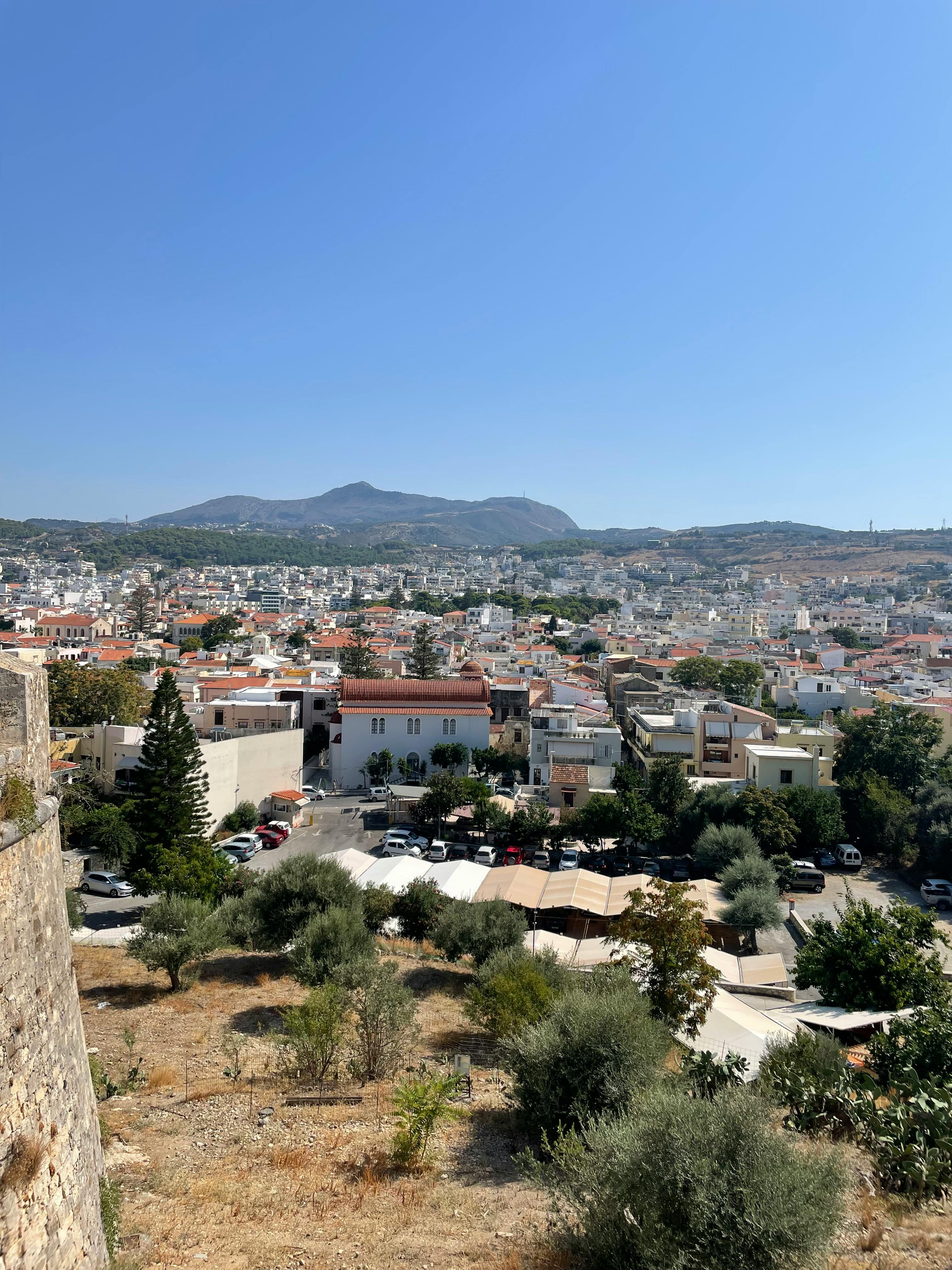
Climb to the northwest bastion and the reward is immediate. The Cretan Sea fills the horizon ahead. Below, the curve of Rethymno's harbor traces a crescent, the Venetian lighthouse marking its tip. Turn inland and Mount Ida rises behind the town, snow still visible on its peak well into May. The wind up here is constant and strong enough to make conversation difficult — which is partly why this stretch of wall stays emptier than the main courtyard.
Run your hand along the parapet. The honey-colored limestone is warm in afternoon sun, pitted and rough from centuries of salt wind. At the corners, the edges have softened into curves. No restoration crew did this. The sea did.
The Quiet Corners: Storage Rooms, Cisterns, and Cats
Most visitors photograph the mosque, walk the main wall, and leave. They miss the best parts. Along the inner perimeter, Venetian storage rooms with low arched ceilings sit half-hidden in the wall's thickness — former military magazines where the air is cool and damp even in August, carrying the mineral smell of enclosed limestone. The compression of these spaces after the vast open courtyard is a physical sensation, like stepping into a cellar.
Scattered across the grounds, cistern openings sit flush with the earth, easy to walk over without noticing. They mark where the fortress's water infrastructure once sustained an entire population — the Fortezza was designed as a self-contained town, not just a defensive wall. And threading through it all, a colony of semi-feral cats occupies the quietest, most sheltered recesses. Follow them. They have spent generations finding the coolest shade, the most protected alcoves, the spots that casual visitors never reach. Look down at doorway thresholds as you go — the stone is worn into deep concave grooves by centuries of foot traffic. Everyone photographs the arches above. The real history is underfoot.
02 In pictures.


Plan and listen to Fortezza Of Rethymno with Audiala.
Audio guide in your pocket, itinerary in your browser. Built for the way you actually visit.
03 Visitor logistics.
The practical scaffolding for a good visit — kept short.
Getting There
The Fortezza crowns Paleokastro hill on the northwest edge of Rethymno's Old Town — a 10-minute uphill walk from the Venetian Harbour. No bus needed; just follow the narrow streets upward until the walls loom above you. Drivers will find parking near the entrance, though spaces fill fast in summer.
Opening Hours
As of 2026, the Fortezza opens daily from 8:00 AM, with closing around 7:15 PM in the warmer months. Winter hours may be shorter — check locally at rethymno.gr before a November or February visit. The site is an open-air ruin, so bad weather can effectively close it even when the gate is open.
Time Needed
Budget 45 minutes if you just want the mosque and the views. But the walls stretch 1,307 meters — longer than 12 football pitches laid end to end — and a proper exploration of the bastions, storage vaults, and sea-facing ramparts takes a solid 1.5 to 2 hours.
Tickets
As of 2026, adult entry is €5, paid at the gate — no online booking system exists. Concession prices and free-entry days are not well advertised; ask at the ticket window. The Archaeological Museum in the Ottoman ravelin at the entrance may require a separate ticket.
Accessibility
The fortress grounds are rough — unpaved, uneven, rocky paths across a large hilltop site with no elevators or ramps. Wheelchair access is extremely limited at best. Sturdy closed-toe shoes are non-negotiable here; sandals will punish you on the loose stone.
04 Tips for visitors.
Small things that change the day.
Time Your Visit
Go at sunrise or in the last two hours before closing. Midday in summer turns the exposed stone into a reflector oven — almost no shade exists inside the walls, and the hilltop catches every degree of heat.
Eat in the Backstreets
Skip the harbour-front restaurants directly below the fortress — they charge tourist premiums for average food (€15–30). Walk two streets inland toward Ethnikis Antistaseos for Cretan tavernas at half the price, where the dakos and kalitsounia are made for locals, not cruise passengers.
Drone Rules Apply
Handheld photography is unrestricted, but drone flights over Greek Ministry of Culture archaeological sites require prior authorization. Don't risk a fine — apply to the Ministry before your trip if aerial shots matter to you.
Pair with the Museum
The Archaeological Museum of Rethymno sits in the Ottoman ravelin right at the Fortezza's main gate — you'll walk past it entering and leaving. Combining the two takes under three hours and gives the fortress ruins the context that the site's own sparse signage doesn't provide.
Walk the Sea Walls
Most visitors photograph the mosque, glance at the view, and leave. The real reward is the sea-facing ramparts on the north side — quieter, windswept, with unobstructed views across the Cretan Sea that make the inland panorama look tame.
Check the Theatre Schedule
The Erofili open-air theatre inside St. Elias Bastion hosts performances in summer — named after a 17th-century Cretan tragedy written during Venetian rule. Watching theatre inside the fortress that inspired the play is the kind of coincidence Rethymno does well. Check listings at rethymno.guide.
Where to Eat
Don't Leave Without Trying
Terrazza
local favoriteOrder: Grilled octopus with fava purée, dakos (barley rusk with tomato and mizithra), and whatever fresh fish is on the daily specials board.
Terrazza is the most-reviewed spot in this guide and sits right in the heart of Rethymno's Old Town alleys—locals and travelers alike trust it for honest, well-executed Mediterranean fare without pretense. The harbor views and relaxed vibe make it perfect for a long lunch or sunset dinner.
Sunset Restaurant
local favoriteOrder: Lamb with stamnagathi (wild Cretan chicory), kalitsounia (cheese pastries), and grilled shrimp. End with loukoumades and complimentary raki.
With over 730 reviews, Sunset Restaurant is the most-reviewed establishment on this list—a clear sign that it delivers consistently good Cretan cooking without pretension. The long hours (9:30 AM–11:30 PM) make it reliable whenever hunger strikes.
Geppetto
local favoriteOrder: Mediterranean small plates, fresh salads, and local cheese boards paired with Greek wine or craft cocktails.
Geppetto is a cooperative-run bar with the highest rating (4.6) on this list and a strong local following. It's the kind of place where you can linger over drinks and light bites in the heart of the Old Town, with genuine warmth and no tourist-trap vibes.
Kaloumba cafe Bar
cafeOrder: Greek coffee, pastries, and light snacks in the morning; cocktails and mezze in the evening.
Kaloumba has the highest rating (4.7) on this list and is perfectly positioned for a pre- or post-Fortezza coffee break. It's the kind of neighborhood spot where regulars gather, making it ideal for soaking up authentic Old Town atmosphere.
Dining Tips
- check Raki etiquette: Complimentary raki at the end of meals is standard practice at traditional tavernas—accept it as a cultural gesture, not an upsell.
- check Vegetarian-friendly: Many Cretan dishes are naturally meat-free, especially during Greek Orthodox fasting periods. Don't hesitate to ask.
- check Timing matters: Old Town restaurants get busy after 8 PM on weekends; arrive early or book ahead if you prefer a quieter experience.
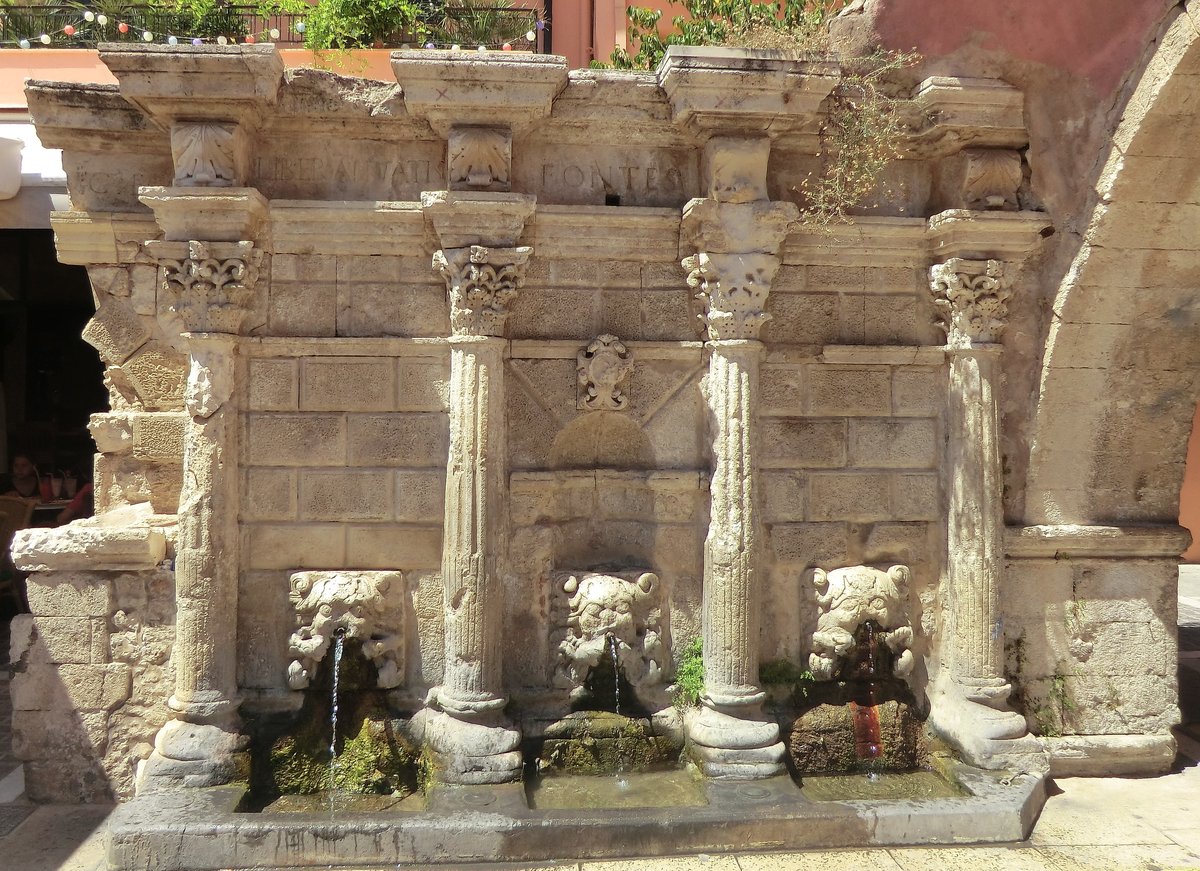
- check The Rimondi Fountain area (5-min walk from Fortezza) is the densest cluster of cafes, tavernas, and food vendors—a natural hub for browsing and eating.
Restaurant data powered by Google
05 A history of reinvention.
The Fortress That Failed Twice
Every stone in the Fortezza records a calculation about who mattered and who didn't. Venice spent the sixteenth century trying to hold Crete — its largest and most profitable colony — against an Ottoman Empire methodically dismantling Venetian possessions across the eastern Mediterranean. Rethymno, the island's third city, sat exposed on the north coast with no deep harbor and no terrain steep enough to discourage a landing.
The Republic's answer was to build. First walls around the city, then — when those failed spectacularly — a hilltop citadel above it. Both projects consumed Cretan labor and Venetian silver. Neither worked.
Sforza Pallavicini and the Impossible Brief
In 1573, military engineer Sforza Pallavicini received a commission shaped by desperation. Two years earlier, the Ottoman corsair Uluç Ali had sacked Rethymno with forty galleys, exposing Venice's coastal defenses as fiction. Cyprus had fallen the same year. Crete was now Venice's last major overseas territory, and Pallavicini was told to design a star-fort on Paleokastro hill large enough to shelter Rethymno's entire population — a fortress that, if it failed, would mark the end of the Republic's eastern empire.
Cretan master builder Giannis Skordilis directed the physical work: 107,142 conscripted laborers and 40,205 requisitioned pack animals, according to contemporary records. These were not volunteers. A colonial population denied full political rights was quarrying, hauling, and laying limestone for a citadel designed to protect their rulers first and themselves as an afterthought.
The design was compromised almost immediately. Venetian officials decided the hilltop was too small to house the whole city, abandoning Pallavicini's original concept mid-construction. Completed by 1580, the fortress lacked a proper defensive ditch and had ramparts its own commissioners judged too low. When the Ottoman siege came in September 1646, disease and starvation gutted the garrison, and the Fortezza held for exactly 45 days before surrender on 13 November. Pallavicini's fortress, built to save an empire, had bought it seventy years.
The Day the First Walls Fell
From Cathedral to Mosque in a Single Act
Listen to the full story in the app
The whole Fortezza Of Rethymno,
told well.
Audio guides for 1,100+ cities across 96 countries. History, stories, and local insight — offline ready.
06 Frequently asked.
The questions travellers send us most about Fortezza Of Rethymno.
Is the Fortezza of Rethymno worth visiting?
Yes — it's the single best place in Rethymno to understand why this city looks and feels the way it does. The panoramic views from the sea-facing bastions sweep across the Cretan Sea, the Venetian harbour below, and on clear days reach the snow-capped peak of Mount Ida inland. Come for the history — Venetian walls, an Ottoman mosque built inside a converted cathedral, and ruins layered over a 2,000-year-old settlement — but stay for the atmosphere of walking through a fortress that 107,000 conscripted Cretans built with their hands between 1573 and 1580.
How long do you need at the Fortezza of Rethymno?
Plan at least 90 minutes, and two hours if you want to walk the full perimeter wall. The site covers roughly 13 hectares — about the size of 18 football pitches — and most visitors underestimate the scale. A quick loop through the mosque and back out takes 45 minutes, but you'll miss the storage rooms, the bastions with the best sea views, and the quieter corners where feral cats lead you to shaded recesses most people walk past.
How do I get to the Fortezza from Rethymno old town?
Walk uphill — it's directly above the old town on Paleokastro hill, roughly a 10-minute climb from the Venetian harbour. No bus or taxi needed. The seafront approach is more direct and less confusing than threading through the old town alleys. After your visit, walk down into the old town rather than retracing the uphill route — the descent flows naturally into the narrow streets below.
What is the best time to visit the Fortezza of Rethymno?
Early morning or late afternoon, and spring over summer. The fortress has almost no shade — in July and August, the exposed limestone and open ground become punishing by midday. Spring brings wildflowers on the battlements, temperatures around 14–18°C, and far fewer visitors. Late afternoon light rakes across the honey-coloured stone and throws every crack and erosion mark into sharp relief, which is when the walls look their best.
How much does it cost to visit the Fortezza of Rethymno?
Admission is around €4–5 per adult, paid at the gate. No online booking system exists — you buy your ticket on arrival. Concession prices for children and students aren't confirmed in current sources, so check at the entrance or on the Municipality of Rethymno website before your visit.
What should I not miss at the Fortezza of Rethymno?
The Sultan Ibrahim Mosque — originally a Venetian cathedral dedicated to St. Nicholas, converted after the Ottoman conquest in 1646 — is the single most striking interior space, with a dome that pools sound in unexpected ways. Beyond that, walk the sea-facing bastion for the widest coastal panorama, and look down at the doorway thresholds worn into deep concave grooves by centuries of foot traffic. The small Church of St. Catherine gets overlooked by nearly everyone but rewards the detour for its contrast in scale and quietness.
What is the history of the Fortezza of Rethymno?
Venice built it between 1573 and 1580 as a direct response to humiliation — in 1571, the Ottoman corsair Uluç Ali sailed 40 galleys into Rethymno's harbour, found only 100 defenders, and burned the city to the ground. The military engineer Sforza Pallavicini designed a star-shaped bastion fortress on Paleokastro hill, and Cretan master builder Giannis Skordilis directed over 107,000 conscripted local labourers to raise it. The irony: when the Ottomans finally besieged it in 1646, the garrison surrendered after just 45 days, undone by disease and starvation rather than any breach in the walls.
Can you visit the Fortezza of Rethymno with kids?
Children tend to enjoy the scale and the sense of exploration — the bastions, archways, and storage rooms feel genuinely adventurous. But the terrain is rough and uneven throughout, with loose gravel and unpaved ground, so sturdy shoes are non-negotiable even for small feet. Bring water and sun protection — shade is almost nonexistent outside the mosque and a few arched passageways. A café near the entrance sells drinks, but don't count on finding much else inside the walls.
Verified, and shown.
Researched and written by the Audiala editorial team from historical records, architectural archives, and local expertise.
Official municipal information on the fortress history, the Paleokastro hill site, and ancient acropolis references
Ministry-linked source confirming 1573 construction date, 1571 sack, Hellenistic residential remains, and bastion system architecture
Greek national tourism authority page confirming the site as an active visitor attraction
General history, construction details, siege dates, Erofyli Theatre, Ottoman conversion of Cathedral of St. Nicolas, and ongoing restoration since the 1990s
Visitor-focused guide with seasonal recommendations, accessibility notes, sensory details, and practical tips on footwear and shade
Visitor reviews providing ticket price (€5), opening hours, time-needed estimates, and complaints about lack of interpretive signage
Visitor overview including illumination at night, architectural description, and area coverage estimates
Detailed history of Sforza Pallavicini's design, conscripted labour figures (107,142 workers, 40,205 animals), and 1602 Venetian report on fortress flaws
Construction supervision by Giannis Skordilis, Hellenistic excavation finds, Ottoman ravelin, and WWII use as a prison for Resistance fighters
Sensory and experiential details including cat colonies, worn stonework, cistern locations, asymmetrical Ottoman modifications, and visit duration guidance
Secondary confirmation of 1571 sack by Uluç Ali and the 1540–1570 city wall construction period
Details on the Sultan Ibrahim Han Mosque conversion from the Cathedral of St. Nicholas
Researched from Wikidata, Wikipedia & official sources · fact-checked · How we make our guides →