
An introduction.
Researched by the Audiala editorial team from historical records, architectural archives, and local expertise.
AA reigning king walked away from his throne, climbed a 400-metre sandstone column by rope net, and never came back down. That column is still standing at the Meteora Monasteries in Thessaly, Greece — six surviving monasteries perched on pillars of 60-million-year-old rock that look less like geology and more like a dare. Come here not for a postcard view but for the vertigo of understanding what faith, fear, and raw stone can build when the world below turns dangerous.
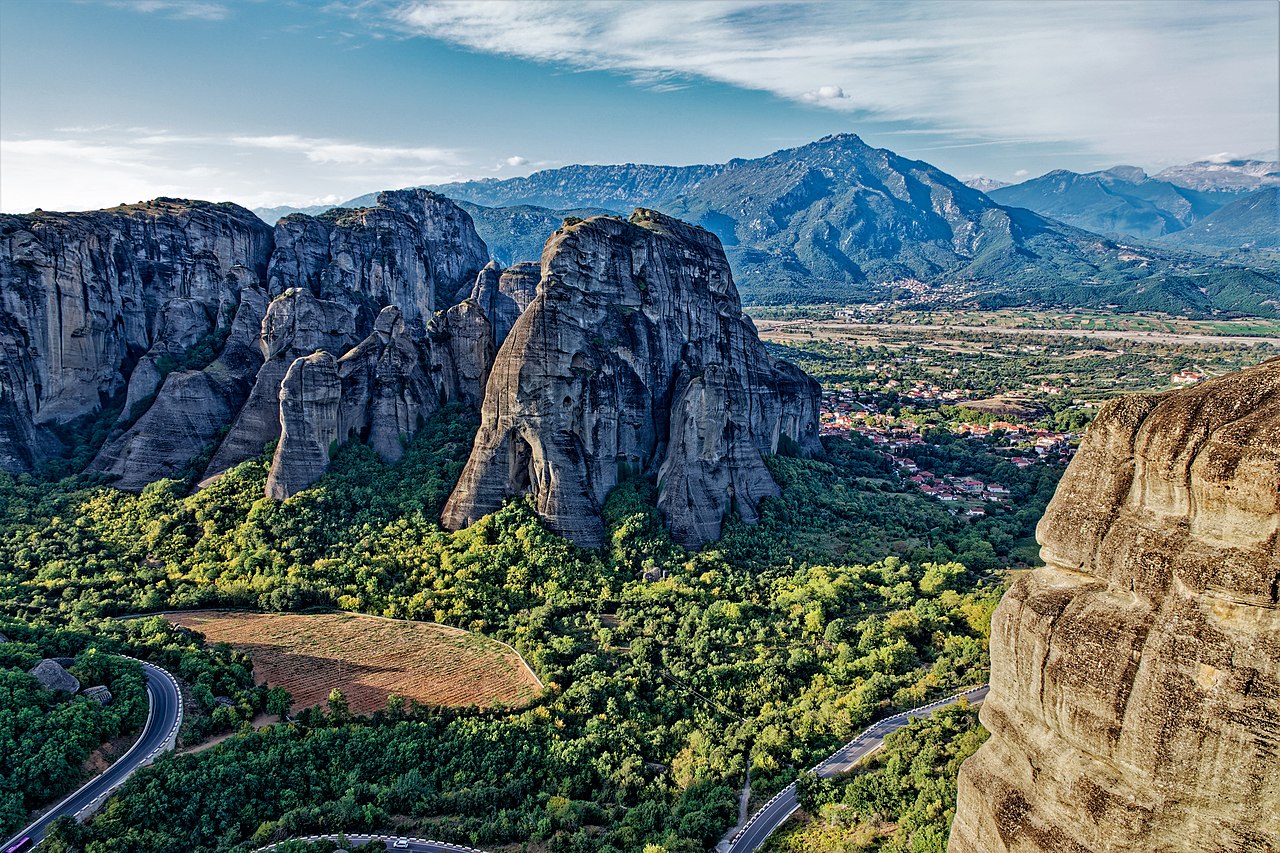
The rocks themselves are older than comprehension — sedimentary towers deposited by a river delta when dinosaurs still walked, then carved into freestanding pillars by millennia of wind, water, and earthquakes. Some rise over 300 metres from the valley floor, roughly the height of the Eiffel Tower. On top of six of them, monasteries cling like barnacles on a ship's hull, their terracotta roofs and stone walls flush against sheer cliff edges.
For roughly 500 years, the only way to reach most of these monasteries was to be hauled up in a rope net dangling over open air. The bridges and rock-cut stairs visitors use today were not built until the 1920s. Before that, supplies, monks, and visiting dignitaries all swung in the same fraying net — replaced, according to monastic tradition, only when the Lord let the rope break.
Six monasteries remain of the 24 that stood here at the 15th-century peak. Four are still active religious communities. The rest are ruins scattered across lesser pillars, slowly being reclaimed by wind and lichen. UNESCO inscribed the site in 1988 under both cultural and natural criteria — one of the rare places where the human story and the geological one are equally staggering.
01 What to see.
Monastery of the Holy Trinity
You descend before you climb — that's the trick Holy Trinity plays on you. A path drops from the road, then 145 steps carved directly into the sandstone rise toward a summit that feels genuinely improbable, a church balanced on a pillar 400 metres above the Thessalian plain. Halfway up, cut into the living rock on your left, sits a tiny rotunda chapel dedicated to St John the Baptist, built in 1682. Most visitors are too focused on counting steps to notice it. Stop. The chapel's walls are the cliff itself, and the silence inside has a mineral quality, cool and absolute, that the main church can't match.
The katholikon at the top dates to 1475–76 and is small enough that three people make it feel crowded. Frescoes from 1741 press close on every surface — saints at arm's length, their pigments still surprisingly warm in the low interior light. But the real reward waits behind the church: a narrow balcony at the rock's highest point, where the wind picks up and the valley opens below you with a disorienting sense of exposure. This is the quietest major viewpoint at Meteora, because you've already paid for it with your legs.
Varlaam Monastery and Its Winch Tower
Until the 1920s, the only way up to Varlaam was a net hauled by rope and winch — monks and supplies alike dangling over a void that would kill you in four seconds flat. The winch tower, built in 1536, still stands at the monastery's edge, its wooden drum and hemp ropes preserved as a kind of engineering confession: this entire way of life hung, literally, by a thread. UNESCO specifically highlights this mechanism as a symbol of how fragile monastic existence was here. When you see the tower, look at the rope grooves worn into the stone lip of the platform. Centuries of friction left those marks.
Inside, Varlaam is richer than you'd expect for a place that was once so hard to reach. The main church, completed in 1541, follows an Athonite cross-in-square plan with a dome that feels generous after the constricted approach. A restored hospital, the chapel of Saints Anargyroi renovated in 1518, and a refectory converted into a small museum fill out the summit. The old hearth in the refectory still smells faintly of soot and stone — or maybe that's imagination shaped by the blackened walls. Either way, Varlaam gives you the clearest physical understanding of how these communities actually worked, not just how they looked.
Saint Nicholas Anapafsas and Theophanes' Signature
This is the most vertical monastery at Meteora — not the tallest, but the most compressed. Its rock plateau is so narrow that the builders stacked everything: a tiny chapel of St Anthony and a crypt at the base, the main church above, then an old refectory and ossuary higher still, each level reached by tight staircases that feel more like ladders. The whole structure reads like a medieval tower house that happens to be a monastery.
The reason to come is on the wall. In 1527, the Cretan painter Theophanes Strelitzas — founder of the Cretan School that would reshape Orthodox art for two centuries — frescoed the interior. UNESCO confirms this as a foundational cycle of post-Byzantine painting. Above the entrance from the narthex to the nave, Theophanes left his signature: "hand of the monk Theophanes of Crete Strelitzas." Almost five hundred years old, easy to walk past, and one of the most important autographs in Greek art. The frescoes themselves glow in the dim light, figures rendered with a psychological intensity that feels startlingly modern against the ancient stone.
The Hermit Caves and Doupiani Trail
Skip the bus loop for a morning and walk the old paths instead. Above the village of Kastraki, ancient winding trails lead to the Badovas hermit caves — rough shelters carved into the base of the pillars where ascetics lived from the 11th century onward, long before anyone built a monastery on top. The caves are unadorned, wind-scoured, and profoundly quiet. One is locally known as the "monk's prison," though whether that's history or folklore is unclear. What is clear: this is where Meteora began, not as architecture but as withdrawal.
The trail connects to the chapel of Panaghia Doupiani, a late 12th-century church at the foot of one of the rock pillars — confirmed by UNESCO as the earliest documented monastic gathering point here. The building is modest, almost domestic in scale, and sits in the shadow of the great columns rather than on top of them. Pair this walk with the sunset route toward Holy Spirit Rock and you'll have the hermit experience rather than the tourist one: raw geology, scattered ruins, and the sound of nothing but wind through dry grass. Best in spring or autumn, when the light softens and the summer crowds haven't arrived.
02 In pictures.




Plan and listen to Meteora Monasteries with Audiala.
Audio guide in your pocket, itinerary in your browser. Built for the way you actually visit.
03 Visitor logistics.
The practical scaffolding for a good visit — kept short.
Getting There
A direct KTEL bus runs Athens to Kalambaka Monday–Saturday at 06:30 (return at 17:45); depart from near Kato Patisia metro station on the Green Line. From Kalambaka, a local KTEL bus climbs to the monasteries at 09:00, 10:45, 12:15, and 14:45 for €1.60, stopping at all six monasteries between Kastraki and St Stephen's. By car, a loop road connects every monastery — but parking near Great Meteoron and Varlaam fills by 09:30 in summer, so arrive before 09:00 or accept a long uphill walk from wherever you find a spot.
Opening Hours
As of 2026, summer hours (April–October) vary by monastery: Great Meteoron 09:30–15:00 (closed Tuesday), Varlaam 09:00–16:00 (closed Friday), Holy Trinity 10:00–16:00 (closed Thursday), St Stephen 09:00–13:30 and 15:30–17:30 (closed Monday), Roussanou 09:00–15:30 (closed Wednesday), St Nicholas Anapafsas 09:00–17:00. Winter hours shrink significantly and add extra closure days — Great Meteoron, for instance, shuts Tuesday through Thursday. Hours change without warning around Orthodox feast days and Holy Week, so confirm the day before you go.
Time Needed
A focused visit to 2–3 monasteries takes 3–5 hours, which is the sweet spot for most people. Attempting all six in a single day is technically possible with a car and iron calves, but local guides call it rushed — you'll spend more time on stairs and in parking queues than absorbing 14th-century frescoes. Two days lets you pair monastery visits with sunrise hiking and a proper Thessalian lunch, which is the rhythm this place rewards.
Accessibility
St Stephen is the only monastery reachable without climbing stairs — a small bridge leads directly to the entrance, making it the clear choice for visitors with limited mobility. Every other monastery demands 140 to 300+ stone steps: Great Meteoron and Holy Trinity are the steepest, each over 300 steps with no elevator or ramp alternative. The monasteries do not provide wheelchair access facilities, and the historic winch baskets are not available to visitors.
Cost & Tickets
As of 2026, entry is €5 per person per monastery, cash only — paid at each gate. Children under 12 enter free. No online booking, no combined ticket, and no skip-the-line option exists; you simply queue and pay. Visiting all six costs €30 per adult, so budget accordingly and bring small bills.
05 Tips for visitors.
Small things that change the day.
Dress Code Enforced
Men need long trousers and sleeved shirts; women need skirts below the knee and covered shoulders — trousers on women are often refused. Wrap skirts are usually provided at monastery entrances for women, but men won't find spare clothing, so plan your outfit before leaving your hotel.
Photography Limits Apply
Shoot freely in courtyards and from viewpoints, but interior chapel photography is banned to protect Byzantine frescoes — flash and tripods are strictly prohibited inside. Drones require written permits from Greek aviation authorities and monastery consent; flying without approval risks fines and confiscation.
Arrive Before Nine
Tour buses flood the monastery road by mid-morning, and parking vanishes fast. The light before 09:00 turns the sandstone pillars a warm amber that photographs beautifully — and you'll have the staircases nearly to yourself.
Eat in Kastraki
Taverna Gardenia and Qastiro in Kastraki serve excellent Thessalian mountain food — wild greens, local kasseri cheese, grilled meats — at budget-to-mid-range prices (€8–20). Kalambaka's Meteoron Panorama offers terrace dining with rock views if you want something slightly more polished.
Walk From Kastraki
A 2.4 km trail from eastern Kastraki (behind the Geological Formations Museum) climbs past Holy Spirit Rock to Varlaam and Great Meteoron in about 70 minutes — skipping the parking nightmare entirely. The path threads between the rock pillars at close range, which no bus window can replicate.
Visit on Weekends
Saturday and Sunday are the only days all six monasteries are reliably open simultaneously — each monastery closes on a different weekday, so a midweek visit guarantees you'll miss at least one. Plan around this or accept the trade-off.
04 A history of reinvention.
A Fortress Made of Prayer
Meteora's monastic history begins not with architecture but with solitude. By the 11th century, hermits were already living in the natural caves and crevices of these sandstone pillars, sleeping on ledges hundreds of metres above the valley. A modest chapel called Panaghia Doupiani — still standing at the foot of the rocks, and still ignored by most visitors — was built in the late 12th century as the first gathering point for these scattered ascetics.
The building boom came in the 14th century, and it was driven by terror as much as devotion. Ottoman raids, Catalan mercenary companies, and Serbian-Byzantine warfare made the Thessalian plain a killing ground. UNESCO is explicit: the monasteries were "systematically built on top of the inaccessible peaks" during a period of severe political instability. The rocks were not just sanctuaries. They were fortresses with God as the excuse and survival as the motive.
The King Who Climbed a Rock and Never Came Down
In the mid-14th century, a monk named Athanasios Koinovitis — fleeing pirate raids on Mount Athos — arrived at the base of the tallest sandstone pillar in the Meteora cluster. Legend holds that an eagle carried him to the summit. The reality involved scaffolding, hand-cut footholds, and rope. He named the rock "Meteoro," meaning suspended in air, and founded what became the Great Meteoron — traditionally dated to 1356, though scholars place it more cautiously in the mid-14th century.
What transformed Meteoron from a hermit's perch into the wealthiest monastery in the region was the arrival of a man named Ioasaph. His birth name was John Uroš Palaiologos, and he was the son of Simeon Uroš, the Serbian-Greek ruler of Thessaly and Epirus. Ioasaph was not a monk seeking power. He was a king abandoning it. He renounced his throne, climbed the rock to study under Athanasios, and in 1388 — according to Britannica — poured his royal treasury into expanding the monastery. New churches, refectories, and living quarters rose on a summit the size of a football pitch.
The personal stakes were absolute. Ioasaph gave up a dynasty, an army, and a territory stretching across northern Greece. In return he got a stone cell, a rope net, and a view of the kingdom he'd surrendered. His royal funding is why Meteora's churches carry iconography more fitting for a palace than a hermitage — and why the Great Meteoron's walls still feel like they belong to a man who had something enormous to atone for.
The Cretan Painter Who Changed Orthodox Art
Bombs, Earthquakes, and Invisible Repairs
Listen to the full story in the app
The whole Meteora Monasteries,
told well.
Audio guides for 1,100+ cities across 96 countries. History, stories, and local insight — offline ready.

06 Frequently asked.
The questions travellers send us most about Meteora Monasteries.
Is Meteora Monasteries worth visiting?
Absolutely — Meteora is one of the few places on earth where geology, architecture, and living religious practice collide at 400 meters above a valley floor. Six monasteries still perch on sandstone pillars that formed 60 million years ago, and the contrast between raw cliff face and painted Byzantine-era interiors is unlike anything else in Greece. Come early or late in the day, though; midday bus traffic can turn a transcendent site into a parking lot.
How long do you need at Meteora Monasteries?
Plan a full day to visit three or four monasteries comfortably, or two days if you want all six plus hiking. Each monastery takes 30–60 minutes inside, but the steep stair climbs (140 to 300+ steps per monastery) and driving or walking between them eat real time. Trying to rush all six into a single day is technically possible but leaves you exhausted and unable to absorb what you're seeing.
How do I get to Meteora from Athens?
The most direct public option is the KTEL intercity bus departing Athens at 06:30 Monday–Saturday, arriving in Kalambaka (the town at Meteora's base). You can also take a train from Athens to Kalambaka, roughly 4–5 hours with a change at Paleofarsalos. By car, the drive is about 350 km via the E92 motorway, taking around 4 hours depending on traffic.
What is the best time to visit Meteora Monasteries?
Spring (April–May) and autumn (September–October) offer the best balance: mild hiking weather, softer light on the sandstone, and far fewer crowds than the July–August crush. Winter brings snow-dusted pillars and dramatic atmosphere, but three of the six monasteries close extra days and hours shrink significantly. Whatever the season, arrive before 09:00 — by mid-morning the parking lots near Great Meteoron and Varlaam are full and the monastery courtyards feel cramped.
Can you visit Meteora Monasteries for free?
No — each monastery charges a flat entrance fee of 5 euros per person, payable in cash at the gate. Children under 12 enter free. There are no confirmed recurring free-admission days, and no online ticketing system exists, so bring coins and small bills for each stop.
What should I not miss at Meteora Monasteries?
Don't skip Varlaam's winch tower — the small stone hut housing the original rope-and-net hoist that was the only way up a 373-meter cliff for roughly 500 years. At St Nicholas Anapafsas, look for Theophanes the Cretan's 1527 signature above the narthex-to-nave entrance, a rare surviving autograph from the painter who fused Byzantine iconography with Italian Renaissance technique. And at Holy Trinity, walk past the main church to the rear balcony for the quietest, most vertiginous viewpoint on the entire circuit.
What is the dress code for Meteora Monasteries?
Men need long trousers and shirts with sleeves; women need skirts below the knee and covered shoulders. Wrap skirts are usually available at monastery entrances for women who arrive in trousers, but men are rarely provided spare clothing, so plan ahead. Enforcement varies by monastery and by day, but you risk being turned away at the door — not a fun outcome after climbing 300 steps.
Are Meteora Monasteries accessible for people with limited mobility?
St Stephen is the only monastery reachable without climbing stairs — a short bridge connects the road directly to the entrance. The other five require between 140 and 300+ carved stone steps, often steep and exposed, with no elevator or wheelchair access. If mobility is a concern, prioritize St Stephen and enjoy the roadside viewpoints, which offer spectacular panoramas without any climbing.
Verified, and shown.
Researched and written by the Audiala editorial team from historical records, architectural archives, and local expertise.
General history, geology, earthquake and rockfall events, monastery counts, and Theopetra Cave details.
Official UNESCO listing with inscription criteria, historical chronology, Theophanes fresco dating, and net-hoist symbolism.
Historical overview including Ioasaph/John Urosh, WWII bombing, 1920s stair construction, and conservation since 1972.
Founding narratives, Saint Athanasios biography, and monastery count discrepancies.
Monastery-by-monastery architectural descriptions, interior spaces, and etymology.
Summer and winter timetables for all six monasteries.
Entrance fees, dress code, step counts, and visit planning guidance.
Varlaam architecture, winch tower, hospital, and historical dates.
Largest monastery details including sacristy skull shelves and katholikon.
Theophanes the Cretan signature location and vertical multi-level layout.
Rock-cut chapel of St John the Baptist, rear balcony viewpoint, and 145-step approach.
Bridge access, three-story layout, and 1545/1560 construction and fresco dates.
Bridge access, easiest monastery for limited mobility, and 1798 church.
Official visiting hours, seasonal closures, and dress code requirements.
Detailed seasonal timetables, closure days, and cash payment confirmation.
Practical tips on accessibility, restrooms, canteens, drone rules, and dress code.
Confirmation of 5 euro fee and free entry for children under 12.
General visit planning, time estimates, and monastery access descriptions.
Off-route sites including Doupiani, Badovas hermit caves, and Ypapanti.
History of the oldest religious structure at Meteora's base.
Guided hiking to ancient hermit caves and cave chapels above Kastraki.
Self-guided SmartGuide app tour in 11 languages.
Parking advice, congestion hours, and early arrival recommendations.
Local bus route information and parking congestion warnings.
Direct Athens-to-Kalambaka bus schedule and departure instructions.
English-language bus schedule from Athens to Meteora.
Local bus timetable between Kalambaka and the monasteries with stops and fares.
Sunset Rock (Psaropetra) and Main Observation Deck viewpoint descriptions.
Seasonal visiting advice and evening atmosphere descriptions.
Official Greek tourism board overview of monastic heritage.
Walking routes from Kastraki and Kalambaka to the monasteries.
Detailed hiking route from Neraida spring to Great Meteoron.
Accessibility details for St Stephen including bridge access.
Restaurant listings near the monasteries in Kastraki and Kalambaka.
Curated restaurant recommendations including Qastiro and Protato.
Varlaam rebuild date (1542) and Apsarades brothers attribution.
Visitor reviews on crowds, dress code enforcement, photography rules, and parking.
UNESCO conservation monitoring PDF for Meteora.
UNESCO monitoring decisions on visitor impact and preservation.
Academic source on overtourism pressures and sacred site management at Meteora.
Luggage storage availability for day-trippers in Kalambaka.
Alternative luggage storage option in Kalambaka.
Local folk tale of a dragon beneath Varlaam Monastery.
Last reviewed
Researched from Wikidata, Wikipedia & official sources · fact-checked · How we make our guides →