Introduction
The world's first known computer — a corroded lump of bronze gears that most visitors walk right past — has been sitting in a quiet corner of the National Archaeological Museum in Athens, Greece, for over a century. This is the kind of place where a 3,500-year-old gold death mask, an ancient astronomical calculator, and a two-metre bronze god pulled from the sea floor all share the same roof. If you see one museum in Athens, it should be this one, and it shouldn't be rushed.
The museum sits on Patission Street — officially 28th October Street, though no Athenian calls it that — in the gritty, graffiti-tagged neighborhood between Exarcheia and Omonia. The neoclassical façade stretches wider than a football pitch, all honeyed stone and Doric columns, looking like someone dropped a piece of 19th-century idealism into the middle of a city that long ago stopped being polite. Inside, more than 11,000 objects span roughly 7,000 years of Greek civilization, from Neolithic clay figurines to late Roman bronzes.
What makes the collection extraordinary isn't just its size. It's the density of objects that changed how we understand the ancient world. The Mycenaean gold that rewrote Bronze Age history. The Cycladic marble figures that Picasso and Modigliani studied before anyone called them art. The Antikythera Mechanism, which proved the Greeks built gear-driven machines two millennia before the European Renaissance.
A major refurbishment by David Chipperfield Architects is underway in the mid-2020s, so check which galleries are open before you go. But even a partial visit here recalibrates your sense of what humans were capable of, and how early they were capable of it.
Top 10 Things To Do in Athens Greece
TravelmojiWhat to See
The Mycenaean Hall and the Mask of Agamemnon
Step through the vestibule and the museum plays its strongest card first. The Mycenaean Hall hits you like walking into a vault — gold-lit vitrines against dark fabric, each one a small sun. The Mask of Agamemnon, hammered from a single sheet of gold around 1550 BC, stares back at you with closed eyes and a thin-lipped calm that has outlasted every empire since. Heinrich Schliemann dug it from Grave Circle A at Mycenae in 1876 and reportedly telegraphed the King of Greece: "I have gazed upon the face of Agamemnon." He was almost certainly wrong about the attribution — the mask predates the Trojan War by roughly three centuries — but the drama was real, and it still is.
Around it, the gold cups of Vapheio show bulls being lassoed with a fluidity that rivals anything in Renaissance metalwork. Tiny Cycladic figurines, white marble reduced to geometry, stand in adjacent cases like 4,500-year-old Brancusis. The room has the hush of a treasury, not a gallery. You'll notice people whispering without being asked to.


The Artemision Bronze and the Sculpture Galleries
The central sculpture halls are flooded with natural light from clerestory windows, and your footsteps on the stone floors echo off the high ceilings — the acoustic is somewhere between a cathedral and an empty swimming pool. At the heart of it all stands the Artemision Bronze, a 2.09-metre figure of either Zeus hurling a thunderbolt or Poseidon throwing a trident, pulled from a shipwreck off Cape Artemision in 1928. Nobody knows which god it is. The debate has run for nearly a century with no resolution, which feels appropriate for a figure this commanding.
Walk the full 360 degrees around it. From the front, the outstretched arms span wider than a person lying down — the pose is all coiled energy, weight on the back foot. From behind, the musculature of the shoulders tells you a 5th-century-BC sculptor understood anatomy as well as any Renaissance master, a thousand years before the Renaissance existed. Nearby, the Jockey of Artemision — a small boy clinging to a galloping horse, recovered from the same shipwreck — captures motion so convincingly that the horse's nostrils flare and the boy's tunic whips backward. The enfilade of doorways stretching through successive galleries makes for the museum's most photographed sightline: pure neoclassical symmetry, designed by Ludwig Lange and executed by Ernst Ziller between the 1860s and 1880s.
The Thera Frescoes, the Antikythera Mechanism, and the Rooms Everyone Skips
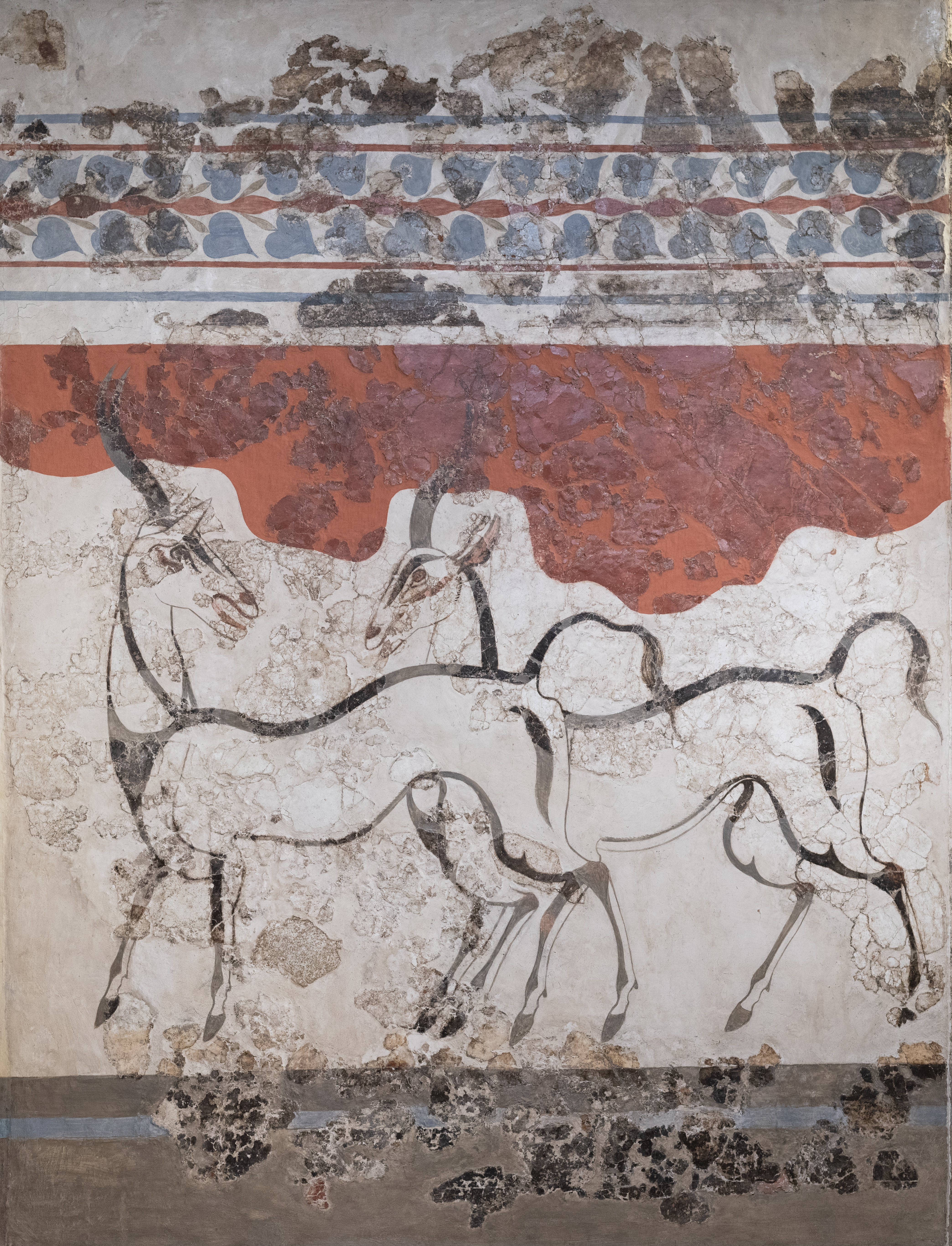
Upstairs, the Thera Frescoes room is a different world. The lighting drops, the temperature falls a few degrees — controlled humidity protects pigments that survived the volcanic burial of Akrotiri on Santorini around 1627 BC. The Spring Fresco covers an entire wall with swallows diving over red lilies, painted with a looseness that feels almost impressionist. The Boxing Boys, two children sparring with one glove each, have a warmth and humor that 3,600 years haven't dimmed. This room is the museum's quietest; most tour groups never climb the stairs.
Back on the ground floor, the Bronze Collection holds the object that arguably matters most to the history of science: the Antikythera Mechanism. Recovered from a Roman-era shipwreck in 1901, its corroded green fragments — no bigger than a shoebox — are the remains of an astronomical calculator with at least 30 interlocking bronze gears, built around 100 BC. Nothing of comparable complexity appears again in the archaeological record for over a thousand years. It sits in a modest case, easy to walk past if you're still dazzled by Mycenaean gold. Don't. And if you have any energy left, the inner courtyard — a planted patio with a small café, scattered with stone fragments — is where the museum exhales. Grab a coffee among the broken torsos. You've earned it.

Videos
Watch & Explore National Archaeological Museum
Top 10 Things To Do in Athens Greece
Things To Do In ATHENS, Greece - TOP 12 (Save this list!)
In the room housing the Mask of Agamemnon, crouch slightly and look at the hammered gold surface at an oblique angle — the fingerprint-like tool marks left by the Mycenaean goldsmith nearly 3,500 years ago are still visible across the beaten surface.
Visitor Logistics
Getting There
Victoria station on Metro Line 1 (green) drops you a 7-minute walk away — head south along Patission Street and the neoclassical facade appears on your left. Omonia station on Line 2 (red) is about 10 minutes on foot. From Syntagma Square, it's a 20-minute walk north, or grab a taxi and ask for "Ethniko Archaiologiko Mouseio" — drivers won't blink. Trolleybus lines 2, 3, 5, 11, and 15 run along Patission with a stop right outside.
Opening Hours
As of 2026, winter hours (mid-November through April 30) run Wednesday–Monday 08:30–15:30, with Tuesday shifted to 13:00–20:00. Summer hours typically extend to 20:00 daily. The museum closes on December 25–26, January 1, March 25, May 1, and Orthodox Easter Sunday. Hours shift between seasons, so check namuseum.gr the week before your visit — the exact changeover date has varied by a day or two in recent years.
Time Needed
A focused sprint through the Mycenaean gold, the Artemision Bronze, and the Antikythera Mechanism takes 90 minutes to 2 hours. A solid visit covering the main permanent collections — sculpture, vases, bronzes, Egyptian wing — needs 2.5 to 3 hours. If you want to linger with the Akrotiri frescoes upstairs and sit in the garden café, budget a full 3 to 4 hours.
Accessibility
Skip the grand ceremonial staircase — a separate accessible entrance on Vassileos Herakleiou Street has a ramp from the forecourt and direct pavement access. Call 213 214 4851 on arrival and staff will assist. Lifts reach the basement and first floor, an accessible WC is in the basement, and wheelchairs are available free from the information desk. Visitors with vision loss can request a tactile list of 20 sculpture exhibits.
Tickets & Free Days
As of 2026, general admission is €20, a significant jump from the old €12/€6 seasonal pricing. Timed-entry e-tickets are required — book at hhticket.gr and arrive within your slot window. Free admission applies on March 6, April 18, May 18, the last weekend of September, October 28, and every first and third Sunday from November through March. EU citizens under 25 and non-EU visitors under 18 enter free year-round.
Tips for Visitors
Arrive at Opening
Tour buses pull up around 10:00, so the 08:30 opening slot on a weekday morning gives you the Mycenaean gold hall nearly to yourself. The light through the high windows is better early too — warmer, less glare on the glass cases.
Photography Rules
Personal photography without flash is fine, but leave tripods and selfie sticks at home — they're banned without a Ministry of Culture permit. Guards have also been known to stop visitors from striking imitation poses next to the statues, so save the "discus thrower" impression for the garden.
Watch Your Pockets
Victoria and Omonia metro stations — the two closest stops — are well-known pickpocket zones, especially on crowded Line 1 trains. Keep phones and wallets in front pockets or zipped bags, and stay alert on the platform during rush hour.
Don't Skip Upstairs
Most visitors exhaust themselves on the ground-floor sculpture galleries and leave. The first floor holds the Akrotiri frescoes from Thera — vivid Bronze Age wall paintings from a Minoan town buried by volcanic ash around 1600 BC, essentially Greece's Pompeii. It's often the emptiest room in the building.
Eat in Exarcheia
After your visit, walk south into Exarcheia along Themistokleous or Tsamadou streets for student-priced mezedopoleia serving small plates with tsipouro — expect €15–25 for a generous spread. Skip the chain coffee shops on Patission itself. For a quick €4 breakfast before the museum, grab a bougatsa (cream-filled phyllo pastry) from any bakery near Omonia.
Check Your Bags
Backpacks and large bags aren't allowed into the galleries — a free cloakroom at the entrance handles them. Travel light if you can, because the check-in queue adds time to your arrival, and you'll want that time for the Antikythera Mechanism instead.
Where to Eat
Don't Leave Without Trying
A Little Taste of Home Restaurant
local favoriteOrder: The slow-cooked beef brisket and oven-baked lamb are melt-in-your-mouth tender — get both and share a tableful of hearty plates.
This cosy spot delivers the kind of generous, home-style Greek cooking that feels like a meal at a local friend's house, with attentive service and a lovely outdoor terrace.
MIRONI Restaurant - Greek Kitchen
local favoriteOrder: The moussaka is textbook perfection, and the grilled squid is equally impressive — pair them with a crisp white wine.
From the Greek music to the blue-and-white décor, MIRONI immerses you in an authentic taverna experience while serving consistently excellent classic dishes that please locals and travelers alike.
Karamanlidika
local favoriteOrder: The Sudjuk karamanlidiko with fried eggs is a spicy, hearty standout; save room for the sweet, cheesy kunefe.
Part deli, part meze taverna, Karamanlidika preserves the vanishing flavours of Greek-Anatolian cuisine with outstanding cured meats, cheeses, and exceptionally well-paired wines.
Ατίταμος
local favoriteOrder: The grilled lamb chops and Feta Antitamos (baked feta) are house signatures — order them with a jar of red house wine.
A bustling, no-reservations taverna beloved by Athenians for its honest, big-plate Greek classics and lively street-side terrace — the queue is part of the experience.
Dining Tips
- check Varvakios Central Market (Mon–Sat, roughly 8am–6pm) is the city’s food soul — wander among stalls of fresh fish, meat, cheese, olives, and spices.
- check The Saturday laiki (farmers’ market) on Kallidromiou Street in Exarchia runs from dawn until about 3pm; it’s the perfect place to pick up local honey, cheese, and seasonal produce.
- check In central neighbourhoods, many restaurants stay open on Sunday, but smaller tavernas often pick a weekday to close (e.g., A Little Taste of Home is closed Tuesdays) — always check ahead.
- check Breakfast is traditionally a quick affair: grab a coffee and a sesame koulouri from a street vendor.
- check Athenian meals are social — order a selection of mezedes, a Greek salad, and a jug of house wine to share and linger.
Restaurant data powered by Google
Historical Context
A Nation's Memory, Buried Twice
Greece's first national archaeological museum wasn't in Athens at all. It was founded by Ioannis Kapodistrias in 1829 on the island of Aigina, because Athens — still a war-scarred Ottoman village — wasn't yet the capital. As the new state took shape and Athens grew into its role, the collections migrated through a series of makeshift homes: the Hephaisteion temple in the Agora, a building near the University, the Varvakeion school. Each move was a reminder that the young nation had more antiquities than it had walls to protect them.
The foundation stone for the current Patission Street building was laid in 1866, and the architects tell a story of their own. Ludwig Lange, a German, drew the original neoclassical plans. Panagis Kalkos, one of the first prominent Greek-born architects in a profession dominated by Bavarian imports, served as the primary executing architect. Ernst Ziller and Armodios Vlachos completed the work. Construction dragged on — sources disagree whether the building was finished in 1874 or as late as 1889 — but by the early 1890s the museum was operational, its galleries filling with the material proof of a civilization the rest of Europe claimed to revere.
The Couple Who Buried a Civilization to Save It
In October 1940, Italy invaded Greece, and museum director Christos Karouzos understood what was coming. He and his wife Semni Karouzou — herself a distinguished archaeologist — organized the most audacious act of cultural preservation in modern Greek history. According to widely cited accounts, the couple and their staff dug trenches in the museum's own basement, lowered bronze statues into them, packed the Mycenaean gold into crates, and covered everything with sand and earth. The Mask of Agamemnon, the Artemision Bronze, the Jockey of Artemision — all of it went underground.
What was at stake for Karouzos personally was everything. He was not just a bureaucrat protecting inventory; he was a scholar whose life's work was these objects, operating under a government that would soon collapse, with no guarantee the occupiers wouldn't tear the building apart looking for loot. The turning point came when German forces entered Athens in April 1941 and found the museum essentially empty. They occupied the building but never located the collection beneath their feet.
The antiquities stayed buried through four years of occupation. Karouzos was later persecuted during the Greek Civil War for his leftist sympathies, and Semni carried on much of the curatorial work in his absence. Stand in the Mycenaean Hall today and look down: you're walking above the floor where the gold of Mycenae lay hidden in sand for the better part of a decade.
The Architect Who Never Saw His Building Open
Panagis Kalkos laid the foundation stone in 1866 and oversaw the museum's construction through its most demanding years. He died in 1875, more than a decade before the building was completed. The irony cuts deep: Kalkos was among the first ethnically Greek architects to lead a major state commission, working in a field where German and Bavarian professionals — brought in by King Otto's court — held nearly every important post. His death mid-project meant Ernst Ziller, a Saxon transplant, received much of the credit for finishing the museum. Today Kalkos's name rarely appears in tourist literature, though records indicate he was the primary architect.
Three Dates, No Consensus
Ask when the museum was built and you'll get at least three answers. One source says 1855–1874, another 1866–1874, a third 1866–1889. The likeliest explanation: design work began in the 1850s under Ludwig Lange, construction started with the 1866 foundation stone, the main block was largely complete by the mid-1870s, and additional wings and interior fittings continued until around 1889. The confusion is a reminder that 19th-century Greek state projects moved at the speed of available funding — which is to say, erratically. The building you see today is the product of at least three decades of intermittent work by four architects across two generations.
Listen to the full story in the app
Your Personal Curator, in Your Pocket.
Audio guides for 1,100+ cities across 96 countries. History, stories, and local insight — offline ready.
Audiala App
Available on iOS & Android
Join 50k+ Curators
Frequently Asked
Is the National Archaeological Museum in Athens worth visiting? add
It holds the largest collection of Greek antiquities on earth — this is where the Mask of Agamemnon, the Antikythera Mechanism (the world's first known analog computer, c. 150–100 BC), and the Artemision Bronze all live under one roof. The Mycenaean Hall alone, with its gold-lit vitrines glowing against dark fabric backing, justifies the trip. If you only visit one indoor museum in Athens, this is the one.
How long do you need at the National Archaeological Museum Athens? add
Plan at least 2.5 to 3 hours for a solid visit; serious archaeology fans should budget 3 to 4 hours. The collection spans Neolithic to Roman across two floors and more than 11,000 exhibits — rushing through in 90 minutes means missing the Thera frescoes upstairs and the entire Egyptian wing. A mid-visit break at the inner courtyard café helps pace the experience.
How do I get to the National Archaeological Museum from central Athens? add
The nearest metro stop is Victoria on Line 1 (green), about a 7–10 minute walk south along Patission Street. Omonia Station on Line 2 (red) is roughly 10 minutes on foot heading north. From Syntagma Square, it's a 20-minute walk; from the Acropolis area, figure 30 minutes on foot or 10 minutes by taxi — tell the driver "Ethnikó Archaiologikó Mouseío."
What is the best time to visit the National Archaeological Museum Athens? add
Weekday mornings right at opening give you the emptiest galleries — tour groups typically arrive around 10:00. Summer afternoons can feel warm in the older, less air-conditioned sculpture halls, while the shoulder months of April–May and September–October offer the best natural light through the clerestory windows. Tuesday has a later opening (13:00) but stays open until 20:00, which suits evening visitors.
Can you visit the National Archaeological Museum Athens for free? add
Yes, on specific dates: March 6, April 18, May 18, the last weekend of September, and October 28 are free-admission days. From November 1 through March 31, the first and third Sunday of each month are also free. EU citizens aged 25 and under and non-EU visitors under 18 get free entry year-round.
What should I not miss at the National Archaeological Museum Athens? add
The Mask of Agamemnon in the Mycenaean Hall is the emotional centerpiece — a gold funerary mask from c. 1550 BC that Schliemann famously (and wrongly) attributed to Agamemnon himself. The Artemision Bronze, a 2-meter Zeus or Poseidon from c. 460 BC, stands free in its gallery so you can walk a full 360 degrees around it. Don't skip the Antikythera Mechanism in the Bronze Collection — it looks like a corroded green lump but is the oldest known analog computer — or the Thera frescoes upstairs, Bronze Age wall paintings from Akrotiri that rival Pompeii in preservation.
How much are tickets to the National Archaeological Museum Athens? add
The official museum website currently lists general admission at €20. Timed entry is required — book your slot in advance through the Hellenic Heritage e-ticket portal (hhticket.gr) to guarantee your preferred time. Older guidebooks still cite €12 or €6, but those prices appear outdated; always check namuseum.gr before your visit.
Is the National Archaeological Museum Athens accessible for wheelchairs? add
Yes — a separate accessible entrance on Vassileos Herakleiou Street has a ramp, and lifts serve the underground level and first floor. The museum provides wheelchairs on request from the information desk, and accessible restrooms are in the basement. Call 213 214 4851–4856 on arrival so staff can assist with the side entrance.
Sources
-
verified
National Archaeological Museum — Official Website (Homepage)
Official museum homepage with general information, founding context, and current admission pricing.
-
verified
National Archaeological Museum — Official History Page
Museum's own account of its institutional history, including the 1829 Aigina predecessor.
-
verified
National Archaeological Museum — Official Visit Page
Current opening hours, seasonal schedules, ticket prices, free-admission dates, and visitor categories.
-
verified
National Archaeological Museum — Official Identity Page
Architectural and institutional identity details, including architect credits.
-
verified
National Archaeological Museum — Official Historical Notes
Conservation history and institutional development notes.
-
verified
Hellenic Heritage E-Ticket Portal
Official timed-entry ticketing system with accessibility info, seasonal hours, and booking rules.
-
verified
Greek Ministry of Culture — Free Admission Policy
Official list of free-admission dates and eligible visitor categories for Greek state museums.
-
verified
Wikipedia — National Archaeological Museum, Athens
General history, construction dates, and collection overview.
-
verified
Greece Is — 17 Must-See Exhibits
Exhibit highlights including founding date (1866) and key objects in each gallery.
-
verified
David Chipperfield Architects — NAMA Project Page
Details on the ongoing major refurbishment and expansion project, including construction timeline.
-
verified
Archello — National Archaeological Museum Athens
Architectural project details and construction date range (1866–1874).
-
verified
Building Design World — National Archaeological Museum
Alternate construction date range (1855–1874) and architectural description.
-
verified
Grokipedia — Panagis Kalkos
Biographical details on the primary Greek architect of the museum, including 1866 foundation stone.
-
verified
Casino-Online-Greece Cultural PDF (Part I Athens)
Identifies full architectural team: Panagis Kalkos, Armodios Vlachos, and Ernst Ziller.
-
verified
Tickets-Athens — Plan Your Visit Guide
Practical visitor info: transport, bus/trolley lines, photography rules, cloakroom, nearby parking.
-
verified
Headout — National Archaeological Museum Guide
Visit duration estimates, older seasonal pricing, and skip-the-line ticket options.
-
verified
Discover Greece — Journey Through Time at NAMA
Metro directions and general collection overview including Egyptian wing.
-
verified
Our Little Lifestyle — Athens National Archaeological Museum
First-person visitor report with practical tips on bags, café, and visit duration.
-
verified
This is Athens — Accessible Routes
Wheelchair accessibility details including lifts and accessible route guidance.
-
verified
Moovit — Public Transit to NAMA
Nearby public transit stops and route options.
-
verified
Greece Is — 6 Delicious Stops Near the Museum
Nearby restaurant and café recommendations.
-
verified
Greeka — Athens Archaeological Museum
Metro directions and general visitor orientation.
-
verified
Olives & Islands Blog — A Walk Through the Centuries
First-person experiential details on gallery atmosphere, inner courtyard, and Thera frescoes room.
-
verified
Pinay Odyssey — Must-Dos and Sees at NAMA
Gallery-by-gallery collection overview and visitor highlights.
-
verified
Artsy Trips — Art Museum Athens Guide
Mycenaean Hall atmosphere and exhibit descriptions.
-
verified
Discover Greece — 12 Most Popular Archaeological Museums
Context on Egyptian wing and Stathatos Collection as lesser-known highlights.
-
verified
Frugal First Class Travel — Dos and Don'ts of Greek Sites
General visitor behavior guidance for Greek archaeological sites.
-
verified
AIA 2017 Abstracts (Archaeological Institute of America)
Academic use of the NAMA acronym and scholarly context.
-
verified
Facebook — Travel the Greek Way Group
Local opinions on the museum's significance and visitor tips.
-
verified
Facebook — The Pappas Post (Repatriation News)
Reporting on 47 stolen artifacts pending return from the United States.
-
verified
Facebook — Greece Travel Group (Overtourism Discussion)
Athens overtourism context and early-morning visit recommendations.
Last reviewed: