account_balance
Ancient Worlds, Still Intact
Athens, Delphi, and Heraklion are not isolated ruins on a coach route. They are working places where temples, sanctuaries, and palace histories still organize how travelers understand the country.
Greece makes sense when you stop treating it as a postcard. It is a country where mountain monasteries, Bronze Age palaces, city markets, and island harbors still shape daily life.
 Greece
EntrySchengen area; 90/180-day rule for many visa-exempt visitors
GA Greece travel guide starts with a useful correction: this is not one trip but a country of mountain roads, ferry wakes, Byzantine domes, and late dinners under plane trees.
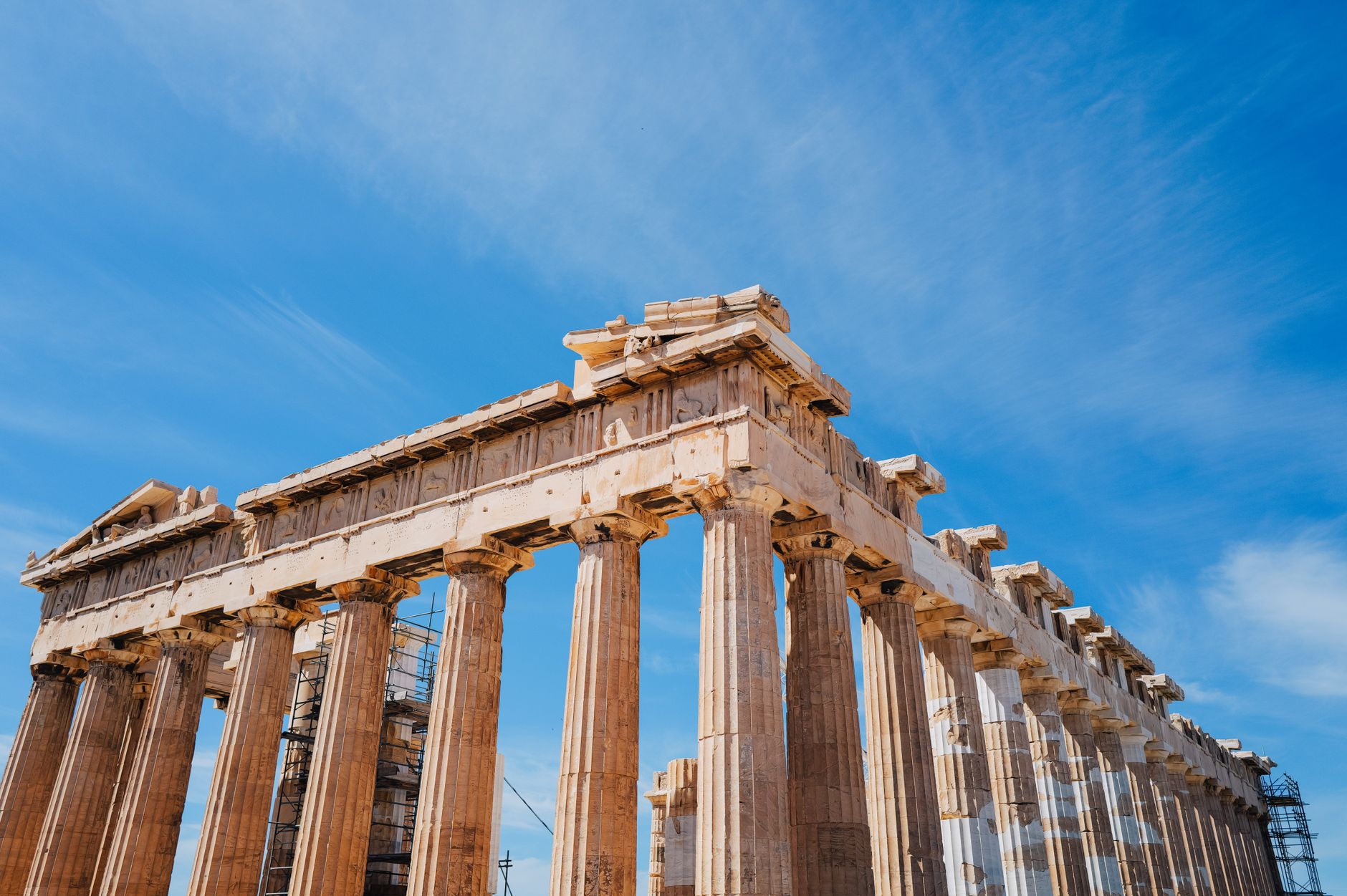
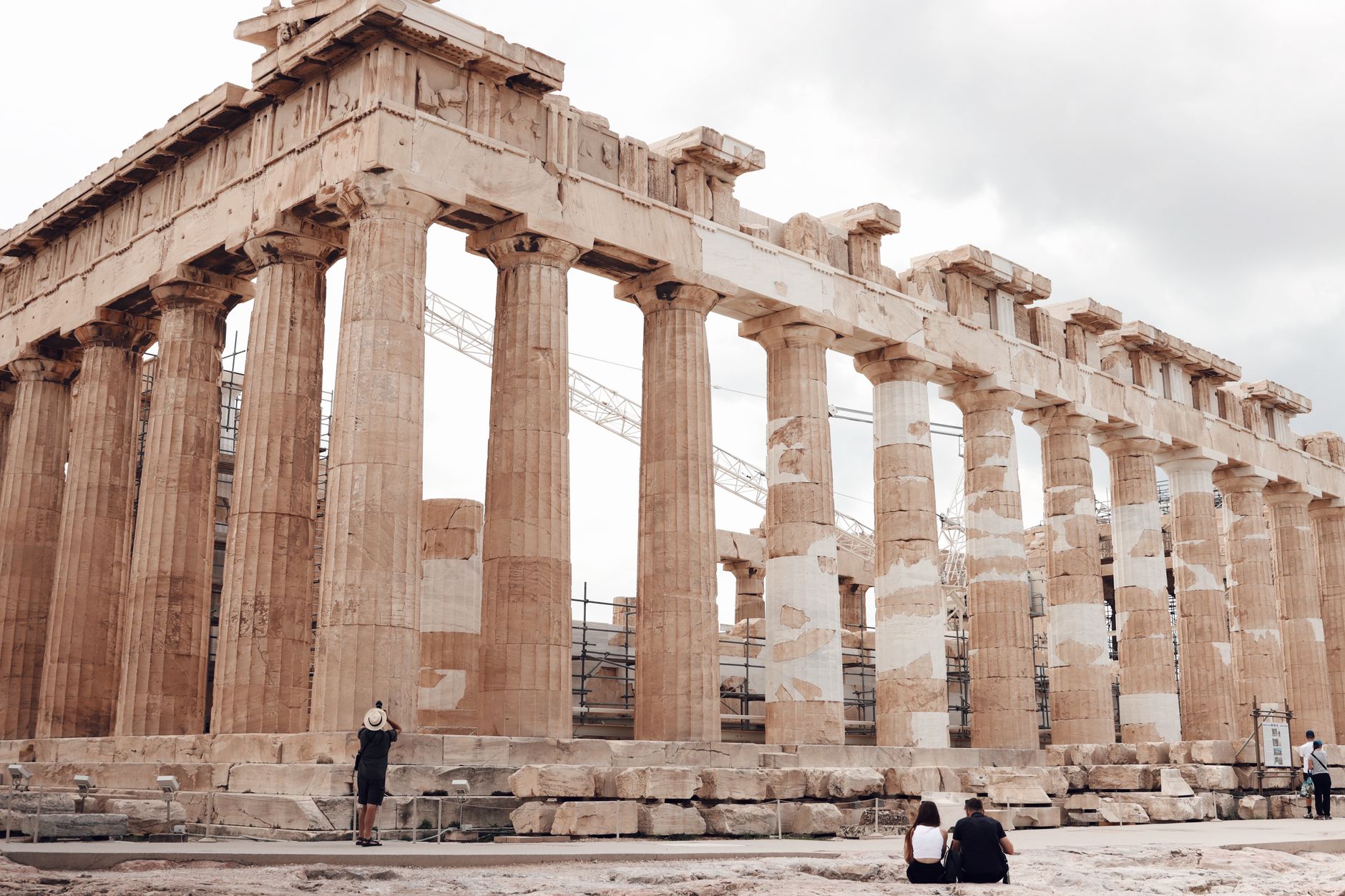
Most first-time travelers arrive in Athens for the Acropolis and leave talking about the contrast instead: marble temples above the city, then ordinary life in Psirri, Pangrati, or the Central Market by noon. That pattern repeats across the country. In Delphi, the mountain light turns archaeology into something almost theatrical. In Nafplio, Venetian walls and neoclassical facades sit a short walk apart. Greece rewards people who like layers, not checklists.
Distance matters here. Mainland Greece makes up about 80% of the territory, and the Pindus range cuts diagonally through the country, which is why an itinerary that looks simple on a map can feel like three different worlds in practice.
Then the islands change the rhythm. Santorini gives you volcanic edges and caldera light; Rhodes folds crusader stone into a beach destination; Corfu feels greener, softer, and more Venetian than the postcard version of the Aegean would suggest. Crete deserves its own scale entirely: Heraklion opens the door to Minoan history, while Rethymno still carries Ottoman and Venetian traces in the street plan. Even Thessaloniki, often treated as a second stop, has one of the strongest food scenes in the country and a more lived-in energy than many capital cities manage.
That is the real appeal of Greece. You can spend one week on ferries and swimming coves, or trade the sea for Meteora, Mystras, and old trading ports like Kavala, and the country still holds together because its history was never tidy to begin with.
Bronze Age Greece, c. 7000-1100 BCE
A clay jar sweats in the heat, a seal stone presses into wet wax, and somewhere in what is now Heraklion, a steward counts oil, wool, and grain in rooms painted with lilies and bulls. This is where Greek history begins in earnest: not with white columns, but with storage magazines, staircases, and the smell of damp plaster. Knossos was less a legend than an administrative machine that later centuries dressed in myth.
What people often miss is that the first grandeur of Greece was not democratic, and not even especially Greek in the later classical sense. On Crete, palaces rose to manage trade and ritual at a scale that still feels theatrical; on the mainland, citadels such as Mycenae and Tiryns turned stone into a declaration of rank. The gates were enormous. The records, by contrast, are heartbreakingly thin.
Then came fire, collapse, and the long aftertaste of memory. Around the end of the Bronze Age, palace society broke apart across the Aegean, and what survived did so in fragments: walls, tombs, stories, names that later poets would embroider until Agamemnon and Minos became more vivid than the clerks and queens who once walked these courts. Legend holds that Minos ruled a labyrinth; archaeology suggests something almost as interesting, a court so complex that bureaucracy itself could feel like a maze.
That is Greece's first secret: ruin came early, and memory got there fast. The country learned, from the beginning, how to live among broken greatness and turn loss into story. Out of that silence, village by village and harbor by harbor, the world of the city-state would emerge.
Minos, whether king or myth, survives because later Greeks preferred to remember power as a family drama rather than an inventory system.
The so-called Treasury of Atreus at Mycenae kept its grand name from legend, although it was not a treasury at all but a monumental tomb with a dome that stunned even later visitors.
Archaic, Classical and Hellenistic Greece, c. 800-146 BCE
Morning breaks on the Acropolis in Athens, and the first light catches fresh marble dust on a building site that will become the Parthenon. Down below, the city argues. That is the miracle and the nuisance of Greece in the archaic and classical age: politics as public performance, honor as fuel, and rivalry elevated into a national habit.
Athens did not invent ambition, but it staged it better than anyone. Its assembly, juries, festivals, and naval swagger produced drama in both senses of the word, while Sparta answered with discipline so severe that it still makes later admirers sit up straighter. What people often miss is that the Greek achievement came from competition as much as harmony. Delphi mattered because every city wanted Apollo to bless its own vanity.
The Persian Wars gave the Greeks a story about themselves, small cities facing an empire and refusing to kneel. Then they immediately resumed their own quarrels, and the Peloponnesian War exposed the vanity, fear, and appetite beneath the polished speeches. Pericles built, yes, but he also spent. Alcibiades dazzled, betrayed, and returned like a man convinced the rules existed for other people.
Out of that exhaustion came Macedon. Philip II disciplined the Greek world by force, and his son Alexander turned a northern court into a machine of conquest, carrying Greek speech and prestige as far as Egypt and the edge of India. He died at thirty-two, leaving an empire with no settled heir, which is a very Greek ending: brilliance, then division, then a wider world remade by a family quarrel.
Alexander the Great was not a marble abstraction but a restless young king with a terrible inheritance problem and no gift for dying at a convenient moment.
The Erechtheion on the Acropolis shelters marks once shown to visitors as Poseidon's trident strike and the salt spring he supposedly summoned during his contest with Athena.
Roman and Byzantine Greece, 146 BCE-1453 CE
A Roman aristocrat arrives in Athens with money, tutors, and cultural insecurity. He has conquered Greece on paper; in practice, he has come to study it. This is the paradox of the Roman age: Greece lost political command, yet it became the finishing school of empire, lending Rome its rhetoric, philosophy, and artistic grammar.
Sanctuaries still drew pilgrims, and cities still polished their prestige, but the center of gravity shifted eastward. When Constantine founded Constantinople in 330, the Greek-speaking world acquired a new court, glittering, ceremonial, suspicious, and devout. The old temples did not simply vanish. They were overshadowed, repurposed, argued over, and slowly folded into a Christian empire that wrote its authority in mosaics rather than marble.
What people often miss is how personal Byzantine power could be. Empresses, eunuchs, monks, generals, and bishops all crowded the same stage, and theology often carried the temperature of a family feud. In Thessaloniki, in Mystras, in monasteries that would one day find their most dramatic expression at Meteora, Greek Christianity became not a footnote to antiquity but a civilization of its own, with its own splendor, its own bureaucracy, and its own scandals.
Then came the long weakening: crusaders who behaved like looters, rival dynasties, Ottoman pressure, exhausted treasuries. The fall of Constantinople in 1453 is remembered as a single catastrophe, but one should picture years of attrition before the last breach. Greece would not stop being Greek under Ottoman rule; it would simply learn, again, how to preserve memory without possessing the state.
Emperor Constantine XI, the last Byzantine ruler, died in armor at the walls of Constantinople and became, in memory, less a statesman than a martyr-king.
Byzantine scholars fleeing west after 1453 carried manuscripts with them, helping to feed the Italian Renaissance with Greek learning saved from a collapsing empire.
Ottoman Rule and the Making of the Greek State, 1453-1922
A schoolroom whispers after dark, a priest hides a book, a shipowner counts coins in a harbor, and a mountain captain sharpens his grievance into patriotism. Ottoman Greece was never a single experience. Islands, trading ports, monasteries, and villages lived under different pressures, but all learned the same lesson: identity could survive in church liturgy, family memory, and stubborn local custom.
The War of Independence, beginning in 1821, did not unfold like a tidy national opera. It was heroic, brutal, improvised, and often divided against itself, with local chiefs, island fleets, foreign philhellenes, and great-power calculations pulling in different directions. Nafplio became an early political stage, and Lord Byron's death at Missolonghi gave Europe the sort of romantic sacrifice it knows how to applaud. The people doing the dying, of course, needed more than applause.
Independence brought freedom, but not serenity. The new kingdom imported a Bavarian prince, Otto, as king, which is one of history's elegant absurdities: a nation fighting to recover its voice and receiving a teenager from abroad to rule it. Athens, chosen as capital in 1834, was then a small town among ruins, more memory than metropolis. Statehood had to be built almost from scratch, stone by stone, ministry by ministry.
Expansion followed, along with fresh wounds. Thessaloniki entered the Greek state in 1912, and the dream of a greater Greece reached its breaking point a decade later with the catastrophe in Asia Minor. Refugees arrived with trunks, icons, recipes, songs, and grief. Modern Greece, the urban Greece of crowded neighborhoods and complicated loyalties, was born as much from that uprooting as from any battlefield victory.
Theodoros Kolokotronis, with his mane of hair and peasant cunning, looks in portraits like a bandit because for part of his life that was nearly the job description.
When Athens became the capital, it had fewer than 10,000 inhabitants and more goats than administrative dignity, yet it was asked to perform the role of resurrected classical capital at once.
Twentieth-Century Greece and the Republic, 1922-present
A family lands with one carpet, one frying pan, and the key to a house in Smyrna that no longer belongs to them. After 1922, hundreds of thousands of refugees reshaped Greek society, especially in Athens and Thessaloniki, bringing labor, music, food, and a bitterness that politics could never quite absorb. Rebetiko grew from those port districts like a bruise set to music.
The century then tightened its grip. Occupation during the Second World War brought famine, executions, and resistance; liberation did not bring peace but civil war, with Greeks killing Greeks under the shadow of the larger Cold War. Corfu, Rhodes, and the islands saw the war from their own angles, but the national wound ran through the mainland like a fault line.
In 1967, the colonels seized power, speaking the stale language of order while practicing censorship, prison, and fear. What people often miss is how provincial dictatorship can look from up close: not only uniforms and decrees, but snooping, whispered caution, banned songs, and the grim comedy of men convinced they could regulate thought. The regime fell in 1974 after the Cyprus disaster, and democracy returned not as a miracle but as a hard political reconstruction, the Metapolitefsi.
Since then Greece has argued loudly, voted passionately, buried illusions, and kept going. The debt crisis exposed the violence hidden inside numbers, yet the deeper continuity remained: a country that has changed rulers, languages of power, and constitutional forms without losing its appetite for memory or debate. That is the bridge to the Greece a visitor meets now, from Athens to Delphi and from Santorini to Rethymno: ancient stones, yes, but also a very modern people who know the price of history because their grandparents paid it.
Melina Mercouri understood that culture could be a form of politics, and she fought for Greek heritage with the flair of an actress who knew how to turn indignation into pressure.
During the military junta, songs by Mikis Theodorakis were banned, which only made them travel faster from hand to hand and mouth to mouth.
Greek greets you before it informs you. Kalimera lands first, warm as bread, and only then does the sentence begin. In Athens, at a bakery counter on Mitropoleos Street, I once heard five syllables do the work of an embrace; the woman selling koulouri had the grave expression of a judge and the voice of a violin.
This language loves the mouth. Theta asks for air, rho asks for a small act of courage, and efharisto turns gratitude into a soft percussion exercise. A visitor who tries a few words will fail beautifully, which is fine. Greece respects effort more than polish. That is a civilization.
The miracle is that Greek can sound intimate and ceremonial at once. On a ferry quay in Heraklion, in a market lane in Thessaloniki, in a kafeneio near Nafplio, people speak with their hands, their eyebrows, their shoulders, as if grammar had rented the whole body. Silence exists, of course. It simply has to earn the right.
Greek food does not arrive as performance. It colonizes the table by increments. First olives, then bread, then a plate of horta with lemon, then something hot, then something grilled, then one more dish because nobody with a conscience would let a table remain half-empty. In Greece, appetite is treated as intelligence.
The genius of the cuisine lies in its refusal to separate hunger from company. Meze is not a category of dishes; it is a social method, almost a constitution. You do not order one thing and defend it with your fork. You surrender. A country is a table set for strangers.
And then the details start their quiet tyranny: oregano on lamb, thyme in the hills, capers on island plates, the cold shock of feta against a tomato still holding the afternoon sun. In Rethymno and Rhodes, fish appears with enough lemon to wake the dead. In mountain country near Delphi or Meteora, beans and greens remind you that piety may have begun as a soup.
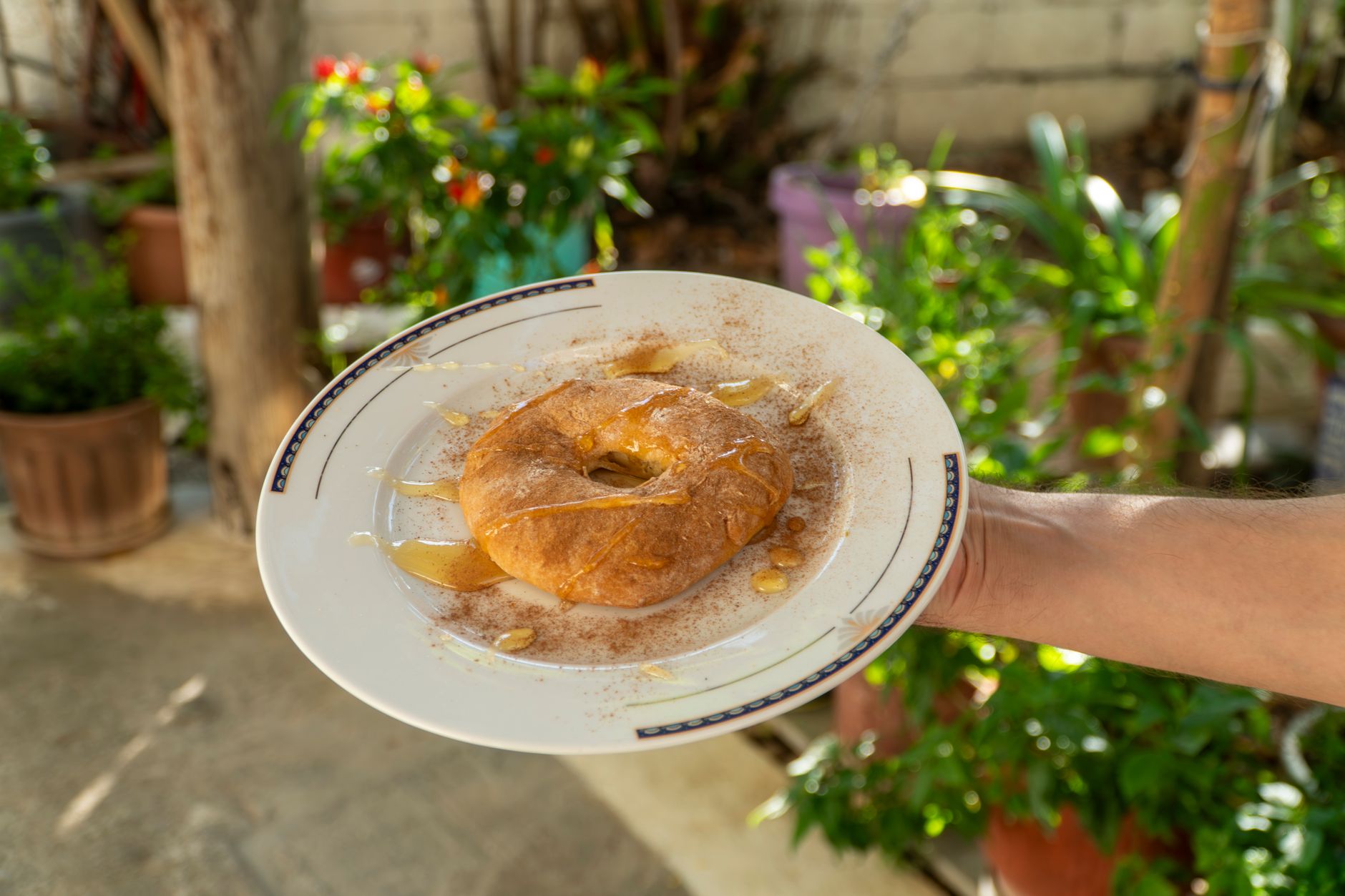
Dessert often behaves like an ambush. Yogurt with honey arrives after you swore you could eat no more. Loukoumades arrive when the group has started to leave, which is exactly when greed becomes honest. The Greeks understand timing. That may be their highest art.
Greek politeness is not made of distance. It is made of approach. Someone will ask if you have eaten, where you are from, why you are rushing, whether you need more bread, and this interrogation is not suspicion but care wearing practical shoes. In many countries hospitality says, I hope you are comfortable. In Greece it says, sit down.
A small gift for a home visit still works. So does greeting people properly, in order, with your face awake. Manners here are concrete. You acknowledge the room. You thank the person who brought the plate. You do not wave your hand around carelessly unless you enjoy discovering the limits of your charm; the moutza has not retired.
What I admire is the Greek talent for insistence without sentimentality. Take more. Stay longer. Have coffee. Have another. Behind the repetition is a serious idea: company should not be efficient. On a square in Corfu or under a plane tree in Kavala, time is not killed. It is fed.
Greek architecture knows that stone has moods. The marble of Athens can look judicial at noon and edible at sunset. A Doric column does not persuade by ornament but by restraint, which is more seductive and much harder to fake. Even ruins in Greece possess manners.
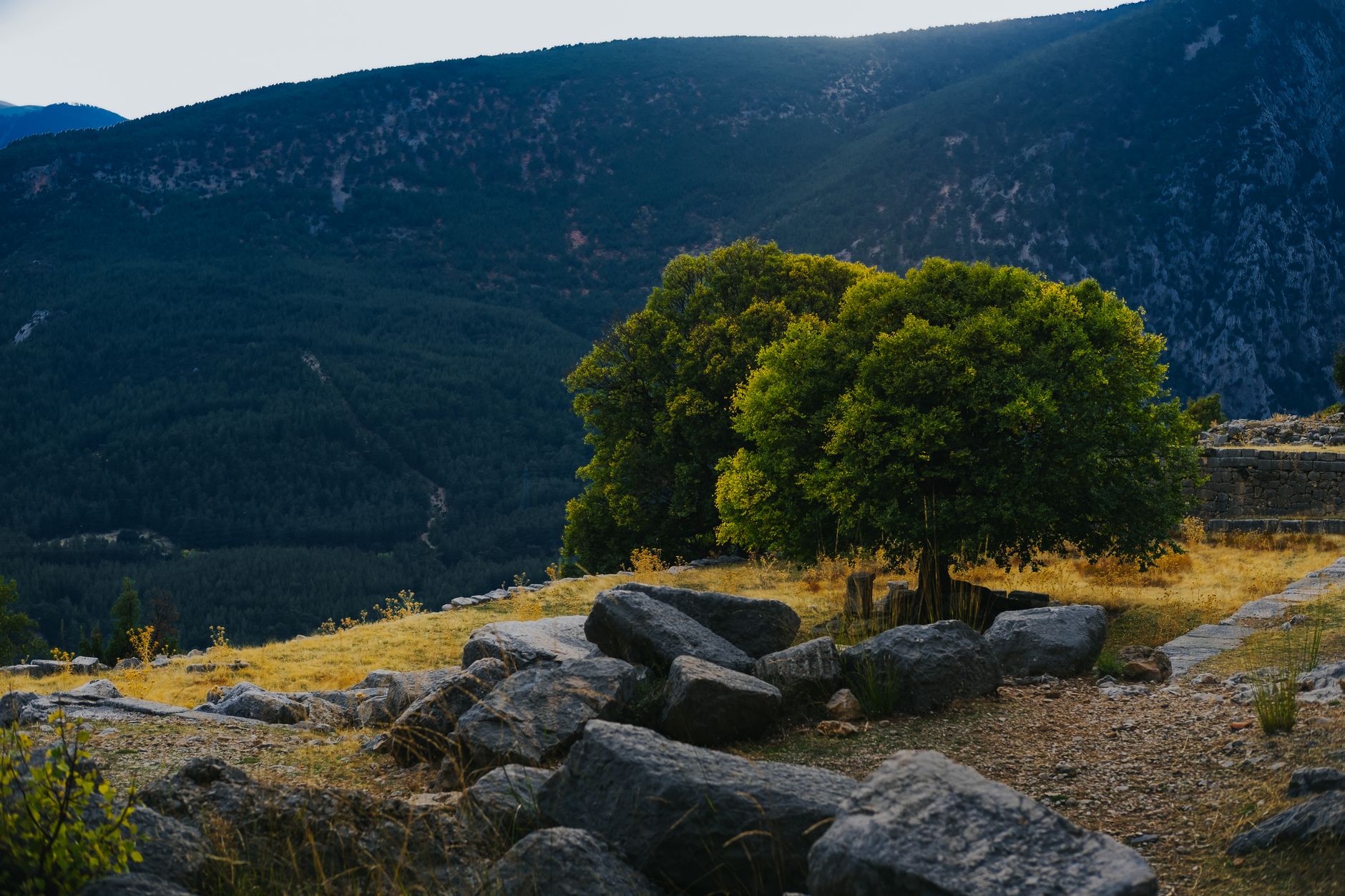
Then the country changes register. In Delphi, the mountain presses so close to the sanctuary that prophecy begins to look like geography. In Meteora, monasteries sit on rock pillars with the serene arrogance of birds that learned masonry. In Mystras, Byzantine walls and churches fold down the hillside like a long argument with gravity.
The houses on islands and in old quarters practice another intelligence: shade, wind, thickness, whitewash, the exact position of a courtyard door. This is design before the age of design, when survival had taste. Walk in Nafplio at dusk or in lanes above a harbor in Santorini and you notice that beauty here often begins as climate discipline.
Greece never lets you forget that buildings are negotiations with heat, salt, conquest, prayer, and vanity. That is why they stay in the mind. They are not objects. They are decisions made visible.
Orthodoxy in Greece is not confined to doctrine. It lives in wax, smoke, silver, bells, and the choreography of entering a church after the glare outside. Step from a white street into a dim nave and the body understands before the mind does: cool stone, lamp flame, the faint sweetness of old incense, a saint's face looking at you with the patience of someone who has seen empires come and go.
The icon is not decoration. It is presence with paint. Gold backgrounds refuse perspective because heaven has no obligation to imitate optics. In a chapel in Rhodes, in a monastery near Meteora, in a church tucked behind a commercial street in Thessaloniki, you begin to grasp why Greek religion feels tactile rather than abstract. Faith here likes surfaces: wood worn by fingers, candles bending in heat, metal polished by repeated hope.
But Greece is too old and too theatrical to keep its sacred worlds in separate drawers. Pagan stones remain in the landscape. Christian ritual took the stage and kept some of the ancient instincts: procession, chant, fasting, feast, the management of awe. Delphi may belong to Apollo in memory and Athens to the Parthenon in photography, yet the small parish church often reveals more about living Greece than any temple.
Religion, here, is a discipline of attention. Light the candle. Kiss the icon if you wish. Stand still. The room will do the rest.
Greek philosophy still haunts the ordinary table, which seems only fair since so many of its founding scenes began in public, among people eating, arguing, interrupting, and refusing to go home. The inheritance is not solemnity. It is appetite attached to inquiry. In Athens, this feels obvious. You can walk from the Acropolis slopes to a coffee shop and hear two retired men disputing politics with the severity once reserved for ontology.
What Greece contributed was not only a set of answers but a style of doubt. Ask what justice is. Ask what beauty is. Ask whether the city deserves your loyalty. Then order another coffee and continue. A bad civilization fears embarrassment. Greece canonized it and called it dialogue.
The strange triumph is that the philosophical reflex survived the collapse of schools, kingdoms, occupations, and certainties. In Thessaloniki, in university corridors and smoky bars, in village squares far from any academy, people still test ideas aloud as if truth were something one approached socially. This is exhausting. It is also magnificent.
Delphi offered oracles. Greece later invented the habit of cross-examining them. That may be the whole national plot.
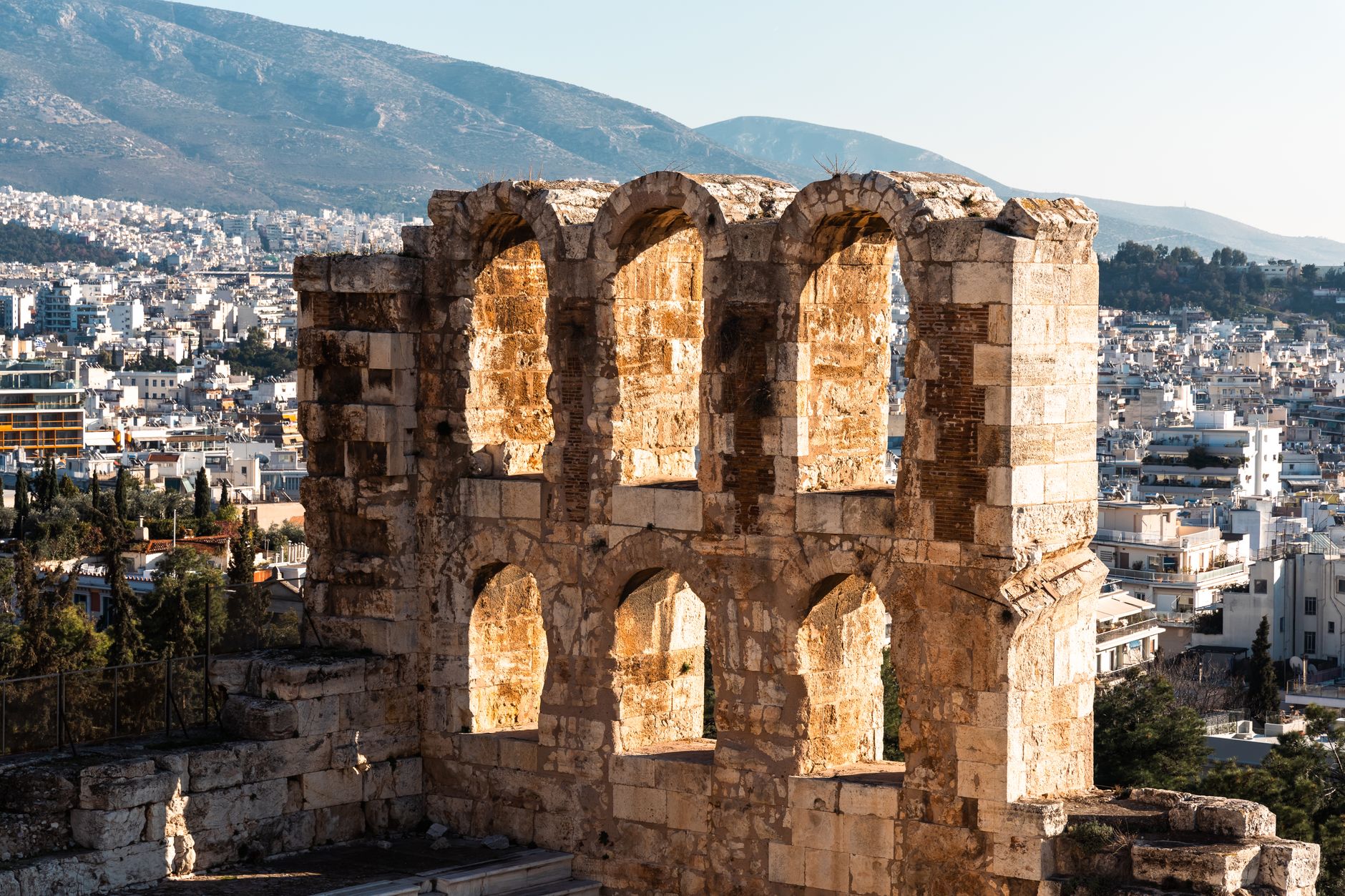
Athens, Delphi, and Heraklion are not isolated ruins on a coach route. They are working places where temples, sanctuaries, and palace histories still organize how travelers understand the country.
Greece is not only classical marble. In Mystras, Nafplio, Rhodes, and Corfu, Byzantine chapels, Frankish fortresses, Ottoman traces, and Venetian facades keep interrupting the familiar ancient-Greece storyline.
Greek food works best in plural: meze, grilled fish, horta, spanakopita, slow lunches, late dinners. Thessaloniki and Crete, especially around Rethymno and Heraklion, make that generosity feel like local law.
The sea gets the attention, but the mainland changes the trip. Meteora, the Pindus spine, and inland road journeys give Greece a vertical drama that most beach-first itineraries miss.
Santorini, Rhodes, and Corfu prove that Greek islands are not interchangeable. Volcanic cliffs, walled harbors, green Ionian coves, and ferry-linked towns each come with their own pace and architecture.
13 cities — start with the ones we'd send you to first.
Athens doesn't preserve its past — it argues with it. Ancient columns hold up Byzantine chapels, Ottoman bathhouses hide behind neoclassical facades, and the whole city stays up past midnight debating what to build next.
Rethymno hands you a Venetian key, whispers an Ottoman secret, then pours tsikoudia until both histories taste the same.
Greece's second city runs on bougatsa at dawn and rembetiko past midnight, with a Byzantine wall cutting straight through the university district.
The caldera is a flooded volcanic crater, and the white villages of Oia cling to its rim 300 metres above a sea that swallowed the island's original centre around 1600 BCE.
The Minoan palace of Knossos sits 5 km from a port city whose Venetian fortress still guards a harbour where Crete's entire modern identity — wine, olive oil, knives — gets loaded onto ferries.
A walled medieval city built by the Knights Hospitaller in 1309 is still inhabited, its cobbled Street of the Knights intact enough that film crews mistake it for Jerusalem.
The sanctuary where Greek city-states came to ask the Oracle for permission to go to war sits on a sheer Parnassus slope at 570 metres, the Sacred Way still paved with their thank-you offerings.
The first capital of modern Greece after 1828 independence, a Venetian-Ottoman town of neoclassical mansions and a sea fortress reached by a short rowboat, quietly outclassing every other small city in the Peloponnese.
Six Eastern Orthodox monasteries built on sandstone pinnacles between the 14th and 16th centuries, accessible only by ladders until the 1920s, still active and still requiring covered shoulders at the door.
Athens is not a museum with traffic added as an inconvenience; the traffic is part of the point. Ancient stone, apartment blocks from the 1960s and late-night souvlaki counters all sit in the same frame, and from here you can push west to Delphi or south toward Nafplio without wasting a day.
Thessaloniki feels looser and less self-conscious than the capital, with a stronger Ottoman and Byzantine aftertaste and some of the country's best everyday eating. Move inland and the terrain rises fast: Meteora's monasteries look impossible, while Kavala gives you a port-city edge that mainland itineraries often ignore.
Crete is large enough to behave like its own country. Heraklion is the practical anchor for Knossos and the archaeological museum, while Rethymno softens the pace with Venetian facades, university life and tavernas where dinner easily becomes a three-hour event.
The Cyclades can be maddening in peak season and magnificent when timed well. Santorini gives you the famous caldera and prices to match, but what stays with many travelers is the geology: black stone, whitewashed edges and villages built as if they were trying to hold on to a cliff.
The Peloponnese rewards people who rent a car and stop taking Greece in postcard-sized pieces. Nafplio is the elegant front door, then the route turns stranger and richer: Byzantine Mystras, the rock-bound lanes of Monemvasia, and inland stretches where history arrives without a ticket desk.
Corfu and Rhodes show two very different versions of maritime Greece. Corfu carries Venetian polish and a greener, wetter landscape, while Rhodes leans toward fortified stone, Crusader memory and a harsher Aegean light that makes the old city look cut from honey-colored rock.
A Greek timeline of collapse, reinvention, empire, revolt and very long memory
Long before the Parthenon, island and mainland communities were already trading, building, burying, and marking status with objects small enough to fit in a hand. Greece begins not as a nation but as a web of sea routes and local worlds.
At sites linked with later Heraklion, palatial centers such as Knossos transformed storage, ritual, and power into architecture. Administration became monumental, and later myth would remember that fact as a labyrinth.
After major destruction at Cretan palaces, mainland elites gained the upper hand across much of the Aegean world. Citadels like Mycenae and Tiryns became the hard-faced symbols of Late Bronze Age authority.
Whether every detail is recoverable or not, this date marks the Greek habit of turning rivalry into ritual. Competition, prestige, and sacred truce were already learning to share the same stadium.
Political reform in Athens widened participation and changed the grammar of power. Democracy did not arrive as pure idealism; it arrived as a response to faction, ambition, and the need to outmaneuver rivals.
Persia looked overwhelming on land and sea, yet the naval battle near Athens gave the Greeks a story they never forgot. Survival turned into self-belief, and self-belief soon turned back into competition among the victors.
Fresh from war and flush with imperial money, Athens began the monument that still shapes the world's picture of Greece. It was art, devotion, and political messaging at once.
Philip II's assassination thrust a young, dazzling, dangerous heir onto the throne. Within a few years he would make Greek culture a world force, though not a peaceful one.
Greek political independence narrowed sharply under Roman power, but Greek culture began one of its most successful revenges. Rome ruled the territory and then sent its sons to Greece for education.
The imperial center shifted east, and the Greek-speaking world found itself close to a new capital of astonishing ceremony. The old Hellenic inheritance would now live inside a Christian empire.
Western crusaders tore into the Byzantine capital, and the blow was not only military but psychological. Greek political unity fractured further, and mistrust of the Latin West deepened for generations.
The last Byzantine emperor died in the city's final defense, and an era closed with brutal clarity. Greek life continued under Ottoman rule, but statehood, for centuries, did not.
Revolt broke out in the Peloponnese and beyond, carried by local chiefs, island fleets, clergy, merchants, and foreign supporters. The struggle was heroic and divided, a liberation war with civil quarrels inside it.
The first governor of independent Greece tried to build order faster than old loyalties could tolerate. His murder in Nafplio showed how hard it would be to turn revolution into a functioning state.
The new kingdom chose Athens, then still a modest town among ruins, as its political center. Symbolism won over convenience, and the modern capital was asked to rise around the skeleton of antiquity.
During the Balkan Wars, Thessaloniki passed from Ottoman rule to Greece, changing the country's scale and imagination at once. The city brought commerce, cosmopolitan habits, and a different northern horizon.
Military defeat in Anatolia ended the dream of expansion and sent waves of refugees into the Greek mainland. Neighborhoods, cuisines, music, and politics were transformed by people who arrived with almost nothing but memory.
Occupation brought famine, repression, deportation, and resistance. The trauma of wartime Greece did not end with liberation; it slid into another and even more intimate conflict.
Left and right fought for the future of Greece under the shadow of the Cold War, but for ordinary people the conflict was local, personal, and bitter. Villages, families, and memories split along lines that lasted for decades.
A military junta imposed censorship, prison, and the stale theatre of authoritarian order. Greek democracy did not disappear quietly; it survived in exile, underground culture, and public resentment.
After the Cyprus disaster, the junta collapsed and parliamentary life was restored. Modern Greek democracy was rebuilt not from innocence but from exhaustion and a very clear memory of what dictatorship had cost.
Entry into the European project confirmed a geopolitical turn that had been years in the making. It also opened a new chapter in the Greek argument about sovereignty, modernity, and belonging.
The return of the Olympics to Athens was part celebration, part logistical gamble, part national self-portrait. For a few summer weeks, Greece staged its past and present on the same set.
Budget figures turned into street anger, shattered careers, and a deep test of trust between citizens and institutions. Greece was forced to debate, in public and in pain, what sovereignty means when creditors are in the room.
Bronze Age Greece
Minos, whether king or myth, survives because later Greeks preferred to remember power as a family drama rather than an inventory system.
A clay jar sweats in the heat, a seal stone presses into wet wax, and somewhere in what is now Heraklion, a steward counts oil, wool, and grain in rooms painted with lilies and bulls. This is where Greek history begins in earnest: not with white columns, but with storage magazines, staircases, and the smell of damp plaster. Knossos was less a legend than an administrative machine that later centuries dressed in myth.
What people often miss is that the first grandeur of Greece was not democratic, and not even especially Greek in the later classical sense. On Crete, palaces rose to manage trade and ritual at a scale that still feels theatrical; on the mainland, citadels such as Mycenae and Tiryns turned stone into a declaration of rank. The gates were enormous. The records, by contrast, are heartbreakingly thin.
Then came fire, collapse, and the long aftertaste of memory. Around the end of the Bronze Age, palace society broke apart across the Aegean, and what survived did so in fragments: walls, tombs, stories, names that later poets would embroider until Agamemnon and Minos became more vivid than the clerks and queens who once walked these courts. Legend holds that Minos ruled a labyrinth; archaeology suggests something almost as interesting, a court so complex that bureaucracy itself could feel like a maze.
That is Greece's first secret: ruin came early, and memory got there fast. The country learned, from the beginning, how to live among broken greatness and turn loss into story. Out of that silence, village by village and harbor by harbor, the world of the city-state would emerge.
The so-called Treasury of Atreus at Mycenae kept its grand name from legend, although it was not a treasury at all but a monumental tomb with a dome that stunned even later visitors.
Archaic, Classical and Hellenistic Greece
Alexander the Great was not a marble abstraction but a restless young king with a terrible inheritance problem and no gift for dying at a convenient moment.
Morning breaks on the Acropolis in Athens, and the first light catches fresh marble dust on a building site that will become the Parthenon. Down below, the city argues. That is the miracle and the nuisance of Greece in the archaic and classical age: politics as public performance, honor as fuel, and rivalry elevated into a national habit.
Athens did not invent ambition, but it staged it better than anyone. Its assembly, juries, festivals, and naval swagger produced drama in both senses of the word, while Sparta answered with discipline so severe that it still makes later admirers sit up straighter. What people often miss is that the Greek achievement came from competition as much as harmony. Delphi mattered because every city wanted Apollo to bless its own vanity.
The Persian Wars gave the Greeks a story about themselves, small cities facing an empire and refusing to kneel. Then they immediately resumed their own quarrels, and the Peloponnesian War exposed the vanity, fear, and appetite beneath the polished speeches. Pericles built, yes, but he also spent. Alcibiades dazzled, betrayed, and returned like a man convinced the rules existed for other people.
Out of that exhaustion came Macedon. Philip II disciplined the Greek world by force, and his son Alexander turned a northern court into a machine of conquest, carrying Greek speech and prestige as far as Egypt and the edge of India. He died at thirty-two, leaving an empire with no settled heir, which is a very Greek ending: brilliance, then division, then a wider world remade by a family quarrel.
The Erechtheion on the Acropolis shelters marks once shown to visitors as Poseidon's trident strike and the salt spring he supposedly summoned during his contest with Athena.
Roman and Byzantine Greece
Emperor Constantine XI, the last Byzantine ruler, died in armor at the walls of Constantinople and became, in memory, less a statesman than a martyr-king.
A Roman aristocrat arrives in Athens with money, tutors, and cultural insecurity. He has conquered Greece on paper; in practice, he has come to study it. This is the paradox of the Roman age: Greece lost political command, yet it became the finishing school of empire, lending Rome its rhetoric, philosophy, and artistic grammar.
Sanctuaries still drew pilgrims, and cities still polished their prestige, but the center of gravity shifted eastward. When Constantine founded Constantinople in 330, the Greek-speaking world acquired a new court, glittering, ceremonial, suspicious, and devout. The old temples did not simply vanish. They were overshadowed, repurposed, argued over, and slowly folded into a Christian empire that wrote its authority in mosaics rather than marble.
What people often miss is how personal Byzantine power could be. Empresses, eunuchs, monks, generals, and bishops all crowded the same stage, and theology often carried the temperature of a family feud. In Thessaloniki, in Mystras, in monasteries that would one day find their most dramatic expression at Meteora, Greek Christianity became not a footnote to antiquity but a civilization of its own, with its own splendor, its own bureaucracy, and its own scandals.
Then came the long weakening: crusaders who behaved like looters, rival dynasties, Ottoman pressure, exhausted treasuries. The fall of Constantinople in 1453 is remembered as a single catastrophe, but one should picture years of attrition before the last breach. Greece would not stop being Greek under Ottoman rule; it would simply learn, again, how to preserve memory without possessing the state.
Byzantine scholars fleeing west after 1453 carried manuscripts with them, helping to feed the Italian Renaissance with Greek learning saved from a collapsing empire.
Ottoman Rule and the Making of the Greek State
Theodoros Kolokotronis, with his mane of hair and peasant cunning, looks in portraits like a bandit because for part of his life that was nearly the job description.
A schoolroom whispers after dark, a priest hides a book, a shipowner counts coins in a harbor, and a mountain captain sharpens his grievance into patriotism. Ottoman Greece was never a single experience. Islands, trading ports, monasteries, and villages lived under different pressures, but all learned the same lesson: identity could survive in church liturgy, family memory, and stubborn local custom.
The War of Independence, beginning in 1821, did not unfold like a tidy national opera. It was heroic, brutal, improvised, and often divided against itself, with local chiefs, island fleets, foreign philhellenes, and great-power calculations pulling in different directions. Nafplio became an early political stage, and Lord Byron's death at Missolonghi gave Europe the sort of romantic sacrifice it knows how to applaud. The people doing the dying, of course, needed more than applause.
Independence brought freedom, but not serenity. The new kingdom imported a Bavarian prince, Otto, as king, which is one of history's elegant absurdities: a nation fighting to recover its voice and receiving a teenager from abroad to rule it. Athens, chosen as capital in 1834, was then a small town among ruins, more memory than metropolis. Statehood had to be built almost from scratch, stone by stone, ministry by ministry.
Expansion followed, along with fresh wounds. Thessaloniki entered the Greek state in 1912, and the dream of a greater Greece reached its breaking point a decade later with the catastrophe in Asia Minor. Refugees arrived with trunks, icons, recipes, songs, and grief. Modern Greece, the urban Greece of crowded neighborhoods and complicated loyalties, was born as much from that uprooting as from any battlefield victory.
When Athens became the capital, it had fewer than 10,000 inhabitants and more goats than administrative dignity, yet it was asked to perform the role of resurrected classical capital at once.
Twentieth-Century Greece and the Republic
Melina Mercouri understood that culture could be a form of politics, and she fought for Greek heritage with the flair of an actress who knew how to turn indignation into pressure.
A family lands with one carpet, one frying pan, and the key to a house in Smyrna that no longer belongs to them. After 1922, hundreds of thousands of refugees reshaped Greek society, especially in Athens and Thessaloniki, bringing labor, music, food, and a bitterness that politics could never quite absorb. Rebetiko grew from those port districts like a bruise set to music.
The century then tightened its grip. Occupation during the Second World War brought famine, executions, and resistance; liberation did not bring peace but civil war, with Greeks killing Greeks under the shadow of the larger Cold War. Corfu, Rhodes, and the islands saw the war from their own angles, but the national wound ran through the mainland like a fault line.
In 1967, the colonels seized power, speaking the stale language of order while practicing censorship, prison, and fear. What people often miss is how provincial dictatorship can look from up close: not only uniforms and decrees, but snooping, whispered caution, banned songs, and the grim comedy of men convinced they could regulate thought. The regime fell in 1974 after the Cyprus disaster, and democracy returned not as a miracle but as a hard political reconstruction, the Metapolitefsi.
Since then Greece has argued loudly, voted passionately, buried illusions, and kept going. The debt crisis exposed the violence hidden inside numbers, yet the deeper continuity remained: a country that has changed rulers, languages of power, and constitutional forms without losing its appetite for memory or debate. That is the bridge to the Greece a visitor meets now, from Athens to Delphi and from Santorini to Rethymno: ancient stones, yes, but also a very modern people who know the price of history because their grandparents paid it.
During the military junta, songs by Mikis Theodorakis were banned, which only made them travel faster from hand to hand and mouth to mouth.
Greek greets you before it informs you. Kalimera lands first, warm as bread, and only then does the sentence begin. In Athens, at a bakery counter on Mitropoleos Street, I once heard five syllables do the work of an embrace; the woman selling koulouri had the grave expression of a judge and the voice of a violin.
This language loves the mouth. Theta asks for air, rho asks for a small act of courage, and efharisto turns gratitude into a soft percussion exercise. A visitor who tries a few words will fail beautifully, which is fine. Greece respects effort more than polish. That is a civilization.
The miracle is that Greek can sound intimate and ceremonial at once. On a ferry quay in Heraklion, in a market lane in Thessaloniki, in a kafeneio near Nafplio, people speak with their hands, their eyebrows, their shoulders, as if grammar had rented the whole body. Silence exists, of course. It simply has to earn the right.
Greek food does not arrive as performance. It colonizes the table by increments. First olives, then bread, then a plate of horta with lemon, then something hot, then something grilled, then one more dish because nobody with a conscience would let a table remain half-empty. In Greece, appetite is treated as intelligence.
The genius of the cuisine lies in its refusal to separate hunger from company. Meze is not a category of dishes; it is a social method, almost a constitution. You do not order one thing and defend it with your fork. You surrender. A country is a table set for strangers.
And then the details start their quiet tyranny: oregano on lamb, thyme in the hills, capers on island plates, the cold shock of feta against a tomato still holding the afternoon sun. In Rethymno and Rhodes, fish appears with enough lemon to wake the dead. In mountain country near Delphi or Meteora, beans and greens remind you that piety may have begun as a soup.
Dessert often behaves like an ambush. Yogurt with honey arrives after you swore you could eat no more. Loukoumades arrive when the group has started to leave, which is exactly when greed becomes honest. The Greeks understand timing. That may be their highest art.
Greek politeness is not made of distance. It is made of approach. Someone will ask if you have eaten, where you are from, why you are rushing, whether you need more bread, and this interrogation is not suspicion but care wearing practical shoes. In many countries hospitality says, I hope you are comfortable. In Greece it says, sit down.
A small gift for a home visit still works. So does greeting people properly, in order, with your face awake. Manners here are concrete. You acknowledge the room. You thank the person who brought the plate. You do not wave your hand around carelessly unless you enjoy discovering the limits of your charm; the moutza has not retired.
What I admire is the Greek talent for insistence without sentimentality. Take more. Stay longer. Have coffee. Have another. Behind the repetition is a serious idea: company should not be efficient. On a square in Corfu or under a plane tree in Kavala, time is not killed. It is fed.
Greek architecture knows that stone has moods. The marble of Athens can look judicial at noon and edible at sunset. A Doric column does not persuade by ornament but by restraint, which is more seductive and much harder to fake. Even ruins in Greece possess manners.
Then the country changes register. In Delphi, the mountain presses so close to the sanctuary that prophecy begins to look like geography. In Meteora, monasteries sit on rock pillars with the serene arrogance of birds that learned masonry. In Mystras, Byzantine walls and churches fold down the hillside like a long argument with gravity.
The houses on islands and in old quarters practice another intelligence: shade, wind, thickness, whitewash, the exact position of a courtyard door. This is design before the age of design, when survival had taste. Walk in Nafplio at dusk or in lanes above a harbor in Santorini and you notice that beauty here often begins as climate discipline.
Greece never lets you forget that buildings are negotiations with heat, salt, conquest, prayer, and vanity. That is why they stay in the mind. They are not objects. They are decisions made visible.
Orthodoxy in Greece is not confined to doctrine. It lives in wax, smoke, silver, bells, and the choreography of entering a church after the glare outside. Step from a white street into a dim nave and the body understands before the mind does: cool stone, lamp flame, the faint sweetness of old incense, a saint's face looking at you with the patience of someone who has seen empires come and go.
The icon is not decoration. It is presence with paint. Gold backgrounds refuse perspective because heaven has no obligation to imitate optics. In a chapel in Rhodes, in a monastery near Meteora, in a church tucked behind a commercial street in Thessaloniki, you begin to grasp why Greek religion feels tactile rather than abstract. Faith here likes surfaces: wood worn by fingers, candles bending in heat, metal polished by repeated hope.
But Greece is too old and too theatrical to keep its sacred worlds in separate drawers. Pagan stones remain in the landscape. Christian ritual took the stage and kept some of the ancient instincts: procession, chant, fasting, feast, the management of awe. Delphi may belong to Apollo in memory and Athens to the Parthenon in photography, yet the small parish church often reveals more about living Greece than any temple.
Religion, here, is a discipline of attention. Light the candle. Kiss the icon if you wish. Stand still. The room will do the rest.
Greek philosophy still haunts the ordinary table, which seems only fair since so many of its founding scenes began in public, among people eating, arguing, interrupting, and refusing to go home. The inheritance is not solemnity. It is appetite attached to inquiry. In Athens, this feels obvious. You can walk from the Acropolis slopes to a coffee shop and hear two retired men disputing politics with the severity once reserved for ontology.
What Greece contributed was not only a set of answers but a style of doubt. Ask what justice is. Ask what beauty is. Ask whether the city deserves your loyalty. Then order another coffee and continue. A bad civilization fears embarrassment. Greece canonized it and called it dialogue.
The strange triumph is that the philosophical reflex survived the collapse of schools, kingdoms, occupations, and certainties. In Thessaloniki, in university corridors and smoky bars, in village squares far from any academy, people still test ideas aloud as if truth were something one approached socially. This is exhausting. It is also magnificent.
Delphi offered oracles. Greece later invented the habit of cross-examining them. That may be the whole national plot.
Pericles gave Athens its marble confidence and its dangerous sense of destiny. He understood that buildings could be political theatre, which is why the Acropolis still feels less like decoration than a manifesto in stone.
Sappho's Greece is not the Greece of generals but of desire, jealousy, and carefully chosen words. From Lesbos she made private emotion public art, and that intimacy still cuts through the noise of heroic history.
Alexander carried Greek prestige across an empire, but he also dragged Greek rivalries into a world far larger than the city-state. The young king from Macedon turned conquest into legend so quickly that later Greece never quite stopped arguing over whether to admire him, fear him, or claim him.
Justinian ruled from Constantinople, but his empire breathed in Greek as much as in law. He belongs in the Greek story because Byzantium preserved and transformed Hellenic inheritance, giving it a Christian court, a legal spine, and a taste for imperial spectacle.
Kolokotronis was the face of the War of Independence at its most stubborn: part strategist, part clan chief, part national symbol created in real time. In Nafplio he moved from war hero to political actor, which in Greece often means the battle has merely changed clothes.
Kapodistrias returned from European diplomacy to build a state that barely existed outside hope and exhaustion. He tried to impose order on a country drunk on victory and division, and paid with his life when he was assassinated in Nafplio.
Born in Crete under Venetian rule, El Greco carried the island's Byzantine eye into the wider Mediterranean and then to Spain. His figures look stretched toward heaven because he never painted the world as stable; he painted it as revelation.
Cavafy wrote outside the Greek kingdom yet straight into the heart of Greek memory. His poems made Hellenistic kings, clerks, exiles, and disappointed men feel immediate again, which is perhaps the most Greek trick of all: turning history into private ache.
Theodorakis gave modern Greece a soundtrack equal to its tempers, its mourning, and its defiance. During dictatorship his music became a form of stubborn citizenship, proof that melody can carry more danger than a speech.
Mercouri wore glamour like armor and used fame for combat. From Athens she fought the junta in exile, then returned to make culture a national cause, speaking of the Parthenon sculptures with the indignation of someone defending family silver.
This is the sharpest short introduction to mainland Greece: a capital layered in marble and traffic, a handsome Peloponnese seaport, then a mountain sanctuary that still feels slightly unreal. It works best if you want history fast and do not want to spend half the trip changing hotels.
Northern Greece gives you a different country: Byzantine churches, student energy, monastery rock towers and a port city facing the northern Aegean. Distances are manageable, food is excellent, and the route avoids the summer crush that swallows parts of the Cyclades.
Start in Crete, where Minoan archaeology and serious tavern food come before beach clichés, then finish with Santorini's caldera drama. Heraklion gives you Knossos and a working city, Rethymno slows the pace, and Santorini earns its reputation best if you arrive after you have already seen a less polished side of Greece.
This route links a crusader-built island city with the stony heart of the southeast mainland. Rhodes brings walls and sea light, Athens resets the historical frame, then Mystras and Monemvasia take you into late Byzantine Greece, where the ruins feel less staged and the road itself becomes part of the trip.
Small plates arrive, multiply, circulate. Friends talk, forks wander, glasses rise, nobody guards territory.
Skewers leave the grill, pita follows, hands take over. Lunch after markets, midnight after bars, hunger without ceremony.
Tomato, cucumber, onion, olives, feta, oil. Summer table, shade, bread, silence for one minute.
Wild greens boil, lemon falls, oil shines. Family lunch, Lenten table, grandmothers approve.
Pan lands hot, portions sink onto plates, forks cut through eggplant and béchamel. Sunday meal, long table, little urgency.
Beans simmer, bread tears, conversation slows. Winter evening, city apartment, mountain village, equal effect.
Coffee brews low and slow, cup settles, grounds remain. Morning talk, business talk, gossip, prophecy.










Greece is in the Schengen Area. Most visitors from the US, UK, Canada and Australia can stay up to 90 days in any 180-day period without a visa, but that clock runs across the whole Schengen zone, not just Greece. ETIAS is scheduled to become part of the entry process for visa-exempt travelers from late 2026, so check the official EU portal before you fly.
Greece uses the euro. A workable budget is about €40-90 a day for hostel-and-souvlaki travel, €100-180 on the mainland for a comfortable mid-range trip, and €300 or more if you are booking peak-season islands, boutique hotels and frequent domestic flights.
Athens is the main international gateway, with strong onward links to Thessaloniki, Heraklion, Rhodes and Santorini. If you are heading straight to Crete or the islands, compare open-jaw flights: arriving in Athens and leaving from Heraklion or Rhodes can save a full day of backtracking.
Mainland Greece works best as a mix of intercity buses, rental cars and a limited rail network. Trains are useful on the Athens-Thessaloniki axis and for Meteora via Kalambaka, but ferries and short flights still do much of the heavy lifting once islands enter the plan.
Expect a Mediterranean pattern on the coasts and islands: hot, dry summers and milder winters. The inland mountains run cooler and can change fast, which is why Delphi and Meteora feel very different from Athens or Rhodes in the same week.
Mobile coverage is solid in cities and on major islands, and eSIMs are easy to set up before arrival. Ferry decks, mountain roads and smaller island ports are where service drops first, so download tickets, maps and hotel details before you leave Athens or Thessaloniki.
Greece is generally easy to travel in, with the usual big-city pickpocket risk around airports, metro lines and crowded ferry terminals. Summer brings the more serious practical hazards: heat, sun exposure, dehydration and occasional wildfire disruption, especially in July and August.
Your money goes much further on the mainland and in Crete than in Santorini in July. If you want one expensive island splurge, pair it with Thessaloniki, Nafplio or Delphi rather than stacking premium islands back to back.
Reserve popular summer ferry legs as soon as your dates are fixed, especially for Santorini and Rhodes. The cheap seats disappear first, and the second-best option is often a slower boat that eats half a day.
A car is most useful in the Peloponnese and parts of Crete, less so in Athens. Pick it up when you leave the city, not on arrival, unless you enjoy paying to park while not using it.
Tipping is appreciated but not compulsory. Rounding up or leaving 5-10% in restaurants is standard when service is good; for taxis and coffee, small change does the job.
Buses, archaeological sites and ferries are all easier before noon in summer. You will spend less time in queues, less time under hard sun and more time actually seeing the place you came for.
A simple kalimera and efharisto changes the tone of an interaction fast. Fluency is irrelevant; the point is that you made the effort before asking for the bill, the bus platform or the hotel key.
In Athens, stay close to a metro line or within walking distance of the center; in island ports, sleep near the harbor only if you have an early departure. Port areas are practical at 7 a.m. and much less charming at midnight.
Explore Greece with a personal guide in your pocket
Audio guides for 1,100+ cities across 96 countries. History, stories, and local insight — offline ready.
Usually no for short trips. US citizens can typically visit Greece for up to 90 days within any 180-day period under Schengen rules, but that limit applies across all Schengen countries you visit on the same trip.
It can be, but the price gap between regions is huge. Athens, Thessaloniki and much of the mainland can still be reasonable at mid-range budgets, while Santorini in peak summer can push hotel and restaurant costs far above the national average.
Use a mix of transport rather than trying to force one system to do everything. Buses and rental cars work best on the mainland, trains cover only part of the country, and ferries or short flights become essential once islands like Rhodes, Corfu or Santorini are involved.
Seven to ten days is the useful minimum if you want more than Athens and one quick side trip. Three days works for Athens, Nafplio and Delphi, but longer trips let you add Crete, Meteora, Thessaloniki or one island without turning the holiday into a transport marathon.
Yes, if you want caldera views and can handle high prices. No, if your priority is value, beach time or a calmer local rhythm, because Crete already gives you stronger food, more space and a deeper historical range.
You can, but an overnight is better. The rock monasteries are most impressive early and late in the day, when the light is lower, the roads quieter and the place stops feeling like a box to tick.
Generally yes. The main issues are petty theft in busy urban areas, transport strikes, extreme heat and occasional wildfire disruption rather than violent crime aimed at visitors.
Rent a car if you are exploring the Peloponnese, Crete or smaller mainland towns. Skip it in Athens, where traffic and parking are a bad trade unless you are leaving the city almost immediately.
Last reviewed