Plan and listen to Stolperstein Dedicated To Sebald Strauss with Audiala.
Audio guide in your pocket, itinerary in your browser. Built for the way you actually visit.
Introduction
Visiting the Stolperstein dedicated to Sebald Strauss in Wiesbaden is a powerful way to connect with the personal histories woven into the broader fabric of Holocaust remembrance. Stolpersteine, or "stumbling stones," are small brass plaques set into sidewalks at the last freely chosen residences of those persecuted by the Nazi regime. Initiated in 1992 by artist Gunter Demnig, this decentralized memorial has become the world’s largest grassroots commemoration project, with over 116,000 stones placed across 31 European countries (Stolpersteine.eu; Wikipedia).
The Stolperstein for Sebald Strauss, located at Alwinenstraße 25, marks the home of a Jewish resident deported to Theresienstadt and murdered in 1942. This stone is part of Wiesbaden’s extensive network of memorials, supported by local institutions like the Aktive Museum Spiegelgasse für Deutsch-Jüdische Geschichte e.V., which coordinates research, installation, and community engagement (Jewiki.net; am-spiegelgasse.de).
This guide offers a detailed overview of the Stolperstein for Sebald Strauss, including its historical context, exact location, accessibility, visitor information, and its role within Wiesbaden's broader culture of remembrance. Whether you are a history enthusiast, educator, or traveler, this article will help you engage meaningfully with Wiesbaden’s living memorial landscape.

History and Concept of the Stolpersteine Project
Gunter Demnig’s Stolpersteine project began in Cologne, Germany, as a decentralized, grassroots memorial to commemorate victims of the Nazi regime—Jews, Sinti and Roma, political prisoners, Jehovah’s Witnesses, homosexuals, people with disabilities, and others (Wikipedia). Each Stolperstein is a 10 x 10 cm concrete cube topped with a hand-engraved brass plate, inscribed with the victim’s name, birthdate, and fate (Germany.info). These stones aim to restore the memory of individuals to their last freely chosen residences, making remembrance a personal and local experience.
As of June 2025, more than 116,000 Stolpersteine have been installed in over 1,860 municipalities across Europe, with strong representation in Germany but also in Austria, Italy, the Netherlands, Hungary, and beyond (Stolpersteine.eu).
The Stolperstein for Sebald Strauss: Location and Description
Location:
Alwinenstraße 25, 65185 Wiesbaden, Germany
GPS Coordinates: 50.078956, 8.255914
(TracesOfWar.com)
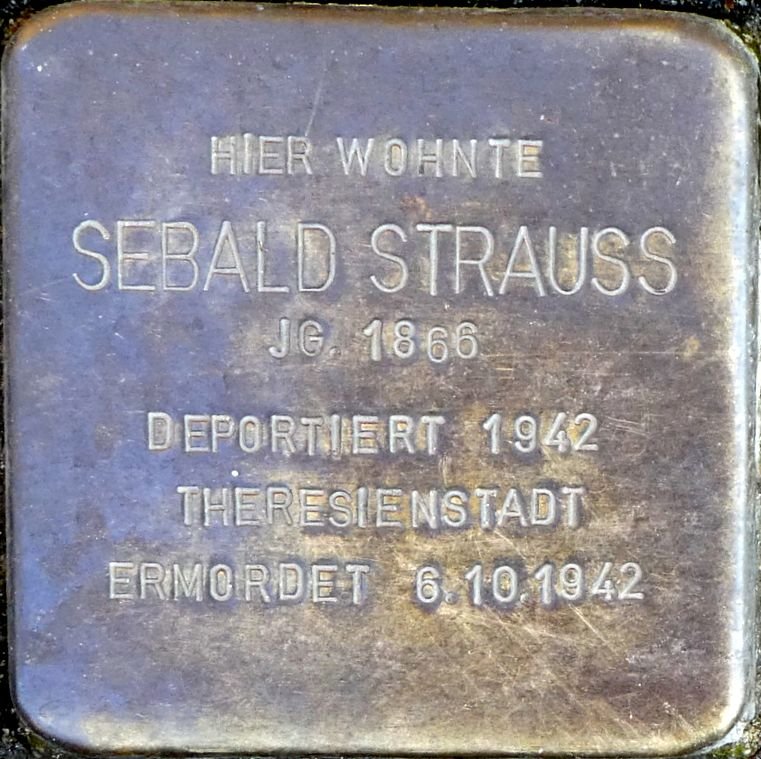
The Stolperstein for Sebald Strauss is embedded in the pavement in front of his last freely chosen residence. The plaque reads (translated):
Here lived
Sebald Strauss
Born 1866
Deported 1942
Theresienstadt
Murdered 6.10.1942
The polished brass stands out against the sidewalk, inviting both reflection and remembrance. Local volunteers regularly maintain the plaque to ensure the inscription remains visible (Jewiki.net).
Historical Significance
Sebald Strauss was born in 1866 and lived at Alwinenstraße 25 until his deportation to Theresienstadt in 1942, where he was murdered. His Stolperstein is one of more than 784 in Wiesbaden, part of a wider European memorial network. Each stone personalizes the tragedy of the Holocaust by focusing on a single life and its abrupt end, while integrating remembrance seamlessly into everyday urban life (Jewiki.net; Stolpersteine.eu).
Visitor Information: Hours, Tickets, and Accessibility
- Visiting Hours: The Stolperstein is accessible 24/7, as it is embedded in a public sidewalk.
- Admission Fee: There is no ticket or admission fee.
- Getting There:
- Public Transport: Alwinenstraße is a 10–15 minute walk from Wiesbaden Hauptbahnhof or easily reachable by bus.
- By Car: Limited street parking; public garages nearby.
- On Foot/Bicycle: The area is pedestrian-friendly.
- Accessibility: The Stolperstein is at street level, suitable for visitors with mobility challenges.
- Etiquette:
- Pause and read the inscription with respect.
- Leaving a small stone or flower is customary.
- Discreet photography is allowed; be respectful of residents.
- Polishing the plaque is welcomed as an act of remembrance.
Community and Educational Initiatives
Wiesbaden’s Stolpersteine are maintained by local volunteers, schools, and organizations such as the Aktive Museum Spiegelgasse für Deutsch-Jüdische Geschichte e.V. Community events include cleaning campaigns and commemorative ceremonies, particularly on Holocaust Remembrance Day (January 27) and other significant anniversaries (am-spiegelgasse.de). Schools often adopt Stolpersteine, researching biographical details and participating in installations (wiesbaden-lebt.de).
The Sebald Strauss Monument and Wiesbaden’s Jewish Heritage
In addition to the Stolperstein, the Sebald Strauss Monument stands in Wiesbaden’s city center as a broader tribute to the Jewish community. The monument is accessible 24/7 free of charge and is close to other sites of Jewish heritage, such as the ruins of the Old Synagogue and the Stadtmuseum am Markt. Guided tours and educational programs are available through the Wiesbaden Tourist Information Center (Wiesbaden Tourist Information).
Nearby Sites and Travel Tips
- Stadtmuseum am Markt: Offers exhibitions on Wiesbaden’s Jewish history and the Stolperstein project.
- Aktives Museum Spiegelgasse: Focuses on German-Jewish history in Wiesbaden and organizes guided tours.
- Other Stolpersteine: Many are located throughout the city and can be explored by foot or with guided tours.
- Travel Tips:
- Best visited from spring to autumn for pleasant weather.
- Download the Stolpersteine-App for interactive maps and biographies.
- Public transport in Wiesbaden is reliable and connects key memorial sites.
Frequently Asked Questions (FAQ)
Q: Are Stolpersteine in Wiesbaden open to the public?
A: Yes, they are accessible at all times, free of charge.
Q: Do I need tickets?
A: No, visiting Stolpersteine is free; tickets may be required for museum exhibitions.
Q: Are guided tours available?
A: Yes, through local museums and organizations. Check their websites for schedules.
Q: Can I participate in cleaning or remembrance events?
A: Community members are welcome to join cleaning and commemorative events.
Q: Is the area accessible for people with disabilities?
A: Most Stolpersteine, including Sebald Strauss’s, are at street level and accessible.
Listen to the full story in the app
The whole Stolperstein Dedicated To Sebald Strauss,
told well.
Audio guides for 1,100+ cities across 96 countries. History, stories, and local insight — offline ready.
Verified, and shown.
Researched and written by the Audiala editorial team from historical records, architectural archives, and local expertise.
Researched from Wikidata, Wikipedia & official sources · fact-checked · How we make our guides →