Plan and listen to Stolperstein Dedicated To Alfred Scherer with Audiala.
Audio guide in your pocket, itinerary in your browser. Built for the way you actually visit.
Introduction
The Stolpersteine (“stumbling stones”) project, launched by artist Gunter Demnig in the early 1990s, is the world’s largest decentralized memorial, commemorating victims of Nazi persecution. These brass plaques, set into sidewalks across Europe, mark the last freely chosen homes or workplaces of those who were murdered, deported, or driven to suicide during the Holocaust. In Wiesbaden, Germany, the Stolperstein for Alfred Scherer provides a poignant, tangible point of connection to the city’s once-vibrant Jewish community and the broader history of the Holocaust.
This comprehensive guide offers detailed information for those wishing to visit the Alfred Scherer Stolperstein in Wiesbaden, including historical background, location details, cultural significance, visitor etiquette, and practical tips. By engaging with this memorial, visitors participate in a living act of remembrance that continues to shape Wiesbaden’s identity and commitment to tolerance. For additional resources, see stolpersteine.eu, am-spiegelgasse.de, and TracesOfWar.com.

The Stolpersteine Project: Origins and Philosophy
Origins and Development:
Initiated in 1992, the Stolpersteine project seeks to counter the fading collective memory of Nazi crimes by embedding remembrance in the streets of European cities. Demnig’s first stones were laid in Berlin in 1996, and since then, over 116,000 have been installed in 31 countries, including more than 784 in Wiesbaden (stolpersteine.eu, Wikipedia: Stolperstein).
Purpose and Philosophy:
Stolpersteine commemorate all groups persecuted by the Nazis—Jews, Sinti and Roma, political dissidents, homosexuals, people with disabilities, Jehovah’s Witnesses, and others. Placed at the threshold of former homes and workplaces, each stone restores a name and story to public memory, transforming anonymous statistics into personal histories (stolpersteine.eu).
Artistic and Memorial Aspects:
Each Stolperstein is a 10 x 10 cm concrete block with a hand-engraved brass plate, listing the victim’s name, birth year, fate, and, if known, date and place of death. The minimalist design invites passersby to pause, reflect, and “stumble” upon history in daily life (Wikipedia: Stolperstein).
Alfred Scherer: Biography and Historical Context
Who was Alfred Scherer?
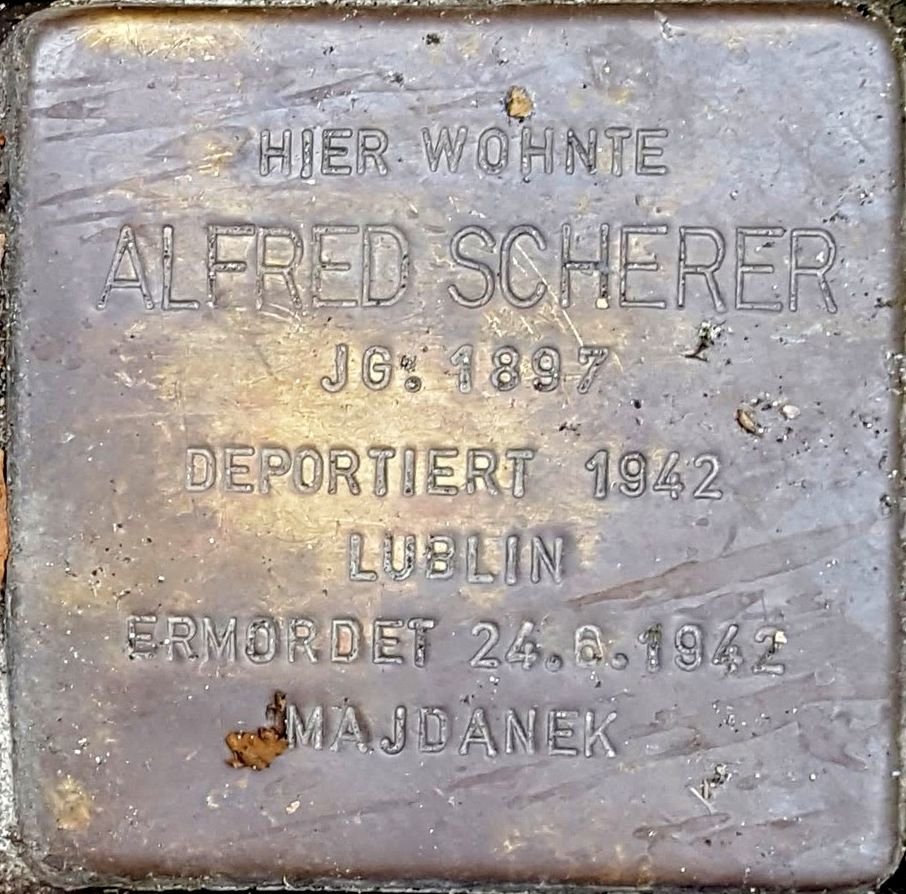
Alfred Scherer was a Jewish resident of Wiesbaden, born in 1897. Like many in the city’s Jewish community, he faced escalating persecution under the Nazi regime. He was ultimately deported and murdered in the Majdanek concentration camp on June 24, 1942 (Jewiki: Liste der Stolpersteine in Wiesbaden).
Wiesbaden’s Jewish Heritage:
Before the Holocaust, over 3,000 Jews called Wiesbaden home, contributing to its economic, social, and cultural life. Nazi policies led to forced deportations and mass murder, leaving only a fraction of the community after 1945. Stolpersteine like that of Alfred Scherer serve as personal reminders of these losses (am-spiegelgasse.de).
Visiting the Alfred Scherer Stolperstein: Location and Hours
Location Details:
- Address: Adelheidstraße 82, 65185 Wiesbaden, Germany
- Coordinates: 50.075678, 8.233287
(TracesOfWar.com)
The Stolperstein is set flush within the pavement in front of this address, a typical late 19th-century building in the centrally located Wiesbaden-Mitte district. The site is easily reached on foot from the city center and is close to public transit stops (Mapcarta).
Description:
The Stolperstein for Alfred Scherer is inscribed:
- Name: Alfred Scherer
- Birth Year: 1897
- Fate: Deported and murdered in Majdanek concentration camp, June 24, 1942
Visiting Hours and Tickets:
- The memorial is accessible at all times, without charge or need for tickets.
- Daytime visits are recommended for legibility and a respectful atmosphere.
Accessibility and Visitor Etiquette
Accessibility:
- The site is wheelchair accessible, though some urban pavements may be uneven.
- Public transportation brings visitors within easy walking distance; limited street parking is available.
Visitor Etiquette:
- Pause quietly to read and reflect upon the inscription.
- It is customary to leave a small stone or flower as a gesture of remembrance.
- Photography is permitted but should be discreet and non-intrusive.
- Please respect the privacy of residents in adjacent buildings and avoid lingering or making noise (Germany Cultural Do’s and Don’ts).
- Eating or drinking at the site is not appropriate.
Nearby Historical and Cultural Sites
- Other Stolpersteine:
At Adelheidstraße 82, memorials also honor Jenny Scherer and Oskar Osias Emanuel Kohn. - Jewish Cemetery Wiesbaden:
A significant historical site preserving the memory of the Jewish community. - Holocaust Memorial Wiesbaden:
Dedicated to all victims of National Socialism. - Wiesbaden City Center:
Offers museums, historic architecture, and additional memorials, all within walking distance.
For maps and further information, consult the Wiesbaden tourism office.
Frequently Asked Questions (FAQ)
Q: Where is Alfred Scherer’s Stolperstein located?
A: Adelheidstraße 82, 65185 Wiesbaden, Germany. Coordinates: 50.075678, 8.233287 (TracesOfWar.com).
Q: Are there tickets or opening hours?
A: No—visiting is free and available at all times.
Q: Is the site accessible for those with mobility issues?
A: The Stolperstein is at ground level and generally accessible, though surfaces may be uneven.
Q: Are guided tours available?
A: Yes, through AMS and the Wiesbaden tourist office.
Q: Can I take photographs?
A: Yes, but please be discreet and respectful.
Q: How can I participate in cleaning or remembrance events?
A: Contact local organizations or check their websites for volunteer opportunities.
Listen to the full story in the app
The whole Stolperstein Dedicated To Alfred Scherer,
told well.
Audio guides for 1,100+ cities across 96 countries. History, stories, and local insight — offline ready.
Verified, and shown.
Researched and written by the Audiala editorial team from historical records, architectural archives, and local expertise.
Researched from Wikidata, Wikipedia & official sources · fact-checked · How we make our guides →