Plan and listen to Stolperstein Dedicated To Albert Liebmann with Audiala.
Audio guide in your pocket, itinerary in your browser. Built for the way you actually visit.
Introduction
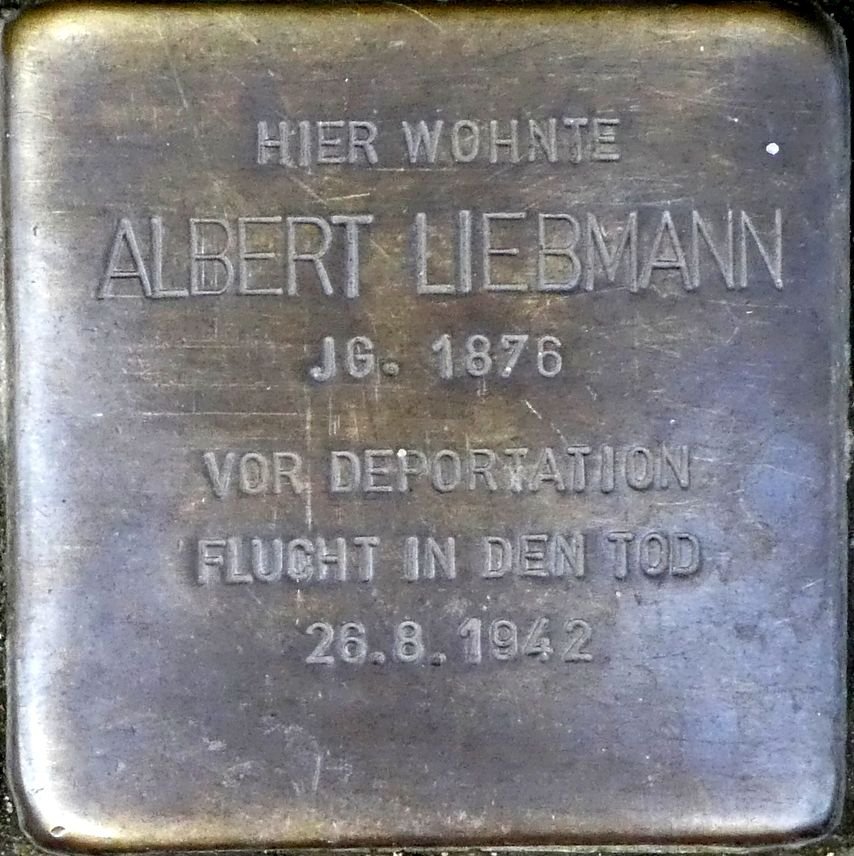
Wiesbaden, the capital of Hesse, Germany, stands as a city deeply engaged in the remembrance of victims of Nazi persecution through its extensive Stolpersteine project. Stolpersteine—small, brass memorial plaques embedded in sidewalks—commemorate individuals who suffered under the Nazi regime, personalizing history and embedding it in the daily life of the city. Among these memorials is the Stolperstein dedicated to Albert Liebmann, a commercial agent and member of Wiesbaden's Jewish community. This guide explores the history, significance, and visitor information for the Albert Liebmann Stolperstein and Monument, offering practical travel tips, accessibility details, and resources for deeper engagement.

What Are Stolpersteine?
Conceived in 1992 by artist Gunter Demnig, Stolpersteine ("stumbling stones") are brass-covered cobblestones placed in sidewalks across Europe, each inscribed with the name, birth date, fate, and, if known, deportation or death date of a victim of Nazi persecution. Over 100,000 Stolpersteine have been installed in more than 28 countries, forming the world’s largest decentralized Holocaust memorial (stolpersteine.eu).
History and Significance of Stolpersteine in Wiesbaden
Wiesbaden has actively participated in the Stolpersteine project since 2006, with more than 784 stones installed across 427 houses as of 2025 (am-spiegelgasse.de). These memorials commemorate not only Jewish residents but also Sinti and Roma, political dissidents, and other groups persecuted by the Nazis. The Stolpersteine transform ordinary streets into sites of memory, fostering a culture of remembrance and local engagement.
The project in Wiesbaden is coordinated by the Aktives Museum Spiegelgasse für Deutsch-Jüdische Geschichte, with support from the city’s parliament. Community members often sponsor Stolpersteine, and local historians research and document the biographies of those commemorated (jewiki.net).
The Albert Liebmann Stolperstein and Monument
Who Was Albert Liebmann?
Albert Israel Liebmann (1876–1942) was a commercial agent from Mainz who later resided in Wiesbaden. In 1926, Albert and his wife Margarethe acquired a residence at Albrechtstraße 13, which later became a "Judenhaus"—a building where Jewish families were forcibly concentrated before deportation during the Nazi era. Albert Liebmann’s life and fate reflect the broader story of Wiesbaden’s Jewish community, and his Stolperstein and nearby monument serve as poignant reminders of this history.
The Stolperstein’s Symbolism
The Stolperstein for Albert Liebmann, embedded at his last freely chosen residence, personalizes the tragedy of the Holocaust, restoring the individuality of a life erased from public memory. Unlike large, anonymous memorials, each Stolperstein invites passersby to pause, reflect, and remember a specific person, making history tangible and immediate.
The Monument
Near Albrechtstraße 13 stands the Albert Liebmann Monument, which not only honors Albert but also symbolizes the resilience and cultural contributions of Wiesbaden’s Jewish community. It forms part of the city’s network of remembrance sites and educational initiatives.
Planning Your Visit
Location
- Stolperstein: Embedded in the sidewalk at or near Albrechtstraße 13, Wiesbaden.
- Monument: Located nearby, accessible via public transport and close to other historical sites.
Visiting Hours and Admission
- Open 24/7: As public memorials, both the Stolperstein and monument are accessible at all times.
- Admission: Free of charge.
Accessibility
- Wheelchair Accessible: Both sites are located on paved sidewalks and are accessible for visitors with mobility challenges.
- Visitor Safety: Best visited during daylight for visibility and safety.
Guided Tours and Educational Initiatives
- Walking Tours: Local associations and tour operators offer guided tours focused on the Stolpersteine and Jewish history of Wiesbaden. Information and booking are available via the Tourist Information Center and local museums.
- Educational Programs: Schools engage students in research, documentation, and commemorative events, integrating the Stolpersteine into the curriculum to foster historical awareness and empathy.
- Community Events: Participation in installation ceremonies and remembrance days is encouraged, with details published on official city channels.
Nearby Historical Attractions
- Jewish Museum Wiesbaden (juedischesmuseum-wiesbaden.de): Offers broader context on Jewish life in the region.
- Gedenkstätte am Michelsberg: Central Holocaust memorial listing over 1,500 Jewish victims from Wiesbaden.
- Museum Wiesbaden: Features exhibits on the city’s history during the Nazi era.
- City Museum: Hosts changing exhibitions on Wiesbaden’s cultural history.
Frequently Asked Questions (FAQ)
Where can I find the Albert Liebmann Stolperstein?
It is embedded in the sidewalk at or near Albrechtstraße 13. Use the Stolpersteine-App or city maps for precise directions.
Are there guided tours including the Stolperstein?
Yes. Bookings are available through local tour operators, the Tourist Information Center, and museums.
What are the visiting hours and fees?
The Stolperstein and monument are accessible 24/7, free of charge.
Is the site accessible to people with disabilities?
Yes, the area is wheelchair accessible with paved sidewalks.
Can I participate in ceremonies or sponsor a Stolperstein?
Yes. Contact the Aktives Museum Spiegelgasse for details (am-spiegelgasse.de).
Discover More
The Stolperstein dedicated to Albert Liebmann in Wiesbaden stands as a powerful testament to the enduring importance of individual memory in the face of historical tragedy. By visiting this and other Stolpersteine, you contribute to a living culture of remembrance and help ensure that the lessons of the past remain relevant for future generations.
Take the next step:
- Download the Stolpersteine-App or the Audiala app for guided visits.
- Explore Wiesbaden’s other historical landmarks and museums.
- Participate in community events and remembrance initiatives.
- Follow Wiesbaden’s cultural sites on social media for updates on new Stolpersteine and events.
Through these actions, you help keep the memory of Albert Liebmann and all victims alive—transforming remembrance into meaningful, ongoing engagement.
Listen to the full story in the app
The whole Stolperstein Dedicated To Albert Liebmann,
told well.
Audio guides for 1,100+ cities across 96 countries. History, stories, and local insight — offline ready.
Verified, and shown.
Researched and written by the Audiala editorial team from historical records, architectural archives, and local expertise.
Researched from Wikidata, Wikipedia & official sources · fact-checked · How we make our guides →