Plan and listen to Stolperstein Dedicated To Abraham Laub with Audiala.
Audio guide in your pocket, itinerary in your browser. Built for the way you actually visit.
Introduction
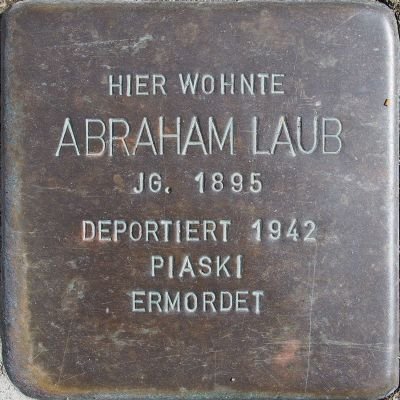
In Wiesbaden, Germany, the Stolperstein (or "stumbling stone") dedicated to Abraham Laub stands as a subtle yet powerful memorial to the victims of the Holocaust. Embedded in the sidewalk at Eleonorenstraße 16 in the Mainz-Kastel district, this brass plaque is part of a vast European network of Stolpersteine—each commemorating an individual whose life was destroyed by Nazi persecution. This guide offers a comprehensive overview of the Abraham Laub Stolperstein, including its historical context, practical visitor information, cultural significance, and resources for a meaningful visit.

The Stolperstein Project: Origins and Meaning
The Stolperstein project was conceived by German artist Gunter Demnig in 1992 as a decentralized memorial to victims of National Socialism. Rather than erecting a single monument, Demnig’s vision embeds small brass plaques into sidewalks in front of the last freely chosen residences or workplaces of those persecuted by the Nazis. Each Stolperstein is a 10x10 cm concrete cube topped with a hand-engraved brass plate, inscribed with the victim’s name, birth year, fate, and, where known, date and place of death (stolpersteine.eu).
By June 2025, over 107,000 Stolpersteine have been installed in nearly 1,900 European municipalities, making it the world's largest decentralized Holocaust memorial (stolpersteine.eu). Wiesbaden alone is home to over 784 Stolpersteine, reflecting its active role in remembering its lost Jewish community (am-spiegelgasse.de; Wikipedia).
The metaphorical "stumbling" is meant to be emotional and intellectual, prompting passersby to pause and remember the individuals and families whose lives were irrevocably changed or ended by the Holocaust (Folklife Magazine).
Abraham Laub’s Stolperstein: Historical and Local Context
Who Was Abraham Laub?
Abraham Laub was one of the many Jewish residents of Wiesbaden persecuted during the Holocaust. His Stolperstein, laid at Eleonorenstraße 16, Mainz-Kastel, marks his last freely chosen residence before his deportation and murder in Piaski, Poland (Stolpersteinliste Wiesbaden, October 2024, p. 12; TracesOfWar). The stone sits among several others commemorating members of the Laub, Oppenheim, and Wolff families, reflecting the collective tragedy suffered by entire households.
Wiesbaden’s Stolpersteine Network
The Stolpersteine initiative began in Wiesbaden in 2008, coordinated by the Aktives Museum Spiegelgasse (AMS) in partnership with Gunter Demnig and supported by local authorities (Spiegelgasse Museum). As of October 2024, more than 784 Stolpersteine have been installed in front of 427 houses throughout the city (Wikipedia). Each stone restores an identity and a story to a victim whose life was erased by Nazi violence.
Cultural and Memorial Significance
Stolpersteine are designed to humanize the victims of Nazi persecution by embedding their memory in the daily life of the city. Unlike centralized monuments, the stones are scattered throughout urban neighborhoods, encountered by residents and visitors alike, making remembrance a personal and ongoing act (Folklife Magazine).
The process of researching, sponsoring, and maintaining Stolpersteine is collaborative and participatory, often involving survivors, descendants, local historians, and students. This collective approach fosters a sense of shared responsibility and encourages intergenerational dialogue (stolpersteine.eu).
Practical Visitor Information
Location and Access
- Address: Eleonorenstraße 16, Mainz-Kastel, Wiesbaden, Germany (Stolpersteinliste Wiesbaden, October 2024, p. 12)
- Access: The Stolperstein is embedded in the public sidewalk and accessible to all visitors at any time.
Visiting Hours and Tickets
- Admission: Free.
- Hours: 24/7, as Stolpersteine are set in public spaces. Daylight hours are recommended for safety and easier reading of inscriptions.
Accessibility
- Physical Accessibility: The Stolperstein is flush with the sidewalk and accessible to visitors with wheelchairs or mobility aids. Note that some older sidewalks may be uneven.
Nearby Attractions
- Jewish Museum Wiesbaden: Offers further context on the city’s Jewish history.
- Gedenkstätte am Michelsberg: Memorial to over 1,500 Wiesbaden Jews murdered during the Holocaust.
- Other Stolpersteine: With over 784 stones throughout the city, visitors can plan routes to multiple memorials.
- Historic City Sites: Include the Kurhaus, Wiesbaden City Museum, and Marktkirche.
Remembrance Rituals and Community Engagement
Visitors are encouraged to engage with the Stolperstein in meaningful ways:
- Pause and Reflect: Take time to read the inscription and contemplate Abraham Laub’s story.
- Polish the Stone: Gently polish the brass plate with a soft cloth—a tradition that keeps the memory alive and the inscription visible.
- Leave a Stone or Flower: Placing a small stone or flower is a Jewish custom of remembrance.
- Join Events: Participate in community commemorations, especially on International Holocaust Remembrance Day (January 27) and Kristallnacht anniversary (November 9) (Folklife Magazine).
Educational Impact
Stolpersteine serve as powerful educational tools. Schools and youth groups often participate in researching victims and in ceremonies, making remembrance tangible for new generations. The stones prompt discussions about history, tolerance, and civic responsibility, ensuring the lessons of the Holocaust remain relevant (stolpersteine.eu).
Ethical Considerations
While Stolpersteine are widely accepted, some critics express concern about stepping on the names of victims. In some cities, alternative forms of memorialization are used. In Wiesbaden, broad community support and active maintenance ensure the stones retain their dignity and impact (Folklife Magazine).
Frequently Asked Questions (FAQ)
Where is the Abraham Laub Stolperstein?
At Eleonorenstraße 16, Mainz-Kastel, Wiesbaden, Germany.
Is there an admission fee or ticket required?
No, the Stolperstein is free to visit and accessible at any time.
Are guided tours available?
Yes, check with the AMS Spiegelgasse or Wiesbaden’s tourist office for schedules.
Is the memorial accessible for people with disabilities?
Yes, it is flush with the pavement. Please note possible uneven sidewalk sections.
Can I take photographs?
Yes, but be respectful of residents and avoid blocking the sidewalk.
Discover More
Plan your visit to Eleonorenstraße 16 and deepen your experience by exploring additional Stolpersteine, museums, and memorials in Wiesbaden. Download the Stolpersteine Wiesbaden app or the Audiala app for self-guided tours and educational content. Join commemorative events, support the maintenance of these living memorials, and share your stories to keep the memory of Abraham Laub and other victims alive.
Listen to the full story in the app
The whole Stolperstein Dedicated To Abraham Laub,
told well.
Audio guides for 1,100+ cities across 96 countries. History, stories, and local insight — offline ready.
Verified, and shown.
Researched and written by the Audiala editorial team from historical records, architectural archives, and local expertise.
Researched from Wikidata, Wikipedia & official sources · fact-checked · How we make our guides →