Plan and listen to Gustav Freytag Memorial with Audiala.
Audio guide in your pocket, itinerary in your browser. Built for the way you actually visit.
Introduction
Located in the serene Kurpark of Wiesbaden, Germany, the Gustav Freytag Memorial stands as a distinguished tribute to one of the 19th century’s most influential literary figures. Celebrating Gustav Freytag's vital contributions to German literature and culture, the memorial offers an enriching experience for visitors interested in history, art, and the intellectual heritage of Wiesbaden. This guide provides a detailed overview of the memorial’s historical background, artistic features, practical visiting information, and tips for a memorable visit. For further insights, consult resources such as the Kurhaus Wiesbaden official site, Wiesbaden tourism information, and Kulturstiftung.

Historical Background and Commissioning
After Gustav Freytag’s death in 1895, Wiesbaden’s civic and literary circles initiated a campaign to commemorate his legacy. Freytag, who spent his later years in Wiesbaden, was celebrated for his significant impact on German literature and the cultural identity of the Wilhelmine era. The memorial, designed by sculptor Fritz Schaper and architect Felix Genzmer, was unveiled on May 28, 1905. It remains the largest monument within the Kurpark, a testament to Freytag’s enduring influence (kurhaus.wiesbaden.de; komoot.com).
Gustav Freytag: Life and Legacy
Gustav Freytag (1816–1895) was a novelist, playwright, literary theorist, and public intellectual. Born in Silesia, he became renowned for works such as Soll und Haben (Debit and Credit, 1855), which exemplifies German Realism, and Bilder aus der deutschen Vergangenheit, a multi-volume cultural history. Freytag also contributed significantly to dramatic theory, with "Freytag’s Pyramid" still serving as a foundational model in literary studies (en.wikipedia.org; kids.britannica.com). His impact extended into politics and journalism, shaping public discourse as a Reichstag member and editor of "Die Grenzboten" (kulturstiftung.org).
Connection to Wiesbaden
Freytag’s relationship with Wiesbaden began in the late 1870s, as he sought the therapeutic benefits of the city’s spa culture. He eventually settled in Wiesbaden, integrating into its vibrant intellectual community until his death in 1895. The location of his memorial in the Kurpark reflects Freytag’s personal affinity for the area, where he often walked and engaged with fellow writers and thinkers (kurhaus.wiesbaden.de; komoot.com).
Artistic Features and Symbolism
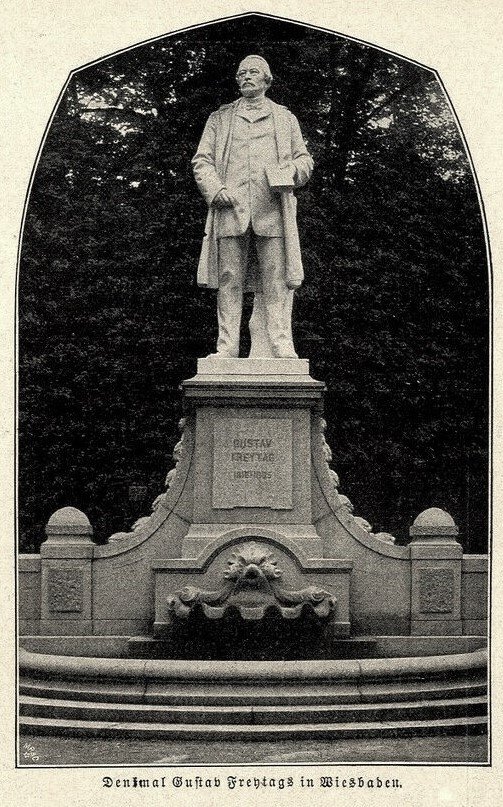
The Gustav Freytag Memorial is a prominent marble statue depicting Freytag in mature age, holding a book symbolizing his literary achievements. The monument stands on a shell limestone pedestal and features:
- Brunnenschale (Fountain Basin): Includes a dolphin-headed waterspout, referencing Wiesbaden’s mineral springs. While reactivated in 1995 for an anniversary event, the fountain is currently inactive (komoot.com).
- Putti Groups: Two marble putti flank the statue—one with a scroll and theater mask (symbolizing drama), the other reading a book (representing literature).
- Integration with Kurpark: The memorial is harmoniously situated among the park’s landscaped gardens, inviting reflection in a tranquil setting.
Visitor Information
Hours and Tickets
- Opening Hours: The Kurpark and memorial are accessible year-round from dawn to dusk.
- Admission: Free of charge; no tickets required.
Accessibility
- Paths: Well-maintained and mostly flat, suitable for wheelchairs and strollers; some steps near the memorial may require assistance.
- Seating: Benches are available throughout the park for rest and contemplation.
Directions
- Location: Kurpark, Kurhausplatz 1, 65189 Wiesbaden, directly behind the Kurhaus.
- Getting There: Reachable by foot from the city center, or by bus and tram. Limited parking is available nearby; public garages are also an option (kurhaus.wiesbaden.de).
Visitor Tips
- Visit early morning or late afternoon for optimal lighting and a quieter experience.
- Combine your visit with nearby attractions for a full cultural outing.
- Wear comfortable shoes to explore the park and surrounding historical sites.
Nearby Attractions
Enhance your visit by exploring:
- Kurhaus Wiesbaden: Historic spa and casino complex (The Crazy Tourist).
- Wilhelmstraße: Main boulevard with shops, cafes, and historic architecture.
- Landesmuseum Wiesbaden: Regional art and natural history museum.
- Ferdinand Hey’l Bust and Flötenspieler Statue: Other notable monuments within the Kurpark.
- Nerobergbahn: Historic funicular railway offering panoramic city views (WildTrips).
Cultural Significance and Preservation
The Gustav Freytag Memorial is a symbol of Wiesbaden’s commitment to celebrating its intellectual heritage and the German middle class’s values during the late 19th and early 20th centuries (kulturstiftung.org). Maintained by the city, the memorial has seen restoration efforts to preserve its historical and artistic integrity, including the partial reactivation of its fountain element in 1995. The memorial remains a site for literary events, guided tours, and educational programs that engage the local community and visitors alike (Wiesbaden Lebt).
FAQs
Q: What are the opening hours of the Gustav Freytag Memorial?
A: The memorial is accessible year-round from dawn to dusk within the Kurpark.
Q: Is there an admission fee?
A: No, both the Kurpark and the memorial are free to visit.
Q: Is the memorial wheelchair accessible?
A: Yes, the main paths are accessible, though assistance may be needed for some steps.
Q: Are guided tours available?
A: Wiesbaden tourism and cultural organizations offer guided tours that include the memorial.
Q: Can I take photos?
A: Personal photography is permitted; please respect the tranquil atmosphere.
Q: Are there nearby facilities?
A: The Kurhaus offers restrooms, cafes, and restaurants; the park provides benches and shaded areas.
Plan Your Visit
The Gustav Freytag Memorial offers a unique intersection of literary history, culture, and natural beauty in Wiesbaden’s Kurpark. With free admission, year-round accessibility, and proximity to other major attractions, it is an ideal stop for anyone exploring the city’s rich heritage. Enhance your visit by attending a guided tour, participating in cultural events, or using digital resources like the Audiala app. Stay informed about upcoming events and visitor tips by following Wiesbaden’s official tourism channels and social media.
Listen to the full story in the app
The whole Gustav Freytag Memorial,
told well.
Audio guides for 1,100+ cities across 96 countries. History, stories, and local insight — offline ready.
Verified, and shown.
Researched and written by the Audiala editorial team from historical records, architectural archives, and local expertise.
Researched from Wikidata, Wikipedia & official sources · fact-checked · How we make our guides →