An introduction.
Researched by the Audiala editorial team from historical records, architectural archives, and local expertise.
AA hill celebrated by Goethe became the site of Buchenwald Concentration Camp in Weimar, Germany, an appalling collision of literary humanism and Nazi terror. Visit Buchenwald Memorial to confront that collision through the gate, roll-call square, crematorium, surviving foundations, and exhibitions that restore names and histories to people the camp tried to reduce to numbers. The silence here isn't empty: wind crosses Ettersberg, footsteps stop at the stump of Goethe's oak, and the past keeps asking what culture is worth when it refuses to resist.
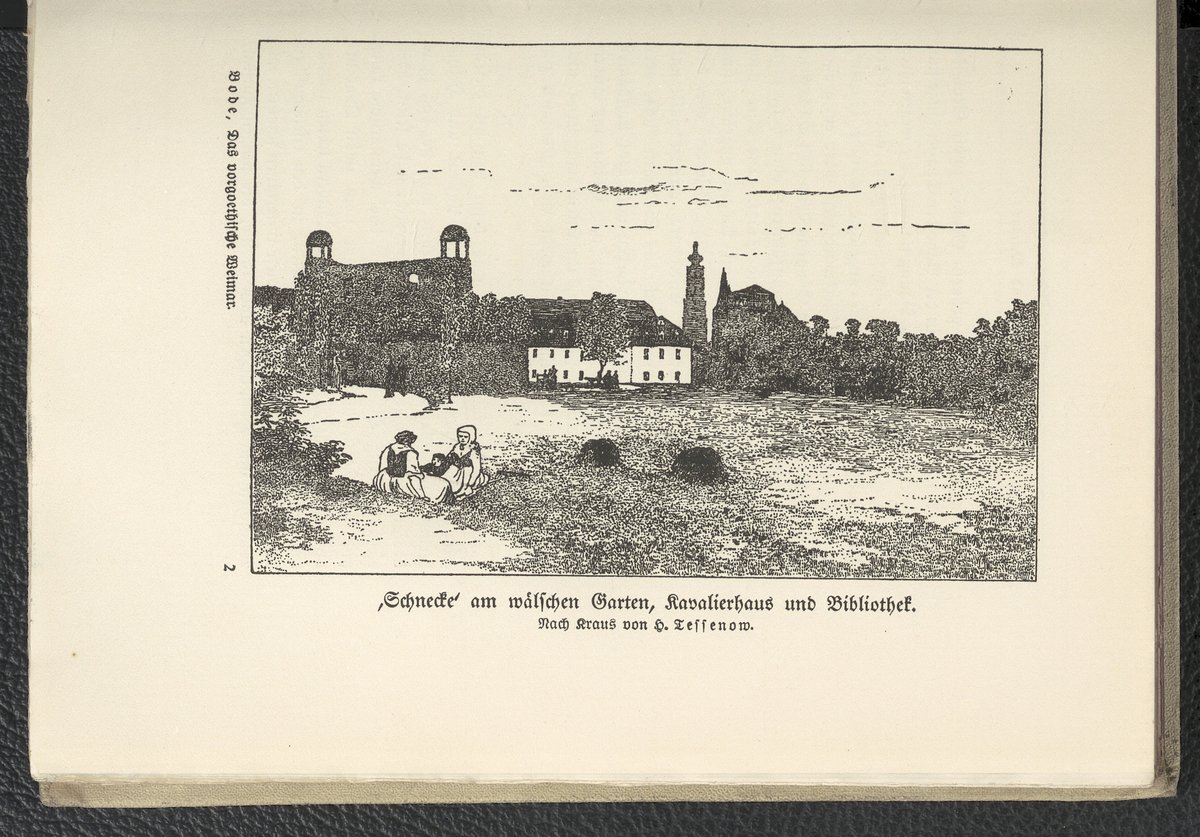
Ettersberg carried a very different reputation before 1937. Memorial records trace the ridge's use as a hunting ground and retreat for Duchess Anna Amalia's circle between 1776 and 1832; according to the memorial's account, Johann Wolfgang von Goethe dined beneath a great oak here in autumn 1827, looking across Thuringia.
The visit unfolds through deliberate contrasts. The iron gate bears the SS motto Jedem das Seine, while the former roll-call square, barrack foundations, crematorium, and wooded paths expose the machinery of imprisonment, forced labor, medical abuse, and murder behind it.
Buchenwald also demands that you continue past April 1945. The site later held Soviet Special Camp No. 2, and the memorial's present exhibitions place Nazi persecution, Soviet internment, Jewish and non-Jewish suffering, resistance, survival, and postwar silence in the same field of vision.
01 What to see.
The Gatehouse, Appellplatz and Prisoner Camp
The Crematorium and Historical Exhibitions
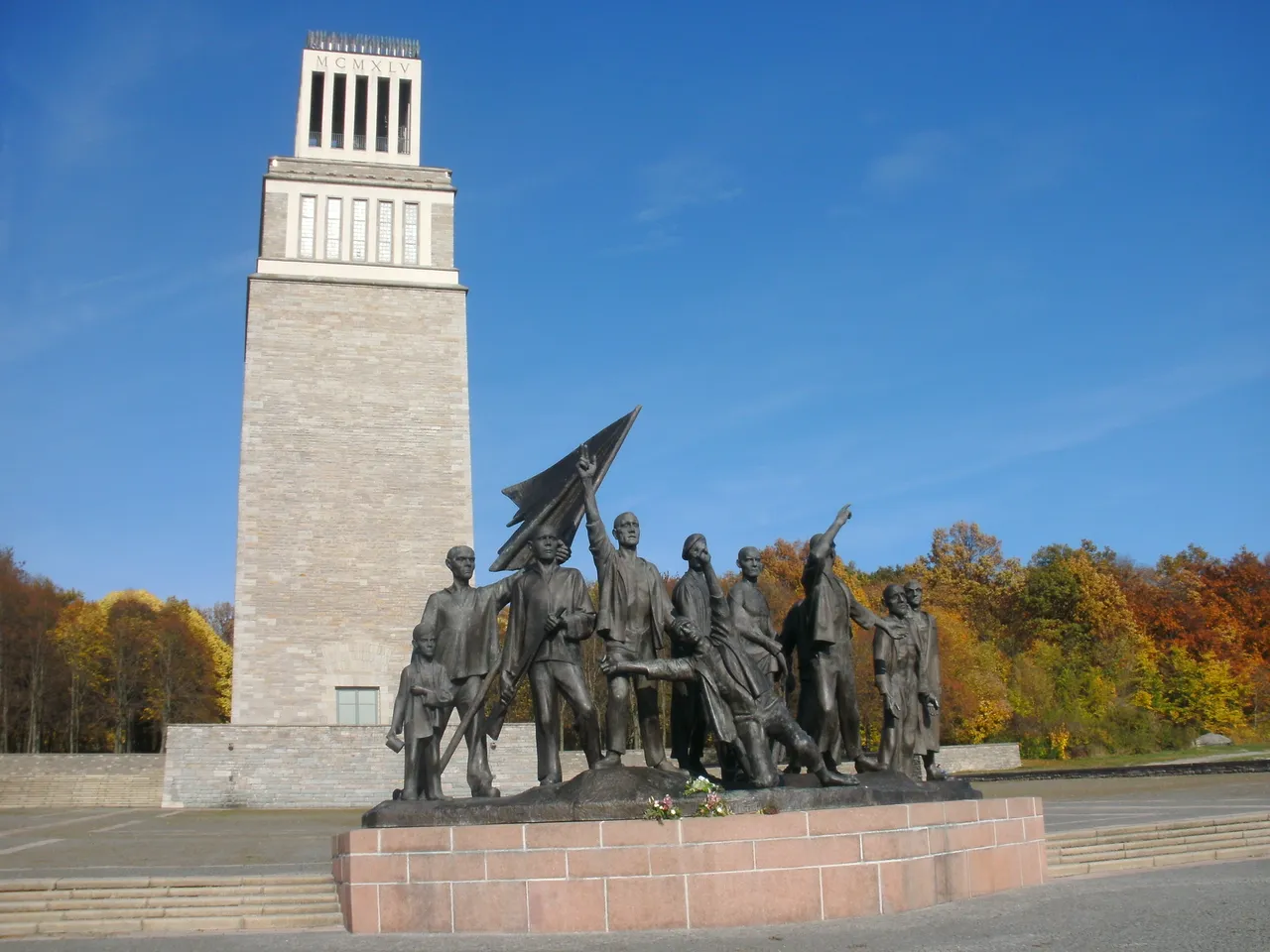
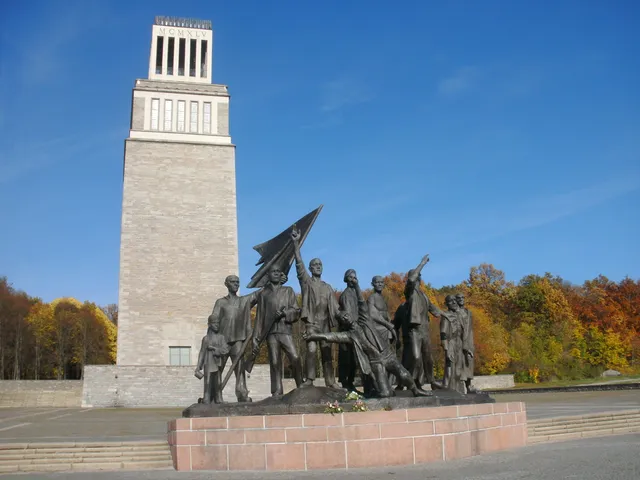
From the Camp Grounds to the National Memorial
02 In pictures.


Plan and listen to Buchenwald Concentration Camp with Audiala.
Audio guide in your pocket, itinerary in your browser. Built for the way you actually visit.
03 Visitor logistics.
The practical scaffolding for a good visit — kept short.
Getting There
From Weimar Hauptbahnhof or Goetheplatz, take Bus 6 to its terminus, Buchenwald, Gedenkstätte; the ride takes about 18–20 minutes, with services roughly hourly on weekdays and every 1–2 hours at weekends. By car, leave the A4 at Exit 48, Nohra, follow Weimar and the brown Buchenwald signs for about 18 km, then use the free car park beside the Visitor Information Centre. Walking from Weimar station takes 2 hours each way over 8.5–10 km of forest paths with steep climbs.
Opening Hours
As of 2026, the outdoor memorial grounds open daily from dawn until dusk. The Visitor Information Centre and exhibitions open Tuesday–Sunday and public holidays from 10:00–18:00 April–October, and 10:00–16:00 November–March; indoor buildings close every Monday and on December 24–26, December 31, and January 1. The main exhibition usually requires entry 30–45 minutes before closing.
Time Needed
Allow 2.5–3 hours for the introductory film, camp gate, Appellplatz, detention cells, crematorium, and a compact walk through the grounds. A fuller visit takes 4.5–6 hours, leaving room for the 2-hour tour or multimedia guide, the permanent exhibition, Art Exhibition, Soviet Special Camp No. 2 museum, and the southern memorials.
Accessibility
The 40-hectare site sits on an exposed hillside, with loose gravel, cobbles, packed earth, slopes, and very little outdoor seating; wet or icy conditions make manual-wheelchair travel harder. The Visitor Centre, cinema, café, bookshop, toilets, and modern exhibitions have step-free access or lifts, while the Bunker, crematorium basement, and former prisoners’ canteen retain narrow doors, high thresholds, or steep stairs. Staff lend tactile Braille maps, guide dogs and assistance dogs are admitted, and the free app includes German Sign Language tours.
Cost and Tickets
As of 2026, the grounds and permanent exhibitions are free, but the main exhibition, “Buchenwald. Ostracism and Violence 1937 to 1945,” requires a free timed reservation; walk-in admission depends on capacity. Public tours cost €10, or €5 reduced, while a physical multimedia guide costs €5; the official app is free and includes several language versions.
04 Tips for visitors.
Small things that change the day.
Dress Respectfully
Treat the former prisoner camp as a cemetery: avoid swimwear, revealing gym clothes, offensive slogans, and right-wing extremist symbols or clothing. No smoking, loud music, speakerphone use, eating, or open alcohol inside the historic camp enclosure.
Photograph Carefully
Personal photography without flash, tripods, or selfie sticks is generally allowed, but photography and recording stop during guided tours and in designated sensitive rooms. Drones and commercial filming need written permission; flippant selfies at the gate or crematorium are considered deeply disrespectful.
Prepare For Exposure
Ettersberg often feels 3–5°C colder than central Weimar, with sharp wind and sudden rain even in warmer months. Bring windproof layers and shoes suited to loose gravel, cobbles, and long slopes; from late October to late March, the memorial removes its outdoor benches.
Reserve Before Arrival
Book the free timed slot for the main permanent exhibition before travelling, especially during school holidays. English public tours run only from June 1 to August 31: Fridays at 11:15, and Saturdays and Sundays at 13:30.
Plan The Meal
Museumscafé Paul beside the Visitor Centre serves simple lunches, coffee, sandwiches, and cakes at budget prices, though staffing can change its hours. In Weimar, a bratwurst stand at Goetheplatz or Markt costs about €3.50–€5, while Gasthaus Zum Weissen Schwan on Frauentorstraße 23 offers mid-range Thüringer Klöße and Sauerbraten.
Add Ettersburg
For a second historical layer, follow the marked one-hour Zeitschneise forest trail from the former armaments area toward Schloss Ettersburg on the opposite side of the ridge. The palace and park connect Goethe-era Weimar with the same Ettersberg that holds the memorial, without softening what happened there.
Use The Free App
Skip the €5 rental device by downloading the official Buchenwald app, which offers tours in several languages and German Sign Language. Since admission is free, reserve the exhibition slot and spend only on a public tour if you want a guide’s historical framing.
Leave Luggage Behind
Large backpacks, suitcases, and bulky bags cannot enter exhibition spaces, and the on-site lockers fit only small daypacks. Store larger luggage at Weimar Hauptbahnhof; leave ordinary pets behind too, since dogs are banned from the former camp and buildings except certified assistance dogs.
05 Where Goethe’s Hill Became a Witness
Buchenwald's history resists a clean ending. Records show that the SS began construction on the northern slope of Ettersberg on July 15, 1937, when the first 149 prisoners cut beech and oak, cleared the ground, and raised the camp perimeter; on July 28, Heinrich Himmler approved the name Buchenwald after Weimar cultural officials objected to placing Goethe's Ettersberg beside a concentration camp.
By 1941, the SS had turned Buchenwald into a killing site and a network of forced-labor camps. The memorial documents executions of roughly 8,000 Soviet prisoners of war by Kommando 99, medical experiments in Block 46, and the growth of 139 subcamps serving armaments production; on April 11, 1945, organized prisoners seized the remaining watchtowers as American units approached.
Franz Ehrlich’s Quiet Rebellion
Franz Ehrlich arrived at Buchenwald in 1937 after the Gestapo arrested him for producing anti-Nazi literature. According to Buchenwald Memorial records, the SS recognized his training at the Bauhaus and assigned him to the camp construction office, where he had to turn his design skills toward the institution imprisoning him. For Ehrlich, the stakes were personal and immediate: he risked his safety if the SS detected defiance, and his artistic integrity if the work became an obedient instrument of the regime.
The turning point came in 1938, when the SS ordered Ehrlich to design the lettering for the iron gate. He rendered the phrase Jedem das Seine, or “To Each His Own,” in the clean geometric style associated with the Bauhaus—a movement Nazi authorities had closed and condemned. The SS approved the design and had the letters cast in iron, apparently missing the outlawed modernism hiding in plain sight; Ehrlich's typography faced the roll-call square, where prisoners could read it head-on.
The gesture did not weaken the camp or save the people trapped inside it. Its force lies elsewhere: a prisoner placed a forbidden visual language inside the architecture of his own imprisonment, and the regime made that act permanent with its own hands. The gate still carries both messages—the SS's cruelty and Ehrlich's refusal to let modernism disappear quietly.
The Camp After Liberation
The Oak, the Fire, and Memory
Listen to the full story in the app
The whole Buchenwald Concentration Camp,
told well.
Audio guides for 1,100+ cities across 96 countries. History, stories, and local insight — offline ready.
06 Frequently asked.
The questions travellers send us most about Buchenwald Concentration Camp.
Is Buchenwald Concentration Camp worth visiting?
Yes—if you approach Buchenwald as a memorial and place of historical responsibility, not a conventional attraction. The former camp covers roughly 40 hectares on Ettersberg, where gravel, cold wind, the inward-facing gate inscription, crematorium, and empty barrack foundations make the history physically present. Its exhibitions also trace the Soviet Special Camp No. 2 and the GDR memorial, showing that Buchenwald’s story did not end with liberation on April 11, 1945.
How long do you need at Buchenwald Concentration Camp?
Plan at least 3 to 4 hours for a thoughtful visit to Buchenwald Concentration Camp. A quick visit can take 2.5 to 3 hours, while a thorough visit needs 4.5 to 6 hours for the main exhibition, former prisoner camp, crematorium, Soviet Special Camp No. 2 exhibition, ring graves, and 50-meter Bell Tower. Wear sturdy shoes: the grounds stretch across sloping paths, gravel, cobbles, and packed earth.
How do I get to Buchenwald Concentration Camp from Weimar?
Take Bus Line 6 from Weimar Hauptbahnhof or Goetheplatz directly to the Buchenwald, Gedenkstätte stop. The ride takes about 18 to 20 minutes, with services roughly hourly on weekdays and every one to two hours on weekends; a city fare costs approximately €2.20–€2.80. Drivers can follow the brown signs from Weimar or approach from A4 exit 48, Nohra, with free parking beside the Visitor Information Centre.
What is the best time to visit Buchenwald Concentration Camp?
May, June, September, and early October offer the best balance of open exhibitions, manageable weather, and daylight for the wide outdoor grounds. Indoor exhibitions open Tuesday to Sunday from 10:00 to 18:00 between April and October, and English public tours run from June 1 to August 31. Winter brings biting wind, fewer visitors, and no outdoor benches, but the 37°C memorial plate becomes especially striking as it melts snow against the cold.
Can you visit Buchenwald Concentration Camp for free?
Yes—the memorial grounds and permanent exhibitions have no admission charge. You must reserve a free timed-entry ticket for the main exhibition, “Buchenwald: Ostracism and Violence 1937–1945,” because walk-in access depends on capacity. Public tours cost €10, reduced admission costs €5, and a rented multimedia guide costs €5.
What should I not miss at Buchenwald Concentration Camp?
Don’t miss the gatehouse inscription “Jedem das Seine,” the 3:15 clock, the heated memorial plate, the Goethe Oak stump, and the crematorium. Franz Ehrlich designed the inward-facing lettering in a Bauhaus style the Nazi regime condemned, while the clock marks the time prisoners took control of the camp perimeter on April 11, 1945. Leave time for the Soviet Special Camp No. 2 exhibition and the GDR memorial’s ring graves, Avenue of Nations, and Bell Tower; together they turn a visit into a reckoning with several layers of German history.
Verified, and shown.
Researched and written by the Audiala editorial team from historical records, architectural archives, and local expertise.
Official overview of the memorial, its history, liberation, exhibitions, and visitor information.
Basic identification and linked reference data for Buchenwald.
Information on Goethe, the Goethe Oak, Bruno Apitz, and the tree’s destruction in 1944.
History of the Goethe Oak, its connection with the camp, and its surviving stump.
Chronology and background on Buchenwald, its commandants, prisoners, liberation, and postwar history.
Background on the Goethe Oak and the traditions surrounding it.
Details on the camp gate inscription, Franz Ehrlich, and the lettering’s Bauhaus design.
Biographical information on Ernst Thälmann and his execution at Buchenwald.
Official history of the Soviet Special Camp No. 2, including detainee numbers, deaths, and closure.
Background on Soviet NKVD special camps and tracing information for detainees.
Online documentation of the Soviet special camp and its prisoners.
Account of the Goethe Oak’s destruction, prisoner testimony, and the tree’s memorial meaning.
Seasonal opening hours for the memorial grounds, exhibitions, and visitor facilities.
Visitor guidance covering admission, reservations, transport, facilities, tours, and conduct.
Free timed-entry reservations for the main permanent exhibition.
Schedules, languages, prices, and arrangements for public guided tours.
Information for arranging guided visits and group tours.
Simplified directions and transport information for reaching the memorial.
Travel guidance on access, the GDR memorial, ring graves, Bell Tower, and visitor planning.
Accessibility information for paths, buildings, seating, tactile maps, and assistance dogs.
Frequently asked questions covering educational visits, age guidance, tours, and visitor conduct.
Official rules on photography, clothing, food, smoking, pets, luggage, and respectful behavior.
History and architectural context of the former SS barracks and parade ground.
Information on the SS zoo and bear enclosure beside the prisoner camp.
History of the arrival route known as the Caracho Path.
Reference material on the gatehouse, detention cells, memorial plate, exhibitions, and site architecture.
Official history of the prisoner enclosure, barracks, roll-call square, and camp organization.
Information on the crematorium, execution rooms, morgue, and Topf & Söhne furnaces.
Details on the main permanent exhibition in the former prisoner storage depot.
Information on survivor artworks, drawings, and sculptures in the former disinfection building.
Visitor account covering the stopped 3:15 clock and practical impressions of the memorial.
History of the November 1938 deportation of Jewish men to Buchenwald.
Information on the executions of Soviet prisoners of war at Buchenwald.
History of the railway connection associated with the camp.
Discussion of Weimar’s relationship with Goethe, classical culture, and Buchenwald.
Travel perspective on the tension between Weimar’s cultural identity and its Nazi history.
Information on the forest trail linking Buchenwald with Schloss Ettersburg.
Context on the memorial’s architecture, conservation, and historical importance.
Background connected with the bronze casting and conservation of Fritz Cremer’s memorial sculpture.
Official answers on admission, behavior, photography, age guidance, and practical visits.
Requirements for commercial photography, filming, drones, and media access.
Information on the café beside the Visitor Information Centre.
Researched from Wikidata, Wikipedia & official sources · fact-checked · How we make our guides →