




Place
Germany Updated Jul 2026
Water runs through Ulm, Germany in two moods at once: the Danube moves broad and gray-blue past the walls, while the Blau slips under half-timbered houses as if the old town were built on stilts and memory. Then you look up and the whole scale changes. Ulm Minster's spire, the tallest church spire in the world, pulls your eye 161.5 meters into the sky and makes the rest of the city feel briefly, usefully small.
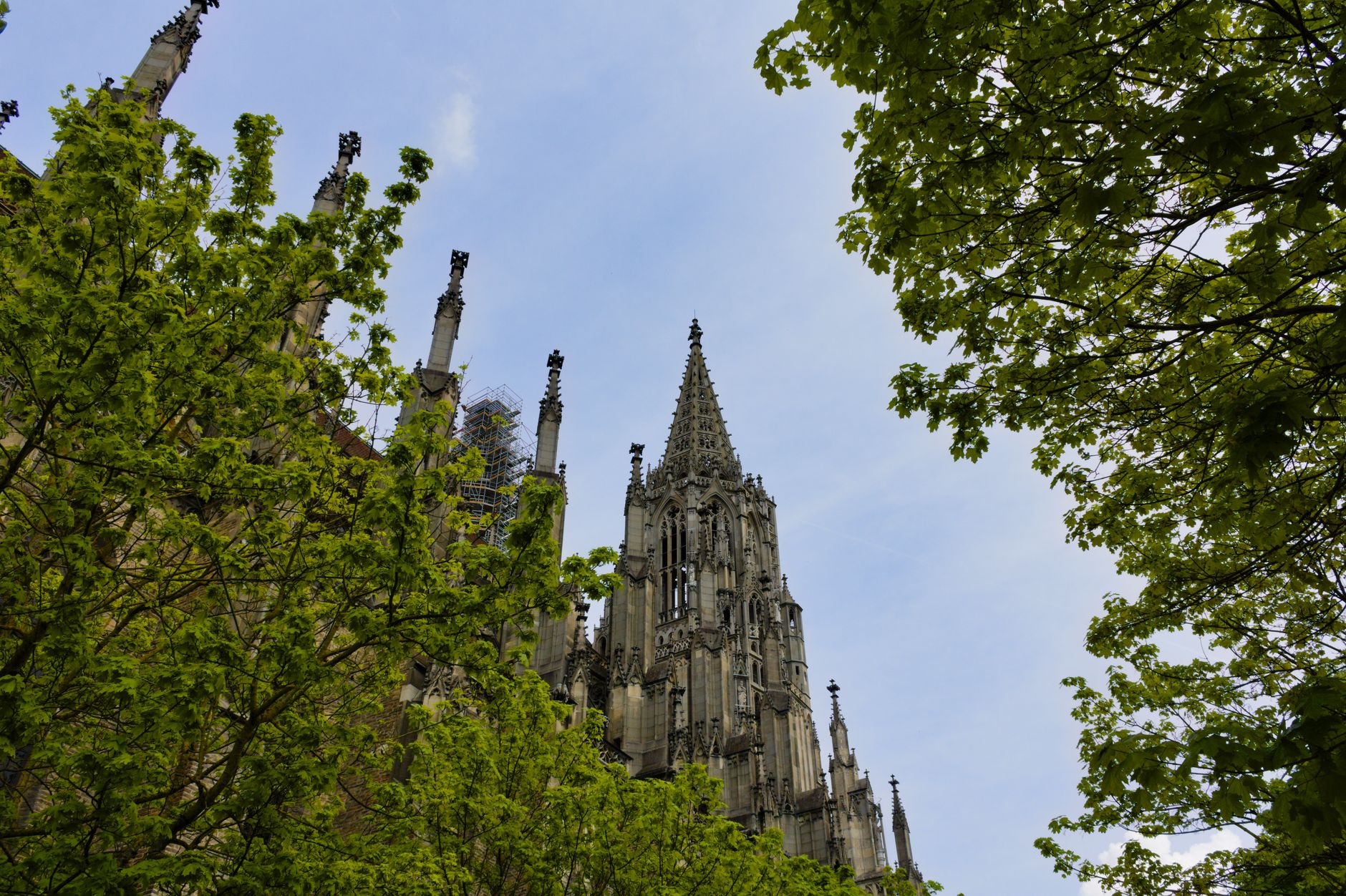 Photo: Matea Gvozdenović / Pexels
Built from cited sources · see the method · How we make our guides →
Ulm works because it refuses to choose one century. On Münsterplatz, the late Gothic bulk of the Minster faces Richard Meier's bright white Stadthaus, and the contrast is sharper in person than in photographs: old sandstone, clean glass, market chatter, bicycle bells, church echoes. Few German cities stage their arguments this openly.
The prettiest part of Ulm is the Fischer- und Gerberviertel, and pretty is not quite the right word for it. The cobbles tilt, the channels smell faintly of cold water and wood, and the half-timbered houses lean toward one another like conspirators. Walk here early or near dusk, when the restaurants are still setting tables and the river catches the last thin light.
Albert Einstein was born here, but Ulm's real trick is less about genius than proportion. It's a city where you can climb a record-breaking spire, spend an hour with archaeology or modern sculpture at Museum Ulm or the Edwin Scharff Museum, then end the day with Maultaschen or Kässpätzle in a room that still looks built for merchants and boatmen. Ulm doesn't overwhelm. It keeps revealing itself.
Not every monument, just the ones we'd walk you past ourselves.
Where to wander, by quarter — each with its own rhythm.
Before you go
From royal estate to design laboratory beneath the tallest church spire on earth
Most scholars place a small Roman military presence near the Danube crossing by the 2nd or 3rd century CE. Soldiers would have known the smell of wet timber, river mud, and smoke from watchfires; the reason was plain enough. Whoever held this crossing could watch trade, troops, and trouble moving east and west.
A document from the reign of Louis the German names the place as Hulma, turning settlement into history you can point to. That matters because written records change everything: rents can be claimed, land can be argued over, and power gains an address.
Ulm is traditionally linked to the granting of city rights under Emperor Conrad II, a step that pulled it toward formal urban life. Markets, tolls, walls, and legal privileges do not sound romantic, but they are the machinery from which a city grows.
Rudolf I of Habsburg raised Ulm to the rank of Free Imperial City, placing it directly under the emperor rather than a local lord. Money stayed closer to home after that. Merchants, guilds, and council families gained room to act with a confidence that still lingers in the city center's stubborn geometry.
Citizens laid the foundation stone of Ulmer Münster in 1377, funding an audacious church largely with urban pride and hard cash. You can still feel the scale of the gamble. Stone by stone, Ulm announced that a trading city on the Danube intended to build like a capital.
During the Swabian City War, Ulm stood with other imperial cities against regional lords who wanted them smaller, weaker, and easier to tax. The conflict hardened Ulm's political instincts. Independence was never an abstract principle here; it was defended with walls, alliances, and armed men.
Jörg Syrlin the Elder carved the Minster's choir stalls in the 1460s and 1470s, filling dark wood with scholars, sibyls, prophets, and unnervingly alert faces. Stand close and the church stops feeling remote. Late medieval Ulm knew how to turn theology into craftsmanship you can almost touch.
Agatha Streicher, born in 1520, became one of Ulm's most remarkable residents: a physician trusted by patients of means and by the imperial court. Her work mattered because medicine in the city was not only clerical or academic; it could be practiced by a woman with authority, skill, and a full waiting room.
The city council formally adopted the Reformation, and church life changed in stone, sound, and routine. Monasteries lost power, sermons gained new weight, and sacred spaces were reordered for Protestant worship. The air inside old buildings changed with the theology.
Johannes Faulhaber was born in 1580 and later made his name in Ulm as a mathematician, engineer, and fortress designer. Numbers were his trade, but numbers meant walls, angles, artillery, and survival. In his hands, calculation became a civic defense system.
Swedish forces occupied Ulm during the Thirty Years' War, and the city paid heavily in contributions, fear, and lost momentum. Trade shrank. A place built on confidence learned what happens when armies treat a city as a purse with gates.
Albrecht Ludwig Berblinger, born in Ulm in 1770, trained as a tailor but became obsessed with human flight. His failed 1811 jump over the Danube made him a local legend, half tragic and half comic. The city remembers him because invention often begins looking ridiculous.
The Reichsdeputationshauptschluss swept away Ulm's status as a Free Imperial City and handed it to Bavaria. One decree did what centuries of pride had resisted. A self-governing city suddenly had to answer to someone else.
A territorial reshuffle moved Ulm from Bavaria to the Kingdom of Württemberg, while the Danube began to harden into a state border with Neu-Ulm on the opposite bank. Maps changed; daily life changed with them. Customs, administration, and military planning all followed the new line.
Construction began on the Bundesfestung Ulm, one of the largest fortress systems in Europe, with rings of bastions, ditches, and detached forts spreading over the hills. This was defensive architecture on an almost obsessive scale. The 19th century did not trust peace for long.
Albert Einstein was born in Ulm on 14 March 1879, though his family left soon after. The city still keeps that fact close, and fairly enough. A place of merchants, engineers, and measured stone can claim a fitting link to the man who bent the way the modern world thinks about time.
Ulmer Münster's spire was completed in 1890 at 161.53 meters, finishing a project that had stretched across more than five centuries. The number matters. So does the sensation from below, when the tower seems less built than pulled upward by sheer civic stubbornness.
The German monarchy collapsed at the end of the First World War, and Ulm moved into the republican order of the new Württemberg state. Politics broke sharply. Factories, rail links, and working-class neighborhoods kept shaping the city's rhythm.
On the night of 17 to 18 December 1944, Royal Air Force bombers dropped roughly 1,450 tons of explosives and incendiaries on the city. About 707 people were killed, around 25,000 left homeless, and roughly 81 percent of the historic center was destroyed. The old streets burned, but the Minster stayed standing with only limited damage, an almost indecent stroke of luck amid ruin.
United States forces secured Ulm in April 1945 and found a city of broken masonry, gutted houses, and industrial wreckage. The next chapter began in dust. Reconstruction here was never only about rebuilding walls; it meant deciding what kind of city deserved to return.
The Hochschule für Gestaltung Ulm opened in 1953 under figures including Inge Aicher-Scholl, Otl Aicher, and Max Bill, giving the city a fierce postwar intellectual edge. This was no quaint local academy. Ulm became one of the places where modern design, visual order, and democratic rebuilding were argued into form.
The University of Ulm was founded in 1967 with a focus on medicine, natural sciences, and engineering. That choice says plenty about the city. Medieval piety and industrial muscle were no longer enough; Ulm wanted laboratories, lecture halls, and a future measured in research.
The kunsthalle weishaupt opened in 2007 near the heart of the old city, placing contemporary art in direct conversation with Gothic stone and rebuilt streets. That juxtaposition suits Ulm. Few German cities wear so much interrupted history while still making room for something new.
Physicist · 1879–1955
Born here
Einstein was born in Ulm on 14 March 1879, then left as an infant, which gives the city a curious claim on the man who changed modern physics without really growing up here. He might smile at that modest beginning: a Danube city of traders and church builders quietly attached to the century’s most famous mind.
Designer · 1922–1991
Worked here; co-founded the Ulm School of Design in 1953
Aicher helped turn postwar Ulm into one of the sharpest design laboratories in Europe when he co-founded the Hochschule für Gestaltung Ulm in 1953. He believed design should think clearly and live honestly, and parts of modern Ulm still carry that stripped-back seriousness.
Writer and educator · 1917–1998
Worked here; co-founded the Ulm School of Design in 1953
After the White Rose and the murder of her siblings by the Nazi regime, Inge Aicher-Scholl helped build something steadier in Ulm: a school that treated design as moral work, not decoration. The city’s postwar identity owes a good deal to that decision.
Architect and artist · 1908–1994
Worked here; first rector of the Ulm School of Design
Max Bill gave Ulm’s famous design school its early form and its exacting tone, bringing Bauhaus logic into a city still rebuilding after war. He would probably approve of Ulm on a clear day, when the geometry of squares, facades, and bridges suddenly snaps into focus.
Sculptor and woodcarver · c. 1425–1491
Worked here
Syrlin carved the choir stalls of Ulm Minster between 1469 and 1474, turning oak into a forest of prophets, sibyls, and faces that still feel uncannily alert. Stand there long enough and the church stops being an abstraction called Gothic; it becomes the work of hands, knives, patience, and sawdust.
Physician · 1520–1581
Lived and worked here
Agatha Streicher practiced medicine in 16th-century Ulm at a time when the profession had little room for women, then earned a reputation strong enough to draw elite patients. Her Ulm was a Protestant imperial city arguing about doctrine and discipline; she made space for expertise anyway.
Where locals actually book dinner — not the tourist menus.
These Swabian stuffed pasta pockets show up boiled in broth, sliced and fried with onions, or plated with potato salad. Try them because they taste like the region thinks: practical, rich, and a little sly.
A proper Swabian rostbraten arrives with a seared beef steak, dark gravy, and a heap of crisp fried onions that smell irresistible from a table away. Order it when you want something rooted in southern Germany rather than another generic schnitzel.
Hand-cut egg noodles, melted cheese, browned onions, steam rising fast. It is Alpine comfort without the costume drama, especially good on a wet Ulm evening when the Danube wind has gone mean.
Lentils with spätzle and sausages may sound plain on paper, but the sweet-sour depth of the sauce is the point. This is everyday Swabian cooking, built for workers and still better than half the polished tourist menus around major squares.
These finger-shaped potato noodles often come pan-fried, sometimes with sauerkraut, sometimes with richer meat dishes. Look for them on seasonal menus; they have the browned edges and soft center that make you keep stealing one more bite.
Ulm does not need a fancy breakfast scene to impress. A good local bakery will hand you a dense, glossy Swabian pretzel with thinner arms than the Bavarian kind, plus coffee strong enough to reset your morning.
For dinner, skip places that trade only on the river view and look for a traditional Gasthaus serving local beer with a short Swabian menu. Ulm rewards restraint: fewer dishes, better execution, and rooms that smell of roast onions, malt, and old wood.
Small things that change how the city treats you.
The city, as it actually looks.
Yes, especially if you like cities that reveal themselves slowly. Ulm has the world’s tallest church spire, a half-timbered river quarter that still feels lived in, and enough museums and old streets for a full weekend without the crowds of bigger German cities.
Two days is the sweet spot for most travelers. One day covers the Minster, Münsterplatz, and the Fischerviertel; a second lets you add museums, the Danube riverfront, and a slower meal without rushing.
The usual route is train via Stuttgart Hauptbahnhof, and it takes about 55 to 70 minutes in total. Take the S-Bahn from the airport to Stuttgart Hbf, then continue by ICE, IC, or RegionalExpress to Ulm Hbf.
Yes, easily. The historic center is compact and walkable, and local transport runs through DING with 2 tram lines, buses, and regional trains covering Ulm and Neu-Ulm.
Yes, Ulm is generally very safe. The bigger day-to-day risk is traffic rather than crime, especially around tram tracks, bikes, and tight crossings near the center and the main station.
No, Ulm is usually more moderate than Munich or Stuttgart. You can keep costs down with the UlmCard, group day tickets, bakery lunches, and regional transport passes if you are staying long enough to use them.
May to September is the best stretch for most visitors. Days are longer, riverfront walks make sense, and temperatures are usually comfortable, though summer storms and spring rain are common.
Start with Swabian food: Maultaschen, Kässpätzle, Linsen mit Spätzle, and Zwiebelrostbraten. If a menu offers Maultaschen geschmelzt, pan-fried with butter and onions, order that and don't overthink it.
Saved and recently read places — kept on this device only.
Photos may have been resized or cropped.