Plan and listen to Stolperstein Dedicated To Jakob Kraus with Audiala.
Audio guide in your pocket, itinerary in your browser. Built for the way you actually visit.
Introduction
The Stolperstein memorial for Jakob Kraus in Stuttgart stands as a moving reminder of individual resistance and the enduring collective memory of those persecuted by the Nazi regime. As part of Gunter Demnig’s international Stolpersteine (“stumbling stones”) project, each small brass plaque is embedded outside the last chosen residence of a Holocaust victim, bringing history directly into the city’s everyday streetscape. The Jakob Kraus Stolperstein, located at Klagenfurter Straße 11 in Stuttgart-Feuerbach, not only honors Kraus’s personal resistance and tragic fate but also serves as a vital part of Stuttgart’s extensive remembrance network, comprising over 1,000 stones across the city (Stolpersteine.eu; Stolpersteine Stuttgart; Traces of War).
This guide delves into the origins of the Stolpersteine project, the story and significance of Jakob Kraus, and practical information for visitors—highlighting how these unique memorials foster education, reflection, and community engagement in Stuttgart.

Origins and Philosophy of the Stolpersteine Project
The Stolpersteine project was initiated by German artist Gunter Demnig in 1992 to honor individuals persecuted by the Nazis—Jews, Sinti and Roma, political prisoners, people with disabilities, and others—by marking their last freely chosen homes or workplaces with a small, inscribed brass plaque. The first Stolperstein was laid in Cologne in 1996. Since then, over 100,000 stones have been installed in more than 280 cities across Europe, making it the world’s largest decentralized Holocaust memorial (Stolpersteine.eu; Wikipedia; Prague Views).
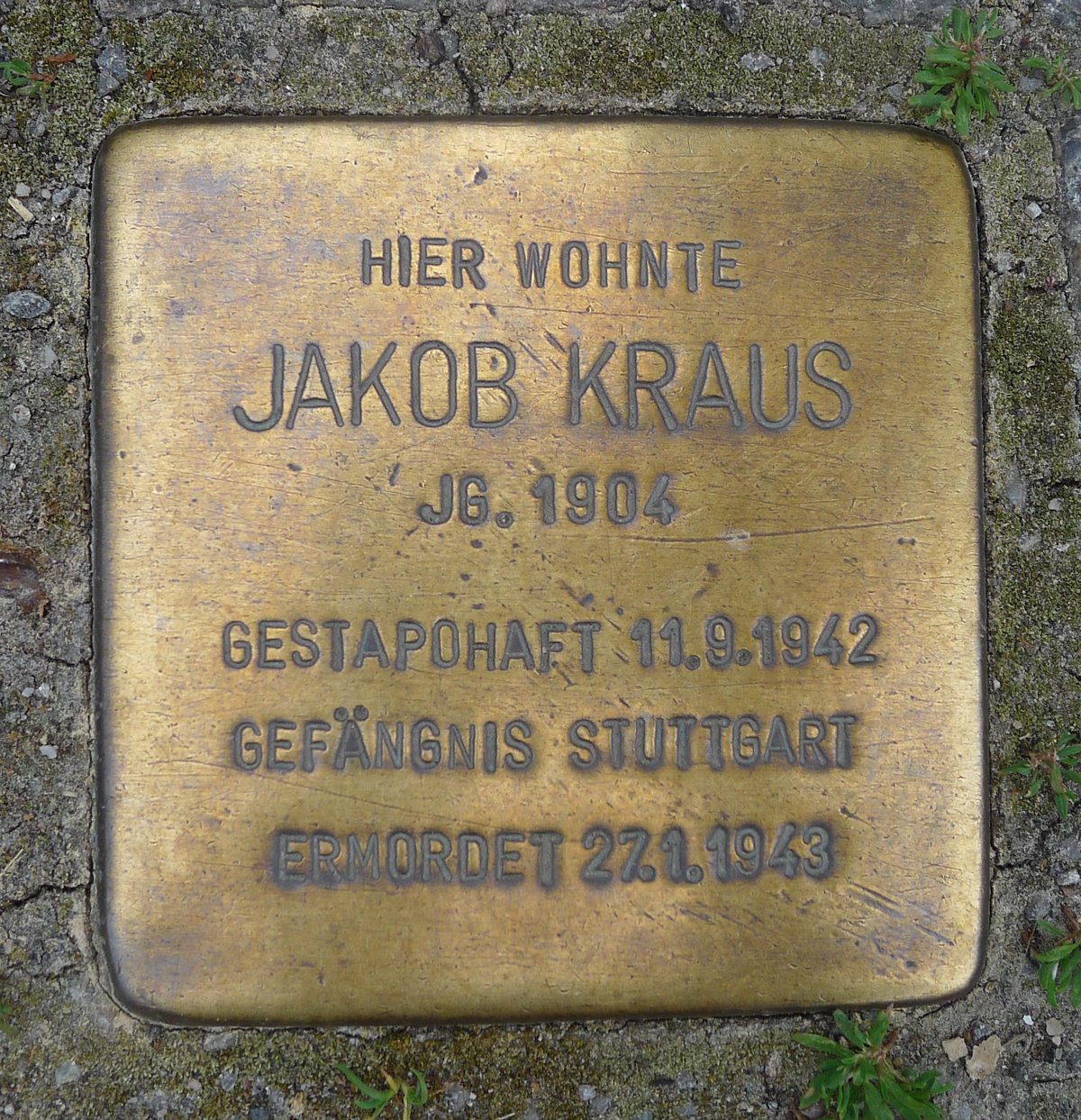
Each Stolperstein measures 10 x 10 cm and bears the victim’s name, year of birth, fate, and, if known, date of death. The intent is for passersby to “stumble” upon these markers—prompting reflection on the victims’ individual lives and the consequences of intolerance.
Jakob Kraus: His Story and Memorial
Biographical Background
Jakob Kraus, born in 1904, was a resistance fighter against the Nazi regime. He lived at Klagenfurter Straße 11 in Stuttgart and was murdered by the Gestapo on January 27, 1943. After his death, his ashes were transferred to his hometown of Ingolstadt at his wife’s request. Kraus’s name is also commemorated at the Feuerbacher Friedhof and in the naming of a nearby street (Stolpersteine Stuttgart).
Memorial Installation
The Stolperstein for Jakob Kraus was installed on November 10, 2006, at his last freely chosen residence. The stone’s inscription reads:
Hier wohnte
Jakob Kraus
Jg. 1904
Ermordet 27.1.1943
durch die Gestapo
This succinct memorial ensures that Kraus’s name and story remain part of Stuttgart’s collective memory.
Cultural and Educational Significance in Stuttgart
Stuttgart’s Stolpersteine have become integral to the city’s culture of remembrance. The project is supported by local initiatives, historians, and educators who organize installations, research biographies, and maintain the stones. Schools use the Stolpersteine for research projects and guided walks, while local media regularly feature stories of those commemorated (Stolpersteine Stuttgart Presse; Theatre Research International).
Stolpersteine are not grand monuments, but subtle reminders encountered in daily life. By integrating memory into the urban landscape, they foster ongoing dialogue about the past and encourage civic responsibility.
Visitor Information: Hours, Location, and Tours
Location
- Address: Klagenfurter Straße 11, 70469 Stuttgart-Feuerbach, Germany
- Coordinates: 48.807895, 9.159926 (Traces of War)
Visiting Hours and Tickets
- Accessibility: The Stolperstein is embedded in a public sidewalk and is accessible 24/7, free of charge. No tickets or advance reservations are required.
How to Get There
- Public Transport: Easily accessible by S-Bahn (S4, S5, S6) and U-Bahn (U6, U13) to Feuerbach, with stops a short walk from the site.
- By Car: Limited street parking is available.
Guided Tours and Remembrance Events
Local organizations offer guided tours focusing on Stolpersteine and Holocaust remembrance in Stuttgart. Tours provide deeper historical context and personal stories. Visit the Stolpersteine Stuttgart events page for details.
Accessibility
The stone is at street level and generally accessible for wheelchair users, though sidewalk conditions may vary. Consult the interactive map for detailed accessibility information.
Tips for a Meaningful Visit
- Reflect: Pause to read the inscription and honor the memory of Jakob Kraus.
- Participate: Join local cleaning initiatives to help maintain the memorial.
- Learn More: Use digital maps and online archives to research the stories behind the stones.
- Be Respectful: Avoid stepping directly on the stone and maintain a contemplative demeanor.
- Explore Nearby: Visit other historical sites in Feuerbach or across Stuttgart to broaden your understanding.
Frequently Asked Questions
Q: Do I need a ticket to visit the Jakob Kraus Stolperstein?
A: No, the memorial is freely accessible in a public space.
Q: Are there specific opening hours?
A: No, you can visit at any time. Daylight hours are recommended for safety and visibility.
Q: Are guided tours available?
A: Yes, local groups offer tours. Check the Stolpersteine Stuttgart website for schedules.
Q: Is the site accessible for wheelchair users?
A: Generally yes, but sidewalk surfaces may vary. Consult the interactive map for specifics.
Q: How can I get involved?
A: Join cleaning campaigns, attend commemorative events, or support local initiatives. Information is available on the Stolpersteine Stuttgart website.
Discover More
The Jakob Kraus Stolperstein, quietly embedded at Klagenfurter Straße 11, offers a deeply personal connection to history, resistance, and memory in Stuttgart. Through its decentralized approach, the Stolpersteine project ensures that the stories of victims like Kraus are not forgotten. Supported by vibrant local initiatives, educational programs, and community engagement, the memorial continues to shape public memory and cultural identity in the city.
Visitors are encouraged to explore the memorial, join guided tours, participate in remembrance events, and use resources like the Audiala app to enrich their experience. Through collective acts of remembrance, we honor the legacy of Jakob Kraus and uphold the importance of historical memory for future generations.
Listen to the full story in the app
The whole Stolperstein Dedicated To Jakob Kraus,
told well.
Audio guides for 1,100+ cities across 96 countries. History, stories, and local insight — offline ready.
Verified, and shown.
Researched and written by the Audiala editorial team from historical records, architectural archives, and local expertise.
Researched from Wikidata, Wikipedia & official sources · fact-checked · How we make our guides →