Plan and listen to Stolperstein Dedicated To Heinrich Baumann with Audiala.
Audio guide in your pocket, itinerary in your browser. Built for the way you actually visit.
Introduction
Visiting the Stolperstein dedicated to Heinrich Baumann in Stuttgart offers a profound opportunity to engage with the city’s living history, commemorating the courage and sacrifice of those who resisted Nazi tyranny. Stolpersteine—literally “stumbling stones”—are small brass plaques set into sidewalks across Europe, each honoring an individual victim of the Nazi regime. These decentralized memorials bring remembrance into the fabric of everyday life, inviting passersby to reflect on the fates of their former neighbors (Stolpersteine.eu; Germany.info).
Heinrich Baumann, a Stuttgart City Council member known for his resolute opposition to the Nazi regime, was arrested for his political activities and murdered in Dachau concentration camp. The Stolperstein marking his last freely chosen residence—now Heinrich-Baumann-Straße 25—anchors his memory in the urban landscape and serves as a daily reminder of the city’s resistance legacy (Wikipedia: Heinrich Baumann (NS-Opfer); Stolpersteine Stuttgart).
This guide provides comprehensive information for visitors, including background on the Stolpersteine project, practical details for visiting Baumann’s memorial, and recommendations for respectful engagement and further exploration.

Stolpersteine Project: Origins, Purpose, and Philosophy
The Stolpersteine project was initiated by artist Gunter Demnig in 1992, originally to commemorate Sinti and Roma people deported from Cologne during the Holocaust. The idea soon expanded: the project now marks the last freely chosen residences of victims of National Socialism with engraved brass plaques, each set into the pavement outside their former homes (Leo Baeck Institute). Every stone begins with “Hier wohnte...” (“Here lived...”), restoring names and stories to individuals erased by the regime.
Now spanning over 1,200 cities with more than 100,000 stones, Stolpersteine form the world’s largest decentralized Holocaust memorial. Victims commemorated include Jews, Sinti and Roma, political dissidents, LGBTQ+ individuals, people with disabilities, and others persecuted between 1933 and 1945 (Stuttgarter Zeitung; Germany.info).
Described as a “social sculpture,” the project is a product of collaboration between artists, historians, local citizens, descendants, and survivors, thereby fostering grassroots dialogue and remembrance (Stolpersteine.eu).
Stolpersteine in Stuttgart: Local Context and Community
Stuttgart’s Stolpersteine initiative began in the early 2000s, driven by local churches, cultural institutions, and engaged citizens. The first stones were laid in 2003, and by 2025, over 1,000 Stolpersteine have been installed throughout the city (Stuttgarter Zeitung). Sixteen active initiatives research biographies, organize ceremonies, and maintain the stones, ensuring each memorial is accompanied by thorough historical context (Stolpersteine Stuttgart).
The city’s official Stolpersteine database allows users to search for stones by name or address, making it easy for visitors to locate specific memorials like that of Heinrich Baumann (Stolpersteine Stuttgart location).
Heinrich Baumann: Biography and Historical Context
Heinrich Baumann was born in Stuttgart and became a prominent member of the city council, known for his dedication to social justice and democratic values. As a political dissident, he was targeted by the Nazis after their rise to power in 1933, eventually arrested and deported to Dachau concentration camp, where he was murdered in 1945 (untergrund-blättle).
Following the war, the former Champignystraße was renamed Heinrich-Baumann-Straße in his honor. The Stolperstein at number 25 marks his last home, embedding his personal story in the city’s landscape (Wikipedia: Heinrich Baumann (NS-Opfer)).
Visiting the Heinrich Baumann Stolperstein
Exact Location and Directions
- Address: Heinrich-Baumann-Straße 25, 70188 Stuttgart, Germany
- District: Stuttgart-Ost (East Stuttgart)
- Public Transport: Closest stops are “Stöckach” (U1, U2, U14) and “Ostendplatz,” both a short walk away (Traces of War; Mapcarta)
Description of the Memorial
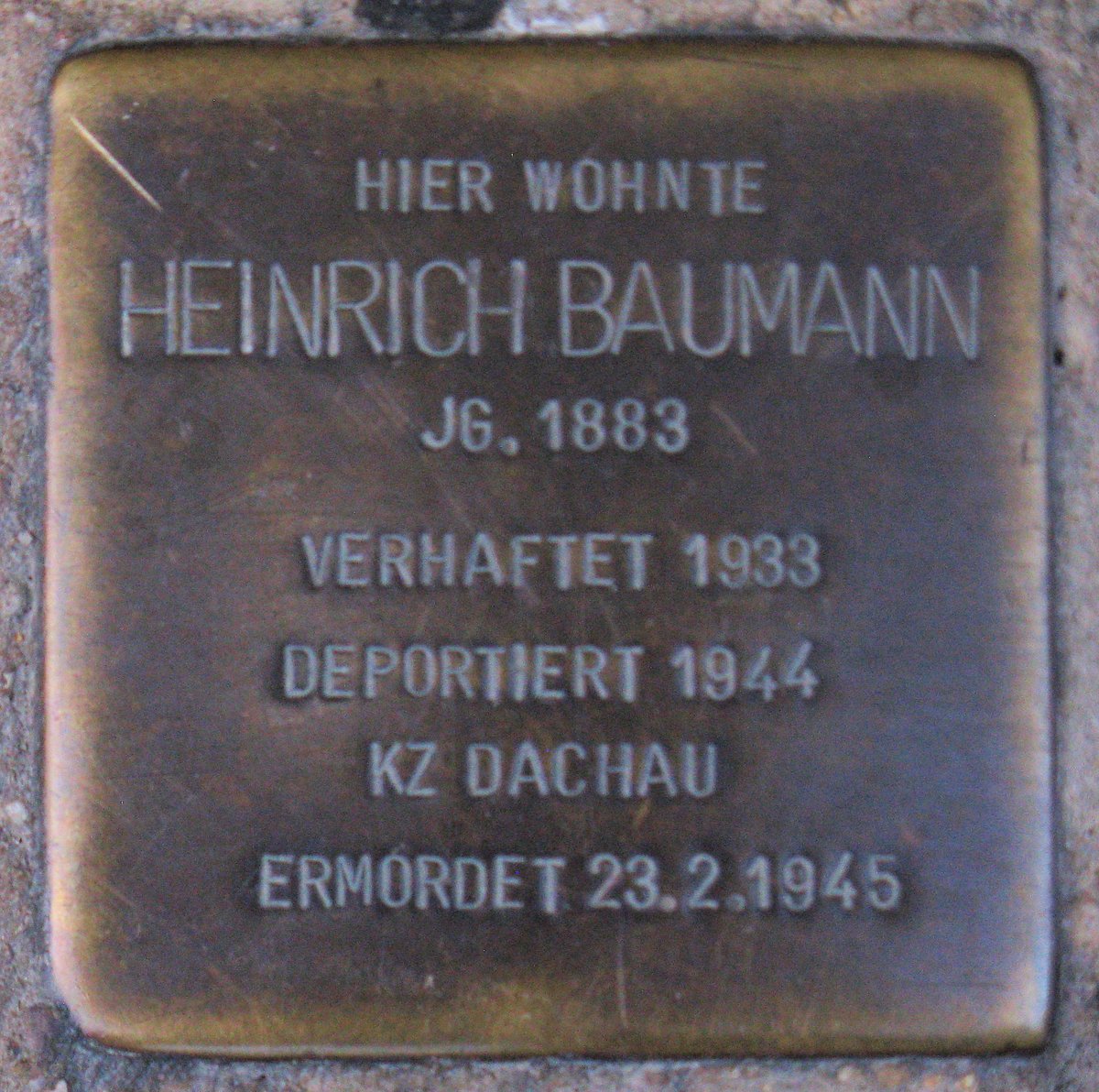
The Stolperstein is a 10 x 10 cm brass plaque set flush into the pavement in front of the building’s entrance at number 25. The inscription reads (translated):
HIER WOHNTE
HEINRICH BAUMANN
JG. 1883
VERHAFTET 1944
KZ DACHAU
ERMORDET 23.2.1945
The plaque is maintained by local volunteers and relatives, ensuring the text remains legible and the memorial visible (Stolpersteine Stuttgart).
Accessibility and Practical Visitor Information
- Visiting Hours: 24/7, year-round. There are no entry fees or tickets as the memorial is part of the public sidewalk.
- Accessibility: The sidewalk is level and generally wheelchair-friendly. Pavement may be uneven in places, as is common in European cities.
- Best Times: Daylight hours provide optimal visibility for reading and photography. Special commemorative events—such as Holocaust Remembrance Day (27 January) or Baumann’s death anniversary (23 February)—often feature cleaning ceremonies or guided walks (Stolpersteine Stuttgart Ost).
- Etiquette: Pause for quiet reflection, consider gently polishing the brass with a soft cloth, and avoid blocking entrances or disturbing residents. Photography is permitted, but be discreet and respect privacy (Stolpersteine Stuttgart: Reinigungstipps).
Enhancing Your Visit: Context and Nearby Sites
- Other Stolpersteine: Stuttgart-Ost features several other Stolpersteine within walking distance, each commemorating different victims (Stolpersteine Stuttgart Ost: Straßenverzeichnis).
- Heinrich-Baumann-Saal: Baumann’s portrait is displayed at Waldheim Sillenbuch, further highlighting his legacy (Wikipedia: Heinrich Baumann (NS-Opfer)).
- Memorial to the Victims of National Socialism: Located near the Stauffenberg Museum, this memorial provides broader historical context (Destination WWII).
Guided Tours and Further Learning
Local Stolperstein initiatives frequently offer guided walks, educational events, and publish brochures about the memorials in Stuttgart. Check event listings on the Stolpersteine Stuttgart and Stuttgart-Ost websites. Audio guides and podcasts, such as “Gedenkworte,” present spoken biographies (Stolpersteine Stuttgart).
Frequently Asked Questions (FAQ)
Q: Where is the Heinrich Baumann Stolperstein located?
A: In front of Heinrich-Baumann-Straße 25, Stuttgart-Ost.
Q: Is there an entrance fee or set visiting hours?
A: No, the Stolperstein is freely accessible 24/7.
Q: Are guided tours available?
A: Yes, local initiatives and historical societies periodically offer guided walks. Check Stolpersteine Stuttgart Ost for schedules.
Q: Is the site accessible for those with mobility impairments?
A: The sidewalk is generally accessible and step-free, though may be uneven in places.
Q: Can I take photographs?
A: Discreet photography is permitted; avoid photographing residents or private property.
Visitor Tips and Recommendations
- Allow 10–20 minutes for reflection and reading at the site.
- Consider combining your visit with nearby Stolpersteine or WWII memorials for a broader perspective.
- Bring a soft cloth if you wish to participate in the cleaning ritual.
- For deeper understanding, review Heinrich Baumann’s biography and the history of the Stolpersteine project before your visit (Stolpersteine Stuttgart).
Discover More
The Stolperstein for Heinrich Baumann is more than a memorial—it is a living testament to individual courage and the enduring necessity of remembrance. By visiting, pausing, and reflecting at this site, you join a collective effort to keep history present and meaningful for future generations. To further enrich your experience, consider participating in guided tours, attending commemorative events, or exploring digital resources such as the Audiala app, which features interactive maps and audio guides for Stuttgart’s historical sites.
Engage with the Stolperstein project not only as a visitor, but as an active participant in preserving the memory of those who resisted oppression and ensuring that such histories are never forgotten.
Audiala2024
Listen to the full story in the app
The whole Stolperstein Dedicated To Heinrich Baumann,
told well.
Audio guides for 1,100+ cities across 96 countries. History, stories, and local insight — offline ready.
Verified, and shown.
Researched and written by the Audiala editorial team from historical records, architectural archives, and local expertise.
Researched from Wikidata, Wikipedia & official sources · fact-checked · How we make our guides →