Plan and listen to Stolperstein Dedicated To Anton Hummler with Audiala.
Audio guide in your pocket, itinerary in your browser. Built for the way you actually visit.
Introduction
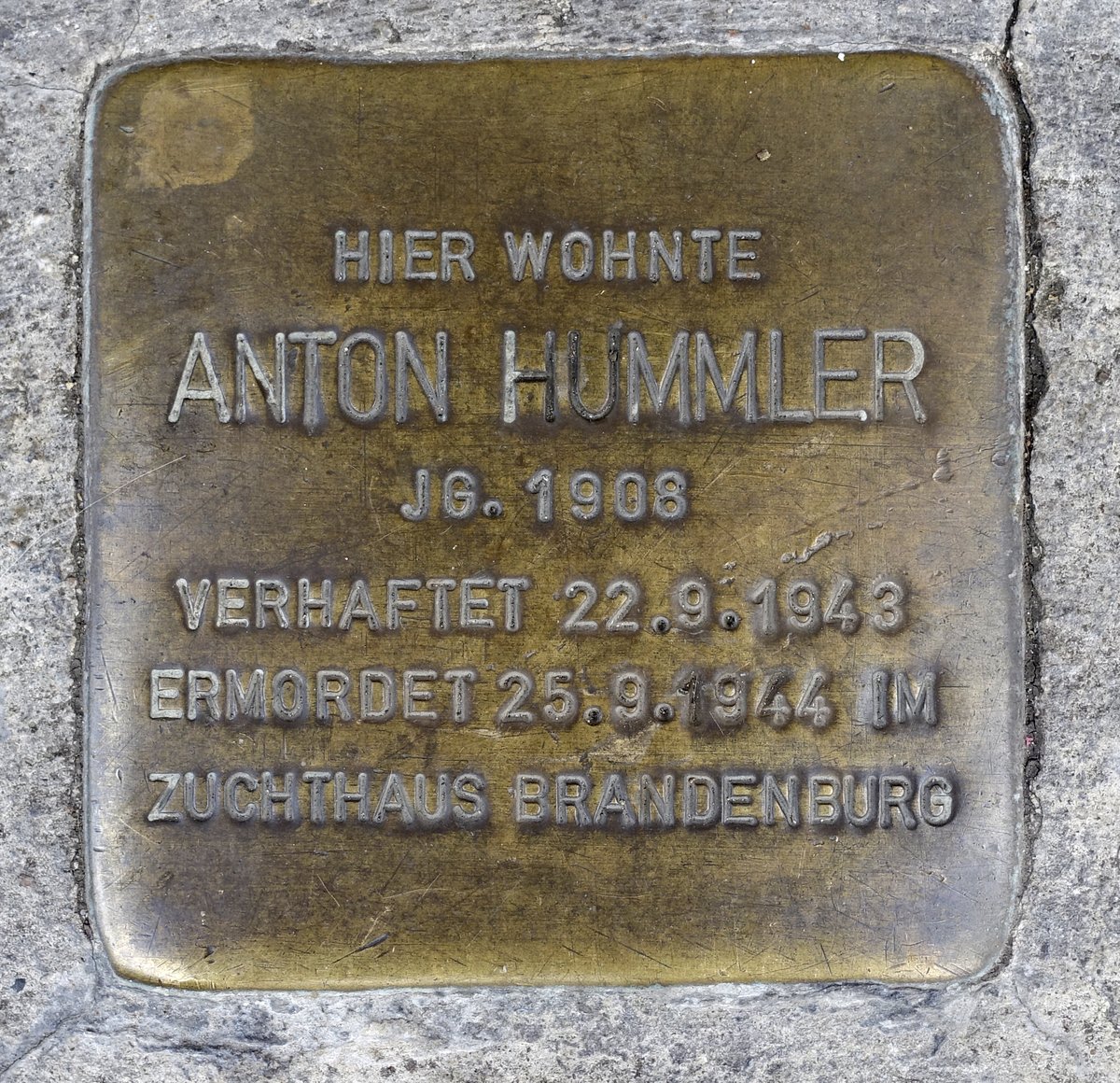
The Stolperstein dedicated to Anton Hummler in Stuttgart-West stands as a powerful testament to the courage and sacrifice of those who resisted the Nazi regime. As part of the largest decentralized memorial project in Europe, Stolpersteine—small brass plaques embedded in public sidewalks—transform ordinary city spaces into sites of remembrance and education. This guide provides a detailed overview of Anton Hummler’s Stolperstein, including its historical context, location, visiting information, and resources for deeper engagement.

Origins and Development of the Stolperstein Project
Initiated in 1992 by German artist Gunter Demnig, the Stolperstein (“stumbling stone”) project aims to commemorate individuals persecuted by the Nazi regime. Each 10 x 10 cm brass-plated cobblestone is installed in front of the last freely chosen residence of a victim, engraved with their name, birth date, fate, and, if known, place and date of death (Stolpersteine.eu). With over 100,000 stones across 21 countries, the Stolperstein project is now the world’s largest decentralized memorial (Stuttgarter Zeitung).
The project's philosophy, “a person is only forgotten when his or her name is forgotten,” drives both the placement of the stones and the ongoing community research that accompanies each memorial.
The Stolperstein Movement in Stuttgart
Stuttgart’s engagement with the Stolperstein project began in the early 2000s, led by local citizens, historians, and civic groups who sought to memorialize the city’s victims of Nazi persecution. The first Stolpersteine in Stuttgart were installed in 2003, and since then, over 1,000 stones have been placed throughout the city, coordinated by 16 local voluntary groups (Stuttgarter Zeitung).
The project serves as a “constant warning” and a call for civic courage, embedding remembrance directly into the city’s urban landscape.
Anton Hummler: Life and Resistance
Anton Hummler was born on February 12, 1908, in St. Gallen, Switzerland, and moved to Stuttgart in 1927. Working as a machine operator at Bosch, he was known for his reliability and friendly nature. Married to Frieda and father to three children, Hummler became active in antifascist and communist groups, notably the “Rote Sportler” and the “Kampfbund gegen den Faschismus” (Stolpersteine Stuttgart; VVN-BdA Baden-Württemberg).
Together with Max Wagner and others, he resisted the Nazi regime by listening to forbidden foreign broadcasts and sharing uncensored news—actions considered high treason.
Persecution and Execution
Hummler’s resistance activities led to his arrest by the Gestapo in 1944. He was tortured at “Hotel Silber,” the Gestapo headquarters in Stuttgart, and later sentenced to death by the Reichsgerichtshof. On September 25, 1944, he was executed at the Zuchthaus Brandenburg prison (Stolpersteine Stuttgart; frage-zeichen.org).
Visiting Stolpersteine in Stuttgart
Locations and Accessibility
The Stolperstein for Anton Hummler is located in front of Bebelstraße 43/1 in Stuttgart-West (Mapcarta). It is embedded flush with the sidewalk, making it easily accessible for pedestrians and visitors with mobility impairments.
To explore other Stolpersteine in the area, consult the interactive map of Stuttgart-West (Stolpersteine Stuttgart-West Map).
Visiting Hours and Tickets
The Stolperstein is outdoors and accessible 24/7, year-round. No ticket or admission fee is required.
Best Times to Visit
Daylight hours are ideal for reading the inscription and reflecting at the site. Commemorative events are often held around the anniversary of the stone’s installation (September 24) and on key remembrance dates such as Holocaust Remembrance Day (January 27).
Guided Tours and Events
Local organizations and the Hotel Silber memorial site offer guided tours that include the Anton Hummler Stolperstein and other key sites of Nazi-era history in Stuttgart. Tours are also available through digital resources like the Stolpersteine Guide app.
Nearby Attractions and Travel Tips
- Public Transport: The site is well-served by S-Bahn, U-Bahn, and local buses. Street parking is available but limited.
- Nearby Sites: Consider visiting the Hotel Silber memorial, the Memorial to the Victims of National Socialism, and other Stolpersteine in Stuttgart-West.
- Local Amenities: The neighborhood features cafes and shops, making it suitable for a reflective walk or extended visit.
Etiquette and Photography
- Respectful Behavior: Pause to read the inscription and reflect on Hummler’s story.
- Cleaning: It is customary to gently clean the Stolperstein with a soft cloth and water.
- Photography: Permitted, but please respect the privacy of residents and avoid blocking the sidewalk.
- Memorial Gestures: Leaving flowers or small stones is a respectful way to honor the memory.
Educational and Cultural Significance
The Stolperstein project is central to Stuttgart’s remembrance culture, involving schools, civic groups, survivors, and descendants in its research and maintenance (Stolpersteine Stuttgart). The story of Anton Hummler is integrated into educational programs and documentaries, such as the film featuring his son, Heinz Hummler (Frage-Zeichen Film). Engagement with Stolpersteine fosters dialogue about civil courage, democracy, and the dangers of totalitarianism.
The Stolpersteine Guide app offers biographies, walking tours, and multimedia content, making these stories accessible to a wide audience.
Frequently Asked Questions (FAQ)
Q: Where is the Anton Hummler Stolperstein located?
A: In front of Bebelstraße 43/1, Stuttgart-West (Mapcarta).
Q: Are there any visiting hours or ticket fees?
A: The site is open 24/7 and free of charge.
Q: Is the Stolperstein accessible for people with mobility issues?
A: Yes, it is flush with the sidewalk and accessible.
Q: Can I take photographs or leave flowers?
A: Yes, both are welcome. Please do so respectfully.
Q: Are guided tours available?
A: Yes, through local groups, the Hotel Silber memorial, and the Stolpersteine Guide app.
Q: How can I support the Stolperstein project?
A: Sponsor a stone, join cleaning initiatives, or donate via official channels.
Discover More
The Stolperstein for Anton Hummler in Stuttgart-West invites visitors to engage personally with the history of Nazi resistance, integrating memory into the city’s everyday life. By visiting, reflecting, and participating in community remembrance, you help ensure that stories like Hummler’s are not forgotten. Download the Stolpersteine Guide app or the Audiala app for interactive tours, and follow local initiatives for updates on events and educational opportunities.
Internal Links:
- Explore More Stuttgart Historical Sites
- Guide to Nazi Resistance in Stuttgart
- Stolpersteine Project Overview
Listen to the full story in the app
The whole Stolperstein Dedicated To Anton Hummler,
told well.
Audio guides for 1,100+ cities across 96 countries. History, stories, and local insight — offline ready.
Verified, and shown.
Researched and written by the Audiala editorial team from historical records, architectural archives, and local expertise.
The Stolperstein Project official website
Stolpersteine in Stuttgart: Ein Mahnmal, das wächst und wächst
In der Logik des nächsten Krieges
Anton Hummler und Max Wagner, Bebelstr. 43/1
Anton Hummler Stolperstein in Stuttgart
Anton Hummler Stolperstein Location Map
Learning and Memorial Site
Heinz Hummler Video Testimony
Researched from Wikidata, Wikipedia & official sources · fact-checked · How we make our guides →