Speyer Cathedral
SpeyerGermany 49° N · 8° E Updated Jul 2026
Eight emperors and kings lie beneath Europe's largest preserved Romanesque church, where Speyer's bright old town gives way to cool stone silence below.
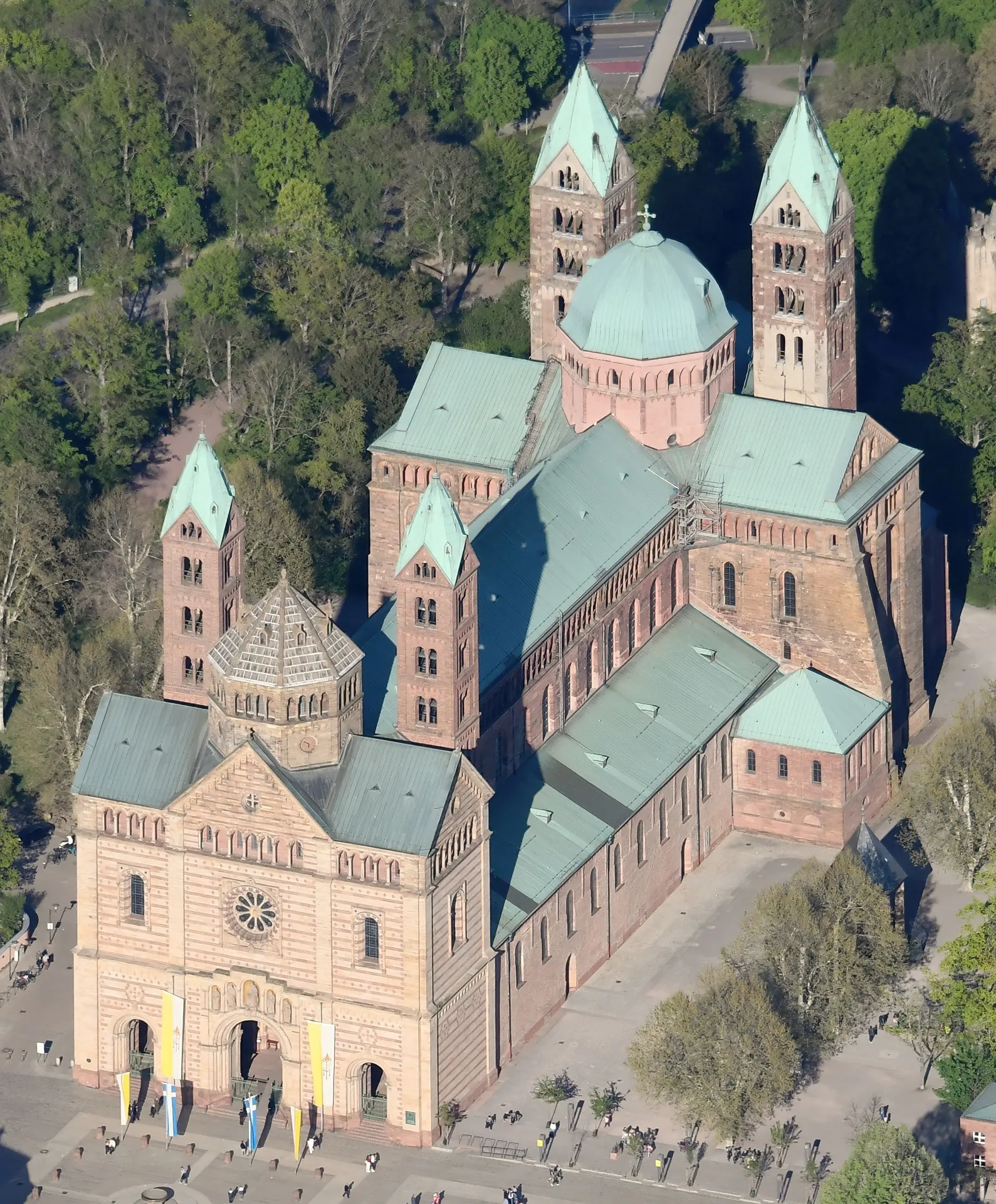 Photo: Carsten Steger · CC BY-SA 4.0
- Time needed
- 1-2 hours
- Entry
- Free
- Best season
- Spring to early autumn (April-September)
Why does Speyer Cathedral in Speyer, Germany feel both older and less innocent than the tidy phrase "Romanesque masterpiece" suggests? You should come because this place does more than show off imperial scale: it teaches you how power stages itself in stone, then how fire, rebuilding, and memory keep rewriting the script. Today the red sandstone mass rises above the trees with the blunt confidence of a fortress, while the nave holds cool air, long echoes, and light that slides across columns thick as ancient tree trunks.
Most visitors arrive expecting one clean medieval story. Speyer refuses that comfort. Records show Conrad II founded the cathedral in 1030, but the building in front of you is also an 18th-century repair, a 19th-century interpretation, and a 20th-century correction stitched onto an 11th-century imperial dream.
Go down into the crypt. The temperature drops, footsteps sharpen against stone, and the imperial tombs stop feeling ceremonial and start feeling personal: these were not symbols first, but bodies, ambitions, grudges, dynasties.
And the setting matters. Speyer Cathedral stands in a city where emperors, bishops, citizens, and Jewish communities all shaped the same few streets, so a visit here is not just about one church but about how a medieval city argued over authority in public, in prayer, and in law.
What to see
-
The Nave and West Front
Speyer Cathedral surprises by refusing to charm you. Conrad II began it around 1030 as an imperial statement, and the building still works that way: 134 meters long, longer than a football field, with vaults rising 33 meters overhead, roughly the height of an 11-story block, so your footsteps click across sandstone while the round arches keep pulling your eyes forward. Stand in the nave for a minute before you move; the relative bareness is the point, because later decoration was stripped back and the Romanesque bones hit harder now, especially when late light warms the red stone and the 1854-1858 west front reveals itself as a 19th-century reimagining of medieval power. -
The Imperial Crypt
The real emotional turn happens downstairs. Beneath the choir, the crypt spreads for about 35 by 46 meters, close to the footprint of a small town square, and its alternating red-and-yellow sandstone arches repeat into the half-dark while the air cools, voices drop, and the tombs of emperors and kings sit with a severity that borders on rude. Records and tradition meet awkwardly here: this was the burial place of Salian rulers and later dynasties for nearly 300 years, yet the room does not flatter them, which is exactly why it lingers in the mind. -
Tower Climb and Domgarten Loop
Take the 304 steps if the weather is clear, even if your calves object. After the Kaisersaal and its 19th-century frescoes, the southwest tower lifts you about 60 meters above the ground, high as a 20-story building, until the crossing dome sits almost at eye level and Speyer falls into place around it; then come back down through the south garden, pause at the tactile models, and walk up toward the Heidentuermchen for the quieter east-end view most people miss. This short circuit changes the cathedral from a monumental facade into a piece of urban engineering, planted in stone and seen properly from more than one angle.
Plan your visit
- Getting There
- Speyer Cathedral stands at Domplatz 1A. From Speyer Hbf, take bus 561 from the station forecourt to "Domplatz/Speyer"; in 2026 it runs every 10 minutes for most of the day, and the ride plus short walk usually takes about 10 to 15 minutes. By car, the practical approach is A61 to B9 to B39, then park at Festplatz, Geibstraße 2; from there the cathedral is less than a 3-minute walk through the Domgarten.
- Opening Hours
- As of 2026, the cathedral opens April to October Monday to Saturday 09:00-19:00 and Sundays or public holidays 11:30-17:30; from November to March it opens Monday to Saturday 09:00-17:00 and Sundays or public holidays 11:30-17:00. The crypt opens 30 minutes later and closes 30 minutes earlier, while the tower and Kaisersaal run April to October only, with last entry at 17:00 on weekdays and Saturdays and from 12:00 on Sundays. Check the cathedral's special-hours page before you go, because weddings and feast-day services regularly cut visitor access on specific 2026 dates.
- Time Needed
- Give it 30 to 45 minutes if you only want the nave, the west front, and a quick circuit outside. Most visitors need 60 to 90 minutes for the cathedral and crypt, while 2 to 3 hours feels right if you add the Kaisersaal, the tower climb, and a pause in the Domgarten after all that red sandstone and echo.
- Accessibility
- Step-free entry to the main cathedral is possible through side portals, and the Dom-Info, tactile model, induction loop, and accessible toilet on the south side of the upper Domgarten make the ground-level visit much easier. The hard limit comes with the vertical parts: the crypt and transept each have 22 steps, the Kaisersaal 90, and the tower climb continues for 214 more, with no regular elevator or stairlift; outside, expect cobbles and chipping paths rather than smooth paving.
- Cost & Tickets
- As of 2026, the main cathedral is free. The crypt and imperial tombs are ticketed, and recent 2026 listings put them at about €4.50 adults, while tower plus Kaisersaal tickets run about €7.00 adults; buy on site at the Dom-Info or crypt entrance, and verify prices the day before because the official price page confirms paid access but does not always display the amounts clearly in cached listings.
History
The Church That Kept Changing Its Story
Speyer Cathedral began as a Salian imperial statement, not a modest act of devotion. Records show Conrad II founded it in 1030, the crypt was consecrated in 1041, and the cathedral itself in 1061; for nearly 300 years, German kings and emperors chose this place as their burial ground.
But the building you see now is no untouched survivor. UNESCO records show the west end burned after French troops plundered the cathedral in 1689, seven western nave bays were rebuilt between 1772 and 1778, and the westwork followed in 1854-1858, which means Speyer is best read as a layered argument about what each century thought the Middle Ages should look like.
The turning point
Henry IV's Stone Rebuttal
At first glance, Speyer seems to tell a simple tale: Conrad II built the grandest Romanesque church in Europe, and later emperors merely inherited it. That is the version the walls encourage. Big enough, solemn enough, inevitable enough.
Then doubt creeps in. Scholars date Henry IV's rebuilding campaign to the 1080s, after the humiliation of Canossa in 1077, and that timing changes everything. Henry was not decorating a family church; he was fighting for authority against a pope who had broken him in public, and records plus later interpretation suggest Speyer became his stone reply, enlarged with vaults and mass on a scale meant to restore imperial dignity.
The revelation is harsher than the postcard version. Henry IV helped remake the cathedral, yet when he died in 1106 he still lay under excommunication and could not be buried inside the church he had transformed; only on 7 August 1111 did his son Henry V have him buried in the cathedral proper. Once you know that, the vast interior stops looking serene. It looks tense, almost defiant, as if the building still remembers what it cost to turn humiliation into architecture.
The Day Safety Became Fuel
A Romanesque Church With a Restorer's Accent
Tips for visitors
Church, Not Museum
Silence matters here. Phones should stay muted, and the cathedral asks visitors not to eat, drink, smoke, or sightsee during services; the big Romanesque vaults throw every whisper back at you like a stone drum.Shoot Lightly
Private photography is allowed only without flash and without tripods. Put the camera down during Mass or concerts, and forget drones entirely; the cathedral bans them, with extra nesting protection around the eagle owls from March 1 to July 31.Best Visit Window
Go early on a weekday morning if you want the nave before the square fills and the stone still holds the night's cool air. Skip relying on the tower in bad weather, because frost, heavy wet conditions, or storm warnings can stop the climb without much romance.Eat Nearby
For a quick break in season, Domgarten Café on Schillerweg 1 is the prettiest nearby stop and lands in budget to mid-range territory. Domhof-Hausbrauerei, Große Himmelsgasse 6, is the better mid-range choice for Pfälzer food and house beer, while AvantGarthe on Ludwigstraße 2 is the place to book if you want a splurge dinner instead of another pretzel.Pair It Properly
Don't treat the cathedral as a stand-alone stop. Walk the full axis from the Dom to the Altpörtel along Maximilianstraße, then add the Historical Museum of the Palatinate or the Judenhof SchUM site; Speyer makes more sense when imperial stone, Jewish heritage, and everyday café life sit in the same afternoon.Save Where It Counts
The free cathedral interior already gives you the full scale hit, so pay for the crypt first if you only choose one extra; the tomb chamber changes the building from grand to personal. Drivers should also use Festplatz instead of hunting for spots by the cathedral, where parking is scarce and mostly short-stay or disabled-only.
Frequently asked
Is Speyer Cathedral worth visiting?
Yes, Speyer Cathedral is worth visiting if you care about architecture with actual muscle. The nave runs 134 meters, longer than a football field, and the crypt feels like a stone forest striped in red and yellow sandstone. UNESCO also matters here, but the real hook is stranger: much of what looks purely 11th century is actually a layered survival of fire, rebuilding, and imperial ambition.
How long do you need at Speyer Cathedral?
You need about 60 to 90 minutes for a satisfying visit, and closer to 2 to 3 hours if you add the crypt, Kaisersaal, and tower. The basic audio guide runs about 30 minutes, with another 30 minutes of extra material, which is a good clue to the pace. Give yourself more time if you want to sit in the nave and let the echo do its work.
How do I get to Speyer Cathedral from Speyer Hbf?
The simplest route from Speyer Hbf is bus line 561 to "Domplatz/Speyer," then a short walk. Buses run every 10 minutes for much of the day, so this is less a logistical puzzle than a clean handoff from station to cathedral square. If you walk instead, the approach through town lets the west front rise gradually, which is the better entrance for first-timers.
What is the best time to visit Speyer Cathedral?
The best time to visit is a clear day between April and October, when the cathedral stays open longer and the tower is open to individual visitors. Late afternoon is especially good because the west front catches warmer light, while the crypt keeps its cool, dim hush even in summer. Avoid arriving blind on feast days or wedding dates, because this is still a working cathedral and hours can shrink without apology.
Can you visit Speyer Cathedral for free?
Yes, you can enter the main cathedral for free. The paid parts are the crypt with the imperial tombs and the tower with the Kaisersaal, so free entry gets you the great volume of the building but not the full story underground or above the roofline. That split is fair enough: the nave gives you the scale, then the ticketed spaces give you the mood and the view.
What should I not miss at Speyer Cathedral?
Do not miss the crypt, the imperial tombs, and the tower climb if your knees agree to the terms. The crypt is the emotional center: cooler, quieter, and more repetitive than the nave, with arches banded in sandstone colors that look almost woven. From the tower, about 60 meters up, you meet the crossing dome almost at eye level, which is rarer and better than a generic panorama.
Sources & attribution 11
- UNESCO World Heritage Centre — Provided UNESCO status, core history, Romanesque significance, major rebuilding phases, and overall architectural importance.
- Speyer Cathedral Official Site — Provided current opening hours for the cathedral, crypt, tower, and Kaisersaal.
- Speyer Cathedral Official FAQs — Confirmed free entry to the main cathedral, visitor rules, and practical on-site guidance.
- Speyer Cathedral Audioguide — Provided audio guide duration and format, useful for estimating visit length.
- Speyer Cathedral Tower and Kaisersaal — Provided tower access details, step counts, viewing platform height, and Kaisersaal context.
- Speyer Cathedral Dimensions — Provided exact measurements such as the cathedral’s 134-meter length and crypt dimensions.
- Visit Speyer - Speyer Cathedral UNESCO World Heritage — Provided visitor-facing historical framing, cathedral significance, and cross-checks on chronology and experience.
- Visit Speyer - Travelling by Train — Provided the route from Speyer Hbf, including bus line 561 and frequency details.
- Visit Speyer - Main Sights of Speyer — Helped confirm the cathedral’s place in the city layout and walking context from nearby landmarks.
- Speyer Cathedral Special Opening Hours — Provided evidence that services, weddings, and feast days can alter access on specific dates.
- Westwards - Speyer Cathedral — Supported the recommendation for late-day exterior light and the visual experience of the west front.
Built from cited sources · see the method · How we make our guides →
Pick up where you left off
Saved and recently read places — kept on this device only.
Photo credits (5)
- File:Speyer, the western facade of the cathedral — Dguendel — CC BY 3.0 (https://creativecommons.org/licenses/by/3.0/) — Source: https://commons.wikimedia.org/wiki/File:File:Speyer,_the_western_facade_of_the_cathedral.jpg
- File:Speyer, cathedral, the crypt — Dguendel — CC BY 3.0 (https://creativecommons.org/licenses/by/3.0/) — Source: https://commons.wikimedia.org/wiki/File:File:Speyer,_cathedral,_the_crypt.jpg
- File:Dome interior of Speyer Cathedral Kuppel — Moleskine — CC BY 4.0 (https://creativecommons.org/licenses/by/4.0/) — Source: https://commons.wikimedia.org/wiki/File:File:Dome_interior_of_Speyer_Cathedral_Kuppel.jpg
- File:Aerial image of the Speyer Cathedral (view from the southwest) — Carsten Steger — CC BY-SA 4.0 (https://creativecommons.org/licenses/by-sa/4.0/) — Source: https://commons.wikimedia.org/wiki/File:File:Aerial_image_of_the_Speyer_Cathedral_(view_from_the_southwest).jpg
- Aerial image of the Speyer Cathedral (view from the southwest) (cropped) — Carsten Steger — CC BY-SA 4.0 (https://creativecommons.org/licenses/by-sa/4.0/) — Source: https://commons.wikimedia.org/wiki/File:Aerial_image_of_the_Speyer_Cathedral_(view_from_the_southwest)_(cropped).jpg
Photos may have been resized or cropped.